

Illustrative patient discussing an infected tooth and treatment choices with a clinician
Specialized Care

Infected Tooth Extraction in Rockwood

Some infected teeth are straightforward to remove; others sit near a nerve, have curved roots or break easily. For anyone in Rockwood, we can assess how complex your tooth is, whether it could be kept, and when a specialist or second opinion makes sense.

Not every extraction is the same

Some teeth come out easily. Yours might not, and that is worth knowing early.

An infected tooth that has broken down to the gumline, a molar with curved roots or a tooth close to a nerve can make removal more involved. Before any of that matters, the dentist has to confirm the tooth responsible and decide whether its structure and support could be preserved. Swelling alone never answers that question.

Complexity is also a common reason people coming from Rockwood, or anywhere else, ask for a second opinion or a specialist. That is reasonable, and so is sharing what earlier providers found or prescribed. The one thing to avoid is letting a calmer week on antibiotics stand in for a plan, because reduced pain does not show that the source has gone.

Phone us to describe the tooth and ask when we can see you. Flag any spreading swelling, fever or general unwellness at once. We will explain the options and whether a referral would serve you better. If you need immediate help and we cannot see you in time, look to another emergency dental provider.

Ask about a complex infected tooth
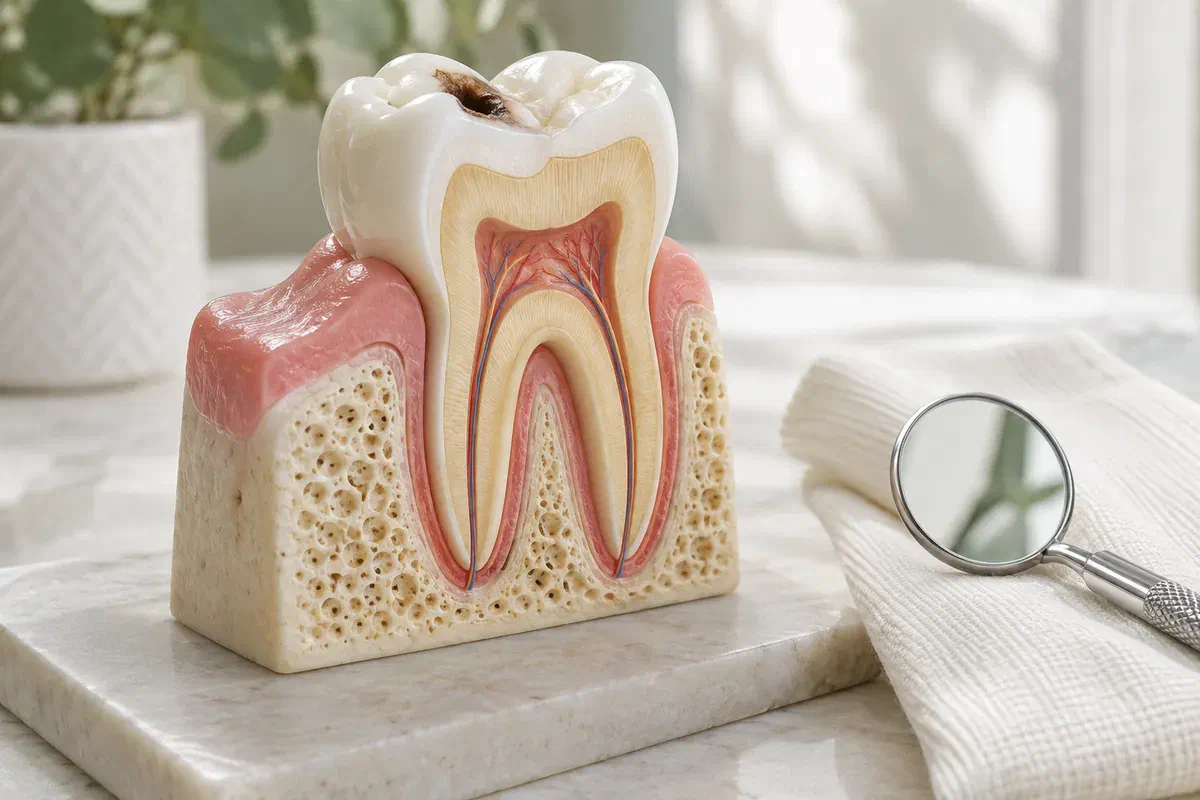
Illustrative physical molar cross-section showing decay within a supported tooth model
What affects difficulty

The anatomy, the history and the health behind the tooth

Earlier X-rays, a specialist’s letter or prescription details are all helpful. The dentist considers how the tooth is built and how it has been treated, as well as how it is today, before advising on removal and who should do it.

Infection that has kept returning

Describe each flare, the treatment given and how long the improvement lasted. Drainage, a persistent bad taste or pain when you bite all help locate the source. Long-standing infection can change the bone around a tooth, so ask how that affects both the urgency and the procedure.

A tooth that may be hard to remove

Heavy decay below the gum, an old root canal, a crown, cracks or limited support can all influence how a tooth comes out. Ask which present findings work against keeping it and which make extraction more involved. History adds context; the current examination sets the plan.

Health factors that change the setting

Provide a complete medicine list and mention bleeding tendencies, immune concerns and complications after past procedures, along with recent antibiotics and reactions. Do not stop routine medicines yourself; the team will explain whether a physician or specialist should be involved.

Some situations cannot wait for a referral appointment. Difficulty breathing or swallowing, swelling spreading quickly or toward the eye, or severe trouble opening your mouth needs emergency medical care. Call 911 if it is an immediate emergency.

What a well-planned removal offers

The right procedure, by the right provider, for the right reason

When the tooth cannot reasonably be kept, extraction can deal with the diagnosed dental source of infection. Ask what else may need treatment or monitoring and how recovery will be checked. With a complex tooth, a clear explanation of what to expect during healing is especially valuable.

The resulting space deserves a few minutes of discussion too. Its location and your wishes shape whether replacement is planned before removal or after healing. Even when the infection needs prompt care, you should know what losing the tooth may mean.

Patient information: American Dental Association — source-directed dental care and antibiotic decisions

A genuine comparison with saving it

For a difficult tooth, it is worth asking whether root canal treatment, retreatment or a specialist’s endodontic opinion might work. Consider the remaining structure, supporting tissue, final restoration and follow-up. What this tooth would really need is the useful question.

Antibiotics, explained in context

There are situations, including spreading or whole-body infection, where a prescription is appropriate. It still leaves the source untreated. Your health, symptoms and how quickly treatment can happen guide the decision. Ask what any medicine is intended to do.

A procedure matched to its complexity

Discuss freezing, how difficult the extraction is expected to be, the risks that apply to your tooth, such as nearby nerves or sinus, and whether an oral surgeon would be better placed. Ask what happens if a root fractures and how complications afterward will be handled.

Working out the plan

Who treats it, how, and when

Timing and setting hinge on how severe the infection is, how the roots are shaped, your general health and which providers can see you. No universal rule says an infected tooth must be removed immediately or only after another intervention has been tried.

  1. A detailed assessment

    The dentist reviews your history, examines the tooth and surrounding area, and uses the tests and images needed to judge both the source and the anatomy. Mention fever, swelling that is spreading or difficulty eating and opening, and ask whether the images suggest a simple or more involved removal.

  2. Prognosis, referral and consent

    You discuss the outlook, the alternatives and whether a specialist would be the better choice for the procedure. If extraction is agreed, confirm the tooth, the expected approach, risks, fees and aftercare. Ask for anything unclear to be explained before you consent.

  3. Removal, with surgical steps if needed

    The dentist chooses the freezing and technique. Some teeth are lifted out whole; others need the gum opened or the tooth sectioned. Tell the team about anxiety or past freezing problems, and agree on a way to signal a pause.

  4. Instructions and follow-up

    You receive guidance on bleeding, cleaning, eating, medicines and stitches. Ask when the site will be reviewed and how to reach help out of hours. Confirm whether further appointments are needed for the remaining plan or replacement.

Recovery from a more involved extraction

A bigger procedure can mean a slower recovery. Know what to expect.

Follow aftercare suited to your extraction and health. An infection beforehand does not make every later symptom normal, and new pain does not automatically call for antibiotics.

Caring for the socket and stitches

Use the bleeding-control method you were shown and avoid disturbing the area, including any stitches. Ask when rinsing and brushing nearby can resume. If bleeding does not settle as described, call the provider rather than repeatedly checking.

Following medicine directions

Take pain relief and any antibiotic exactly as prescribed. A pharmacist or the dentist can answer questions about how they sit with your other medicines. Do not use leftover medicines or increase doses out of worry. Continue your regular medicines unless the responsible clinician has advised a change.

Reporting symptoms that do not fit

Call about pain that is worsening rather than easing, swelling that returns, fever, persistent bleeding or numbness or tingling that is new or lasting. Mention the extraction date. Keep your review even if you feel well, so healing can be confirmed.

Patient information: Royal Devon — bleeding advice and prescribed anticoagulant precautions

The available routes

General dentist, specialist or hospital?

Which route fits depends on the diagnosis, the tooth’s condition, the severity of the infection and the complexity of the procedure. Urgent care may start the plan and still leave another stage to complete.

When structure and prognosis allow it

Preserving a suitable tooth

A root canal, retreatment by a specialist or another indicated approach may be offered, along with the final restoration and review. Ask whether specialist input would change the outlook. Saving the tooth should be a realistic long-term plan.

When removal is the reasonable choice

Extraction in the right hands

Expect an explanation of why keeping the tooth is not suitable, or confirmation that removal is your preference. Review the procedure, risks and resulting space, and ask whether it can be done here or is better performed by an oral surgeon.

When severity or anatomy goes beyond routine

Specialist or hospital-level care

A severe infection, significant medical issues or very challenging anatomy may call for a specialist or hospital team. Ask what the referral aims to address and the timeframe you should keep to. A more convenient location is never a good reason to hold back necessary escalation.

Rockwood questions

Complex teeth, referrals and second opinions

Bring earlier records and prescriptions. These answers give general background; an examination is still the only way to confirm whether your tooth should come out and who should remove it.

(905) 876-4488
When is an extraction usually referred to an oral surgeon?
Referral is considered when the anatomy is complex, the tooth is likely to break, it sits close to a nerve or sinus, the infection is severe, or your health needs extra support. The dentist will explain the reason if a referral is suggested.
Is it reasonable to get a second opinion before having the tooth removed?
Yes. Extraction is permanent, and a second opinion can be worthwhile, especially when the decision is close. Ask how the timing fits with the infection so care is not delayed unsafely.
Why might a tooth need to be taken out in pieces?
Teeth with curved or spread roots, heavy decay or a large crown can be removed more safely in sections. It is a recognised technique, and the dentist should tell you in advance if it is likely.
Can an infected upper back tooth affect the sinus?
Upper back teeth sit close to the sinus, and infection or extraction in that area can sometimes involve it. The dentist considers this when planning and will explain any relevant precautions.
Will waiting for a specialist let the infection get worse?
It depends on severity. The dentist should explain how urgently the referral needs to happen and what to do if symptoms change while you wait. Spreading swelling or feeling very unwell needs urgent care, not a wait.
What if the specialist suggests keeping a tooth my dentist wanted to remove?
Different assessments can reach different conclusions on borderline teeth. Ask each provider to explain their reasoning about structure, support and prognosis so you can make an informed choice.
From Rockwood

Find out how involved your extraction might be.

Call our Bronte Street practice on (905) 876-4488 to describe your symptoms and arrange a visit. Bring any X-rays or specialist letters. If you need care urgently and cannot be seen here in time, please contact another emergency dental provider.

Extraction, timing, antibiotics, referral and replacement are individual decisions made after examination. Use email and online forms only for non-urgent questions.

Visit Milton Dental Clinic
Unit 1, 342 Bronte St. S, Milton, ON L9T 5B7
Get directions Clinic hours
Monday–Thursday
11am–7pm
Friday–Sunday
By appointment only

Areas we serve

  • Milton
  • Oakville
  • Mississauga
  • Georgetown
  • Halton Hills
  • Acton
  • Campbellville
  • Brampton
  • Burlington
  • Puslinch
  • Rockwood
  • Erin
  • Caledon
  • Etobicoke
  • Old Milton
  • Bronte Meadows
  • Timberlea
  • Dorset Park
  • Dempsey
  • Clarke
  • Beaty
  • Coates
  • Harrison
  • Scott
  • Willmott
  • Ford
  • Bowes
  • Cobden
  • Walker
  • Mountain View
  • Milton Heights
  • Hawthorne Village
  • Valley View
  • Fallingbrook
  • Nassagaweya
  • Trafalgar
  • Esquesing
  • Nelson
  • Brookville
  • Moffat
  • Glen Williams
  • Norval
  • Limehouse
  • Stewarttown
  • Ashgrove
  • Hornby
  • Silver Creek
  • Speyside
  • Scotch Block
  • North Oakville
  • River Oaks
  • Glen Abbey
  • West Oak Trails
  • Palermo
  • Bronte Creek
  • College Park
  • Joshua Creek
  • Uptown Core
  • Preserve
  • Iroquois Ridge
  • Lisgar
  • Meadowvale
  • Meadowvale Village
  • Churchill Meadows
  • Erin Mills
  • Central Erin Mills
  • Streetsville
  • East Credit
  • Creditview
  • Heartland
  • Sheridan
  • Mount Pleasant
  • Credit Valley
  • Huttonville
  • Churchville
  • Springbrook
  • Northwest Brampton
  • Bram West
  • Fletcher's Meadow
  • Fletcher's Creek South
  • Alton Village
  • Orchard
  • Millcroft
  • Headon Forest
  • Tansley
  • Brant Hills
  • Tyandaga
  • Kilbride
  • Lowville
  • Aberfoyle
  • Morriston
  • Arkell
  • Hillsburgh
  • Freelton
  • Carlisle
  • Waterdown
  • Flamborough
  • Mountsberg

How can we help?

Milton Dental Clinic

Have a question about your smile? Choose the option that works best for you.

For urgent dental concerns, please call.
Messages are reviewed during clinic hours.