

Illustrative patient calmly discussing jaw movement with a dental clinician
Specialized Care

Jaw Clicking Assessment

A jaw click is worth understanding in context. Discuss the sound, movement, pain, or locking with our Milton team. Painless clicking commonly needs no treatment, while a change in comfort or function can call for a more focused assessment.

A closer look at jaw clicking assessment

Understand the sound in the context of how your jaw feels and moves.

A click or pop near the ear can be noticeable when you open, close, or chew. The jaw joints move every time you use your mouth, and sounds can occur without pain or a problem requiring treatment. Hearing a click does not by itself mean that the joint is damaged or that your bite needs correcting.

The assessment becomes more important when the sound is accompanied by discomfort, locking, restricted movement, or a change after injury. The clinician needs to know what has changed and how it affects ordinary activities. A sound recording or an online comparison cannot provide the same information as a history and examination.

At Milton Dental Clinic, explain what you have noticed and what worries you about it. We can discuss the jaw and dental findings, whether observation is appropriate, and whether further care or referral is needed. The goal is an understandable plan for comfort and function rather than a promise to eliminate every joint sound.

Discuss a change in jaw movement
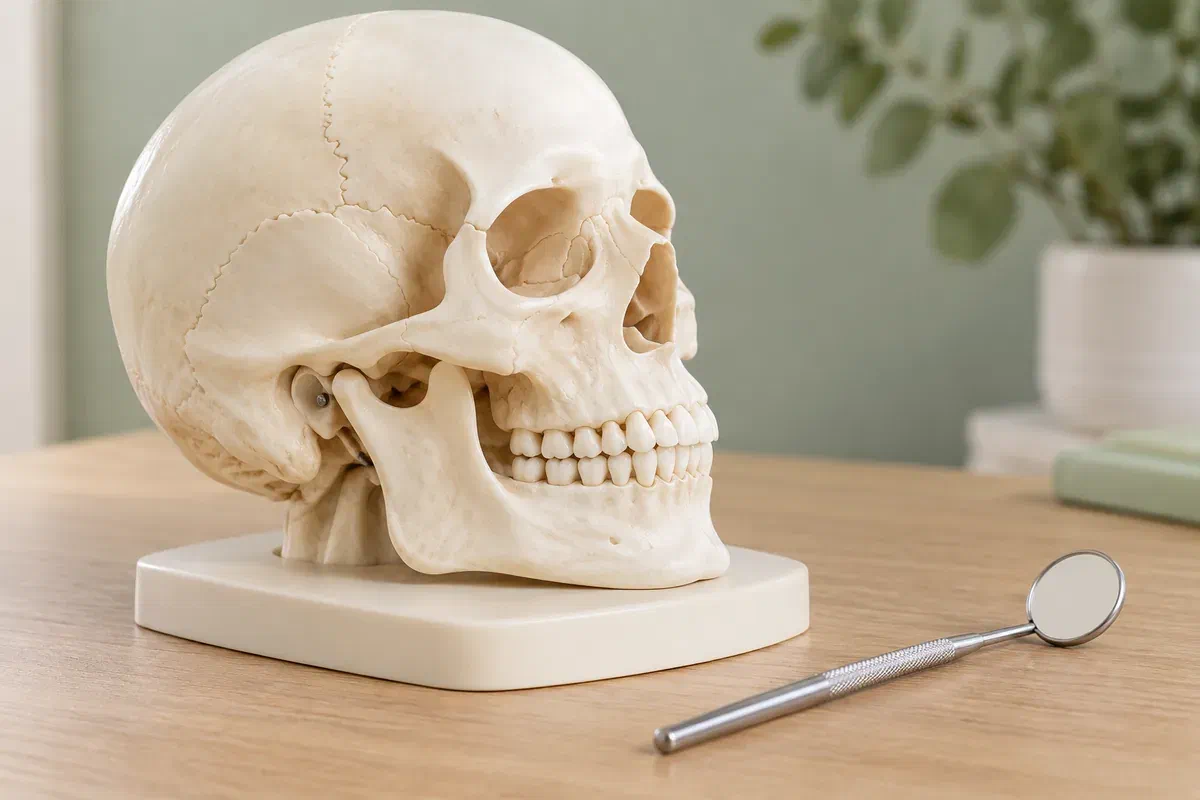
Illustrative anatomical skull model with an attached lower jaw and visible joint region
What accompanies the click

The difference between a sound and a functional problem matters.

Describe the side involved, when the sound occurs, and whether it is longstanding or new. You do not need to repeatedly reproduce the click to prepare for a visit; an account of your normal experience is useful.

A familiar click without pain or restriction

Tell the clinician if the sound has been present for a long time and does not affect eating or opening. Ask whether anything in the examination changes the significance of that history. Reassurance and observation can be appropriate when there is no associated problem requiring intervention.

Clicking that has become painful or affects chewing

Explain whether discomfort occurs at the joint, in the cheek muscles, or elsewhere, and which activities are difficult. Mention tenderness, fatigue, and any dental symptoms. Pain needs its own assessment rather than being assumed to come from the loudest or most noticeable sound.

Catching, locking, or a new limit in movement

Describe whether the jaw catches briefly, remains stuck, or no longer opens as it usually does. Mention injury and difficulty eating or drinking. Contact a clinician promptly for significant restriction or locking; do not try to force the jaw through the movement or copy a home-repositioning technique.

A jaw that is stuck, a significant injury, or inability to eat or drink needs prompt professional assessment. Breathing or swallowing difficulty, major swelling, or other severe symptoms requires emergency medical care.

What the consultation should establish

Decide whether anything needs treating before choosing a treatment.

An assessment can help distinguish a harmless sound from a complaint involving pain or limited function. Ask what the findings support and whether a specific diagnosis has been established. The explanation should leave room for uncertainty rather than turning every click into the same named joint disorder.

If management is appropriate, its purpose should be clear. Improving comfortable chewing or addressing restricted movement is different from pursuing silence in an otherwise comfortable joint. Ask how the proposed plan relates to the problem that brought you in and how its usefulness will be reviewed.

An examination connected to your actual symptoms

The clinician considers movement, tenderness, the history, and relevant dental findings together. Ask which findings matter and which may be incidental. A click that is easy to reproduce should not overshadow another complaint that is more important to your day-to-day comfort.

A reason for any additional test or referral

Further investigation is considered when it can answer a clinical question or change care. Ask what an image would add and what its limitations are. Not every joint sound calls for the same scan, and a scan result still needs interpretation alongside the examination.

A conservative plan when care is needed

Discuss suitable reversible approaches and a review point before considering permanent changes. Ask what outcome is expected and what to do if the recommendation makes symptoms worse. The plan should not assume that altering the teeth is necessary simply because the jaw makes a sound.

How jaw clicking is assessed

Listen to the history, examine movement, and explain the significance.

The appointment begins with what you experience during ordinary activities. Tell the clinician if opening is uncomfortable and ask how to signal a pause during the examination.

  1. Describe the sound and the changes around it

    Explain when the clicking began, whether one or both sides are involved, and whether pain or restriction is present. Mention injuries, previous jaw care, appliances, and relevant health information. Ask to focus the discussion on the change that matters most to you.

  2. Assess comfortable jaw movement and relevant structures

    The clinician examines opening and closing, tenderness, and associated dental findings as appropriate. You should not need to push through sharp pain to demonstrate the problem. Explain if the examination reproduces your familiar symptom or feels different from what happens at home.

  3. Discuss what is established and what remains uncertain

    Ask whether the findings support observation, a jaw-related diagnosis, another dental concern, or further assessment. If imaging or referral is recommended, clarify the question it is intended to answer. A useful explanation distinguishes the observed sound from an assumption about its mechanism.

  4. Agree on monitoring or management and a review point

    Confirm whether any treatment is needed and what changes should prompt earlier contact. If care is proposed, ask about its purpose, costs, limitations, and follow-up. Keep the plan specific enough that you know what to report rather than checking the click repeatedly throughout the day.

After the assessment

Monitor meaningful changes without making the sound a daily test.

Follow the advice appropriate to your findings. A plan for painless clicking may be very different from a plan for pain or locking, so avoid adopting someone else's exercise routine simply because their jaw also clicks.

Notice function and comfort during normal activities

If monitoring is advised, pay attention to new pain, catching, or difficulty with eating and opening. There is no need to repeatedly make the sound to prove it is still present. Ask what changes would be useful to record and when the clinician would want to review them.

Use only the movement advice recommended for you

If exercises or temporary activity changes are suggested, ask for a demonstration and clear limits. Do not force a locked jaw or use a painful movement as a way to make a click disappear. Contact the provider if a recommended activity worsens discomfort or restriction.

Bring an existing appliance to the review if relevant

Tell the clinician why the appliance was prescribed and whether symptoms changed while using it. Do not modify it yourself or buy a replacement solely to silence a click. If a prescribed device causes pain, stop using it and seek advice from the treating provider.

Matching the response to the findings

Observation, conservative care, and referral serve different purposes.

Ask which option fits the combination of sound, pain, and function. The recommendation should address the assessed problem rather than make disappearance of every click the condition for a successful outcome.

When clicking is painless and function is comfortable

Explanation and observation without a procedure

The clinician may explain that no treatment is required for the sound itself. Ask what would justify reassessment and whether it can be reviewed during ordinary care. Choosing observation should come with enough explanation that you understand why an appliance or procedure is unnecessary.

When pain or another assessed jaw concern needs care

Reversible management of associated discomfort

A suitable conservative plan may address habits, comfortable movement, or other contributing factors. Ask which measure is being tried and how response will be judged. Treatment should follow the diagnosis and your needs, with realistic expectations rather than a promise that one approach corrects every joint sound.

When the history or findings need another level of assessment

Further evaluation for locking, injury, or persistent difficulty

A clinician with relevant jaw-joint or facial-pain expertise may be appropriate when the problem is complex or function remains limited. Ask what information will be shared and whether you need care while awaiting the appointment. Urgent symptoms should not be left to a routine referral timeline.

Patient information: NIDCR — conservative TMD care and avoiding permanent bite changes

Jaw-clicking questions

Ask what the sound means for your comfort and function.

These questions can help you discuss clicking without assuming that every sound needs correction. Describe pain, locking, or a change in movement clearly when arranging an assessment.

(905) 876-4488
Does a painless jaw click mean I should begin treatment before damage develops?
Not automatically. Painless clicking is common and often does not require treatment. Ask whether the examination identifies any associated concern and what changes should prompt review. A sound alone is not a sufficient reason to begin a device or irreversible procedure.
Can the loudness of a jaw click tell me how serious the problem is?
Loudness alone does not establish a diagnosis or the need for care. The history, pain, movement, and examination are more useful. Explain how the jaw functions during ordinary activities rather than judging its condition only by how noticeable the sound is.
Should I keep opening widely until I can demonstrate the jaw click at my appointment?
No. Describe when it usually happens and let the clinician guide a comfortable examination. Repeatedly provoking the sound or forcing movement is not necessary preparation. Mention any pain or locking even if the click cannot be reproduced during that particular visit.
If the clicking stops but my jaw suddenly opens less, should I still seek assessment?
Yes. A new restriction or locking deserves attention even if the sound has changed. Contact a clinician promptly, particularly if eating or drinking is affected. Do not assume that silence means the underlying situation has improved or try to force the jaw open.
Is a jaw MRI automatically required to investigate a clicking sound?
No. Imaging is considered when it answers a clinical question and may affect management. Ask what the history and examination suggest, what the proposed test would add, and whether observation is reasonable. A sound by itself does not determine one mandatory scan.
Can orthodontics or tooth reshaping be justified solely to remove a painless jaw click?
That should not be assumed. Permanent changes to the bite are not a routine response to painless joint sounds. Ask for the diagnosis, evidence, and alternatives before considering irreversible care, and seek an independent opinion if the proposed purpose remains unclear.
Jaw clicking assessment in Milton

Explain what has changed and get a plan that fits the findings.

Contact our Bronte Street practice to discuss clicking with discomfort, catching, or movement concerns. Let the team know if the jaw is locked, opening is significantly restricted, or eating and drinking have become difficult.

Painless sounds may need no treatment. Diagnosis, imaging, management, and referral depend on the history and examination; elimination of clicking is not guaranteed.

Visit Milton Dental Clinic
Unit 1, 342 Bronte St. S, Milton, ON L9T 5B7
Get directions Clinic hours
Monday–Thursday
11am–7pm
Friday–Sunday
By appointment only

How can we help?

Milton Dental Clinic

Have a question about your smile? Choose the option that works best for you.

For urgent dental concerns, please call.
Messages are reviewed during clinic hours.