

Illustrative patient calmly discussing jaw movement with a dental clinician
Specialized Care

Jaw Clicking Assessment in Caledon

Noticed you clench while concentrating, then hear a click when you relax? From Bolton or elsewhere in Caledon, our team can look at both. A painless click frequently needs nothing, while daytime aching, catching, or a shorter opening is worth assessing.

Clenched on the drive, clicking at the door

Are you holding tension in your jaw without realising?

A long drive, a deadline, a tricky repair in the garage. You notice your teeth pressed together and your cheeks tight, and when you finally let go, the jaw clicks. That combination is common. The click itself is often harmless: the joints by your ears move constantly and can make sounds with no pain or injury. Hearing one does not mean damage, and it is not evidence that your teeth have to be changed.

What deserves attention is how the jaw feels and moves over time. Do the muscles ache by evening? Does the jaw ever snag, lock, or stop opening as far? Was there a knock or fall before it began? Habits like daytime clenching may be part of the story, or may not. Sorting that out takes a careful history and examination, which a phone recording cannot provide.

Bring us what you have observed, including any habits you have caught yourself in. We will examine the jaw and teeth, talk about whether keeping watch is enough, and explain if further care or a referral would help. What you should leave with is a plan for comfort and function. A guarantee that the click disappears is not on offer.

Ask about jaw tension and clicking
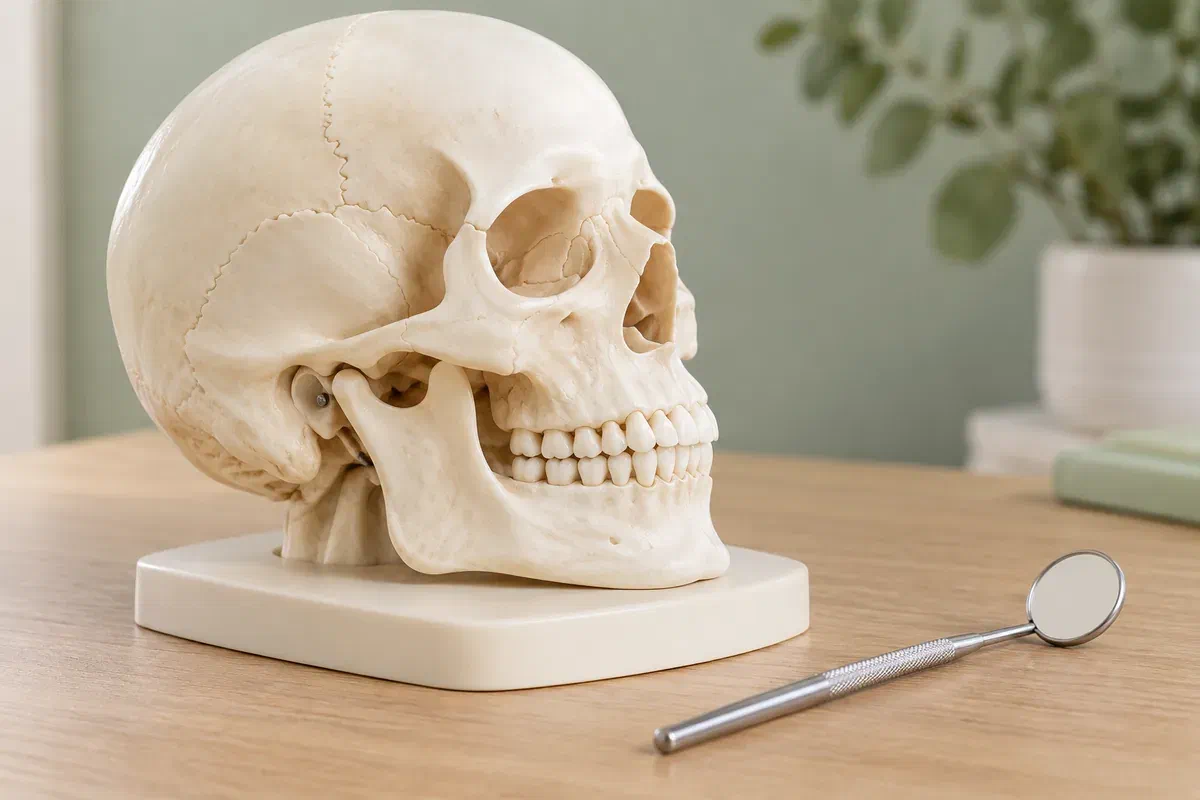
Illustrative anatomical skull model with an attached lower jaw and visible joint region
Patterns we hear about in Caledon

Tension, sound, and movement, one at a time

Note which side clicks, what you were doing when you noticed it, and how long it has been happening. You do not need to clench or click on purpose to prepare. A plain description of a typical day helps most.

A click and nothing more

If the sound has been around for some time without affecting your meals or how wide you open, describe it that way. Ask whether the examination shows anything that alters its importance. With no other findings, explanation and periodic review may be all that is needed.

Tired, sore jaw muscles

Point to where it aches: the joint, the cheek muscles, the temples, or elsewhere, and when it is worst. Mention tenderness, fatigue after concentrating or chewing, and any tooth sensitivity. Muscle discomfort is assessed in its own right, because it may not be linked to the click.

A snag, a lock, or less opening

Maybe it hitches for a second as you unclench, maybe it sticks, or maybe your widest yawn is smaller than it used to be. Say so, along with any knock to the face or struggle with food and drink. A locked or badly limited jaw is a reason to call promptly, not to lever it open yourself.

Get prompt professional help when a jaw is stuck, after a serious facial injury, or if eating or drinking is no longer possible. Breathing or swallowing difficulty, marked swelling, or any severe symptom is a reason for emergency medical care.

What the consultation sorts out

Is it the joint, the muscles, a habit, or simply a sound?

An assessment helps tell a harmless joint sound apart from a problem involving pain or limited movement, and helps show whether muscle tension is part of it. It is reasonable to ask how firm the conclusions are and whether a diagnosis has been reached. Honest uncertainty is better than one label stretched over every clicking jaw.

If care is suggested, its target should be clear. Easing sore muscles, or restoring comfortable opening and chewing, is a meaningful aim. Making a painless joint silent is a separate and weaker one. Ask how the plan connects to the reason you booked and how its benefit will be checked.

Your daily pattern at the centre

Habits, history, jaw movement, tenderness, and dental findings such as wear are considered together. Ask which findings are important and which are probably incidental. The click should not draw attention away from muscle aching that affects you more.

Extra tests only with a reason

A scan or second opinion should be tied to something the clinician genuinely needs to know. Ask what it might reveal and what it would leave unanswered. There is no single scan every clicking joint needs, and results still need the examination to interpret them.

Conservative support first

If treatment is needed, ask about reversible options, such as habit awareness, and when progress will be reviewed. Find out what change you might expect and what to do if symptoms flare. A clicking jaw does not by itself mean the teeth need permanent work.

During the visit

Habits and history first, then a hands-on look

We open with your routine, including work, driving, and stress, as well as meals and conversation. If opening is uncomfortable, tell the clinician, and settle on a signal for a pause.

  1. Describe your days

    Explain when the clicking started, which side or sides are affected, and whether aching, stiffness, or catching comes with it. Mention any clenching or grinding you are aware of, old knocks to the face, previous jaw treatment, any guard you own, and medical details that might matter.

  2. Comfortable examination

    The clinician checks opening and closing, feels the joint and muscles for tenderness, and looks for related dental findings such as wear. You should not push through sharp pain. Say whether the examination reproduces your familiar ache.

  3. Explain the picture

    Ask whether the findings point to observation, a muscle or joint diagnosis, a separate dental problem, or further assessment. If imaging or referral is mentioned, clarify what it would answer. A clear explanation keeps the click apart from assumptions about its cause.

  4. Agree on a plan and a check-in

    Find out whether treatment is required and which changes should bring you back early. If something is proposed, you should hear what it is for, what it costs, where it falls short, and how it will be followed up. Concrete instructions let you notice what matters without testing the click.

In everyday life

Notice the clench. Let the click go.

Use the advice given for your own findings. A plan for a painless click differs a great deal from one for pain or locking, so another person's jaw routine is not a safe stand-in.

Catch tension in the moment

If monitoring is advised, watch for new pain, catching, or difficulty eating and opening, and notice when you clench. There is no need to make the click on purpose. Ask which details are worth recording and when to report them.

Practise only what you were shown

Relaxation exercises or a short break from certain activities only help if done the way they were shown, so watch them in the room and learn where to stop. Never force a locked jaw, and avoid painful movements meant to stop a click. Contact the provider if the advice makes symptoms worse.

Bring any appliance you use

Tell us what your guard or splint was meant to do and whether the aching eased while you had it in. Keep it as it is, and resist ordering a new one purely for a quieter joint. If a prescribed device starts causing pain, stop using it and speak with the provider who supplied it.

What might come next

From reassurance to referral

Ask which approach fits your mix of sound, pain, tension, and function. The recommendation should address the problem that was assessed, without making a perfectly quiet joint the definition of success.

Painless clicking and comfortable movement

Explanation and review

The click may need no treatment of its own. Ask what would make a fresh look worthwhile and whether it can be checked at routine visits. You should leave knowing why no appliance or procedure is needed.

Pain, clenching, or another assessed concern

Conservative care for muscle discomfort

Reversible care may focus on habit awareness, comfortable jaw use, or other contributing factors. Find out which step comes first and how its effect will be judged. Care should match the diagnosis and your goals, with no promise that a single approach ends every sound.

Locking, injury, or ongoing difficulty

Referral for further assessment

When the jaw keeps locking, an injury is involved, or opening refuses to improve, someone who concentrates on jaw joints and facial pain may be the better fit. Find out which notes will go with you and how to manage until that appointment. Anything urgent is dealt with straight away.

Patient information: NIDCR — conservative TMD care and avoiding permanent bite changes

Questions about tension and clicking

Clenching, chewing habits, and when to book

Use these as conversation starters rather than answers to every case. A noisy jaw does not automatically need fixing, so when you call, focus on aching, catching, and how freely you open.

(905) 876-4488
Where should my teeth be when my jaw is relaxed?
For many people, a relaxed jaw rests with the lips together and the teeth slightly apart. If you notice your teeth pressed together often, mention it. The clinician can discuss whether habit awareness might help in your case.
I have started chewing only on one side to avoid the click. Is that a problem?
It is worth mentioning, because it may suggest discomfort or a pattern the clinician should know about. Avoid forcing yourself to change habits before the assessment, and describe what you have been doing.
Could a physiotherapist help with jaw muscle tension?
Some jaw muscle problems are managed with input from other providers, including physiotherapists who work with the jaw. The clinician can discuss whether that makes sense once the history and examination are complete.
Is daytime clenching the same as night grinding?
They are related habits but happen at different times, and people may have one, both, or neither. Either can contribute to jaw muscle discomfort. Mention what you or others have noticed.
Is a scan needed to understand a clicking jaw?
Not usually as a first step. The history and a hands-on examination come first, and a scan is only worth it if it could change what happens next. You can always ask what the clinician hopes it would show.
Do I have to clench or click in front of the clinician?
No. Describe what usually happens and let the examination stay comfortable. Pain, catching, or reduced opening are worth reporting even if nothing shows up on the day.
Caledon bookings

Bring the habits and the questions.

Reach our Bronte Street practice about clicking with discomfort, catching, muscle tension, or limited movement. If your jaw is locked, opening is very restricted, or eating and drinking are hard, tell the team when you call so they can advise you.

A painless click may need no treatment. Recommendations, including imaging and referral, depend on your history and examination, and the click may not go away completely.

Visit Milton Dental Clinic
Unit 1, 342 Bronte St. S, Milton, ON L9T 5B7
Get directions Clinic hours
Monday–Thursday
11am–7pm
Friday–Sunday
By appointment only

Areas we serve

  • Milton
  • Oakville
  • Mississauga
  • Georgetown
  • Halton Hills
  • Acton
  • Campbellville
  • Brampton
  • Burlington
  • Puslinch
  • Rockwood
  • Erin
  • Caledon
  • Etobicoke
  • Old Milton
  • Bronte Meadows
  • Timberlea
  • Dorset Park
  • Dempsey
  • Clarke
  • Beaty
  • Coates
  • Harrison
  • Scott
  • Willmott
  • Ford
  • Bowes
  • Cobden
  • Walker
  • Mountain View
  • Milton Heights
  • Hawthorne Village
  • Valley View
  • Fallingbrook
  • Nassagaweya
  • Trafalgar
  • Esquesing
  • Nelson
  • Brookville
  • Moffat
  • Glen Williams
  • Norval
  • Limehouse
  • Stewarttown
  • Ashgrove
  • Hornby
  • Silver Creek
  • Speyside
  • Scotch Block
  • North Oakville
  • River Oaks
  • Glen Abbey
  • West Oak Trails
  • Palermo
  • Bronte Creek
  • College Park
  • Joshua Creek
  • Uptown Core
  • Preserve
  • Iroquois Ridge
  • Lisgar
  • Meadowvale
  • Meadowvale Village
  • Churchill Meadows
  • Erin Mills
  • Central Erin Mills
  • Streetsville
  • East Credit
  • Creditview
  • Heartland
  • Sheridan
  • Mount Pleasant
  • Credit Valley
  • Huttonville
  • Churchville
  • Springbrook
  • Northwest Brampton
  • Bram West
  • Fletcher's Meadow
  • Fletcher's Creek South
  • Alton Village
  • Orchard
  • Millcroft
  • Headon Forest
  • Tansley
  • Brant Hills
  • Tyandaga
  • Kilbride
  • Lowville
  • Aberfoyle
  • Morriston
  • Arkell
  • Hillsburgh
  • Freelton
  • Carlisle
  • Waterdown
  • Flamborough
  • Mountsberg

How can we help?

Milton Dental Clinic

Have a question about your smile? Choose the option that works best for you.

For urgent dental concerns, please call.
Messages are reviewed during clinic hours.