

Illustrative patient discussing gum-treatment options with a clinician and a dental model
Specialized Care

Laser Gum Treatment

Understand the procedure behind the phrase laser gum treatment. Discuss your gum findings in Milton, the purpose of any proposed laser use, the evidence and alternatives, and whether conventional periodontal care or specialist assessment is more appropriate.

A closer look at laser gum treatment

Begin with the gum condition, then ask which approach is justified.

Laser gum treatment is a broad description rather than one diagnosis or one procedure. Different devices and techniques can be used for different tissue purposes. Before deciding whether the approach is relevant, the clinician needs to establish what condition is present and explain exactly what the proposed laser step is intended to accomplish.

For periodontal disease, the comparison includes established care such as appropriate cleaning below the gumline, reassessment, and ongoing maintenance. A laser is not automatically a superior alternative, and evidence varies with the procedure and device. The discussion should make the expected added benefit clear instead of relying on the technology's name.

At Milton Dental Clinic, bring your gum concerns or a laser-treatment recommendation you would like explained. We can discuss the assessment and appropriate options, including referral when needed. Suitability, the specific technique, and provider availability must be confirmed; this page does not promise a particular device or branded treatment protocol.

Discuss a laser gum-treatment recommendation
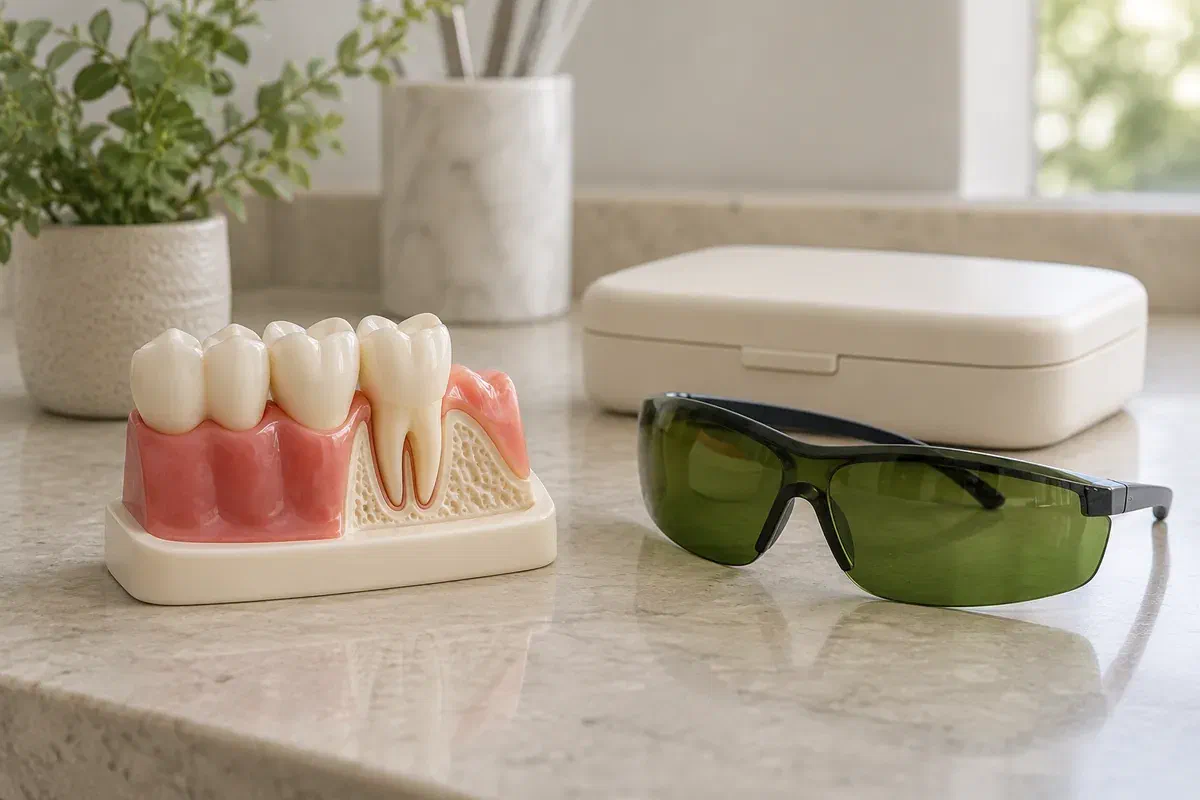
Illustrative gum model, protective eyewear, and a closed instrument case
Clarify what needs treatment

A recommendation should name the problem as clearly as the technology.

Explain whether the concern is bleeding, periodontal pockets, a local tissue issue, or advice received elsewhere. The reason for treatment determines which comparisons and questions are useful.

A periodontal diagnosis or deep-cleaning recommendation

Ask which sites are affected and what the clinical findings show. If laser use is proposed alongside cleaning, clarify what it adds and how that benefit would be measured. The recommendation should distinguish the essential treatment from an additional step being offered.

Persistent symptoms after previous gum care

Bring details of earlier treatment, review findings, and home-care difficulties. Continuing bleeding or discomfort deserves reassessment of the cause. It does not automatically show that a laser is the missing solution or that another cleaning should be repeated without a clearer explanation.

A local soft-tissue procedure described as laser treatment

Ask for the procedure's actual name and purpose, including whether tissue is being removed, reshaped, or treated in another way. A local tissue procedure is not interchangeable with treatment of periodontal disease. Its indication, alternatives, risks, and recovery need their own discussion.

Photographs, device names, and claims of advanced technology do not establish that a procedure is suitable. Ask how the recommendation follows from your examination and what care would be recommended without the laser component.

Evaluate the proposed benefit

Ask what the laser step changes and how strong the supporting evidence is.

A useful consultation separates the intended tissue effect from a promised long-term outcome. A device may be able to perform a particular task without proving that it improves periodontal results over an appropriate conventional approach. Ask which outcome matters in your case and whether the evidence applies to the exact procedure proposed.

The comparison should include practical considerations as well as possible benefit. Discuss discomfort, anaesthetic, healing, cost, further visits, and alternatives. Choosing a treatment should leave you with a realistic understanding of the whole course of care, including the maintenance needed after the initial procedure.

Patient information: American Academy of Periodontology — laser evidence, conventional care, and tissue-safety considerations · European Federation of Periodontology S3 guideline — evidence for adjunctive lasers in periodontitis care

A diagnosis-based explanation

Ask the clinician to show which findings are being addressed and why the chosen method fits them. A broad statement about bacteria does not explain every periodontal problem. The recommendation should connect the procedure to specific clinical needs and describe what it cannot resolve.

A fair comparison with established options

Discuss conventional periodontal instrumentation and any other appropriate approaches. Current evidence does not justify assuming all laser methods are better, and guidance does not support routine adjunctive laser use for every periodontitis case. Ask what makes the proposed addition worthwhile for your situation.

Clear information about risks and provider arrangements

Laser use requires appropriate training, equipment selection, and safety precautions. Discuss tissue injury, postoperative discomfort, and other procedure-specific risks alongside potential benefits. Confirm who would provide care, where it would take place, and whether a periodontist should be involved.

From assessment to an informed choice

Establish the diagnosis, compare the methods, and define the review.

A consultation about laser care need not lead to laser treatment. The assessment may support conventional care, another procedure, observation, or specialist advice instead.

  1. Assess the gums and review previous care

    Discuss symptoms, relevant health information, medicines, and earlier periodontal treatment. The clinician examines the tissues and supporting structures as appropriate. Ask what diagnosis is established and whether further records or investigation are needed before comparing treatment methods.

  2. Identify the precise procedure and its alternatives

    Ask what the laser would be used to do and whether it is an addition to another treatment or a proposed alternative. Review the evidence, expected benefit, limitations, fees, and possible referral. A recognizable product name should not substitute for this explanation.

  3. Confirm consent, comfort, and safety arrangements

    If an indicated procedure is selected and available, the treating provider explains preparation, anaesthetic, protective measures, and the planned sequence. Ask how you can request a pause. The specific device, technique, and safety requirements depend on the treatment rather than one universal laser protocol.

  4. Provide aftercare and assess the clinical response

    Receive instructions matched to the tissue procedure or periodontal care performed. Agree when healing and treatment response will be reviewed, and which findings will guide further care. Maintenance and daily cleaning remain part of the plan when periodontal disease is involved.

After a laser-assisted gum procedure

Follow the procedure's instructions rather than assumptions about the device.

The word laser does not tell you how to clean, what to eat, or how long healing will take. Those instructions must reflect the tissue treated, the extent of care, and your health circumstances.

Clarify cleaning at the treated sites

Ask which areas can be cleaned normally and which need a temporary adjustment. If a rinse or other product is recommended, confirm its purpose and duration. Do not assume that the site is sterilized permanently or that a laser procedure removes the need for ongoing plaque control.

Understand expected symptoms and when to call

Ask what discomfort, sensitivity, swelling, or bleeding may occur and which changes need review. Contact the treating provider about worsening symptoms, persistent bleeding, fever, or an unexpected tissue change. A procedure described as minimally invasive can still require aftercare and assessment of concerns.

Attend reassessment before judging the final result

Improvement should be evaluated using the clinical goal agreed beforehand, not only how the gum looks immediately afterward. Ask whether further treatment is needed and what maintenance interval is appropriate. A short-term change in comfort or appearance does not establish permanent control of periodontal disease.

Choosing care on its merits

Compare the treatment plan, not simply the instrument used.

Ask which option is supported by your diagnosis and what evidence supports any additional step. The right discussion includes expected outcomes, uncertainty, cost, risks, and the care required afterward.

When established nonsurgical treatment addresses the need

Conventional periodontal care and reassessment

Appropriate instrumentation, daily cleaning support, and review may be the recommended route. Ask which areas are being treated and how the response will be assessed. Choosing conventional care is a clinical decision that can be explained without assuming newer equipment is necessary for effective management.

When a specific indication and reasonable benefit are established

An individually justified laser-assisted procedure

Ask what technique is proposed, how its evidence applies to your condition, and which other care remains essential. Confirm availability and costs before proceeding. No general promise of painless treatment, faster healing, bone regrowth, or avoidance of all future surgery should replace an individual explanation.

When disease complexity or the tissue concern requires broader planning

Periodontal specialist assessment or another procedure

Advanced or persistent disease may need specialist review and a different treatment approach. Ask what the referral should clarify and how its recommendations will be coordinated. A laser should not be used as a reason to defer care that the diagnosis and tissue condition actually require.

Patient information: American Dental Association — nonsurgical periodontitis guideline and varying evidence for adjuncts

Laser gum-treatment questions

Ask about the evidence and the complete course of care.

These questions help turn a technology-focused recommendation into a treatment discussion. The answers depend on the diagnosis and the exact procedure, not the word laser alone.

(905) 876-4488
Is laser gum treatment one standardized procedure for every periodontal problem?
No. Different devices and techniques have different purposes. Ask for the specific procedure name, the condition it is intended to treat, and whether it supplements or replaces another step. That information is necessary before comparing benefits, risks, recovery, or cost.
Does using a laser guarantee better periodontal results than scaling and root planing?
No. Evidence varies by method, and laser use should not be assumed to improve every case. Ask what benefit is expected beyond appropriate conventional care and how strong the evidence is for the proposed procedure. Routine additional technology is not a substitute for a clinical indication.
Can a laser gum procedure guarantee that lost bone will grow back?
No. Claims about regeneration require evidence for the specific condition and procedure. Ask which tissue changes are realistically expected and how they will be assessed. A device name or an early improvement in gum appearance does not establish that lost bone has been restored.
Will laser treatment mean I no longer need periodontal maintenance?
No. Ongoing daily care and professional review remain important when periodontal disease has been treated. Ask what maintenance is recommended and why. The initial technique does not remove the need to monitor previously affected sites or address future changes.
Should I expect a laser gum procedure to need no anaesthetic or recovery time?
Not automatically. Comfort arrangements and recovery depend on the tissue procedure and its extent. Ask what will be done, whether anaesthetic is proposed, what symptoms to expect, and which activities or cleaning methods need temporary adjustment. Avoid relying on a general painless-treatment claim.
Can I request an explanation of the non-laser option before deciding on gum care?
Yes. Ask what care would be recommended without the laser component and how the options compare in evidence, cost, risks, and follow-up. You should understand the reason for each proposed step before choosing, including whether a specialist assessment would help clarify the decision.
Laser gum-treatment consultation in Milton

Understand the recommendation before choosing the technology.

Contact our Bronte Street practice to discuss your gum findings or a proposed laser procedure. Bring earlier periodontal records or treatment plans so the indication, alternatives, and any referral needs can be reviewed.

Specific laser equipment, protocols, treatment availability, suitability, and expected benefit must be confirmed individually. No superiority over conventional treatment or guaranteed outcome is claimed.

Visit Milton Dental Clinic
Unit 1, 342 Bronte St. S, Milton, ON L9T 5B7
Get directions Clinic hours
Monday–Thursday
11am–7pm
Friday–Sunday
By appointment only

How can we help?

Milton Dental Clinic

Have a question about your smile? Choose the option that works best for you.

For urgent dental concerns, please call.
Messages are reviewed during clinic hours.