

Illustrative patient discussing gum-treatment options with a clinician and a dental model
Specialized Care

Laser Gum Treatment in Acton

Told a small patch of gum could be "lasered"? From Acton, find out what that really involves. We explain whether the issue is a local tissue concern or periodontal disease, what the procedure would do, how it compares with other options, and when a specialist should take a look.

Acton: one spot or the whole mouth?

A small tissue fix and gum-disease care are two separate decisions.

Sometimes the conversation starts with one spot: a flap of gum that traps food, tissue that has grown over part of a tooth, or a gumline that looks uneven. Someone mentions a laser could take care of it. That may be true, but it's worth knowing exactly what would be done and why before saying yes.

Lasers are used for a range of soft-tissue tasks, and different devices suit different jobs. Treating a local tissue concern is not the same as treating periodontal disease, which is managed with cleaning below the gumline, reassessment, and maintenance. In either case, a laser is one possible tool rather than an automatic improvement, and evidence differs by procedure.

If you're coming from Acton with a specific area in mind, or with a broader gum concern, our Bronte Street team can examine it, explain what's going on, and outline reasonable options, including referral. Laser suitability, the technique, and provider availability must be confirmed for you; no specific device or branded protocol is promised.

Ask about a gum area that concerns you
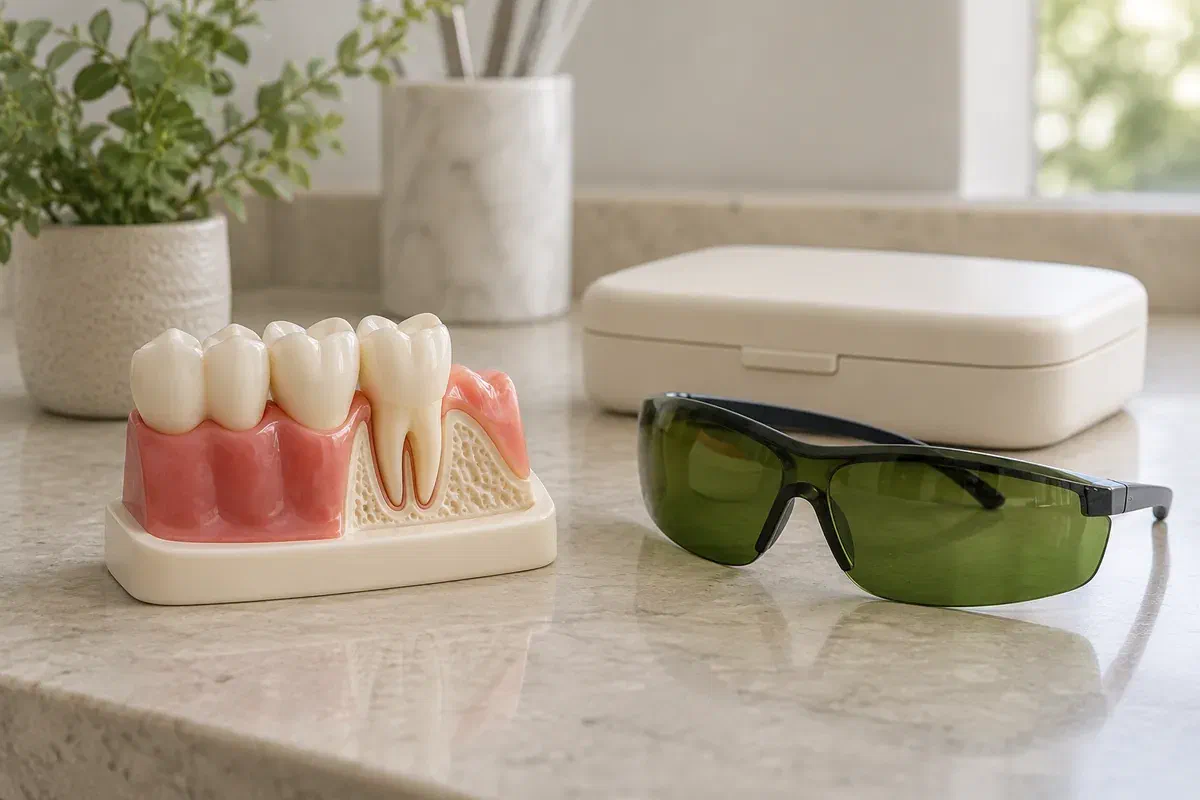
Illustrative gum model, protective eyewear, and a closed instrument case
Narrowing it down

Local problem, widespread problem, or both?

A single area of tissue, periodontal pockets around several teeth, and symptoms that keep coming back are approached differently. It's possible to have more than one at once.

Pockets and inflammation around several teeth

If the issue is periodontal disease, ask which teeth are affected and what the readings showed. A laser suggested alongside cleaning should come with a clear explanation of what it adds and how that would be checked. Keep the essential care distinct from optional extras.

One area that keeps bleeding or feeling sore

Share past treatment and where cleaning is awkward. A spot that won't settle may be caused by trapped food, a restoration edge, or deeper gum disease. The cause should be identified before choosing any procedure, laser or otherwise.

Extra, overgrown, or uneven gum tissue

Ask the proper name of the proposed procedure and what it would change: removing a small amount of tissue, reshaping the gumline, or something else. Ask why the tissue is there, since some overgrowth relates to medicines or inflammation. Discuss alternatives, risks, and healing.

Before-and-after images of someone else's gumline don't establish that a procedure suits yours. Ask how the recommendation follows from your examination and what could be done without a laser.

What would actually change

Clarify the goal: comfort, cleanability, appearance, or disease control.

With local tissue procedures, the aim might be easier cleaning, less irritation, or a change in appearance. With gum disease, it's long-term control. A laser can do certain tissue tasks well, yet that alone doesn't prove better periodontal outcomes than solid conventional care. Ask which goal applies and whether there's good evidence for the particular procedure in that situation.

Discuss comfort, anaesthetic, healing, fees, number of visits, and the alternatives, including leaving a minor issue alone and monitoring it. Understanding the full course, including maintenance where gum disease is involved, helps you make a decision you won't second-guess.

Patient information: American Academy of Periodontology — laser evidence, conventional care, and tissue-safety considerations · European Federation of Periodontology S3 guideline — evidence for adjunctive lasers in periodontitis care

A purpose you can name

Your clinician should explain precisely which tissue or site is the target and what result is intended. A broad claim about bacteria doesn't explain a local tissue problem or every case of gum disease. Ask what the procedure can't achieve.

Other methods compared honestly

Conventional instruments, a scalpel-based procedure, or simply improved cleaning may be options depending on the issue. For periodontitis, evidence doesn't make all laser methods superior, and guidance doesn't support adding one routinely. Ask why the laser is preferred for you.

Safety and the provider's role

Laser procedures require training, suitable equipment, and precautions such as eye protection. Talk about tissue injury, discomfort afterward, and risks specific to the technique. Confirm who would do the procedure, where, and whether a periodontist is better placed to do it.

What to expect

Identify the tissue issue, then decide on the method

Asking about a laser doesn't commit you to one. You may end up with conventional care, a different procedure, monitoring, or a referral.

  1. Look at the area and the rest of the mouth

    We discuss symptoms, health, medications, and previous treatment, and examine both the specific area and your overall gum health. Ask whether any records or images are needed to understand the issue before methods are compared.

  2. Name the procedure and its alternatives

    Learn what a laser would do to the tissue, what it would replace or supplement, and what other approaches exist. Review evidence, expected result, limitations, fees, and possible referral. A product name shouldn't substitute for that explanation.

  3. Go over consent, comfort, and protection

    Once a suitable procedure is agreed and offered, whoever is treating you will describe preparation, freezing, protective eyewear, and the steps of the visit. Agree on a pause signal. Safety measures vary with the device and the technique used.

  4. Heal, then review

    Aftercare should fit the tissue treated. Agree when the area will be rechecked and what would prompt further care. If gum disease is also present, maintenance and daily cleaning remain part of your plan.

Looking after the treated area

Small procedures still need proper aftercare.

Whether or not a laser was used, cleaning, eating, and healing time depend on how much tissue was treated, where, and your health.

Clean near the site the right way

Ask whether you can brush and floss next to the area as usual or should be gentler for a few days. If a rinse is advised, confirm why and for how long. Plaque returns to treated tissue, so regular cleaning remains important.

Watch how it heals

Ask what tenderness, sensitivity, swelling, or bleeding is normal for your procedure. Contact the treating office about increasing pain, bleeding that continues, fever, or a change in the tissue you didn't expect. A quick procedure can still benefit from a follow-up call.

Assess the result once healing settles

Judge the outcome against the goal set at the start, whether that was easier cleaning or a change in appearance, rather than the first few days. Ask whether more care is likely and, if gum disease is present, how often maintenance should be.

Approaches to compare

Match the procedure to the problem.

Ask which choice your diagnosis supports and what evidence justifies it. Consider expected results, uncertainty, cost, risks, and aftercare.

When standard care resolves the concern

Conventional periodontal care or improved home cleaning

Careful instrumentation, a cleaning routine adjusted to the problem area, and a scheduled review may be enough. Ask what will be treated and how you'll know it's working. Choosing this is a sound decision and doesn't imply that newer equipment was required.

When a defined indication and sensible benefit are present

A laser-assisted tissue procedure

Ask which technique is proposed, how evidence supports it for your issue, and what other care is still needed. Confirm fees and availability first. Claims of painless treatment, faster healing, bone regrowth, or avoiding surgery should never replace an individual explanation.

When the tissue concern or disease needs wider planning

A periodontist's assessment or a different procedure

Some tissue problems and advanced gum disease are better handled by a specialist, sometimes with a different technique. Ask what the referral is meant to resolve and how care will be coordinated. A laser shouldn't delay treatment your condition needs.

Patient information: American Dental Association — nonsurgical periodontitis guideline and varying evidence for adjuncts

Local tissue questions

About lasers and single-area gum procedures

These questions help separate a technology pitch from a clear treatment plan. Answers depend on the diagnosis and the specific procedure.

(905) 876-4488
Can a laser remove a small flap of gum that traps food?
Sometimes a small soft-tissue procedure is an option, but it depends on why the flap is there, its location, and whether other approaches would work. Ask for an examination and an explanation of alternatives, risks, and healing before deciding.
Why has my gum grown over part of a tooth?
Possible causes include inflammation, certain medications, or how a tooth has erupted. Identifying the cause matters because it affects the treatment choice. Mention all medicines you take, since some are known to affect gum tissue.
Is reshaping my gumline the same as treating gum disease?
No. Reshaping addresses tissue form, often for cleaning or appearance, while gum disease treatment aims to control infection and inflammation. Each has its own reasons, alternatives, and risks, so they should be discussed separately.
Is a laser always better than a traditional instrument for small tissue procedures?
Not automatically. The best tool depends on the procedure, the tissue, and the provider’s training and experience. Ask why a particular method is being suggested, what the alternatives would involve, and whether comfort, bleeding control, or healing are expected to differ between them in your case.
Will I need stitches after a laser tissue procedure?
That depends on the procedure and the amount of tissue involved. Ask the treating provider what to expect, including any stitches, dressings, or follow-up visits, and how eating and cleaning should change while the area heals.
Should I wait and watch a minor gum issue instead?
Sometimes monitoring is reasonable, especially if the area is comfortable and easy to clean. Ask what signs would mean treatment is needed and when the area should be rechecked.
Gum consultations for Acton

Show us the spot that's bothering you.

Contact our Bronte Street practice about a specific gum area or a laser procedure you've been offered. Bringing earlier records or treatment plans helps us review the cause, the alternatives, and whether a referral would help.

Each person's suitability, the laser equipment and technique, availability, and realistic benefit must be confirmed. We don't claim laser care is superior to conventional methods or guarantee a result.

Visit Milton Dental Clinic
Unit 1, 342 Bronte St. S, Milton, ON L9T 5B7
Get directions Clinic hours
Monday–Thursday
11am–7pm
Friday–Sunday
By appointment only

Areas we serve

  • Milton
  • Oakville
  • Mississauga
  • Georgetown
  • Halton Hills
  • Acton
  • Campbellville
  • Brampton
  • Burlington
  • Puslinch
  • Rockwood
  • Erin
  • Caledon
  • Etobicoke
  • Old Milton
  • Bronte Meadows
  • Timberlea
  • Dorset Park
  • Dempsey
  • Clarke
  • Beaty
  • Coates
  • Harrison
  • Scott
  • Willmott
  • Ford
  • Bowes
  • Cobden
  • Walker
  • Mountain View
  • Milton Heights
  • Hawthorne Village
  • Valley View
  • Fallingbrook
  • Nassagaweya
  • Trafalgar
  • Esquesing
  • Nelson
  • Brookville
  • Moffat
  • Glen Williams
  • Norval
  • Limehouse
  • Stewarttown
  • Ashgrove
  • Hornby
  • Silver Creek
  • Speyside
  • Scotch Block
  • North Oakville
  • River Oaks
  • Glen Abbey
  • West Oak Trails
  • Palermo
  • Bronte Creek
  • College Park
  • Joshua Creek
  • Uptown Core
  • Preserve
  • Iroquois Ridge
  • Lisgar
  • Meadowvale
  • Meadowvale Village
  • Churchill Meadows
  • Erin Mills
  • Central Erin Mills
  • Streetsville
  • East Credit
  • Creditview
  • Heartland
  • Sheridan
  • Mount Pleasant
  • Credit Valley
  • Huttonville
  • Churchville
  • Springbrook
  • Northwest Brampton
  • Bram West
  • Fletcher's Meadow
  • Fletcher's Creek South
  • Alton Village
  • Orchard
  • Millcroft
  • Headon Forest
  • Tansley
  • Brant Hills
  • Tyandaga
  • Kilbride
  • Lowville
  • Aberfoyle
  • Morriston
  • Arkell
  • Hillsburgh
  • Freelton
  • Carlisle
  • Waterdown
  • Flamborough
  • Mountsberg

How can we help?

Milton Dental Clinic

Have a question about your smile? Choose the option that works best for you.

For urgent dental concerns, please call.
Messages are reviewed during clinic hours.