

Illustrative patient discussing gum-treatment options with a clinician and a dental model
Specialized Care

Laser Gum Treatment in Caledon

Hoping one laser session will settle your gum problems for good? From Caledon, it's worth hearing the longer story first. We explain your diagnosis, what a laser step could contribute, how it compares with standard periodontal care, and what the years after treatment usually involve.

Caledon: thinking long term

Gum disease is managed over years, not erased in an afternoon.

The appeal is easy to understand: one modern procedure, then done. Periodontal disease rarely works that way. It is usually controlled rather than cured, through an initial phase of treatment followed by regular check-ins that catch changes early. A laser may play a part at some stage, but it doesn't remove the need for that longer arc.

Lasers vary, and so do the procedures that use them. Some target gum disease; others handle small soft-tissue tasks. The well-established route for periodontitis is deep cleaning beneath the gumline, a follow-up evaluation, and maintenance visits that continue. Evidence for adding a laser differs by technique and doesn't show a benefit in every case.

Families in Bolton and Caledon's villages can bring past charts, X-rays, or a plan they've been given. At our Bronte Street practice we'll go over the findings, the realistic options, and whether a periodontist should be involved, then sketch what follow-up could look like. Laser suitability, method, and provider availability need confirmation; no particular device or branded protocol is promised.

Talk through a long-term gum plan
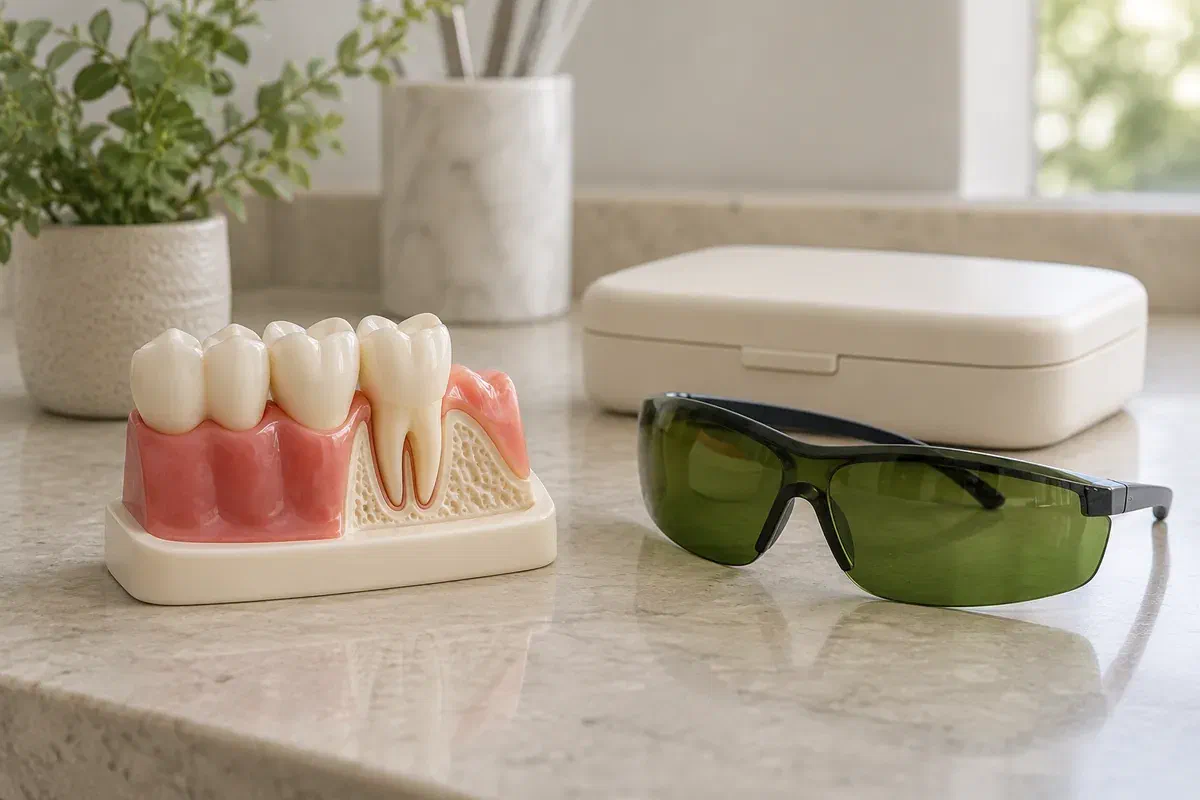
Illustrative gum model, protective eyewear, and a closed instrument case
Where you are in the story

New diagnosis, returning symptoms, or a single tissue issue

Each stage calls for different expectations. A first diagnosis, a relapse after earlier care, and a one-off tissue concern have different timelines and follow-up.

Newly diagnosed periodontal disease

Ask which sites are affected and how the first phase of treatment will be organised. If a laser is offered alongside cleaning, find out its intended contribution and how you'd see it at review. Know which parts are essential and which are optional.

Symptoms returning after earlier treatment

Relapse can happen when maintenance lapses, health changes, or some sites never fully settled. Bring records of earlier care. Returning bleeding calls for a fresh look at causes, not an automatic laser session or a repeat of the same cleaning.

A one-time soft-tissue procedure

Some laser procedures address one small area. Ask what it's properly called and what it does to the tissue. That's separate from managing gum disease, and its purpose, alternatives, risks, and healing need their own explanation.

Promises of a permanent fix or cutting-edge technology don't establish that a procedure suits you. Ask how the advice follows from your examination, and what the plan would be with no laser included.

Short-term effect, long-term health

What will still be true in five years?

Keep the treatment day and the years afterward separate in your mind. A device can perform a specific task well, yet the long-term question is whether your gums stay stable, and laser use hasn't consistently outperformed careful conventional care on that front. Ask which long-term result is expected and whether research supports this precise procedure.

Comfort, anaesthetic, healing, fees, and the number of visits all deserve discussion, along with alternatives. So does the maintenance schedule that follows, since that's where most of the long-term work happens. Understanding the full arc of care makes it easier to commit to it.

Patient information: American Academy of Periodontology — laser evidence, conventional care, and tissue-safety considerations · European Federation of Periodontology S3 guideline — evidence for adjunctive lasers in periodontitis care

A link from findings to method

Expect the plan to name particular teeth and pocket readings, then explain why this technique suits them. A slogan about wiping out bacteria can't account for every gum problem. Just as useful is hearing what the procedure is not going to change as the years pass, so expectations stay realistic.

Conventional care as the baseline

Thorough scaling and root planing is the yardstick any newer approach gets measured against. Studies haven't put every laser method ahead of it, and current guidance doesn't recommend a laser as a standard addition for periodontitis. The question to press is what lasting difference the extra step should make for you.

Risk, training, and continuity

Lasers call for a trained operator, the right equipment, and protective measures. Talk about tissue injury, discomfort afterward, and risks that come with the particular technique. Since gum care stretches over years, also settle who performs the procedure, where, whether a periodontist will share the work, and which office runs maintenance.

The full timeline

Treat, reassess, and then keep watching

Asking about lasers won't commit you to one. The plan may involve conventional care, a different procedure, monitoring, or a specialist, and almost always ongoing maintenance.

  1. Establish the starting point

    We review symptoms, health, medications, and earlier gum care, then examine the gums and supporting bone as needed. You'll hear the diagnosis, and whether X-rays or charting now would give a useful baseline for comparing future visits.

  2. Choose the initial treatment

    If a laser is proposed, find out what it would do and whether it adds to or stands in for another step. Discuss evidence, expected benefit, limits, fees, and referral. A familiar brand name isn't a reason on its own.

  3. Prepare for the procedure

    Where a suitable procedure goes ahead, the provider explains preparation, freezing, protective eyewear, and the visit sequence. Agree on a pause signal. Each device and technique carries its own safety requirements.

  4. Move into maintenance

    Aftercare should fit the treatment. After reassessment, a maintenance interval is set based on how your gums responded and your risk factors. Daily cleaning and regular reviews become the long-term plan.

The first weeks, and beyond

Healing comes first; habits keep the result.

Whichever tool was used, your brushing, meals, and healing time are set by the area treated, how much was done, and your general health. Ask for those instructions in writing before you head home.

Follow the short-term cleaning plan

Some spots can be cleaned normally from day one; others may need a lighter touch at first. A prescribed rinse should come with a clear purpose and a stopping point. Bacteria settle back onto treated sites within days, so the habits you rebuild now are the ones that protect the result.

Know the signs that need a call

Ask how much tenderness, sensitivity, or puffiness is usual for your procedure. Phone the treating office if pain builds rather than eases, bleeding won't settle, a fever starts, or the tissue looks unexpected. Even a minor procedure can merit a quick look.

Treat the review as the real result

Progress should be measured against the agreed goal, not how things look in week one. The reassessment is where your maintenance interval gets set, and that interval matters more over a decade than any single visit. Short-term comfort doesn't prove that gum disease is permanently under control.

Planning for the long run

Pick the plan you can sustain.

Each option should be supported by your diagnosis, with evidence for anything extra. Weigh outcomes, uncertainty, cost, risks, and the maintenance each requires.

When established nonsurgical treatment meets the need

Conventional periodontal care and maintenance

Thorough cleaning below the gumline, coaching on your routine, a reassessment, and then a steady rhythm of maintenance may be the whole recommendation. You'll know the teeth involved and what improvement should look like. It's a well-supported path and says nothing negative about skipping newer equipment.

When a specific indication and realistic benefit are established

A laser-assisted step with a clear rationale

Ask about the technique, how evidence applies to you, and what other care, including maintenance, remains necessary. Confirm fees and availability first. Promises of painless care, quick healing, regrown bone, or no future surgery aren't a substitute for an individual explanation.

When complexity requires broader planning

Specialist care or a different procedure

Advanced or persistent disease may need a periodontist and another approach, sometimes with shared maintenance. Ask what the referral should clarify and how care will be coordinated. A laser shouldn't delay necessary treatment.

Patient information: American Dental Association — nonsurgical periodontitis guideline and varying evidence for adjuncts

Long-term gum care questions

What happens after the first treatment

These answers focus on the long-term plan rather than the technology. Your situation depends on your diagnosis and the procedure involved.

(905) 876-4488
Can laser treatment cure gum disease permanently?
Periodontal disease is generally managed rather than cured. Treatment aims to bring it under control, and maintenance helps keep it there. Ask what control looks like for you and how it will be monitored.
How often will I need gum maintenance visits?
It varies with how your gums responded, your risk factors, and your history. Some people need visits more often than a standard check-up. Ask what interval is recommended and why.
What happens if my gum disease comes back?
Changes found at maintenance visits can be reassessed and treated. The approach depends on what’s found, which sites are involved, and what has changed in your health or routine. Keeping to the maintenance schedule helps catch problems while they are still small and easier to manage.
Does a laser lower the chance of needing gum surgery later?
That can’t be promised. Future needs depend on how your disease responds and progresses. Ask what the evidence says for the specific procedure and what other factors affect long-term outcomes.
Is adding a laser to scaling and root planing worth it long term?
It depends. Results in studies differ from one method to another, and the added laser step hasn’t helped in every situation. Ask what lasting benefit the office expects beyond conventional care, how that would show up at maintenance visits, and whether research on that exact procedure backs it.
Can lost gum or bone be restored with a laser?
That shouldn’t be assumed. Claims of regeneration require evidence for the specific condition and technique. Ask what realistic tissue changes are expected and how they would be measured over time.
Gum care for Caledon

Plan the first step with the next ten years in mind.

Contact our Bronte Street practice to discuss gum concerns, a proposed laser procedure, or long-term maintenance. Bring earlier records or plans so we can review the indication, alternatives, referral needs, and what follow-up would look like.

Before any laser procedure, we confirm with you whether it fits, whether it can be offered, which equipment and protocol would apply, and what it could reasonably achieve. It is not presented as superior to conventional care, and no outcome is guaranteed.

Visit Milton Dental Clinic
Unit 1, 342 Bronte St. S, Milton, ON L9T 5B7
Get directions Clinic hours
Monday–Thursday
11am–7pm
Friday–Sunday
By appointment only

Areas we serve

  • Milton
  • Oakville
  • Mississauga
  • Georgetown
  • Halton Hills
  • Acton
  • Campbellville
  • Brampton
  • Burlington
  • Puslinch
  • Rockwood
  • Erin
  • Caledon
  • Etobicoke
  • Old Milton
  • Bronte Meadows
  • Timberlea
  • Dorset Park
  • Dempsey
  • Clarke
  • Beaty
  • Coates
  • Harrison
  • Scott
  • Willmott
  • Ford
  • Bowes
  • Cobden
  • Walker
  • Mountain View
  • Milton Heights
  • Hawthorne Village
  • Valley View
  • Fallingbrook
  • Nassagaweya
  • Trafalgar
  • Esquesing
  • Nelson
  • Brookville
  • Moffat
  • Glen Williams
  • Norval
  • Limehouse
  • Stewarttown
  • Ashgrove
  • Hornby
  • Silver Creek
  • Speyside
  • Scotch Block
  • North Oakville
  • River Oaks
  • Glen Abbey
  • West Oak Trails
  • Palermo
  • Bronte Creek
  • College Park
  • Joshua Creek
  • Uptown Core
  • Preserve
  • Iroquois Ridge
  • Lisgar
  • Meadowvale
  • Meadowvale Village
  • Churchill Meadows
  • Erin Mills
  • Central Erin Mills
  • Streetsville
  • East Credit
  • Creditview
  • Heartland
  • Sheridan
  • Mount Pleasant
  • Credit Valley
  • Huttonville
  • Churchville
  • Springbrook
  • Northwest Brampton
  • Bram West
  • Fletcher's Meadow
  • Fletcher's Creek South
  • Alton Village
  • Orchard
  • Millcroft
  • Headon Forest
  • Tansley
  • Brant Hills
  • Tyandaga
  • Kilbride
  • Lowville
  • Aberfoyle
  • Morriston
  • Arkell
  • Hillsburgh
  • Freelton
  • Carlisle
  • Waterdown
  • Flamborough
  • Mountsberg

How can we help?

Milton Dental Clinic

Have a question about your smile? Choose the option that works best for you.

For urgent dental concerns, please call.
Messages are reviewed during clinic hours.