

Illustrative patient discussing gum-treatment options with a clinician and a dental model
Specialized Care

Laser Gum Treatment in Erin

Scrolling past home gum-light gadgets and wondering if they're the same as a dentist's laser? From Erin, get a straight comparison. We explain what professional laser gum care involves, what your gums actually need, how the evidence stacks up, and why at-home devices aren't a substitute.

Erin: gadgets versus treatment

A glowing mouthpiece is not a periodontal procedure.

Online shops are full of light-based gadgets promising healthier gums from your bathroom. They can look a lot like what a clinic offers, and the marketing often borrows the same words. The difference is that clinical lasers are used after an examination, for a specific tissue purpose, by someone trained to manage the risks.

Even in a clinic, laser gum treatment isn't one procedure. Different devices and techniques do different things. With gum disease, the established approach is professional cleaning under the gumline, reassessment, and long-term maintenance, alongside good daily cleaning at home. A professional laser isn't automatically better than that, and research findings vary with the method.

For households in Erin and Hillsburgh, it can be tempting to try a home fix before making the trip. If your gums bleed, feel tender, or have been flagged at a check-up, an assessment at our Bronte Street practice is the more reliable next step. Laser suitability, technique, and provider availability must be confirmed; we don't promise a particular device or protocol.

Get your gums properly assessed
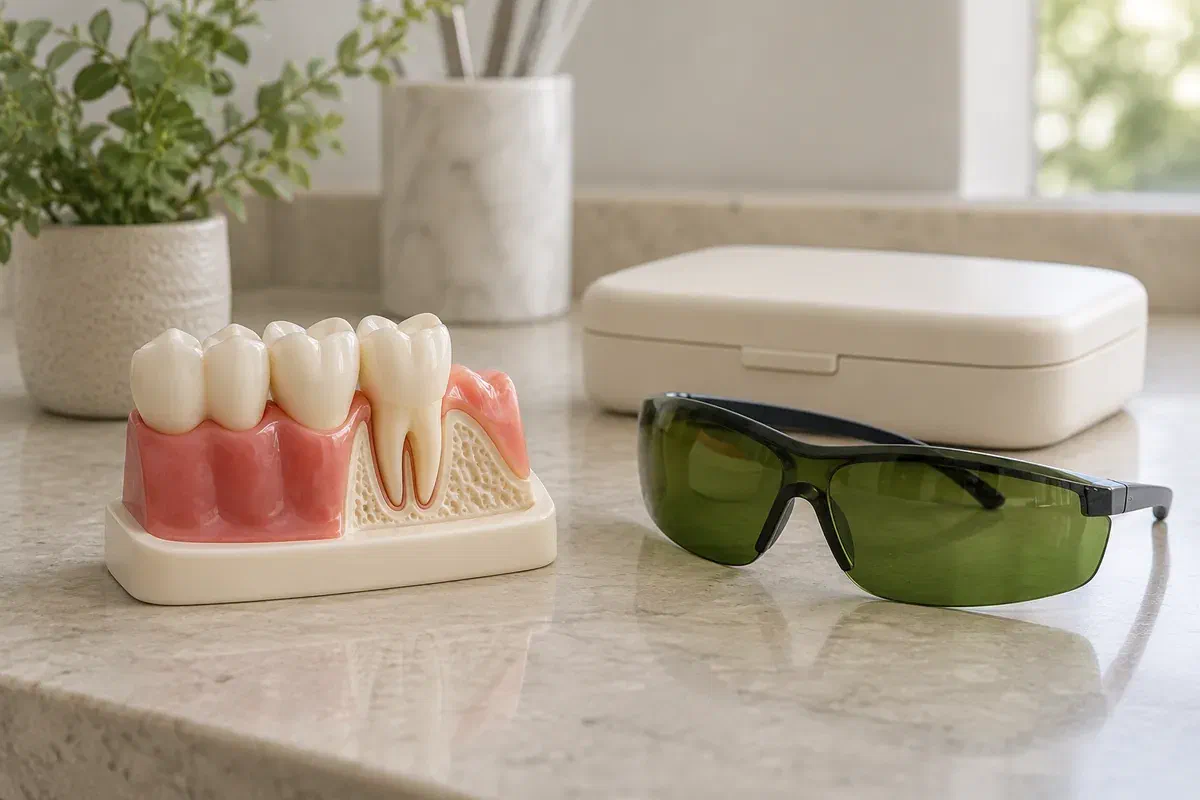
Illustrative gum model, protective eyewear, and a closed instrument case
What made you start searching

Bleeding, a diagnosis, or one sore spot?

People often look for home remedies when gums bleed, after hearing about pockets at a cleaning, or when one area stays irritated. Each of those deserves a proper look rather than a guess.

A hygienist mentioned pockets or a deep cleaning

No home gadget can remove hardened deposits below the gumline. Ask which teeth are affected and what was measured. If a professional laser is suggested with the cleaning, find out what it would add and how anyone would tell. The necessary care should stand apart from extras.

Bleeding that hasn't improved

If you've tried new brushes, rinses, or devices and still see bleeding, bring that history. Persistent bleeding calls for an examination of the cause. It doesn't mean a stronger gadget is needed, or that a clinical laser is the answer by default.

A single spot that stays irritated

A local problem might be food trapping, a rough edge, or extra tissue. If a clinical laser procedure is suggested, ask its proper name and what it does to the tissue. That decision is separate from gum-disease care and has its own alternatives, risks, and recovery.

Reviews, influencer videos, and the word laser on a box don't show that something suits your mouth. Ask how any recommendation follows from your own examination, and what care you'd receive without a laser at all.

Clinic laser, home gadget, or neither

Ask what each one is actually shown to do.

In a dental office, the laser carries out one defined tissue task during the appointment. Doing that task doesn't automatically mean healthier gums later, and research hasn't consistently shown laser use beating well-done conventional care. Home light devices are a different category again, and they're not a replacement for professional treatment. In the chair, ask what outcome is expected and whether evidence supports that exact procedure.

Weigh comfort, anaesthetic, healing, fees, appointments, and alternatives. Ask what your daily routine should look like afterward, since home care carries the results forward. Understanding the full course, including maintenance, beats a single quick fix.

Patient information: American Academy of Periodontology — laser evidence, conventional care, and tissue-safety considerations · European Federation of Periodontology S3 guideline — evidence for adjunctive lasers in periodontitis care

An explanation tied to your mouth

Your clinician should identify the sites being treated and why the chosen method fits them. Marketing claims about bacteria don't explain every gum problem. Ask what the procedure won't accomplish.

Standard care on equal footing

Conventional periodontal instrumentation should be part of any comparison. Not every laser technique has proven better, and guidance doesn't support routinely adding one for periodontitis. Ask what would make the addition worth it for you.

Real safety measures

Clinical lasers require training, appropriate equipment, and protective steps such as eyewear. Discuss tissue injury, soreness, and technique-specific risks. Confirm the treating provider, the location, and whether a gum specialist should be consulted.

What a real assessment includes

Examine, explain, treat if needed, then recheck.

An assessment might lead to conventional treatment, a different procedure, monitoring, or a referral. A laser is only one possibility.

  1. Examine the gums properly

    We go over symptoms, health, medications, any products or devices you've tried, and past gum care. Then the gums and supporting bone are examined as needed. Ask what the diagnosis is and whether X-rays or charting are needed.

  2. Explain what's recommended and why

    If a laser is part of the plan, find out its specific job and whether it supplements or replaces another step. Discuss evidence, likely benefit, limits, fees, and referral. A device name doesn't replace a reason.

  3. Treat with safeguards in place

    When a procedure is justified and the clinic can provide it, you'll be walked through preparation, freezing, eye protection for everyone in the room, and each step of the visit. Agree beforehand on a simple way to ask for a pause. Precautions differ from one device and technique to the next, which is exactly what separates clinical use from a gadget.

  4. Review the response

    Aftercare should fit what was done. A recheck is scheduled, with the findings that will guide what comes next. For gum disease, maintenance visits and daily cleaning carry on.

The home routine afterward

Simple tools, used well, do the most for healing gums.

A laser doesn't dictate your cleaning, diet, or healing time. Those depend on the area treated, the amount of care, and your health. Gadgets aren't part of the plan unless your provider says so.

Clean the way you've been shown

Ask which areas can be brushed and flossed normally and where to go gently in the first days. Any rinse you're given should come with a reason and an end date. Bacteria return to treated sites, so a soft brush and steady daily cleaning do more for healing than any extra product.

Call about symptoms that worry you

Ask what tenderness, sensitivity, or swelling is typical for your procedure. Get in touch with the treating office if pain climbs instead of fading, bleeding keeps on, a fever starts, or the tissue simply doesn't look right. A quick call first can tell you whether the drive in is needed.

Judge the result at review

The real test is the goal set before treatment, not how gums look a few days later. Ask whether more care is needed and how often maintenance should be. Feeling better early doesn't prove lasting control of gum disease.

Real options

Professional choices, compared honestly

Every option should trace back to your diagnosis, with evidence for anything added. Think about results, uncertainty, cost, risks, and the care that follows.

When standard nonsurgical treatment does the job

Conventional periodontal care and home coaching

Careful instrumentation, practical help with your routine, and a scheduled review may be recommended. Know which sites are treated and how improvement will be measured. This is a sound clinical decision, not a lesser option.

When an indication and a reasonable benefit are clear

A clinical laser step with a specific purpose

Ask which technique is proposed, how evidence applies to you, and which other care is still required. Confirm fees and availability ahead of time. Claims of painless treatment, faster healing, regrown bone, or no future surgery are no stand-in for an individual explanation.

When the condition needs wider planning

Specialist review or a different procedure

Advanced or persistent disease may need a periodontist and another approach. Ask what the referral should settle and how care will be coordinated. Neither a home device nor a clinical laser should delay care your diagnosis calls for.

Patient information: American Dental Association — nonsurgical periodontitis guideline and varying evidence for adjuncts

Questions about devices and lasers

Sorting real treatment from marketing

These answers steer the focus from gadgets and technology to your actual gum care. What's right for you depends on your diagnosis and the procedure.

(905) 876-4488
Are home gum-light devices the same as a dentist's laser?
No. They’re different products used in different ways. A clinical laser is used after an examination for a specific purpose by a trained provider. Home devices aren’t a substitute for professional assessment and treatment.
Can a home device treat gum disease on its own?
It can’t remove hardened deposits below the gumline or replace professional periodontal care. Relying on one may also delay treatment while the condition progresses quietly. If you have bleeding, tenderness, loose teeth, or a diagnosis of gum disease, see a dental professional.
Is it safe to keep using my gadget while I'm having gum treatment?
Ask your treating provider before using any device, particularly on healing tissue. Bring it, or a photo of the packaging, to your appointment if you’d like it reviewed. It’s better to pause a gadget for a few weeks than to irritate tissue that is still settling.
Does a clinical laser always outperform a standard deep cleaning?
No. Evidence varies by method, and a laser hasn’t been shown to improve every case. Ask what benefit is expected over well-done conventional care and what the research shows for that particular procedure.
Which home tools actually help my gums?
A soft toothbrush, a fluoride toothpaste, and a way to clean between teeth, such as floss or interdental brushes, are the basics. Your hygienist can recommend what suits your mouth. Tools help most when combined with regular professional care.
After professional treatment, can I rely on home care alone?
Not if periodontal disease was treated. Home care is essential, but professional maintenance visits are still needed to monitor and clean areas you can’t reach. Ask how often yours should be.
From Erin to Bronte Street

Skip the guesswork. Get an assessment.

Contact our Bronte Street practice about bleeding gums, a deep-cleaning recommendation, or a laser procedure you'd like explained. Bring earlier records, treatment plans, or even the products you've tried, so we can review the cause, options, and any referral.

Suitability, availability, equipment, protocol, and realistic benefit of any laser procedure are confirmed individually. We don't claim it outperforms conventional care, and we can't guarantee results.

Visit Milton Dental Clinic
Unit 1, 342 Bronte St. S, Milton, ON L9T 5B7
Get directions Clinic hours
Monday–Thursday
11am–7pm
Friday–Sunday
By appointment only

Areas we serve

  • Milton
  • Oakville
  • Mississauga
  • Georgetown
  • Halton Hills
  • Acton
  • Campbellville
  • Brampton
  • Burlington
  • Puslinch
  • Rockwood
  • Erin
  • Caledon
  • Etobicoke
  • Old Milton
  • Bronte Meadows
  • Timberlea
  • Dorset Park
  • Dempsey
  • Clarke
  • Beaty
  • Coates
  • Harrison
  • Scott
  • Willmott
  • Ford
  • Bowes
  • Cobden
  • Walker
  • Mountain View
  • Milton Heights
  • Hawthorne Village
  • Valley View
  • Fallingbrook
  • Nassagaweya
  • Trafalgar
  • Esquesing
  • Nelson
  • Brookville
  • Moffat
  • Glen Williams
  • Norval
  • Limehouse
  • Stewarttown
  • Ashgrove
  • Hornby
  • Silver Creek
  • Speyside
  • Scotch Block
  • North Oakville
  • River Oaks
  • Glen Abbey
  • West Oak Trails
  • Palermo
  • Bronte Creek
  • College Park
  • Joshua Creek
  • Uptown Core
  • Preserve
  • Iroquois Ridge
  • Lisgar
  • Meadowvale
  • Meadowvale Village
  • Churchill Meadows
  • Erin Mills
  • Central Erin Mills
  • Streetsville
  • East Credit
  • Creditview
  • Heartland
  • Sheridan
  • Mount Pleasant
  • Credit Valley
  • Huttonville
  • Churchville
  • Springbrook
  • Northwest Brampton
  • Bram West
  • Fletcher's Meadow
  • Fletcher's Creek South
  • Alton Village
  • Orchard
  • Millcroft
  • Headon Forest
  • Tansley
  • Brant Hills
  • Tyandaga
  • Kilbride
  • Lowville
  • Aberfoyle
  • Morriston
  • Arkell
  • Hillsburgh
  • Freelton
  • Carlisle
  • Waterdown
  • Flamborough
  • Mountsberg

How can we help?

Milton Dental Clinic

Have a question about your smile? Choose the option that works best for you.

For urgent dental concerns, please call.
Messages are reviewed during clinic hours.