

Illustrative patient discussing gum-treatment options with a clinician and a dental model
Specialized Care

Laser Gum Treatment in Milton

Saw an advertisement for laser gum care, or heard the term at a cleaning? Talk it through in Milton. We look at what your gums actually show, what a laser step would be for, how the evidence compares, and when standard periodontal care or a specialist makes more sense.

Laser gum care, explained in Milton

The gums come first. The tool comes second.

An advertisement can make laser gum treatment sound like a single, modern fix. In practice the phrase covers many devices and many techniques, each meant for a different tissue job. None of that is useful until someone has examined your gums, named the condition, and told you plainly what a laser would be asked to do.

When the problem is periodontal disease, the yardstick is well-established care: thorough cleaning beneath the gumline, a planned reassessment, and regular maintenance afterward. Lasers are not automatically better than that approach. Research results differ from one device and method to the next, so any proposed extra step should come with a clear reason.

Here in Milton, you can bring a bleeding-gum worry, a hygienist's comment, or a laser plan you were given and would like decoded. Our team will go over the assessment, the realistic options, and whether a referral is the better route. Whether a laser procedure suits you, and who could provide it, has to be confirmed; no particular device or branded protocol is promised here.

Ask us about a laser gum-treatment suggestion
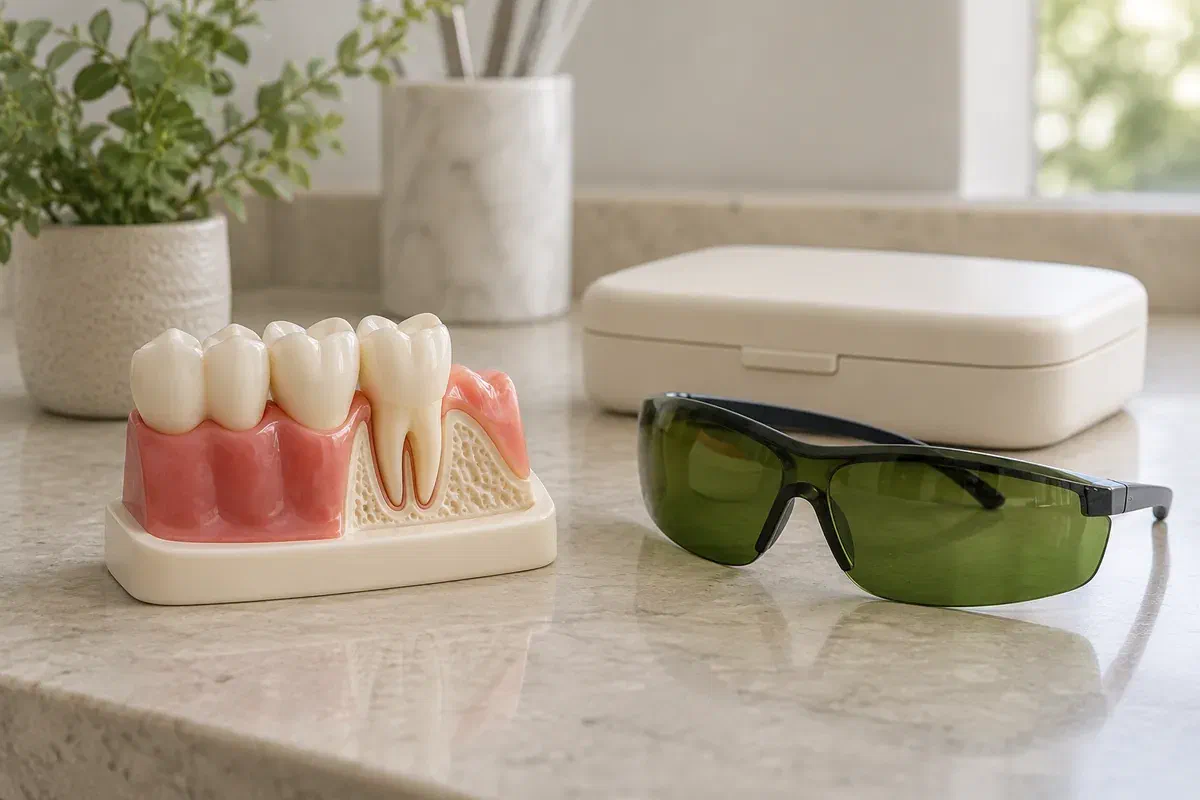
Illustrative gum model, protective eyewear, and a closed instrument case
What brought the question up

Name the gum problem before weighing any equipment.

Tell us whether you have noticed bleeding, been told about pockets, have one small area of tissue that bothers you, or are holding a recommendation from another office. The starting point decides which questions matter.

You've been told you need a deep cleaning

Find out which teeth are involved and what the measurements and images showed. If a laser is being suggested alongside the cleaning, ask what extra it brings and how anyone would know it helped. The core treatment should be clearly separated from any optional addition.

Bleeding or tenderness that hasn't settled

Share what was done before, what the follow-up visits found, and where daily cleaning feels hard. Ongoing bleeding is a reason to look again at the cause. It is not, on its own, proof that a laser is the answer, nor a reason to simply repeat the same cleaning without explanation.

A small tissue procedure that someone called laser work

Ask what the procedure is properly called and what it does: removing tissue, reshaping it, or something else. A localized soft-tissue procedure is a different thing from treating gum disease. It needs its own discussion of why, what else could be done, the risks, and healing.

Before-and-after photos, brand names, and talk of advanced technology cannot show that a procedure fits you. Ask how the plan follows from your own examination and what would be offered if the laser part were left out.

Weighing the claimed advantage

What would the laser actually add, and how sure is the research?

It helps to keep two ideas apart: what a device does to tissue on the day, and what happens to your gum health over the following months and years. A laser may perform a specific task well without showing better periodontal results than sound conventional treatment. Ask which outcome is the target for you and whether published evidence covers that exact procedure.

Benefit is only half of the picture. Talk about comfort, freezing, how healing usually goes, fees, the number of visits, and the other choices available. By the end, you should understand the whole plan, including the maintenance visits and home care that follow the first treatment.

Patient information: American Academy of Periodontology — laser evidence, conventional care, and tissue-safety considerations · European Federation of Periodontology S3 guideline — evidence for adjunctive lasers in periodontitis care

Reasoning tied to your findings

The clinician should be able to point to the readings or areas being treated and explain why this method suits them. A general remark about killing bacteria doesn't cover every gum condition. Expect to hear what the procedure is meant to fix and what it cannot.

An honest side-by-side with standard care

Cover conventional periodontal instrumentation and any other reasonable routes. The evidence does not support treating every laser method as superior, and current guidance does not back adding a laser to every case of periodontitis. Ask what makes the addition worth it for you specifically.

Plain talk about risks and who provides care

Safe laser use depends on training, the right equipment, and protective steps. Ask about tissue injury, soreness afterward, and risks particular to the technique, not only the hoped-for gains. Confirm who would treat you, where, and whether a periodontist ought to be part of the plan.

How a consultation unfolds

Diagnosis, comparison, then a clear plan for review

Asking about laser care does not commit you to it. After an assessment, the advice might be conventional treatment, a different procedure, watchful monitoring, or a specialist opinion.

  1. Look closely at the gums and your history

    We talk through your symptoms, health background, medications, and any gum treatment you've already had. The tissues and the structures supporting your teeth are examined as needed. Ask what the diagnosis is and whether more records or tests should come before anyone compares methods.

  2. Pin down the exact procedure and the alternatives

    Find out what job the laser would do and whether it adds to another treatment or replaces one. Go over the evidence, the likely benefit, its limits, fees, and any referral. A familiar product name is not a substitute for this conversation.

  3. Agree on consent, comfort, and safety steps

    If a suitable procedure is chosen and offered, the treating provider walks you through preparation, freezing, eye protection, and the order of the appointment. Agree on a signal to stop. Safety measures depend on the device and the technique, so there is no single protocol that fits every laser.

  4. Leave with aftercare and a review date

    Instructions should match the procedure or the gum care you received. Settle when healing and response will be checked and which findings will shape next steps. If periodontal disease is part of the picture, maintenance visits and daily cleaning stay in the plan.

Healing after laser-assisted care

Your instructions come from the procedure, not from the device's reputation.

Knowing a laser was used tells you nothing about how to brush, what to eat, or how long tissue takes to settle. That guidance depends on what was treated, how much, and your general health.

Know how to clean each treated area

Check which spots you can brush and floss as usual and which need a gentler approach for a while. If a rinse or another product is suggested, ask why and for how long. A laser does not leave a site permanently germ-free, and daily plaque control still matters.

Learn what's normal and what needs a call

Ask which kinds of soreness, sensitivity, swelling, or bleeding are expected and which are not. Call the treating office if symptoms get worse, bleeding won't stop, you develop a fever, or the tissue changes in a way you didn't expect. Minimally invasive care can still need follow-up.

Wait for the review before judging success

Results should be measured against the goal you agreed on at the start, not just how the gums look a few days later. Ask whether more treatment is likely and how often maintenance should be booked. Feeling better in the short term is not the same as lasting control of gum disease.

Picking the right route

Judge the whole plan, not the instrument in it.

Ask which choice your diagnosis supports and what evidence stands behind any extra step. A good conversation covers likely results, uncertainty, fees, risks, and what care looks like afterward.

When proven nonsurgical care meets the need

Standard periodontal treatment with a follow-up check

Careful instrumentation, support with daily cleaning, and a scheduled review may be all that's recommended. Ask which areas will be treated and how progress will be judged. Choosing conventional care is a sound clinical decision and does not mean newer equipment was needed to manage the problem well.

When there is a defined indication and a sensible expected benefit

A laser-assisted step with a clear reason

Ask which technique is proposed, how the research applies to your condition, and what other care must still happen. Confirm availability and fees first. A blanket promise of no pain, quicker healing, regrown bone, or never needing surgery should not stand in for an explanation about you.

When the disease or tissue concern calls for wider planning

A periodontist's opinion or a different procedure

More advanced or stubborn disease may need a specialist and a different plan. Ask what the referral is meant to answer and how the advice will be coordinated with your regular care. A laser should never become a reason to postpone treatment your diagnosis genuinely calls for.

Patient information: American Dental Association — nonsurgical periodontitis guideline and varying evidence for adjuncts

Questions we hear in Milton

Straight answers about lasers and gum care

These answers are meant to move the conversation from the equipment to the treatment itself. What applies to you depends on your diagnosis and the specific procedure, not on the word laser.

(905) 876-4488
I saw an ad for laser gum therapy. Is that the same as what a dentist would recommend?
Not necessarily. Advertising tends to describe the technology, while a recommendation should start from your diagnosis. Ask what condition the advertised procedure treats, what it involves, and whether it would be an addition to standard cleaning or a replacement. Then compare it with what your examination suggests.
Is a laser more effective than a regular deep cleaning for gum disease?
Not as a rule. Results vary by technique, and adding a laser has not been shown to help every case. Ask what improvement is expected over appropriate conventional treatment and how strong the evidence is for the specific procedure being offered to you.
Does my bleeding when I floss mean I need laser treatment?
Bleeding is a sign worth checking, but it doesn’t point to any one treatment. It can come from inflammation that responds to better daily cleaning and a professional cleaning, or from deeper periodontal problems. An examination is what tells you which, and what the sensible next step is.
What records should I bring to a gum consultation?
Bring any recent X-rays, gum measurement charts, treatment plans, or notes from previous periodontal care if you have them. A list of your medications and health conditions helps too. These let the clinician see how your gums have changed and what has already been tried.
Could my medications or health conditions affect gum treatment?
They can. Some conditions and medicines influence bleeding, healing, or how the gums respond to care. Mention everything you take, including supplements, and any recent changes in your health. The treating provider may adjust the plan or coordinate with your physician when that is appropriate.
If I go ahead with a laser procedure, will I still need regular gum maintenance?
Yes, when periodontal disease has been treated. Daily cleaning and professional reviews remain part of keeping the condition under control, whatever technique was used first. Ask how often maintenance should be scheduled and which sites will be watched most closely.
Plan your gum visit

Talk through the plan before anyone picks a tool.

Call or message our Bronte Street practice to go over your gum findings or a laser procedure someone has proposed. Bringing earlier periodontal records or treatment plans lets us review the reason for care, the alternatives, and whether a referral would help.

Laser equipment, protocols, availability, suitability, and likely benefit all need to be confirmed for each person. We do not claim laser care is better than conventional treatment, and no result is guaranteed.

Visit Milton Dental Clinic
Unit 1, 342 Bronte St. S, Milton, ON L9T 5B7
Get directions Clinic hours
Monday–Thursday
11am–7pm
Friday–Sunday
By appointment only

Areas we serve

  • Milton
  • Oakville
  • Mississauga
  • Georgetown
  • Halton Hills
  • Acton
  • Campbellville
  • Brampton
  • Burlington
  • Puslinch
  • Rockwood
  • Erin
  • Caledon
  • Etobicoke
  • Old Milton
  • Bronte Meadows
  • Timberlea
  • Dorset Park
  • Dempsey
  • Clarke
  • Beaty
  • Coates
  • Harrison
  • Scott
  • Willmott
  • Ford
  • Bowes
  • Cobden
  • Walker
  • Mountain View
  • Milton Heights
  • Hawthorne Village
  • Valley View
  • Fallingbrook
  • Nassagaweya
  • Trafalgar
  • Esquesing
  • Nelson
  • Brookville
  • Moffat
  • Glen Williams
  • Norval
  • Limehouse
  • Stewarttown
  • Ashgrove
  • Hornby
  • Silver Creek
  • Speyside
  • Scotch Block
  • North Oakville
  • River Oaks
  • Glen Abbey
  • West Oak Trails
  • Palermo
  • Bronte Creek
  • College Park
  • Joshua Creek
  • Uptown Core
  • Preserve
  • Iroquois Ridge
  • Lisgar
  • Meadowvale
  • Meadowvale Village
  • Churchill Meadows
  • Erin Mills
  • Central Erin Mills
  • Streetsville
  • East Credit
  • Creditview
  • Heartland
  • Sheridan
  • Mount Pleasant
  • Credit Valley
  • Huttonville
  • Churchville
  • Springbrook
  • Northwest Brampton
  • Bram West
  • Fletcher's Meadow
  • Fletcher's Creek South
  • Alton Village
  • Orchard
  • Millcroft
  • Headon Forest
  • Tansley
  • Brant Hills
  • Tyandaga
  • Kilbride
  • Lowville
  • Aberfoyle
  • Morriston
  • Arkell
  • Hillsburgh
  • Freelton
  • Carlisle
  • Waterdown
  • Flamborough
  • Mountsberg

How can we help?

Milton Dental Clinic

Have a question about your smile? Choose the option that works best for you.

For urgent dental concerns, please call.
Messages are reviewed during clinic hours.