

Illustrative patient discussing gum-treatment options with a clinician and a dental model
Specialized Care

Laser Gum Treatment in Mississauga

Short on time and hoping a laser means fewer gum appointments? For people in Mississauga, we explain what your gums need, what a laser step would really do, how many visits a sensible plan involves, and when standard care or a periodontist is the better fit.

Mississauga schedules, realistic plans

Faster is a fair hope. It still needs a diagnosis behind it.

Work, school runs, and a commute leave little room for a string of dental visits, so it's natural to wonder whether a laser could shorten things. Sometimes the answer turns on details: which condition you have, how many areas are affected, and what exactly the device would be doing.

There's no single laser gum procedure. Different tools and techniques serve different purposes in soft tissue. When gum disease is the issue, the standard is thorough cleaning under the gumline, a check on how the tissues respond, and maintenance that continues afterward. A laser layered on top hasn't been shown to beat that in every case, and findings vary by method.

Coming from Mississauga, you can tell us your scheduling limits up front along with your gum concerns or any plan you've received. We'll explain the assessment, the options that fit your diagnosis, and when a referral makes sense. Laser suitability, technique, and provider availability all need confirmation; no particular device or brand of protocol is promised.

Plan gum care around your schedule
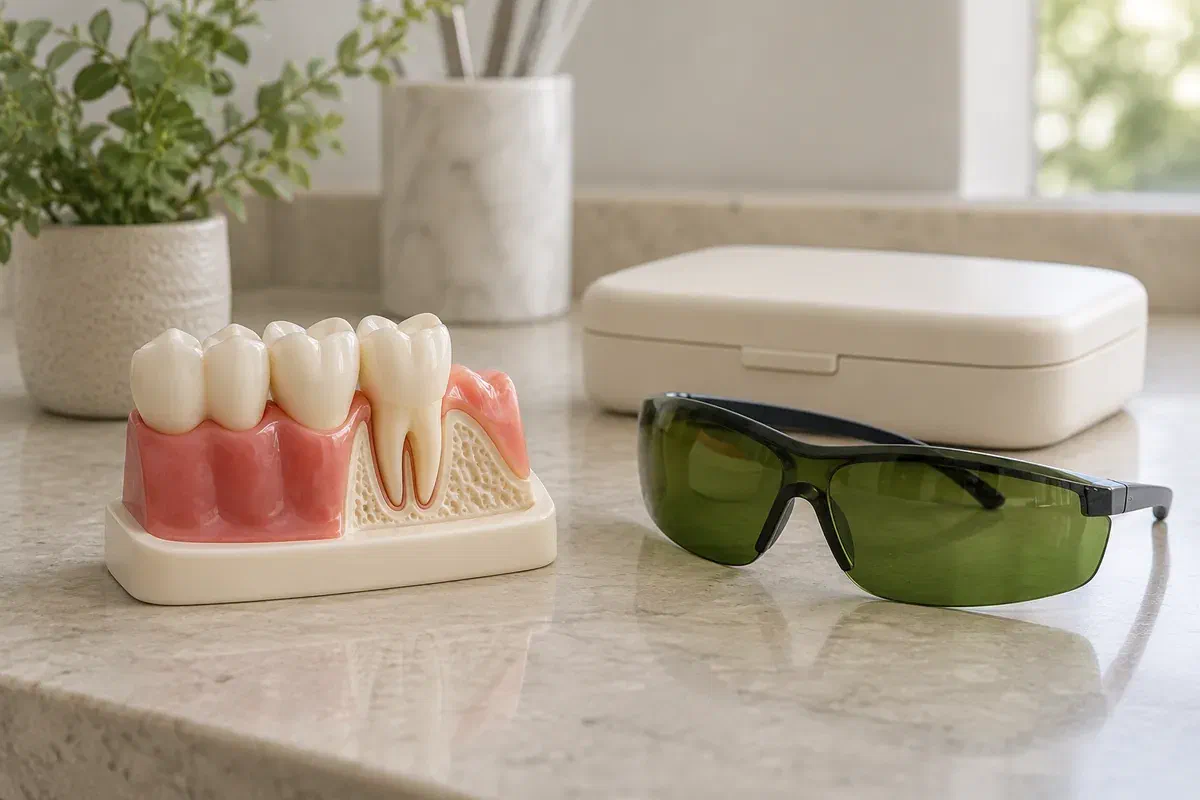
Illustrative gum model, protective eyewear, and a closed instrument case
What's prompting the visit

Pockets, lingering bleeding, or one stubborn spot?

The problem you bring sets the length of the plan. Periodontal disease, symptoms that never quite cleared, and a small local tissue issue each lead to different questions and different visit counts.

Pocket readings and a deep-cleaning proposal

Ask how many sites are involved and whether treatment will be split across appointments. If a laser is offered with the cleaning, find out what it contributes and how its effect would be measured later. The part you need should be clearly separated from the part that's optional.

Gums that still bleed after earlier care

Tell us what was done, what follow-up showed, and which areas are hard to reach when you're rushing through a morning routine. Continuing bleeding is worth a closer look at the cause, not an automatic laser referral or a repeat of the same cleaning.

A small soft-tissue procedure

Find out what the procedure is called and whether it removes, reshapes, or treats tissue another way. This is distinct from managing gum disease. Its purpose, alternatives, risks, and healing time, including any days of adjusted eating or cleaning, deserve a separate explanation.

A promise of fewer visits or advanced technology doesn't prove a procedure suits you. Ask how the recommendation flows from your examination and what plan you'd be offered without a laser.

Time saved, or benefit gained?

Ask what you'd gain, then count what it costs you.

Fewer chair hours is one possible benefit. Better gum health months from now is a different one. A device can accomplish a specific task during treatment without demonstrating improved periodontal results compared with sound conventional care. Ask which result you're aiming for and whether published research covers the very procedure you've been offered.

The trade-offs matter on a busy calendar. Cover comfort, freezing, the typical healing course, fees, the number and length of visits, and the other routes. A clear plan includes the follow-up and maintenance visits too, so you can book them realistically.

Patient information: American Academy of Periodontology — laser evidence, conventional care, and tissue-safety considerations · European Federation of Periodontology S3 guideline — evidence for adjunctive lasers in periodontitis care

A plan connected to your findings

The clinician should show which readings or areas are being treated and why the chosen approach fits. Talk of zapping bacteria won't account for every gum problem. Ask what the procedure won't fix as well as what it targets.

Conventional care in the comparison

Standard periodontal instrumentation belongs in the discussion, along with other options. Not all laser methods have outperformed it, and guidance does not support adding a laser to every periodontitis case. Ask why the addition is worth it for you.

Clarity on risk and logistics

Lasers require trained providers, suitable equipment, and safety precautions. Possible tissue injury, post-treatment tenderness, and risks tied to the technique are all fair topics. Confirm who would provide care, where, whether a periodontist should be involved, and how many appointments the full course needs.

What the visits look like

Four stages, booked to suit you

Asking about lasers won't lock you into one. Depending on what we find, the plan may involve conventional care, another procedure, monitoring, or a specialist referral.

  1. First visit: examination and history

    We cover symptoms, health, medications, and any past gum care, then examine the tissues and supporting structures as needed. By the end of this visit you should know the working diagnosis and whether extra records or images are worth getting before a method is picked.

  2. Talking through the procedure and options

    Get a plain description of the laser's job, and whether it sits on top of another treatment or takes its place. Review evidence, expected benefit, limits, fees, visit count, and referral. A known brand name shouldn't stand in for this explanation.

  3. Treatment day: consent and comfort

    If an indicated procedure is chosen and offered, the provider explains preparation, freezing, eye protection, and how the appointment will run. Ask how to signal a break. Safety steps depend on the device and technique, so there isn't one routine for all lasers.

  4. Review visit: measuring the response

    Aftercare instructions should match the treatment performed. Book the recheck before you leave, and ask which measurements will decide what happens next. If gum disease is involved, maintenance and daily cleaning continue past the first round.

Back to your routine

Recovery advice should fit your procedure.

Knowing a laser was used won't settle your toothbrush technique, your lunch, or how soon things feel normal. Those depend on what was treated, how extensively, and your overall health.

Sort out cleaning before you leave

Confirm which areas can be cleaned as usual and which need gentler care for now. If a rinse or product is recommended, ask what it does and how long to keep using it. Treated tissue doesn't stay sterile, so plaque removal remains a daily job.

Know when a call can't wait

Ask what soreness, sensitivity, swelling, or bleeding is normal. Phone the treating office about worsening symptoms, bleeding that won't stop, fever, or unexpected changes. Procedures described as minimally invasive can still need prompt follow-up, so keep the number handy at work.

Keep the review appointment

Success is judged against the goal set at the start, not by a glance in the mirror on day three. That appointment is where you'll hear whether more care is needed and what maintenance rhythm suits you. Feeling better quickly is not proof that gum disease is under lasting control.

Comparing routes

The best plan is the justified one.

Line each option up against your diagnosis and ask for the evidence behind anything added. Fold in likely results, uncertainty, cost, risks, time commitment, and the care that follows.

When standard nonsurgical care covers the need

Conventional gum treatment and a follow-up check

Careful instrumentation, home-care support, and a scheduled review may be the recommendation. You should know the sites involved and the yardstick for judging improvement. Going conventional is a sound clinical decision, not a lesser option.

When an indication and a reasonable gain are established

A laser-assisted step with a defined purpose

Ask which technique is proposed, why research suggests it suits a case like yours, and what further care it leaves in place. Confirm fees and availability ahead of time. Blanket claims of painless treatment, faster healing, regrown bone, or avoiding surgery are not a substitute for reasons that apply to you.

When complexity requires wider planning

Referral to a periodontist or another procedure

More advanced or persistent disease may need specialist input and a different approach. Ask what the referral should answer and how both offices will share information. Waiting on a laser appointment is never a good reason to put off care your gums need now.

Patient information: American Dental Association — nonsurgical periodontitis guideline and varying evidence for adjuncts

Busy-schedule questions

Planning gum care when time is tight

These answers keep the focus on the treatment rather than the gadget. Your own answer will hinge on the diagnosis and the procedure involved.

(905) 876-4488
Will a laser gum procedure mean fewer appointments overall?
Not necessarily. The number of visits depends on how many areas need care, whether treatment is staged, and when reassessment happens. Ask for the full sequence in writing so you can compare plans by their total commitment, not only the first visit.
Can I go back to work the same day after gum treatment?
Many people can, but it depends on the procedure, its extent, freezing, and how you feel afterward. Ask the treating provider what to expect and whether any activities should be limited. Plan a lighter afternoon if you’re unsure.
What can I eat after a laser-assisted gum procedure?
Ask for advice specific to the area treated. Some procedures call for softer foods or avoiding certain textures and temperatures for a while. The instructions come from the tissue and extent of treatment, not from the fact that a laser was used.
Is every laser gum treatment basically the same procedure?
No. Devices and techniques vary widely in purpose. Ask for the procedure’s name, the condition it treats, and whether it adds to or replaces standard cleaning. You’ll need those details before weighing benefits, risks, recovery, or cost.
Can I split gum treatment across several shorter visits?
Often, yes. Treatment is commonly divided by area, and scheduling can sometimes be arranged around your commitments. Ask whether splitting affects the plan, how reassessment would be timed, and which visits are essential.
Will I still need routine gum maintenance after laser care?
Yes, if periodontal disease was treated. Daily cleaning and periodic professional reviews remain necessary whatever technique was used. Ask how often maintenance should be booked and whether visits can line up with your other dental appointments.
Mississauga gum consultations

Tell us your schedule. We'll help shape a sensible plan.

Contact our Bronte Street practice to talk about what your gums are doing or a laser option someone raised. Bring past periodontal records or plans, and let us know your availability, so we can review the indication, options, and referral needs.

Whether a laser is available, appropriate, or likely to help is confirmed case by case, along with the equipment and protocol. Conventional treatment is not presented as inferior, and results are not guaranteed.

Visit Milton Dental Clinic
Unit 1, 342 Bronte St. S, Milton, ON L9T 5B7
Get directions Clinic hours
Monday–Thursday
11am–7pm
Friday–Sunday
By appointment only

Areas we serve

  • Milton
  • Oakville
  • Mississauga
  • Georgetown
  • Halton Hills
  • Acton
  • Campbellville
  • Brampton
  • Burlington
  • Puslinch
  • Rockwood
  • Erin
  • Caledon
  • Etobicoke
  • Old Milton
  • Bronte Meadows
  • Timberlea
  • Dorset Park
  • Dempsey
  • Clarke
  • Beaty
  • Coates
  • Harrison
  • Scott
  • Willmott
  • Ford
  • Bowes
  • Cobden
  • Walker
  • Mountain View
  • Milton Heights
  • Hawthorne Village
  • Valley View
  • Fallingbrook
  • Nassagaweya
  • Trafalgar
  • Esquesing
  • Nelson
  • Brookville
  • Moffat
  • Glen Williams
  • Norval
  • Limehouse
  • Stewarttown
  • Ashgrove
  • Hornby
  • Silver Creek
  • Speyside
  • Scotch Block
  • North Oakville
  • River Oaks
  • Glen Abbey
  • West Oak Trails
  • Palermo
  • Bronte Creek
  • College Park
  • Joshua Creek
  • Uptown Core
  • Preserve
  • Iroquois Ridge
  • Lisgar
  • Meadowvale
  • Meadowvale Village
  • Churchill Meadows
  • Erin Mills
  • Central Erin Mills
  • Streetsville
  • East Credit
  • Creditview
  • Heartland
  • Sheridan
  • Mount Pleasant
  • Credit Valley
  • Huttonville
  • Churchville
  • Springbrook
  • Northwest Brampton
  • Bram West
  • Fletcher's Meadow
  • Fletcher's Creek South
  • Alton Village
  • Orchard
  • Millcroft
  • Headon Forest
  • Tansley
  • Brant Hills
  • Tyandaga
  • Kilbride
  • Lowville
  • Aberfoyle
  • Morriston
  • Arkell
  • Hillsburgh
  • Freelton
  • Carlisle
  • Waterdown
  • Flamborough
  • Mountsberg

How can we help?

Milton Dental Clinic

Have a question about your smile? Choose the option that works best for you.

For urgent dental concerns, please call.
Messages are reviewed during clinic hours.