

Illustrative patient discussing gum-treatment options with a clinician and a dental model
Specialized Care

Laser Gum Treatment in Oakville

Holding a laser gum plan from another office and not sure what it means? From Oakville, you can bring it in for a second look. We go through the diagnosis behind it, what the laser would do, the evidence, the alternatives, and whether a periodontist should be consulted.

A second look for Oakville

What exactly does this treatment plan propose?

A printed estimate with the word laser on it raises fair questions. Which teeth? For what condition? Instead of, or on top of, a regular cleaning? Getting a second opinion is a normal step, and it starts by translating the plan into plain terms: the diagnosis, the procedure, and the reason one was chosen for the other.

The label laser gum treatment can describe quite different things, from managing periodontal pockets to trimming a small area of soft tissue. For gum disease, proven care means cleaning beneath the gumline, rechecking the response, and keeping up maintenance. A laser added to that is not automatically an improvement, and research findings differ between devices and methods.

If you're coming from Oakville, bring the plan, any X-rays or gum charts, and your questions. Our team can review the findings with you, explain reasonable options, and suggest a referral when it would help. We can't promise a particular device or branded protocol, and whether a laser procedure suits you, and who might perform it, needs individual confirmation.

Bring us a laser gum plan to review
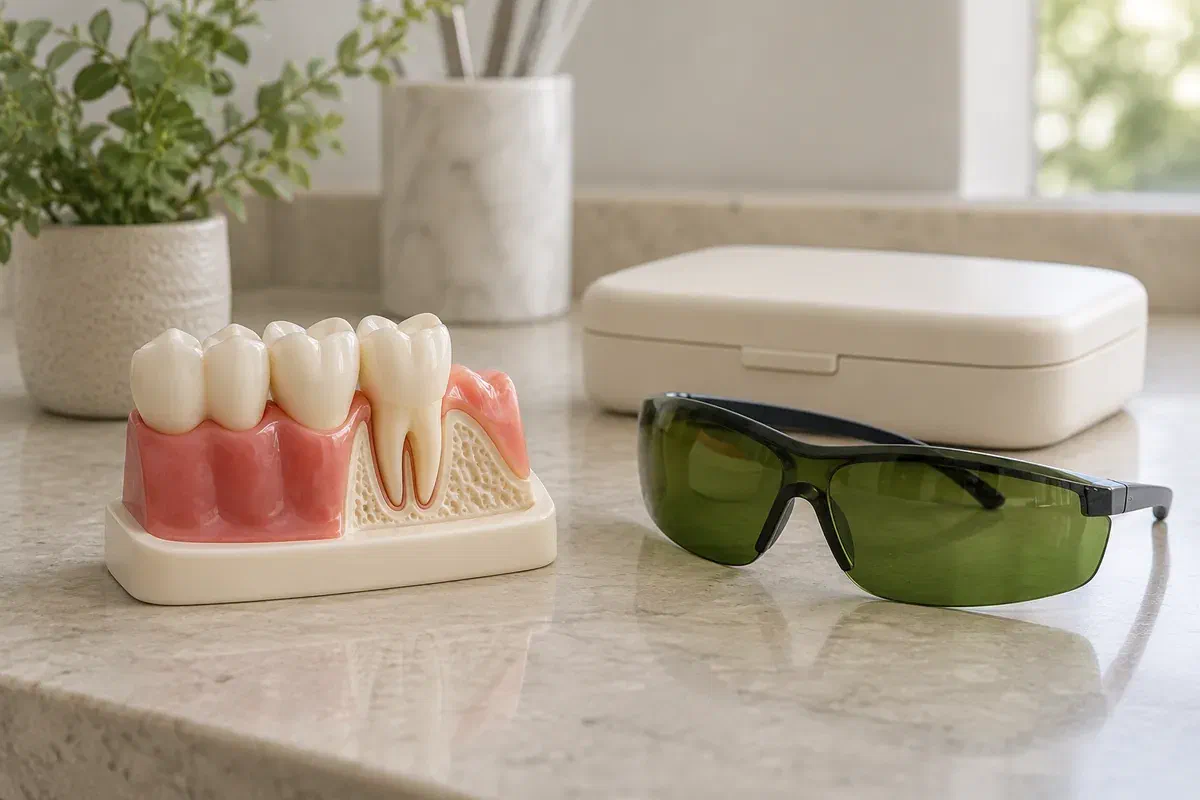
Illustrative gum model, protective eyewear, and a closed instrument case
Reading the plan

Three kinds of recommendation, three sets of questions

A plan might target periodontal disease, follow up on care that hasn't worked, or address one patch of tissue. Knowing which one you have makes the second opinion far more useful.

Deep cleaning with a laser line item added

Check which sites are listed and what readings support them. Ask the original office, or us, what the laser portion contributes beyond the cleaning and how that would be confirmed at review. You should be able to see which part is essential and which part is optional.

A new plan after earlier care didn't settle things

Gather notes from past treatment, follow-up results, and any trouble you have keeping certain areas clean. Ongoing bleeding or tenderness calls for a careful look at the cause. It does not by default mean a laser is needed, or that the same cleaning should simply be repeated.

A soft-tissue procedure described in laser terms

Ask what the procedure is properly called and whether it removes, reshapes, or otherwise treats tissue. A local procedure like this is not the same as gum-disease treatment. Its reasons, alternatives, risks, and recovery deserve a separate conversation.

Glossy images and device names on an estimate don't confirm that a procedure is right for you. Ask how each line of the plan follows from your examination, and what the plan would look like with the laser removed.

Testing the claim

Benefit on the day versus benefit over years

When reviewing someone else's plan, it helps to ask two separate things. What will the device do to the tissue during the appointment? And what difference is that expected to make to your gum health later on? The first can be true without the second being proven. Ask whether the evidence covers the exact procedure listed, for a condition like yours.

Practical details belong in the comparison too: comfort, freezing, the usual healing course, total fees, the number of visits, and the choices left out of the plan. A sound decision rests on understanding the full course of care, maintenance included.

Patient information: American Academy of Periodontology — laser evidence, conventional care, and tissue-safety considerations · European Federation of Periodontology S3 guideline — evidence for adjunctive lasers in periodontitis care

Findings that match the method

Ask to see which readings or areas the laser is meant for and why that method fits them. General statements about bacteria do not explain every gum problem. The explanation should include the limits of the procedure, not just its aims.

A fair comparison, not a sales pitch

Standard periodontal instrumentation and other options should be part of the conversation. Evidence does not show that all laser methods work better, and guidance does not recommend adding a laser to every periodontitis case. Ask what makes it worthwhile here.

Who, where, and with what safeguards

Laser treatment calls for training, suitable equipment, and safety precautions. Ask about tissue injury, postoperative soreness, and risks particular to the technique. Confirm who would treat you, at which location, and whether a periodontist should share in the planning.

How we review a plan

Examine, translate, compare, and agree on follow-up.

A second opinion doesn't steer you toward laser care or away from it. It may confirm the plan, suggest conventional care, propose another procedure, recommend monitoring, or point to a specialist.

  1. Examine your gums independently

    We ask about symptoms, health conditions, medicines, and prior gum care, then examine the tissues and supporting structures as needed. Ask whether our findings match the original diagnosis and whether updated records would help before comparing approaches.

  2. Translate the proposed procedure

    Go line by line: what would the laser do, and is it an extra step or a substitute? Discuss the evidence, likely benefit, limitations, fees, and possible referral. A brand name on the estimate should not take the place of that explanation.

  3. Understand the treatment day

    Should you go ahead with an indicated procedure that's available, the treating provider describes preparation, freezing, eye protection, and the sequence of the visit. Ask how to call a pause. Safety steps depend on the specific device and technique, not one protocol for every laser.

  4. Know how the result will be judged

    Aftercare should match what was actually done. Agree on when healing and response will be rechecked and which measurements will decide next steps. Where periodontal disease is involved, maintenance and daily cleaning carry on afterward.

Once the procedure is done

Aftercare depends on the tissue treated.

A laser label doesn't tell you how to clean, what to eat, or how long healing lasts. Those details come from the specific area, the amount of treatment, and your health.

Adjust cleaning only where you're told to

Find out which areas can be brushed and flossed normally and which need temporary care. If a rinse or product is prescribed, ask its purpose and how long to use it. The treated area does not stay sterile, so daily plaque removal remains essential.

Recognize when to phone the office

Ask what level of soreness, sensitivity, swelling, or bleeding to expect. Call the treating provider about worsening pain, bleeding that continues, fever, or unexpected changes in the tissue. A minimally invasive procedure can still need attention afterward.

Hold off on a verdict until reassessment

The real measure is the goal agreed at the start, not the appearance of your gums a few days later. Ask whether more treatment is planned and how often maintenance should occur. Short-term comfort does not confirm lasting control of periodontal disease.

Laying out the alternatives

Compare plans by their reasoning.

Ask which option your diagnosis supports and what evidence backs any added step. The comparison should include expected results, uncertainty, cost, risk, and the care required later.

When established nonsurgical care is enough

Conventional periodontal therapy, then a recheck

Careful instrumentation, coaching on home care, and a scheduled review may be the recommendation. Ask which sites will be treated and how the response will be assessed. Choosing conventional care is a legitimate clinical decision, not a sign that you missed out on newer equipment.

When there is a specific indication and a reasonable expected gain

Laser-assisted care chosen for a stated reason

Ask which technique is proposed, how its evidence relates to your condition, and what other care is still required. Confirm fees and availability before booking. Promises of painless care, quicker healing, regrown bone, or no future surgery are not a substitute for an explanation tailored to you.

When complexity calls for broader planning

Specialist assessment or a different procedure

Advanced or persistent disease may need a periodontist's input and another approach. Ask what the referral should clarify and how the advice will be coordinated. A laser shouldn't become a reason to postpone care that your diagnosis truly requires.

Patient information: American Dental Association — nonsurgical periodontitis guideline and varying evidence for adjuncts

Second-opinion questions

Before you sign the estimate

These questions help turn a technology-led estimate into a clear treatment discussion. Answers depend on your diagnosis and the specific procedure, not on the word laser.

(905) 876-4488
Is it okay to get a second opinion on a laser gum treatment plan?
Yes. A second opinion is a reasonable step before any significant treatment. Bring the plan, recent X-rays, and gum charts if you have them. A fresh examination can confirm the diagnosis, explain the proposed procedure, and show how it compares with other options.
What should I ask the office that recommended the laser?
Ask for the procedure’s name, the sites involved, the condition it treats, and whether it adds to or replaces standard cleaning. Ask what benefit they expect and how it will be measured. Written answers make it easier to compare advice.
Does a laser make scaling and root planing work better?
It depends on the method, and it cannot be assumed for every case. Ask what improvement is expected beyond appropriate conventional care and how strong the evidence is for that specific procedure. Extra technology is not the same as a clinical reason.
Why might two dentists recommend different gum treatments?
Findings, interpretation, available equipment, and experience can all differ. That’s why it helps to compare the reasoning, not just the procedure names. Ask each clinician what they found, why they chose their approach, and what would happen if you chose the other one.
Do I need freezing for laser gum work?
Not necessarily, and not necessarily not. Comfort arrangements depend on the procedure and how much is treated. Ask what will be done, whether anaesthetic is planned, what you’ll likely feel afterward, and whether cleaning or activities need adjusting for a while.
If I decline the laser part, can I still have the rest of the treatment?
Often, yes. Ask what the plan would look like without the laser component and how the options differ in evidence, cost, risk, and follow-up. You should understand the purpose of every step before deciding, including whether a specialist opinion would help.
Oakville second opinions

Get clarity before committing.

Contact our Bronte Street practice to review your gum findings or a laser plan from another office. Bring the estimate, X-rays, and periodontal records so we can look at the reasons for care, the alternatives, and whether referral is needed.

Each person's suitability, the laser equipment and protocol, availability, and expected benefit must be confirmed individually. We do not claim superiority over conventional treatment or guarantee any result.

Visit Milton Dental Clinic
Unit 1, 342 Bronte St. S, Milton, ON L9T 5B7
Get directions Clinic hours
Monday–Thursday
11am–7pm
Friday–Sunday
By appointment only

Areas we serve

  • Milton
  • Oakville
  • Mississauga
  • Georgetown
  • Halton Hills
  • Acton
  • Campbellville
  • Brampton
  • Burlington
  • Puslinch
  • Rockwood
  • Erin
  • Caledon
  • Etobicoke
  • Old Milton
  • Bronte Meadows
  • Timberlea
  • Dorset Park
  • Dempsey
  • Clarke
  • Beaty
  • Coates
  • Harrison
  • Scott
  • Willmott
  • Ford
  • Bowes
  • Cobden
  • Walker
  • Mountain View
  • Milton Heights
  • Hawthorne Village
  • Valley View
  • Fallingbrook
  • Nassagaweya
  • Trafalgar
  • Esquesing
  • Nelson
  • Brookville
  • Moffat
  • Glen Williams
  • Norval
  • Limehouse
  • Stewarttown
  • Ashgrove
  • Hornby
  • Silver Creek
  • Speyside
  • Scotch Block
  • North Oakville
  • River Oaks
  • Glen Abbey
  • West Oak Trails
  • Palermo
  • Bronte Creek
  • College Park
  • Joshua Creek
  • Uptown Core
  • Preserve
  • Iroquois Ridge
  • Lisgar
  • Meadowvale
  • Meadowvale Village
  • Churchill Meadows
  • Erin Mills
  • Central Erin Mills
  • Streetsville
  • East Credit
  • Creditview
  • Heartland
  • Sheridan
  • Mount Pleasant
  • Credit Valley
  • Huttonville
  • Churchville
  • Springbrook
  • Northwest Brampton
  • Bram West
  • Fletcher's Meadow
  • Fletcher's Creek South
  • Alton Village
  • Orchard
  • Millcroft
  • Headon Forest
  • Tansley
  • Brant Hills
  • Tyandaga
  • Kilbride
  • Lowville
  • Aberfoyle
  • Morriston
  • Arkell
  • Hillsburgh
  • Freelton
  • Carlisle
  • Waterdown
  • Flamborough
  • Mountsberg

How can we help?

Milton Dental Clinic

Have a question about your smile? Choose the option that works best for you.

For urgent dental concerns, please call.
Messages are reviewed during clinic hours.