

Illustrative patient discussing gum-treatment options with a clinician and a dental model
Specialized Care

Laser Gum Treatment in Old Milton

Years of gum history, and now someone has mentioned a laser? From Old Milton, bring that history with you. We review what has changed, what the proposed laser step is meant to do, how it compares with proven periodontal care, and when a specialist should weigh in.

Old Milton gum care, long view

Your gum story started long before the word laser came up.

Plenty of adults carry a long dental record: a deep cleaning a decade ago, some recession, a tooth that has always needed watching. When a laser is suggested now, it can feel like a fresh start. Really, it is one possible tool among many, and its value depends on what your gums are doing today.

Laser gum treatment does not describe a single procedure. Devices differ, techniques differ, and so do the reasons for using them. For periodontal disease, the benchmark remains careful cleaning below the gumline followed by reassessment and ongoing maintenance. Evidence for adding a laser is mixed and varies by method, so the expected gain needs to be spelled out.

Our Bronte Street practice sits close to Old Milton's historic downtown, and you are welcome to bring old charts, X-rays, or a plan you received elsewhere. We can go over your current findings, your options, and whether referral makes sense. Suitability, technique, and who could provide any laser procedure must be confirmed; no specific device or branded protocol is promised.

Review your gum history with us
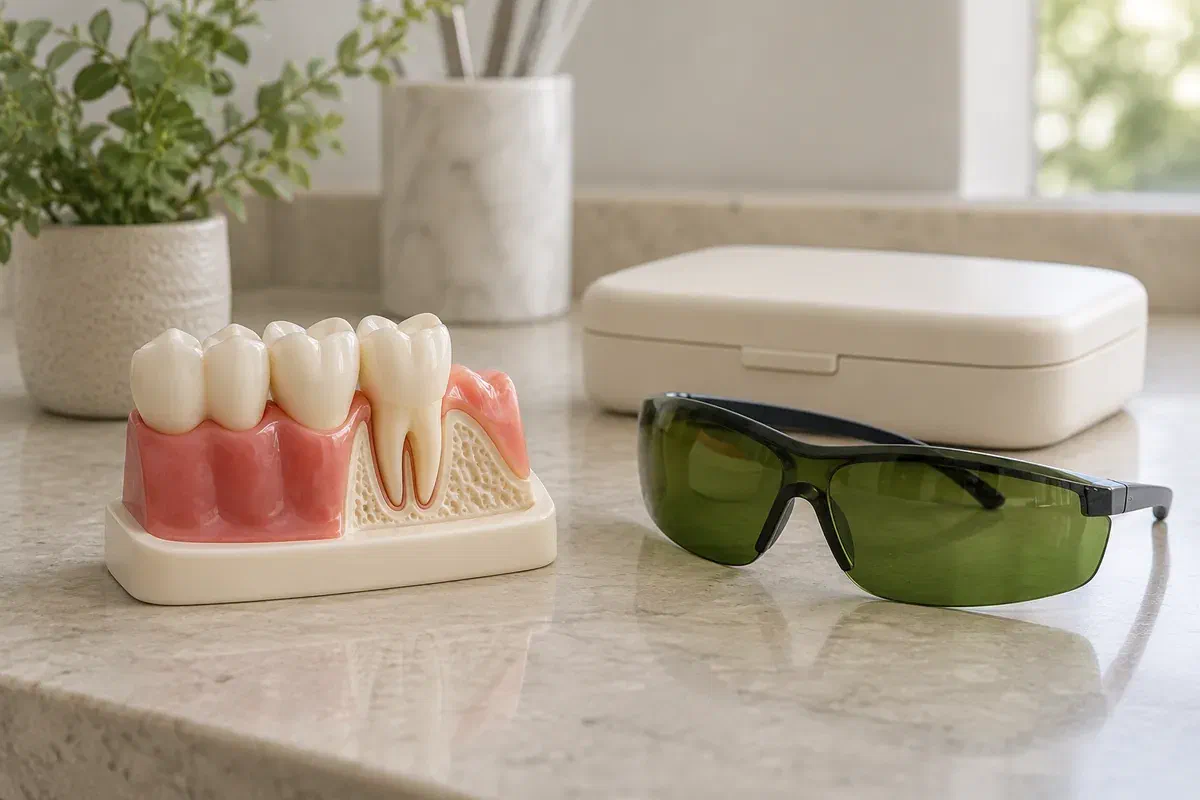
Illustrative gum model, protective eyewear, and a closed instrument case
Where things stand now

Is this an old problem, a new one, or a plan you were handed?

Let us know if gum disease was treated before, if symptoms have returned, if one area of tissue is bothering you, or if another office has recommended laser care. Each situation leads to different questions.

Gum disease that was treated once and is being watched again

Ask which sites have changed since earlier records and what the current measurements show. If a laser is proposed with another round of cleaning, find out what it is expected to contribute and how that would be checked. Keep the necessary care distinct from anything optional.

Old symptoms that have crept back

Describe what was done in the past, how your gums responded, and where home cleaning has become harder, perhaps around crowns, bridges, or receding gums. Returning bleeding deserves a fresh look at why. It does not prove a laser is the missing piece.

A small tissue procedure labelled as laser care

Ask for the real name of the procedure and its purpose: is tissue being removed, recontoured, or treated some other way? This is a separate matter from managing periodontal disease, and it needs its own explanation of reasons, alternatives, risks, and healing time.

A long list of past treatment, a polished brochure, or the promise of new technology does not show that a procedure is right for you. Ask how the advice follows from today's examination and what would be suggested without a laser.

Sizing up the benefit

Measured against your history, what would change?

With a long record, it becomes easier to compare. Were earlier results stable? Which teeth slipped? A good discussion separates the immediate effect of a device on tissue from the long-term health of your gums. A laser can do a particular job without improving outcomes over sound conventional treatment, so ask whether the research covers the exact procedure suggested.

Then weigh the practical side. Talk through comfort, freezing, the usual healing course, fees, extra appointments, and other routes. You should walk away knowing the full shape of care, maintenance included, rather than only the first visit.

Patient information: American Academy of Periodontology — laser evidence, conventional care, and tissue-safety considerations · European Federation of Periodontology S3 guideline — evidence for adjunctive lasers in periodontitis care

A link between findings and method

The clinician should show which readings or areas are the target and why this approach suits them. A general claim about bacteria will not explain every gum problem. You should also hear what the procedure is not expected to resolve.

A balanced look at conventional care

Discuss standard periodontal instrumentation and other reasonable options. Not every laser method has been shown to work better, and guidance does not support adding a laser to every case of periodontitis. Ask what makes it worthwhile in your mouth, given your history.

Openness about risks and arrangements

Lasers require proper training, the right device, and safety measures. Ask about possible tissue injury, soreness afterward, and risks particular to the technique. Confirm who would do the work, where, and whether a periodontist should be involved, especially if earlier care was specialist-led.

Step by step

Compare then and now before choosing anything

A conversation about laser care can end in many places: conventional treatment, a different procedure, monitoring for a while, or a periodontist's advice.

  1. Set today's findings beside your records

    We go over symptoms, health changes, medications, and the gum care you've had over the years. The gums and supporting bone are examined as appropriate. Ask what the diagnosis is now and whether older X-rays or new ones are needed before methods are compared.

  2. Clarify what the laser is for, and what else exists

    Find out whether the laser would add to another treatment or stand in for one, and what it would actually do. Review the evidence, expected benefit, limits, fees, and any referral. A well-known brand name is no replacement for that explanation.

  3. Settle consent, comfort, and protection

    If a suitable procedure is chosen and available, the provider explains preparation, freezing, protective eyewear, and how the appointment will run. Ask how to signal for a break. Safety requirements follow the specific device and technique, not one standard routine for all lasers.

  4. Go home with instructions and a check-in date

    Aftercare should fit the tissue procedure or gum treatment done. Agree on when healing and response will be reviewed and which findings will guide what follows. With periodontal disease, maintenance and daily cleaning continue to matter after the first treatment.

The weeks after

Let the treated tissue, not the technology, set the rules.

Knowing a laser was involved won't tell you how to brush, what to eat, or how quickly things settle. Those answers depend on the area treated, how extensive the care was, and your overall health.

Ask how to clean around treated spots

Confirm which areas you can clean as usual and which need a softer touch for a while, including around bridges or implants. If a rinse is suggested, ask what it's for and how long to use it. A treated site is not permanently free of bacteria, and plaque control still counts.

Know which symptoms are expected

Ask what soreness, sensitivity, swelling, or bleeding is normal, and which signs mean you should call. Contact the treating office if symptoms worsen, bleeding persists, you run a fever, or the tissue looks unexpectedly different. Even gentle procedures can need follow-up.

Judge results at the review, not the mirror

Progress should be assessed against the goal agreed beforehand, not only by how the gums appear soon after. Ask whether more care is likely and how often maintenance should happen. A quick improvement in comfort does not mean gum disease is permanently controlled.

Options worth comparing

Weigh the whole course of care, not just the equipment.

Ask which choice your diagnosis supports and what evidence stands behind any added step. Cover expected results, what remains uncertain, cost, risks, and the care you'll need later.

When established nonsurgical care meets the need

Conventional periodontal treatment and a planned review

Thorough instrumentation, help with home cleaning, and a scheduled recheck may be the advice. Ask which areas will be treated and how progress will be measured. Choosing this route is a reasoned clinical decision and doesn't imply newer equipment was required for good management.

When a clear indication and realistic benefit have been shown

A laser-assisted procedure with a specific justification

Ask what technique is planned, how the evidence relates to your condition, and which other treatment still has to happen. Confirm fees and availability first. General promises of no pain, faster healing, regrown bone, or avoiding future surgery should not replace a personal explanation.

When the disease or tissue issue needs broader planning

A periodontist's review or another procedure

Long-standing or advanced disease may call for a specialist and a different approach. Ask what the referral should answer and how advice will be shared with your regular dentist. A laser should not become a reason to delay care your gums actually need.

Patient information: American Dental Association — nonsurgical periodontitis guideline and varying evidence for adjuncts

Old Milton questions

What long-time patients tend to ask

These answers help shift attention from the equipment to the treatment plan. What fits you depends on your diagnosis and the procedure involved, not on the label.

(905) 876-4488
I had deep cleanings years ago. Does that make me a candidate for laser treatment now?
Not by itself. Past treatment tells us where to look, but the decision depends on what your gums show today. Ask how current findings compare with earlier records and whether conventional care, a laser step, or a specialist opinion fits that comparison best.
Can laser treatment reverse gum recession?
Recession is a different problem from inflamed pockets, and a laser is not a general fix for it. Some recession is monitored, and some is treated with other procedures, often by a periodontist. Ask what is causing yours and which options are realistic.
Will a laser regrow the bone I've lost over the years?
That should not be assumed. Any claim about regeneration needs evidence for your condition and the exact procedure. Ask what tissue changes are realistically expected, how they would be measured, and why an early improvement in how the gums look is not the same as restored bone.
Is it safe to have gum treatment around crowns, bridges, or implants?
Often care can be planned around existing work, but the approach depends on what is there and its condition. Mention every crown, bridge, and implant. Ask how the treated areas will be cleaned afterward and whether any restorations affect the choice of method.
How do I know a laser procedure isn't just a newer way to charge more?
Ask the clinician to explain what the laser step adds over conventional care for your findings, and what the evidence says for that exact procedure. Ask for a written plan with fees for each option. A clear reason, not novelty, should justify any addition.
After treatment, will my gum maintenance schedule change?
It might, but maintenance does not disappear. The interval depends on how your gums respond and your risk factors. Ask what schedule is recommended, which sites will be watched, and what changes would prompt an earlier visit.
Visit from Old Milton

Bring the history. We'll help you read the plan.

Reach our Bronte Street practice to talk over your gum findings or a laser procedure someone has recommended. Earlier periodontal charts, X-rays, or treatment plans help us review the reasons for care, the alternatives, and any need for referral.

Laser equipment, protocols, availability, suitability, and expected benefit must be confirmed for each patient. We make no claim that laser care outperforms conventional treatment and offer no guaranteed outcome.

Visit Milton Dental Clinic
Unit 1, 342 Bronte St. S, Milton, ON L9T 5B7
Get directions Clinic hours
Monday–Thursday
11am–7pm
Friday–Sunday
By appointment only

Areas we serve

  • Milton
  • Oakville
  • Mississauga
  • Georgetown
  • Halton Hills
  • Acton
  • Campbellville
  • Brampton
  • Burlington
  • Puslinch
  • Rockwood
  • Erin
  • Caledon
  • Etobicoke
  • Old Milton
  • Bronte Meadows
  • Timberlea
  • Dorset Park
  • Dempsey
  • Clarke
  • Beaty
  • Coates
  • Harrison
  • Scott
  • Willmott
  • Ford
  • Bowes
  • Cobden
  • Walker
  • Mountain View
  • Milton Heights
  • Hawthorne Village
  • Valley View
  • Fallingbrook
  • Nassagaweya
  • Trafalgar
  • Esquesing
  • Nelson
  • Brookville
  • Moffat
  • Glen Williams
  • Norval
  • Limehouse
  • Stewarttown
  • Ashgrove
  • Hornby
  • Silver Creek
  • Speyside
  • Scotch Block
  • North Oakville
  • River Oaks
  • Glen Abbey
  • West Oak Trails
  • Palermo
  • Bronte Creek
  • College Park
  • Joshua Creek
  • Uptown Core
  • Preserve
  • Iroquois Ridge
  • Lisgar
  • Meadowvale
  • Meadowvale Village
  • Churchill Meadows
  • Erin Mills
  • Central Erin Mills
  • Streetsville
  • East Credit
  • Creditview
  • Heartland
  • Sheridan
  • Mount Pleasant
  • Credit Valley
  • Huttonville
  • Churchville
  • Springbrook
  • Northwest Brampton
  • Bram West
  • Fletcher's Meadow
  • Fletcher's Creek South
  • Alton Village
  • Orchard
  • Millcroft
  • Headon Forest
  • Tansley
  • Brant Hills
  • Tyandaga
  • Kilbride
  • Lowville
  • Aberfoyle
  • Morriston
  • Arkell
  • Hillsburgh
  • Freelton
  • Carlisle
  • Waterdown
  • Flamborough
  • Mountsberg

How can we help?

Milton Dental Clinic

Have a question about your smile? Choose the option that works best for you.

For urgent dental concerns, please call.
Messages are reviewed during clinic hours.