

Illustrative patient discussing restricted jaw movement with a dental clinician
Specialized Care

Limited Jaw Opening Assessment

When your jaw no longer opens as comfortably as usual, everyday tasks can become difficult. Our Milton team can assess the restriction, discuss possible causes, and explain whether dental care, conservative management, or another assessment is appropriate.

A closer look at limited jaw opening

Understand the restriction before trying to stretch through it.

Limited jaw opening describes a change in movement, not a diagnosis by itself. You might notice that a toothbrush no longer reaches comfortably, that meals require smaller bites, or that the jaw seems to stop before it normally would. Explaining those changes helps the dentist understand how the restriction affects your daily life.

The assessment considers when the problem began, whether pain or a catching sensation accompanies it, and what happened beforehand. A sudden change after an injury needs a different conversation from gradually increasing stiffness. Dental infection, jaw muscle or joint problems, and a history of medical treatment can also influence the investigation and the appropriate setting for care.

At Milton Dental Clinic, the aim is to establish a useful starting point and a clear plan. You do not need to prove how far you can force your mouth open. Tell us what feels comfortable, what has changed, and whether eating, drinking, or cleaning your teeth has become difficult.

Discuss a change in jaw opening
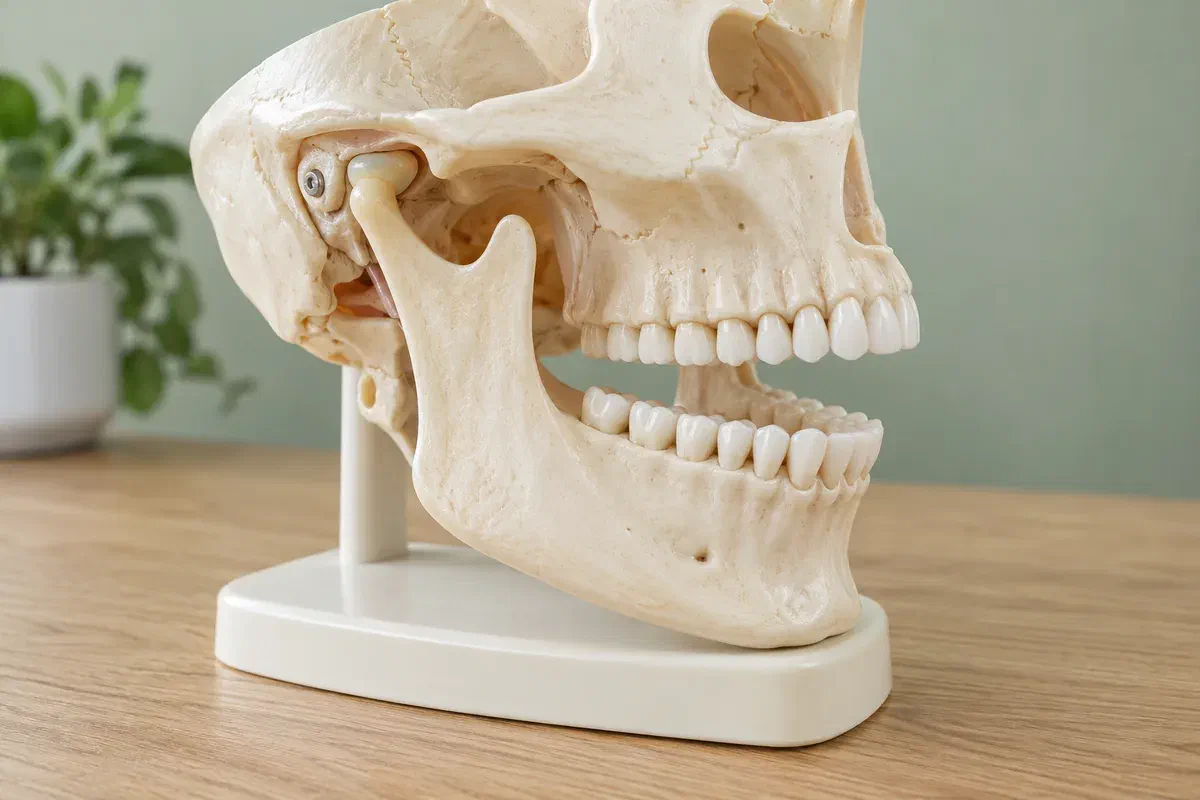
Illustrative physical teaching model showing the jaw and its supporting joint
Changes worth describing

The timing and effect of the restriction matter as much as the opening itself.

Give the team a practical picture of the problem when you call. Mention a sudden deterioration or associated swelling immediately, rather than waiting to discuss it at a routine appointment.

A new limit, catch, or locking episode

Explain whether movement stops suddenly, feels stiff throughout, or changes from one attempt to another. Mention whether the jaw has become stuck open or closed and how long that lasted. Do not repeatedly reproduce a painful catch simply to demonstrate that it exists.

Difficulty with eating, drinking, or oral hygiene

Describe which everyday activities are affected and whether you can maintain fluids and meals. A restriction that prevents drinking or makes normal care impossible needs prompt advice. Practical examples also help the clinician plan an examination that respects your current range of movement.

A relevant injury, infection, or treatment history

Tell us about recent dental procedures, facial injury, swelling, or earlier jaw problems. Also mention head and neck surgery or radiotherapy when relevant. These details can change the questions that need answering and whether another member of your healthcare team should be involved.

Seek urgent assessment for new severe restriction, a locked jaw, or difficulty eating or drinking. Trouble breathing or swallowing, rapidly spreading swelling, or swelling affecting the eye requires emergency medical care; call 911 for an immediate emergency.

What an assessment can establish

Create a baseline that connects movement, symptoms, and daily function.

A measurement can help document the examination, but it is only one part of the picture. Ask how your history and findings fit together and whether the clinician has identified a likely cause. If uncertainty remains, the plan should describe what information would help resolve it rather than rely on a number alone.

The appointment is also an opportunity to discuss how dental care can be made manageable while movement is restricted. Explain what position or activity causes difficulty and agree on a stop signal. If a complete examination is not possible, ask what can be assessed safely and how the remaining questions will be addressed.

Patient information: NIDCR — assessment and management of temporomandibular disorders

A comfortable assessment of movement

The dentist can observe and document opening while listening to your description of pain or resistance. Tell the clinician when you reach your comfortable limit. The purpose is to understand the pattern, not to make you compete with a target or force movement through significant discomfort.

Attention to possible causes outside the joint

The examination may include teeth, gums, muscles, and other relevant areas. Ask which findings support the proposed explanation and whether further investigation is needed. Calling every restriction a jaw joint problem can overlook another condition that requires a different response.

A review that measures useful improvement

Discuss what progress would look like for you, such as easier brushing or more comfortable meals. Agree on when to review the problem and which changes should prompt earlier contact. A plan is easier to follow when its purpose and limits are clear from the beginning.

How the visit develops

Start with your experience, then examine what can be assessed comfortably.

You can explain the restriction without repeatedly showing the most painful movement. Tell the team beforehand if opening for an examination is difficult so the appointment can be approached thoughtfully.

  1. Trace the onset and relevant health history

    Describe whether the restriction began suddenly or gradually and whether it is improving, worsening, or fluctuating. Review injuries, recent treatment, medicines, and medical history. Bring relevant records or contact details for another treating team if these may help explain the change.

  2. Observe movement and examine related areas

    The clinician assesses what your jaw can do comfortably and looks for findings related to the complaint. Explain where you feel symptoms and whether they match your usual experience. Pauses and adjustments may be needed; an incomplete examination should be acknowledged rather than treated as a complete answer.

  3. Explain the working assessment and any investigation

    Discuss what appears likely and what remains uncertain. Images or referral are considered when they would help answer a clinical question. Ask what the proposed investigation could change and whether the problem needs dental, medical, or specialist assessment before a management programme begins.

  4. Agree on a manageable plan and review point

    Confirm any interim advice, the purpose of treatment, and how progress will be assessed. If exercises are recommended, ask for instructions suited to your diagnosis and circumstances. Establish who to contact if symptoms worsen or the plan makes movement more painful.

Between assessment and review

Protect comfortable function while the cause is being addressed.

Advice should follow the assessment. A routine designed for someone recovering from a particular operation may not suit a new unexplained restriction, even if both situations involve limited opening.

Avoid forcing a wider opening on your own

Do not use objects, aggressive stretching, or repeated painful movements to test your limit. If a clinician prescribes a movement programme, clarify its technique, frequency, and stopping rules. Contact them if it increases symptoms rather than adding more repetitions without guidance.

Keep track of function without constant testing

Note meaningful changes in meals, drinking, brushing, and comfort. A short record of when symptoms occur can be useful at review. You do not need to measure every opening or repeatedly provoke a lock; describe what happens during ordinary activities instead.

Ask for help when basic care becomes difficult

Explain if you cannot clean an area or maintain adequate food and fluids. The team can discuss appropriate adjustments or further assessment. Do not quietly postpone necessary care because you assume the opening must improve before anyone can help you plan around it.

Patient information: Guy's and St Thomas' — jaw opening advice after relevant medical treatment

Matching care to the findings

The reason for restricted movement determines the next step.

Ask what the proposed approach is intended to change and how its effect will be reviewed. Limited opening does not automatically justify an appliance, a procedure, or permanent changes to your bite.

When the examination finds a dental source

Care for an identified dental cause

A tooth or surrounding tissue problem may need treatment directed at that source. Discuss the urgency and whether the required care can be provided in the current setting. Improving movement alone would not resolve an underlying infection or another untreated dental condition.

When the findings support a muscle or joint approach

Conservative management with reassessment

An individually selected plan may include education and other reversible measures. Ask what to try first, what to avoid, and when to return. A gradual approach allows the response to be reviewed without assuming that an irreversible bite change is necessary.

When the history or persistent restriction needs wider input

Specialist or coordinated rehabilitation advice

A specialist or your existing medical team may need to assess the problem, particularly after relevant surgery or radiotherapy. Ask who will coordinate care and which question the referral addresses. Rehabilitation instructions should be individualized rather than copied from another person's recovery plan.

Limited jaw opening questions

Prepare for an assessment without pushing your jaw further.

These answers explain what to discuss at the appointment. New severe restriction or difficulty maintaining food and fluids needs prompt advice rather than a routine online request alone.

(905) 876-4488
Should I force my mouth wider before a limited jaw opening assessment?
No. Explain your comfortable range and what happens when movement becomes difficult. Repeatedly forcing the jaw is not necessary to prepare for the appointment. The clinician can discuss an appropriate examination and whether a supervised movement programme is suitable after assessment.
Does a smaller opening measurement identify the cause by itself?
No. The measurement needs to be considered with the symptom history, examination, and relevant health information. Ask what the combined findings suggest and whether further investigation is needed. A single number cannot explain every reason for restricted movement.
Can I still request dental care if I cannot open very far?
Yes. Tell the team about the limitation before the appointment and describe any difficulty with eating or cleaning. They can discuss how to approach assessment and whether another setting is needed. Do not assume that all dental care must wait indefinitely.
Should I mention previous head and neck radiotherapy when my jaw feels restricted?
Yes. Relevant surgery and radiotherapy can affect planning, even when treatment occurred earlier. Bring details of the treating team if available. The dentist may recommend coordination with that team rather than treating the restriction as an isolated routine jaw complaint.
Is a jaw that suddenly locks the same as occasional painless clicking?
No. Describe a new lock or significant loss of movement promptly, including whether you can eat and drink. Painless clicking without restricted function is a different presentation. The urgency and assessment should reflect what is actually happening to your movement.
How will we judge progress after a limited jaw opening assessment?
Agree on a review that considers symptoms, movement, and everyday function. Easier meals or brushing may be useful changes to report alongside examination findings. Ask what would trigger an earlier review and whether persistent restriction would require further investigation or referral.
Limited jaw opening assessment in Milton

Tell us how your movement has changed and what it is making difficult.

Call our Bronte Street practice at (905) 876-4488 to discuss an assessment. Mention sudden locking, swelling, an injury, or difficulty eating and drinking so the team understands the urgency when helping you plan the next step.

The cause, recommended care, need for referral, and recovery vary. Online requests are for non-urgent enquiries and do not replace urgent assessment when symptoms are severe or worsening.

Visit Milton Dental Clinic
Unit 1, 342 Bronte St. S, Milton, ON L9T 5B7
Get directions Clinic hours
Monday–Thursday
11am–7pm
Friday–Sunday
By appointment only

How can we help?

Milton Dental Clinic

Have a question about your smile? Choose the option that works best for you.

For urgent dental concerns, please call.
Messages are reviewed during clinic hours.