

Illustrative patient discussing restricted jaw movement with a dental clinician
Specialized Care

Limited Jaw Opening Assessment in Milton

When your jaw stops short at breakfast or catches mid-yawn is worth a proper look. Our Milton team examines the restriction gently, talks through what may be behind it, and explains which kind of care, if any, fits what we find.

When opening feels shorter than it should

Notice the change first. Work out the reason second.

Most people first notice it during something ordinary. A forkful of food that used to fit now needs cutting smaller. A yawn halts partway. Brushing the back molars suddenly feels awkward. Restricted opening is a description of what your jaw is doing rather than a diagnosis, and those small daily examples are exactly what helps the dentist understand it.

Several quite different problems can produce the same symptom. An infected tooth, tight or sore chewing muscles, a jaw joint that has started catching, a recent knock to the face, or past medical treatment around the head and neck can each limit movement. How quickly the change arrived, and whether pain or swelling came with it, points the conversation in the right direction.

Since you’re already here in Milton, it is easy to call early instead of waiting to see whether things settle. You won’t be asked to prove how wide you can open. We simply want to hear what feels comfortable, what has changed and whether meals, drinks or cleaning have become harder.

Talk to us about your jaw movement
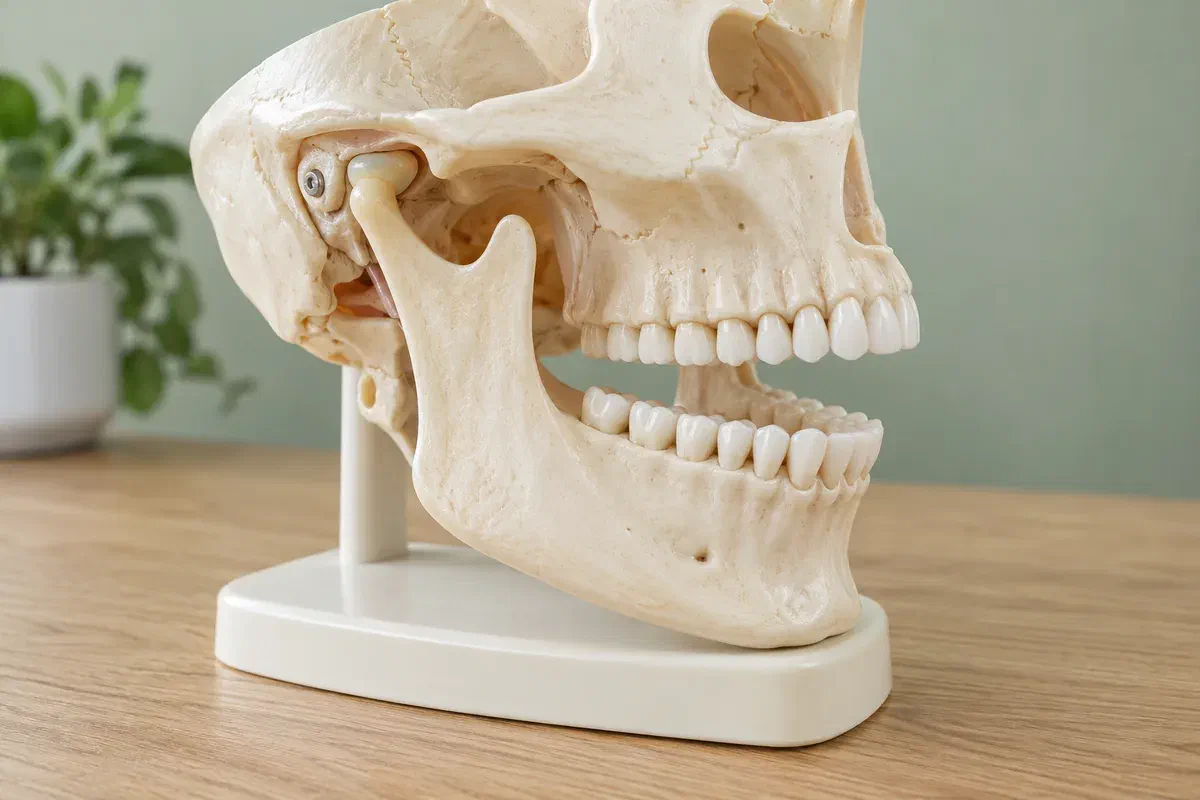
Illustrative physical teaching model showing the jaw and its supporting joint
What to tell us when you call

How the restriction started says a lot about what to do next.

A short phone description helps the team judge timing. If opening has worsened suddenly or there is swelling, say so straight away instead of saving it for a future checkup.

Catching, sticking or locking

Describe the feel of it: a firm stop at one point, general stiffness, or movement that varies through the day. Tell us if the jaw has ever stuck open or shut and for how long. There is no need to keep triggering a painful catch just to show it happens.

Meals, drinks and brushing that have become harder

Explain which routines are affected and whether you are managing enough fluids and food. A restriction that stops you drinking or keeping your teeth clean calls for prompt advice. Everyday examples also let the clinician plan an exam that stays within your present range.

Recent treatment, injury or swelling

Mention any recent dental work, a blow to the face, swelling, or earlier jaw trouble. Previous head and neck surgery or radiotherapy is important too. Details like these shape the questions to be answered and whether someone else involved in your health care should be consulted.

A jaw that has locked, a sudden severe loss of opening, or being unable to eat or drink needs urgent assessment. If swallowing or breathing is affected, swelling is spreading fast or has reached the eye, get emergency medical help and call 911 when it cannot wait.

What you leave with

A starting picture that links movement, symptoms and daily life.

The dentist may record how far you open, yet that figure is only one piece of evidence. Ask how it fits with your history and the rest of the examination, and whether a likely cause has emerged. Where some doubt remains, the plan should name what extra information would settle it instead of leaning on a single measurement.

This visit is also the time to work out how dental treatment can stay manageable while movement is limited. Let the clinician know which positions or actions bring on difficulty, and agree on a signal for stopping. If a full exam is not possible today, find out what can be checked safely and how the rest will be handled later.

Patient information: NIDCR — assessment and management of temporomandibular disorders

Movement checked within your comfort

The dentist watches and notes your opening while listening to how you describe pain or tightness. Say when you reach the edge of what feels comfortable. The goal is to understand the pattern of movement, not to hit a target or push through real discomfort.

A look beyond the joint itself

Teeth, gums, muscles and nearby tissues may all be examined. Ask which findings support the suggested explanation and whether more investigation would help. Assuming every restriction is a joint problem risks missing another condition that needs a different kind of care.

Progress measured in ways that matter to you

Talk about what improvement would mean day to day, perhaps easier brushing or meals that no longer need cutting small. Set a review date and agree which changes should bring you back sooner. A plan is easier to follow when its purpose and limits are clear.

Your appointment, step by step

We listen first and examine only as far as is comfortable.

You can describe the problem without repeating the movement that hurts most. If opening for an exam is difficult, mention it when booking so the visit can be planned with care.

  1. Talk through how it began and your health background

    Explain whether the change came on suddenly or slowly and whether it is easing, worsening or coming and going. We go over injuries, recent treatment, medicines and general health. Bring records or contact details for another treating team if they might help explain things.

  2. Watch the movement and check nearby structures

    The clinician sees what your jaw manages comfortably and looks for signs linked to your complaint. Point out where you feel symptoms and whether they match your usual experience. Breaks and adjustments are fine; if parts of the exam cannot be done, that gap should be acknowledged openly.

  3. Share the working explanation and any tests

    You hear what seems most likely and what is still unclear. X-rays or a referral are suggested when they would answer a specific clinical question. Ask how a test could change the plan and whether dental, medical or specialist input is needed before any management begins.

  4. Settle on a plan and a time to review

    Confirm any short-term advice, what treatment is meant to achieve and how progress will be judged. If exercises are suggested, ask for instructions that suit your diagnosis. Know who to contact if symptoms get worse or the plan makes movement more painful.

Until your follow-up

Keep everyday function comfortable while the cause is sorted out.

Home advice should follow from the assessment. A routine meant for someone recovering from a specific operation may not suit a new, unexplained restriction, even though both involve limited opening.

Leave the stretching to a prescribed plan

Avoid wedging objects between your teeth, hard stretching or repeating painful movements to test the limit. If a clinician gives you a movement programme, check the technique, how often to do it and when to stop. Get in touch if it makes symptoms worse rather than simply doing more.

Notice function without testing all day

Jot down real changes in eating, drinking, brushing and comfort. A brief note of when symptoms show up is useful at review. You don’t need to measure every opening or keep provoking a lock; describing ordinary moments tells us more.

Speak up if basic care becomes hard

Let us know if you can’t clean an area or keep up with food and fluids. The team can talk through practical adjustments or further assessment. Don’t put off needed care on the assumption that your opening must improve before anyone can plan around it.

Patient information: Guy's and St Thomas' — jaw opening advice after relevant medical treatment

Care that follows the findings

What is causing the restriction decides the route forward.

Every recommendation should come with a reason and a way of telling whether it worked. A jaw that opens less than before is not, by itself, grounds for a night appliance, a procedure or reshaping how your teeth meet.

When a tooth or gum problem is found

Treating a dental source

An infected tooth or inflamed surrounding tissue may need treatment aimed directly at it. Discuss how urgent it is and whether it can be treated here. Getting the jaw moving better would not on its own clear an infection or another untreated dental problem.

When the findings point to muscles or the joint

Reversible muscle and joint care

Here the starting point is usually understanding what is going on, plus simple steps that can be undone if they don’t help. You should know which measure comes first, which habits to ease off and when you’re due back. Working gradually shows how you respond before anyone considers altering your bite.

When your history or ongoing restriction needs more input

Specialist or shared rehabilitation

Past operations or radiation treatment near the jaw, or a restriction that simply isn’t shifting, can call for a specialist or the doctors already caring for you. Be clear on who is coordinating and what the referral should find out. Rehabilitation advice should be tailored to you, not borrowed from someone else’s recovery.

Common questions from Milton

What people ask before a jaw opening assessment

These answers cover what to raise at your visit. A sudden severe restriction, or trouble keeping up with food and fluids, needs a phone call for prompt advice rather than an online request alone.

(905) 876-4488
My jaw only feels tight in the morning. Is that worth an appointment?
It can be. Morning stiffness that eases quickly may have a different cause from a restriction that lasts all day, so describe when it starts, how long it lasts and whether it is changing. If it is getting worse or affecting meals, call rather than waiting.
Do I have to open as wide as I can during the exam?
No. Tell the clinician where your comfortable range ends and what happens beyond it. Forcing the jaw is not part of preparing for or completing the assessment. Any supervised movement programme is considered only after the cause has been looked at.
Could a problem tooth be the reason I can’t open properly?
Sometimes. Infection or inflammation around a tooth, including a back tooth, can limit opening. That is one reason the exam looks at teeth and gums as well as the joint. Mention any toothache, swelling or a bad taste when you call.
What should I bring to the appointment?
A list of medicines, notes on when the restriction began, and any records from recent dental work or medical treatment are helpful. If another team has treated your head or neck, bring their contact details so coordination is easier.
Is the number recorded for my opening the whole answer?
No. A measurement is read alongside your symptoms, examination and health history. Ask what the combined findings suggest and whether anything else needs checking. One figure on its own cannot explain why movement is limited.
Can I see you quickly if my jaw locks again?
Call the clinic as soon as it happens and describe whether you can eat and drink. The team can advise on timing. If there is difficulty breathing or swallowing, or swelling spreading quickly, seek emergency medical care instead.
Jaw opening assessments in Milton

Describe the change, and we’ll help you plan from there.

Phone (905) 876-4488 to reach our Bronte Street practice about an assessment. Let us know about sudden locking, swelling, a recent injury or trouble eating and drinking, so the team can gauge urgency and suggest the right next step.

Causes, suitable care, the need for referral and recovery all differ from person to person. Online requests are for non-urgent questions and are not a substitute for urgent care when symptoms are severe or worsening.

Visit Milton Dental Clinic
Unit 1, 342 Bronte St. S, Milton, ON L9T 5B7
Get directions Clinic hours
Monday–Thursday
11am–7pm
Friday–Sunday
By appointment only

Areas we serve

  • Milton
  • Oakville
  • Mississauga
  • Georgetown
  • Halton Hills
  • Acton
  • Campbellville
  • Brampton
  • Burlington
  • Puslinch
  • Rockwood
  • Erin
  • Caledon
  • Etobicoke
  • Old Milton
  • Bronte Meadows
  • Timberlea
  • Dorset Park
  • Dempsey
  • Clarke
  • Beaty
  • Coates
  • Harrison
  • Scott
  • Willmott
  • Ford
  • Bowes
  • Cobden
  • Walker
  • Mountain View
  • Milton Heights
  • Hawthorne Village
  • Valley View
  • Fallingbrook
  • Nassagaweya
  • Trafalgar
  • Esquesing
  • Nelson
  • Brookville
  • Moffat
  • Glen Williams
  • Norval
  • Limehouse
  • Stewarttown
  • Ashgrove
  • Hornby
  • Silver Creek
  • Speyside
  • Scotch Block
  • North Oakville
  • River Oaks
  • Glen Abbey
  • West Oak Trails
  • Palermo
  • Bronte Creek
  • College Park
  • Joshua Creek
  • Uptown Core
  • Preserve
  • Iroquois Ridge
  • Lisgar
  • Meadowvale
  • Meadowvale Village
  • Churchill Meadows
  • Erin Mills
  • Central Erin Mills
  • Streetsville
  • East Credit
  • Creditview
  • Heartland
  • Sheridan
  • Mount Pleasant
  • Credit Valley
  • Huttonville
  • Churchville
  • Springbrook
  • Northwest Brampton
  • Bram West
  • Fletcher's Meadow
  • Fletcher's Creek South
  • Alton Village
  • Orchard
  • Millcroft
  • Headon Forest
  • Tansley
  • Brant Hills
  • Tyandaga
  • Kilbride
  • Lowville
  • Aberfoyle
  • Morriston
  • Arkell
  • Hillsburgh
  • Freelton
  • Carlisle
  • Waterdown
  • Flamborough
  • Mountsberg

How can we help?

Milton Dental Clinic

Have a question about your smile? Choose the option that works best for you.

For urgent dental concerns, please call.
Messages are reviewed during clinic hours.