

Illustrative patient discussing tooth support with a clinician and a dental teaching model
Specialized Care

Loose Adult Tooth Treatment in Campbellville

Out in the countryside, a dental trip often gets combined with errands, so it pays to arrive prepared. If a permanent tooth has started to move, a few notes about when and how will help our dentist examine it, check the gum and bone around it, and plan care for your Campbellville household.

Arriving with the right details

Jot it down before you head into town.

When you live rurally, it makes sense to bundle a dental visit with other trips and to get as much as possible from each one. A short written record of what you've noticed about a loose tooth does exactly that. Note the date you first felt it, what you were doing, and anything that happened just before. Leave out the daily wiggle check; it adds nothing and may disturb the tooth.

Those notes help the dentist think about causes. An adult tooth can loosen after a slip on the farm lane, a tumble on a trail or a bump from a gate. It can also loosen gradually as gum and bone support changes, through other dental conditions, or because a crown on it has come free. Pain isn't a reliable signal, so a comfortable tooth still deserves attention.

From Campbellville, start with a phone call. If there was an injury, timing matters, and the team will tell you how soon to come. If the change has been slow, you can usually plan a single, well-prepared appointment that covers the exam and the discussion of options.

Plan a loose tooth appointment
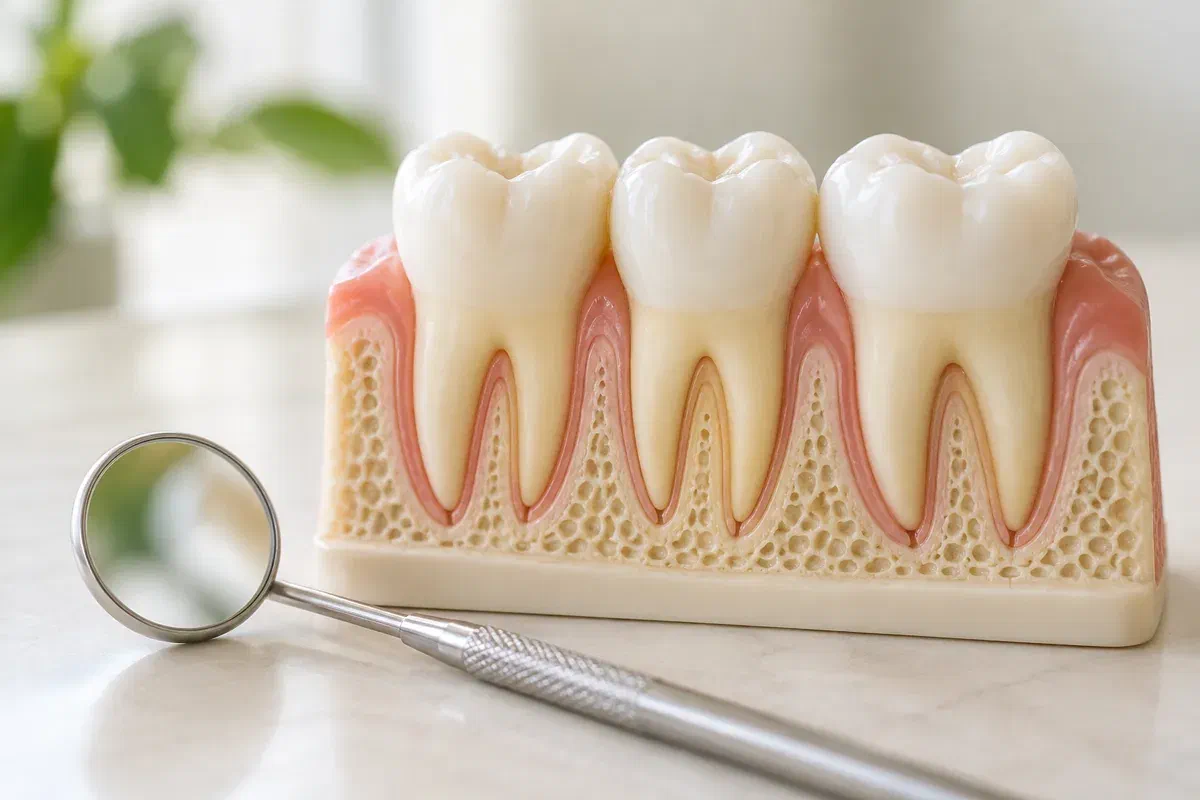
Illustrative cross-section teaching model showing teeth within gum and supporting bone
Notes worth bringing

A quick record turns a vague worry into useful information.

Some details change the urgency. A permanent tooth knocked loose or out of line by an accident should be seen promptly, so call first rather than waiting until your next planned trip.

If you were injured

Write down when and how it happened, whether the tooth looks out of place, and whether your teeth meet differently. Note cuts to the lip, swelling, or jaw pain. Other teeth near the impact may need checking as well, so mention any that feel tender.

If the change was gradual

Record any bleeding when you brush, gums that seem to be shrinking back, new gaps, or food catching in new places. Add any history of gum treatment. These notes guide the dentist toward the support around the root.

If there's dental work involved

Jot down any crowns, bridges or fillings in that part of your mouth, and roughly when they were done. Describe the feeling rather than prodding at it. If a piece comes off, keep it in a clean container and bring it; don't glue it back.

Call promptly about a loose or displaced permanent tooth after an injury. A tooth knocked completely out is a separate, time-critical emergency, so phone at once. A badly injured face, bleeding that keeps coming, or any struggle to breathe is a job for emergency services: dial 911.

Getting real answers

Come home knowing the cause, the support and the choices.

The dentist needs to see what's holding the tooth before saying whether it can be kept reliably. That means looking at the root and at the gum and bone around it. Ask which of the findings influence the outlook most and what remains unclear. If more tests or a specialist are suggested, ask what each should establish, and whether they can be lined up to save trips.

Ask too where short-term protection ends and treatment of the cause begins. Steadying a tooth may be right in certain circumstances, but it doesn't restore lost support or stop gum disease. Knowing what each step accomplishes helps you plan both care and travel.

Patient information: NIDCR — assessment and treatment of gum disease

The tissues around the tooth

Gums, supporting tissues and appropriate images are assessed along with the tooth. Your medical history and earlier gum care inform the reading of results. Ask whether this is a local issue or a reason to review your gum health more broadly.

Whether the tooth or the restoration moves

Dental work that has worked free is a different repair job from a natural tooth losing its grip. Find out which one you're dealing with and whether the tooth under any crown is still in good health. That tells you whether re-cementing alone would be sufficient.

A plain-spoken prognosis

Weigh up what each choice offers, where it falls short, what it costs and how much follow-up it needs. Keeping a tooth may involve ongoing care, and outcomes can't be guaranteed. Ask what could change the plan and how you'd hear about it.

Making the most of the visit

Your notes, our exam, one clear plan.

Tell the dentist about tenderness or any worry about losing the tooth. We'll explain what we find in plain language, so you can share in the decision with confidence.

  1. Go through your notes together

    We'll review when the movement started and whether an injury or treatment came first. Your notes on gum care, symptoms, medicines and health conditions save time. Records from previous dentists can show how the tooth has changed.

  2. Examine the tooth and its support

    Next comes the hands-on part. The dentist looks at the loose tooth and at anything close by that could account for the movement, and only takes the tests or images that the question calls for. When the root, bone or nerve is under investigation, have the results explained to you.

  3. Separate urgent care from planned care

    Injury damage sometimes can't wait, while slower causes usually lend themselves to a staged plan that you can fit around other trips. A splint, if offered, should come with an explanation of how long it stays and what treatment it bridges to. If losing the tooth is raised, hear exactly why saving it looks unlikely.

  4. Line up the reviews

    Agree on what each follow-up checks and when, plus any referral. Ask how to look after the area at home and what changes mean calling ahead. Booking review dates before you leave makes them easier to fit with other trips.

Back on the property

Easy habits at home, and a call if anything changes.

Home care for a knocked tooth looks different from home care for gum-related loosening or a lifting crown. The instructions you leave with are written for your situation, so use those instead of a neighbour's remedy.

Resist poking at it

Every nudge from your tongue or thumb unsettles the area a little. Keep tough foods away from that tooth, and take extra care during chores or outdoor work where you might knock your face. Home fixes, from pulling to gluing to tying, are off the table.

Learn how to keep any splint clean

Should you leave with a splint or new restoration, get a short lesson in the chair on brushing and cleaning around it. Say which corners are awkward for you. Splints create extra places for plaque to settle, so the routine needs to look after your gums as much as the device.

Phone before making the trip

If movement increases, your bite shifts, pain or swelling appears, or a splint loosens, call first so the team can advise how soon to come in. Don't remove a splint yourself. After an injury, keep the reviews even when things feel settled.

Options to consider

Treatment matched to the reason it moved.

Loose teeth are handled case by case. When a treatment is put forward, find out which finding it responds to, what it's meant to achieve, and roughly how many trips in it will take.

When periodontal disease is behind it

Gum care and maintenance

If periodontal disease turns up, you may be offered gum therapy and then maintenance at regular intervals. Get a clear sense of how much bone and gum support is left and what the care can do from here. It targets the disease itself; nobody can promise that each loose tooth will firm up.

When the injury warrants it

A splint after injury

Some injuries are best managed with a splint and a series of check-ups. Find out what other treatment might come with it and roughly when the splint will be taken off. Root canal treatment is a separate decision based on the nerve's condition.

When dental work or the outlook decides

Repair or removal

A crown or filling that has come loose may be redone when the tooth under it is still sound. Where the tooth itself has a poor outlook, taking it out and replacing it at a later stage might be talked through. Hear the reasons and the other routes before you settle on one.

Campbellville questions

Practical answers for rural households.

These answers are general, and your own exam has the final word. A tooth that starts moving is reason enough to ring, and an injury makes the call more urgent. Mention any shift in where the tooth sits or how your teeth close.

(905) 876-4488
What's worth writing down before I come in?
Note when you first noticed the movement, any injury, gum bleeding, changes in your bite, dental work in the area, and a list of your medicines. These details help the dentist focus the exam.
I loosened a tooth in a fall on the property. Can it wait until my next trip in?
Probably not. A permanent tooth loosened by an injury should be examined promptly. Call to describe what happened, and the team will advise how soon to come in.
Is ice helpful after a knock to the mouth?
A cold compress on the outside of the face may help with swelling. It doesn’t replace an exam. Call about a loosened tooth after any injury, and seek emergency care for serious injuries.
If the tooth doesn't hurt, how soon should I book?
Without an injury or swelling, it may not be an emergency, but it still needs examining. Describe it on the phone and the team can advise on timing.
Could the crown be loose instead of the tooth?
It could. A crown that has lost its seal often feels like a moving tooth. Leave it alone rather than rocking it, and the dentist can examine the crown and the tooth beneath it at the same visit.
Do I need to come back if it feels firm after an injury?
Yes. Feeling firmer doesn’t replace the recommended reviews. Ask what the dentist is monitoring and for how long, since later findings may change the plan.
Loose tooth care for Campbellville

Call ahead, then come in prepared.

Ring our Bronte Street practice at (905) 876-4488 to talk through the change and book an assessment that fits your schedule. After an injury, mention it first so the team can advise on urgency before you set out.

Your examination, not this page, decides if the tooth can be saved, whether a splint or a specialist is involved, and how it responds. Online forms suit questions that can wait a day or two.

Visit Milton Dental Clinic
Unit 1, 342 Bronte St. S, Milton, ON L9T 5B7
Get directions Clinic hours
Monday–Thursday
11am–7pm
Friday–Sunday
By appointment only

Areas we serve

  • Milton
  • Oakville
  • Mississauga
  • Georgetown
  • Halton Hills
  • Acton
  • Campbellville
  • Brampton
  • Burlington
  • Puslinch
  • Rockwood
  • Erin
  • Caledon
  • Etobicoke
  • Old Milton
  • Bronte Meadows
  • Timberlea
  • Dorset Park
  • Dempsey
  • Clarke
  • Beaty
  • Coates
  • Harrison
  • Scott
  • Willmott
  • Ford
  • Bowes
  • Cobden
  • Walker
  • Mountain View
  • Milton Heights
  • Hawthorne Village
  • Valley View
  • Fallingbrook
  • Nassagaweya
  • Trafalgar
  • Esquesing
  • Nelson
  • Brookville
  • Moffat
  • Glen Williams
  • Norval
  • Limehouse
  • Stewarttown
  • Ashgrove
  • Hornby
  • Silver Creek
  • Speyside
  • Scotch Block
  • North Oakville
  • River Oaks
  • Glen Abbey
  • West Oak Trails
  • Palermo
  • Bronte Creek
  • College Park
  • Joshua Creek
  • Uptown Core
  • Preserve
  • Iroquois Ridge
  • Lisgar
  • Meadowvale
  • Meadowvale Village
  • Churchill Meadows
  • Erin Mills
  • Central Erin Mills
  • Streetsville
  • East Credit
  • Creditview
  • Heartland
  • Sheridan
  • Mount Pleasant
  • Credit Valley
  • Huttonville
  • Churchville
  • Springbrook
  • Northwest Brampton
  • Bram West
  • Fletcher's Meadow
  • Fletcher's Creek South
  • Alton Village
  • Orchard
  • Millcroft
  • Headon Forest
  • Tansley
  • Brant Hills
  • Tyandaga
  • Kilbride
  • Lowville
  • Aberfoyle
  • Morriston
  • Arkell
  • Hillsburgh
  • Freelton
  • Carlisle
  • Waterdown
  • Flamborough
  • Mountsberg

How can we help?

Milton Dental Clinic

Have a question about your smile? Choose the option that works best for you.

For urgent dental concerns, please call.
Messages are reviewed during clinic hours.