

Illustrative patient discussing tooth support with a clinician and a dental teaching model
Specialized Care

Loose Adult Tooth Treatment in Oakville

An elbow in a rec-league game, a slip on the stairs, a cycling tumble: an adult tooth can loosen in a second. For adults coming from Oakville, our dentist checks the tooth and its support, explains what the injury or another cause has done, and sets out the options.

After the knock

One hit, one tooth that no longer sits quite right.

Adults play hard. A stick, a ball, a handlebar or a doorframe can catch a front tooth, and afterwards it feels tender or slightly out of place. It may not hurt much. That doesn't settle anything. A permanent tooth that moves after an impact needs to be looked at promptly, because the injury can involve the root and the tissue holding it as well as what you can see.

Not every loose tooth comes from a knock, of course. Gum and bone changes, other dental problems, or a crown working free can produce a similar feeling over time. Sometimes an old injury and slow gum change overlap. The exam is how the dentist tells these apart before talking about treatment.

From Oakville, the most useful thing you can do is call soon and describe what happened. You don't need to check how far the tooth bends. Tell the team when the injury or change occurred, whether the tooth looks shifted, and whether your teeth now close differently.

Request an injury or loose tooth exam
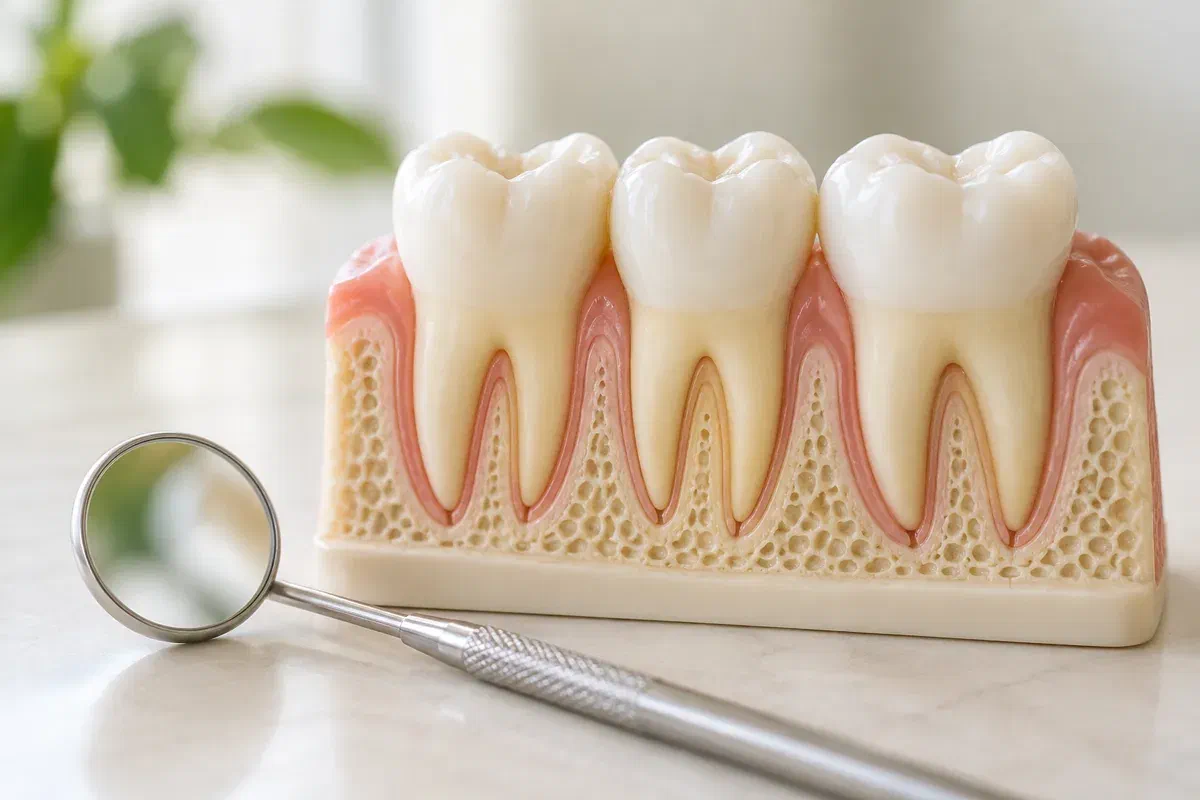
Illustrative cross-section teaching model showing teeth within gum and supporting bone
Before you call

A few facts that shape how soon you're seen.

The cause matters as much as the movement. An adult tooth loosened or pushed out of position by an accident should be examined promptly rather than watched at home to see whether pain develops.

A sports or accident injury

Note the time of the injury, whether the tooth sits in a new position, and whether your bite feels off. Report any cuts inside the lip, facial swelling, or jaw pain too. Neighbouring teeth can be hurt in the same impact, so the dentist checks them as well.

Slow change with gum signs

If nothing hit the tooth, gum clues become important: bleeding, gums that seem lower, new spaces, or food lodging where it didn't before. Mention any past gum therapy. These help the dentist focus on the support around the root, not just the crown.

Dental work that might be the culprit

Let the team know if the tooth has a crown, filling or veneer. Describe what you feel without repeatedly pressing on it. If part of a tooth or restoration breaks off, keep it in a clean container and bring it along. Don't glue anything back on.

Call without delay about an adult tooth that is loose or displaced after trauma. A tooth knocked completely out is an emergency of its own where time matters a great deal. For severe facial injury, bleeding that won't stop, or breathing problems, call 911 and seek emergency medical care.

What the exam sorts out

The damage, the support, and the choices that follow.

How much a tooth moves is only one clue. Before advising whether it can be kept in the long term, the dentist weighs the condition of the root, gum and bone. Ask which results carry the most weight and which questions remain open. If further imaging or a specialist opinion is suggested, ask what it is expected to tell you.

Short-term protection and long-term treatment are not the same thing, and a clear explanation keeps them separate. A splint may help in some injuries. It does not, by itself, regrow lost support or cure gum disease. Ask what each step realistically accomplishes for this tooth.

Patient information: NIDCR — assessment and treatment of gum disease

A full view of the surrounding tissues

Gums, supporting bone and appropriate images are examined along with the tooth itself. Your medical background and any gum care you have had help interpret what is found. Ask whether the issue seems limited to the injured area or whether your gum health overall needs a look.

Tooth or restoration: which is moving

A natural tooth that moves and a crown that has come loose are handled differently. Ask which applies and whether the tooth underneath is healthy. That answer explains whether re-cementing alone could solve the problem.

An honest outlook

Talk through the benefits, limits, costs and follow-up of each option. Keeping an injured tooth can involve continued monitoring, and its future can't be predicted from appearance. Ask what later findings would change the plan.

What happens at the appointment

Four stages, each explained as we go.

Tell the dentist if the tooth is sore or if you're worried about losing it. Every finding is explained in plain terms so you can take part in the decision instead of trying to diagnose it from the mirror.

  1. Recap the injury and your history

    Describe when and how the tooth was hurt, or when you first felt it move if there was no injury. Mention any gum treatment you've had, other symptoms, the medicines you take and your general health. If the tooth was treated somewhere else, records from that office can be helpful.

  2. Check the tooth and nearby structures

    The dentist examines the loose tooth and anything nearby that might be involved. Tests and images are chosen to fit the question. Ask what they show about the bone, root, or nerve inside the tooth, especially after an impact.

  3. Decide what needs doing now

    Some injuries call for prompt treatment; other causes are better handled over several visits. If a splint is suggested, ask how long it stays, what it protects, and what comes after. If removal is mentioned, ask why keeping the tooth may not be realistic.

  4. Book the reviews that injuries need

    Confirm when you'll be seen again, why, and whether a referral is planned. Ask how to brush and chew around the area until then and what changes mean calling sooner. Reviews matter most when you know what will be checked.

In the days that follow

Give the tooth a rest, and come back when asked.

Aftercare depends on whether the cause was an injury, gum disease, a restoration problem or something else. Follow the advice from your own visit rather than a remedy meant for another situation.

Hands and tongue off

Pushing the tooth to check it can disturb healing. Avoid biting hard foods with it while you wait for or recover from treatment. Don't try to pull it, glue it, or hold it in place with anything from home.

Clean carefully around a splint

If a splint is placed, ask the team to show you how to brush and clean around it. Mention any spots that are difficult. Splints create new places for plaque to gather, so the advice should cover both the device and the gums nearby.

Watch for changes and return for checks

Call if the tooth loosens further, your bite changes, pain or swelling develops, or the splint becomes loose. Don't take a splint off yourself. Injured teeth often need several reviews, even after they feel settled, because some changes appear later.

Treatment choices

Pick the treatment that fits why the tooth moved.

Loose teeth don't all get the same procedure. Ask how a recommendation fits your findings, and whether it aims to protect the tooth now, manage disease, repair dental work, or prepare for replacement.

When gum disease is behind the movement

Periodontal care

If periodontal disease is found, gum treatment and regular maintenance may be recommended. Discuss how much support has been lost and what goals make sense. Treatment manages the disease; it can't promise every loose tooth will tighten.

When the injury calls for it

Splint and injury management

For certain injuries, a splint with a planned review schedule may be advised. Ask what else will be required and how long the splint will stay. Root canal treatment is based on the condition of the nerve, not on the fact that the tooth moved.

When dental work or the outlook decides

Repair or removal

A loose crown or filling may be repaired if the tooth underneath allows. A tooth with a poor outlook may lead to a conversation about removal and replacement options later. Ask for the reasons and alternatives before committing to a path.

Oakville questions after a tooth injury

Common worries, answered plainly.

Which options apply depends on your exam. Call promptly about a new loose tooth, especially after a blow, and mention whether it or your bite has shifted.

(905) 876-4488
I took a puck to the mouth last weekend and my front tooth feels loose. How soon should I call?
As soon as you can. A permanent tooth loosened by an injury should be examined promptly, even if the pain has faded. Describe the injury and any change in how your teeth meet. Nearby teeth will usually be checked as well.
Would a sports mouthguard help protect a tooth after it has healed?
Mouthguards are commonly recommended for contact sports and activities with a risk of falls or impact. Ask the dentist whether a guard suits your activity and your treated tooth. A custom guard can be discussed at a later visit.
Can an injured tooth change colour later on?
Sometimes an injured tooth darkens over time, which can be one sign the nerve was affected. This is one reason follow-up visits matter. Report any colour change, new pain or swelling between reviews rather than waiting.
Do I need a root canal just because the tooth is loose?
Not necessarily. Decisions about root canal treatment rest on the condition of the nerve and the type of injury, not on movement alone. Ask what tests or findings support any treatment suggested inside the tooth.
Is there anything I should do at home before the appointment?
Rest the tooth, eat soft foods, and avoid testing it. Rinse gently if there’s a cut. If a piece of tooth or a crown came off, keep it in a clean container. Call immediately if a tooth is knocked out completely.
The splint feels strange. Is that something to worry about?
A splint often feels odd for a while. Tell the team if it rubs, makes cleaning very difficult, or feels loose. Don’t adjust or remove it yourself; the dentist can check it and decide whether a change is needed.
Help for a loose tooth, from Oakville

Call us after the injury, not after the pain.

Reach our Bronte Street practice at (905) 876-4488 to explain what happened and book the right assessment. If the tooth loosened after a blow, say so straight away so the team can discuss urgency and what to do before you arrive.

Whether a tooth can be kept, whether a splint or referral is needed, and how it heals depend on individual findings. Online forms are for non-urgent enquiries only.

Visit Milton Dental Clinic
Unit 1, 342 Bronte St. S, Milton, ON L9T 5B7
Get directions Clinic hours
Monday–Thursday
11am–7pm
Friday–Sunday
By appointment only

Areas we serve

  • Milton
  • Oakville
  • Mississauga
  • Georgetown
  • Halton Hills
  • Acton
  • Campbellville
  • Brampton
  • Burlington
  • Puslinch
  • Rockwood
  • Erin
  • Caledon
  • Etobicoke
  • Old Milton
  • Bronte Meadows
  • Timberlea
  • Dorset Park
  • Dempsey
  • Clarke
  • Beaty
  • Coates
  • Harrison
  • Scott
  • Willmott
  • Ford
  • Bowes
  • Cobden
  • Walker
  • Mountain View
  • Milton Heights
  • Hawthorne Village
  • Valley View
  • Fallingbrook
  • Nassagaweya
  • Trafalgar
  • Esquesing
  • Nelson
  • Brookville
  • Moffat
  • Glen Williams
  • Norval
  • Limehouse
  • Stewarttown
  • Ashgrove
  • Hornby
  • Silver Creek
  • Speyside
  • Scotch Block
  • North Oakville
  • River Oaks
  • Glen Abbey
  • West Oak Trails
  • Palermo
  • Bronte Creek
  • College Park
  • Joshua Creek
  • Uptown Core
  • Preserve
  • Iroquois Ridge
  • Lisgar
  • Meadowvale
  • Meadowvale Village
  • Churchill Meadows
  • Erin Mills
  • Central Erin Mills
  • Streetsville
  • East Credit
  • Creditview
  • Heartland
  • Sheridan
  • Mount Pleasant
  • Credit Valley
  • Huttonville
  • Churchville
  • Springbrook
  • Northwest Brampton
  • Bram West
  • Fletcher's Meadow
  • Fletcher's Creek South
  • Alton Village
  • Orchard
  • Millcroft
  • Headon Forest
  • Tansley
  • Brant Hills
  • Tyandaga
  • Kilbride
  • Lowville
  • Aberfoyle
  • Morriston
  • Arkell
  • Hillsburgh
  • Freelton
  • Carlisle
  • Waterdown
  • Flamborough
  • Mountsberg

How can we help?

Milton Dental Clinic

Have a question about your smile? Choose the option that works best for you.

For urgent dental concerns, please call.
Messages are reviewed during clinic hours.