

Illustrative patient discussing bite contacts with a clinician beside a dental cast
Specialized Care

Occlusal Adjustment in Milton

The freezing wears off, you sit down to dinner, and one tooth seems to land before the rest. A bite assessment in Milton can sort out whether a small, targeted adjustment makes sense, which surface it would touch, and whether something else deserves a look first.

Bite contacts, explained for Milton

That first meal after new dental work tells you a lot.

Occlusion is simply the way your upper and lower teeth meet. An occlusal adjustment carefully changes one chosen contact point, often on a filling or crown, once an examination has found a specific reason. It is not a promise that any odd-feeling bite can be smoothed away, and changing a surface always has consequences.

Here is the typical scene in Milton: a filling placed in the afternoon, numbness gone by supper, and a sense that one spot is touching early. That is worth reporting. Still, soreness when you chew can come from other sources as well, so the dentist looks at the tooth and the surrounding contacts before deciding that a surface change would actually help.

When you come in, it is fair to ask what the examination found and what the adjustment would physically involve. Find out whether the change would affect filling or crown material, or your own enamel. Understanding the purpose, the limits and the other options comes before agreeing to anything that cannot be undone.

Ask for a bite review
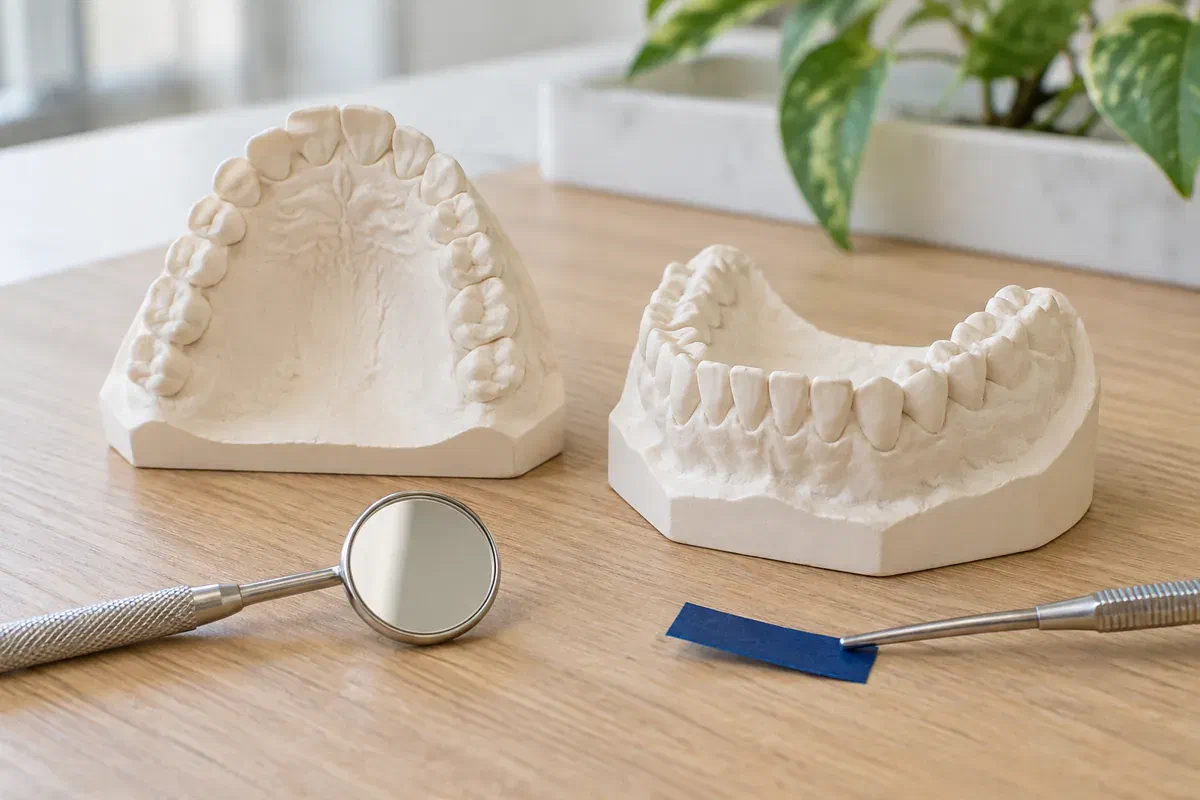
Illustrative dental casts beside a mirror and articulating-paper holder
Signs worth mentioning

Tell us what you feel, and let the examination do the testing.

Share when the feeling started and whether it came after recent treatment. That history helps separate a single high contact from a different tooth problem or a wider change in how your jaw feels.

A fresh filling or crown that lands early

Let the team know which tooth was worked on and the day you first noticed the early contact. Say whether it shows up when you simply close or only when you slide your jaw a certain way. Reach out to the dentist who placed it instead of waiting for heavy chewing to grind it down.

Soreness on biting down or letting go

Point out where it hurts and when, including any sensitivity to cold or aching at rest. A sore bite does not automatically mean a filling sits too high. A crack, an issue inside the tooth, or another condition might need checking before anyone alters a contact.

A bite that feels uneven in a wider or shifting way

Along with the bite sensation, mention jaw aching, locking, a recent knock to the face, or a new or changed appliance. Note whether the feeling is constant or comes and goes. The assessment should weigh all of this rather than reach for broad reshaping as a starting point.

An uneven bite that appears after treatment deserves a review. Pain that is getting worse, swelling, fever or trouble opening your mouth needs prompt advice too, and may call for something quite different from adjusting a restoration.

What a good assessment pins down

Know exactly which surface, why, and what should improve.

A helpful explanation names the surface, describes the finding and says what benefit is expected. Ask the dentist to tie the recommendation back to the problem you described. When the contact finding does not really account for your symptoms, more investigation often makes better sense than taking away material bit by bit while chasing a comfortable feeling.

There is also a real difference between a small correction to a filling and altering many of your natural teeth. Those choices carry different consequences. It is reasonable to ask how much work is planned, why it is needed and what the alternatives are if the examination has not pointed to a clear target.

A clear account of the contact problem

Examination and contact-marking materials can show the dentist how your teeth come together. Ask what the findings mean when taken together. A coloured mark has to be interpreted by a clinician; on its own it does not explain pain or justify reshaping every surface it lands on.

Agreement that names what will change

Confirm whether the work affects a filling, a crown or natural tooth. Talk through the relevant risks, including the chance that more restorative treatment could later be needed. Enamel does not regrow once it is removed, so the reason and the amount should be clear before anything starts.

A next step if symptoms linger

Find out when to call about ongoing discomfort and what a reassessment would look like. Symptoms that continue can mean the first explanation was incomplete or a separate problem is still present. A follow-up should revisit the findings, not assume that further adjustment is automatically the answer.

How a bite review unfolds

Small procedure, same need for a diagnosis and your informed consent.

Expect the dentist to walk you through the approach in plain terms and leave room for questions. If you are unsure whether natural tooth structure would be touched, settle that before you agree.

  1. Go over the history and look at the tooth

    Explain the original treatment, the first change you noticed and any pain or sensitivity that came with it. The clinician examines the relevant tooth and restoration. Further tests can be appropriate when the symptoms raise questions that a contact check by itself cannot resolve.

  2. Study how the teeth meet

    The dentist watches your teeth come together and may use marking materials during chosen movements. Say whether the check brings back the familiar feeling. Results are read together with your history rather than treated as a map that decides by itself what material comes off.

  3. Carry out only what you agreed to

    When an adjustment is suitable, confirm the target surface and the benefit it should bring. Ask about alternatives and risks beforehand. The clinician can describe how the surface will be smoothed and checked afterward, which varies with the material and the clinical situation.

  4. Check the contact again and plan follow-up

    Describe how normal closing feels afterward, without clamping down hard over and over. Ask what to watch for and when to get in touch. If another tooth or restoration issue remains, confirm the separate care it needs.

In the days that follow

Eat and close normally, and speak up if a change sticks around.

What you are told will depend on what was checked or treated. Keep following instructions for the original filling, crown or procedure alongside anything given at the bite review.

Skip the repeated self-testing

Try not to keep clenching, tapping or crunching hard foods to test the contact. Notice ordinary meals and gentle closing instead. If biting is uncomfortable, call for guidance rather than pushing the tooth to adapt.

Remember the rest of the plan

Adjusting a contact does not wrap up every restorative or root canal plan. Ask whether a temporary filling or crown still has to be replaced or whether another visit is still needed. A bite that feels better should not become a reason to delay a necessary final restoration without advice.

Describe precisely what has or hasn’t changed

If you are still uncomfortable, say whether it is the same symptom, a new sensitivity or a different contact feeling. Report swelling or pain that comes on by itself promptly. That detail lets the clinician reassess properly instead of assuming the original diagnosis and target still hold.

Possible directions

Sometimes the right response leaves the tooth surface alone.

Depending on what is found, the next step might be a small correction, further testing, or care aimed somewhere else entirely. Ask which route matches the findings and what would make the dentist change course.

When a clear finding supports adjusting

A small correction to a confirmed restoration contact

The dentist may suggest reshaping and polishing a defined area of filling or crown material. Ask whether the restoration will still be sound afterward and what result to expect. It is a focused decision about one examined tooth, not a reason to routinely reshape others.

When another dental cause needs attention

More testing or a different restoration

Some teeth need further assessment or a new restoration because adjusting would not properly solve the problem. Ask what each test is meant to clarify. A contact change should never stand in for investigating persistent tooth pain or structural damage.

When muscles or joints are involved

Gentle, reversible care for a jaw concern

Jaw symptoms deserve their own assessment. Permanent bite changes are not an evidence-supported routine treatment for temporomandibular disorders and can make things worse. Ask about reversible approaches or specialist input rather than assuming widespread grinding of teeth will fix it.

Patient information: NIDCR — evidence and cautions concerning occlusal treatments for TMD

Common bite questions

What people ask before a contact is changed

These answers help separate a focused check of one restoration from broader, permanent treatment. Any recommendation should rest on your own examination and the symptoms you have reported.

(905) 876-4488
My filling was done this morning and feels tall. Should I wait until the numbness fully wears off before calling?
Letting the freezing wear off first is sensible, since numbness can make any bite feel strange. If the tooth still touches first once feeling returns, call and describe what you notice.
Could the dentist be adjusting my enamel rather than the filling?
It depends on what is proposed, so ask directly. The dentist should name the surface and explain the reason, the amount, the risks and the alternatives. Removing natural tooth is permanent, and your consent should make clear whether it is involved or only a restoration.
Can I chew on that side while I wait for my appointment?
Favouring the other side for softer foods is a reasonable comfort step while you wait. Avoid testing the tooth with hard or sticky foods. If pain is building, or you notice swelling, call for advice rather than waiting for the booked visit.
Is there anything I should bring or note down before a bite review?
A short note of when the feeling began, which tooth it seems to involve and what triggers it is helpful. Mention any night guard, retainer or other appliance you use. If the restoration was placed elsewhere, details of that treatment help too.
Would grinding down my teeth help the clicking in my jaw?
Permanent changes to teeth are not a routine treatment for jaw clicking or TMD pain. Ask for a proper jaw assessment and about conservative, reversible options. A second opinion is reasonable if extensive irreversible work is suggested for an unexplained jaw complaint.
Can I be seen at your Milton clinic for a crown another dentist placed?
Yes, you can ask for an assessment. Contacting the treating dentist is also worthwhile, since they know the details. Bring what you know about the crown and when it was placed.
Bite reviews in Milton

Tell us which tooth feels high and since when.

Phone our Bronte Street practice at (905) 876-4488 to set up a bite assessment. Let us know about recent fillings, crowns, root canal work or changes to an appliance, so the visit can concentrate on the history and findings that matter for your tooth.

An assessment does not mean an adjustment will automatically follow. Whether one is suitable, how much is done and which material is affected depend on your clinical findings and your informed consent.

Visit Milton Dental Clinic
Unit 1, 342 Bronte St. S, Milton, ON L9T 5B7
Get directions Clinic hours
Monday–Thursday
11am–7pm
Friday–Sunday
By appointment only

Areas we serve

  • Milton
  • Oakville
  • Mississauga
  • Georgetown
  • Halton Hills
  • Acton
  • Campbellville
  • Brampton
  • Burlington
  • Puslinch
  • Rockwood
  • Erin
  • Caledon
  • Etobicoke
  • Old Milton
  • Bronte Meadows
  • Timberlea
  • Dorset Park
  • Dempsey
  • Clarke
  • Beaty
  • Coates
  • Harrison
  • Scott
  • Willmott
  • Ford
  • Bowes
  • Cobden
  • Walker
  • Mountain View
  • Milton Heights
  • Hawthorne Village
  • Valley View
  • Fallingbrook
  • Nassagaweya
  • Trafalgar
  • Esquesing
  • Nelson
  • Brookville
  • Moffat
  • Glen Williams
  • Norval
  • Limehouse
  • Stewarttown
  • Ashgrove
  • Hornby
  • Silver Creek
  • Speyside
  • Scotch Block
  • North Oakville
  • River Oaks
  • Glen Abbey
  • West Oak Trails
  • Palermo
  • Bronte Creek
  • College Park
  • Joshua Creek
  • Uptown Core
  • Preserve
  • Iroquois Ridge
  • Lisgar
  • Meadowvale
  • Meadowvale Village
  • Churchill Meadows
  • Erin Mills
  • Central Erin Mills
  • Streetsville
  • East Credit
  • Creditview
  • Heartland
  • Sheridan
  • Mount Pleasant
  • Credit Valley
  • Huttonville
  • Churchville
  • Springbrook
  • Northwest Brampton
  • Bram West
  • Fletcher's Meadow
  • Fletcher's Creek South
  • Alton Village
  • Orchard
  • Millcroft
  • Headon Forest
  • Tansley
  • Brant Hills
  • Tyandaga
  • Kilbride
  • Lowville
  • Aberfoyle
  • Morriston
  • Arkell
  • Hillsburgh
  • Freelton
  • Carlisle
  • Waterdown
  • Flamborough
  • Mountsberg

How can we help?

Milton Dental Clinic

Have a question about your smile? Choose the option that works best for you.

For urgent dental concerns, please call.
Messages are reviewed during clinic hours.