

Illustrative patient discussing bite contacts with a clinician beside a dental cast
Specialized Care

Occlusal Adjustment in Oakville

Pain when you bite can come from a contact that is slightly high, or from the tooth itself. If you are coming from Oakville, a careful bite assessment helps tell those apart, so any adjustment is small, targeted and agreed with you, and a different problem is not overlooked.

For Oakville: bite or tooth?

Is it the bite, or is it the tooth?

That question sits underneath almost every bite complaint. Occlusion is the dental word for how your top and bottom teeth come together, and an occlusal adjustment is a deliberate change to one of those meeting points, often on a filling or crown, made only when the examination supports it. The term does not mean an uncomfortable bite will automatically be reshaped, and altering any surface has trade-offs.

A high spot on fresh dental work is a common and reasonable suspicion. It is not the only one. Soreness on chewing can also come from a cracked tooth, irritation inside the tooth, gum problems or the jaw, so the dentist examines the tooth and how it meets its partners before a surface is touched.

Come with questions. What did the examination show, and what exactly would be changed? Would the adjustment affect restoration material or your natural enamel? Knowing the purpose, the limits and the alternatives lets you make a real choice before any irreversible step.

Ask about a bite assessment
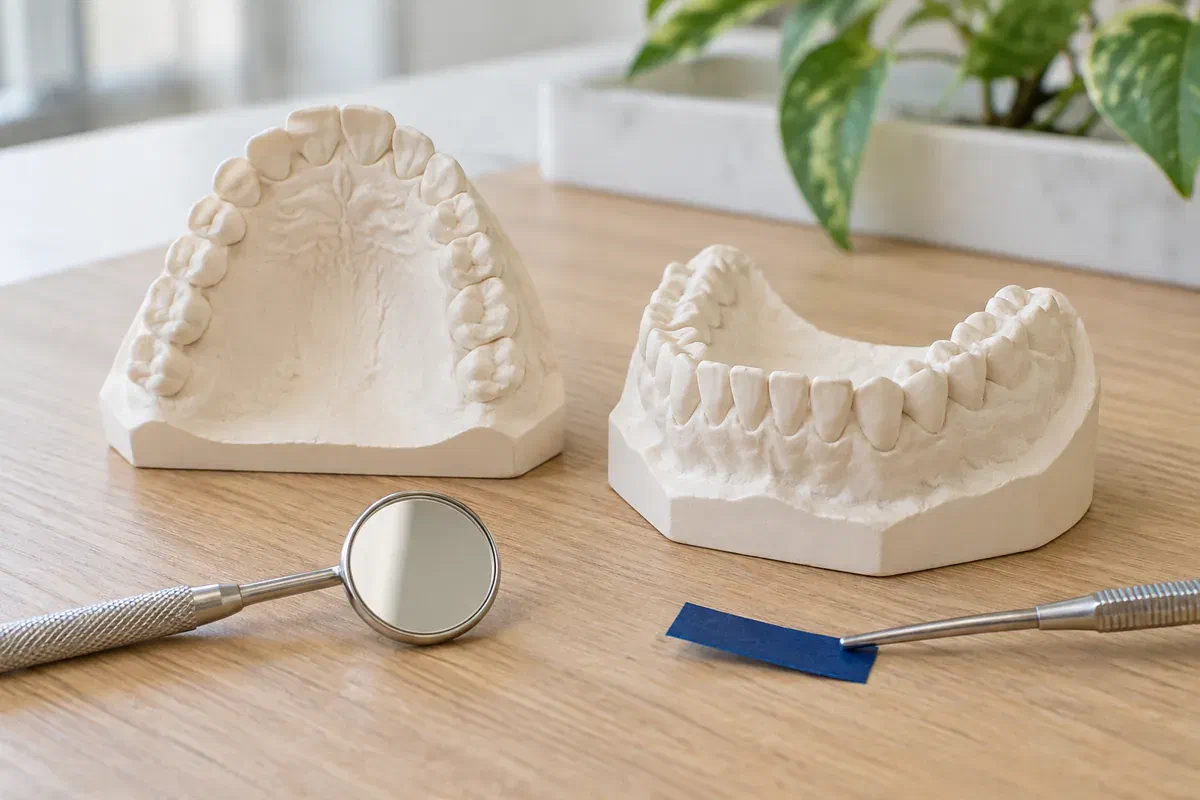
Illustrative dental casts beside a mirror and articulating-paper holder
Sorting out the signals

Patterns matter more than how hard you can bite.

When did it begin? Did it follow a filling, crown or root canal? Those answers help the dentist separate one contact issue from a tooth problem or a more general jaw complaint.

Recent work that seems to hit before the rest

Note the tooth, the date of treatment and when the early contact became obvious. Is it there every time you close, or only when grinding sideways? Call the dentist who placed the restoration, since chewing hard to wear it down is not a reliable fix.

A sharp twinge on biting or letting go

Pain that flashes when you release a bite, or lingers after cold, tells the dentist something different from a dull high-spot pressure. Do not assume a high filling. Cracks and problems within the tooth are among the possibilities that need ruling out before any contact is altered.

An off feeling that drifts or spreads

If your whole bite feels unfamiliar, mention jaw aching, catching or locking, any recent blow, and new or adjusted appliances. Say whether the feeling is constant. A wide-ranging complaint calls for a wide-ranging assessment, not reshaping by default.

A bite that changed after treatment should be looked at. Worsening pain, swelling, fever or trouble opening your mouth warrants prompt advice and may need a quite different response from polishing a restoration.

A useful outcome

You leave knowing what was found and why it matters.

Good advice is concrete. It points to a surface, describes what the dentist saw and says what should feel different afterward. Ask how that connects to what brought you in. When the contacts do not convincingly account for the pain, looking further is usually the better course than taking off material repeatedly in search of comfort.

Keep in mind the gap between touching up a single filling and reshaping several healthy teeth. One is a small, local decision; the other is a far larger commitment. You are entitled to know the scope, the reason and the options if no clear target has emerged.

A diagnosis, not just a mark

Thin marking paper or film can show where teeth touch, and the dentist pairs that with an examination. Ask how everything fits. A dark spot has to be interpreted; by itself it neither explains pain nor justifies grinding every place the paper marks.

Clear consent about the material involved

Is it a filling, a crown or your own tooth that would change? Talk about risks, including whether more restorative treatment could follow. Enamel cannot regrow, so understand the reason and the amount before the handpiece comes out.

A plan if the soreness stays

Ask when persistent discomfort should be reported and what a second look would cover. Lingering symptoms can mean another cause is involved. Reassessment should reopen the question rather than assume a little more adjustment is due.

What the appointment looks like

Examine first, adjust only if it fits, then confirm.

Expect plain explanations and space to ask questions. If it is unclear whether your natural tooth would be affected, get that answered before saying yes.

  1. Start with the story and the tooth

    Walk the dentist through the treatment you had, the first moment things felt different and any pain or sensitivity since. The clinician examines the tooth and its restoration. Other tests may help when the symptoms suggest something a contact check cannot reveal.

  2. Check how the teeth meet

    Your bite is observed in closing and in chosen movements, sometimes with marking materials. Tell the dentist if the check brings back the sensation you know. Results are weighed against your history, never read as a chart that decides on its own what to remove.

  3. Make only the change you agreed to

    Where adjustment is appropriate, confirm which surface and what benefit to expect. Ask about alternatives and risks beforehand. The clinician can explain how the area is finished and rechecked, which depends on the material and the situation.

  4. Confirm comfort and plan what comes next

    Close gently and describe how it feels, rather than clamping down again and again. Ask what to monitor and when to call. If a separate tooth or restoration problem was found, make sure its care is arranged instead of treating everything as solved.

Afterward

Give it ordinary use and honest attention.

Instructions depend on what was done. Whatever you were told about the original filling, crown or procedure still applies alongside the bite review advice.

Let everyday eating be the measure

Constant clenching, clicking your teeth together or biting something hard to test the spot can irritate the area. Notice how normal meals feel. If comfortable chewing is not possible, call for advice rather than pushing through.

Do not let the larger plan slip

A smoother bite does not mean a crown, root canal or other restoration is finished. Check whether a temporary still has to be replaced or another visit is booked. Feeling better is not a reason to postpone a needed final restoration without speaking to the dentist.

Describe what you notice in detail

If something still bothers you, is it the original problem, a new sensitivity or a contact that now feels wrong somewhere else? Report swelling or pain that starts on its own quickly. Precise detail lets the dentist reassess properly.

Three possible paths

Polishing a contact is only one of them.

What the dentist finds may point to a small correction, more investigation, or care for a different source. Ask which path fits your findings and what would change the plan.

When the finding is specific

Refining a confirmed contact on a restoration

The dentist may suggest smoothing a defined spot of filling or crown material. Ask whether the restoration stays sound and what you should feel afterward. This is about one examined tooth, and it does not open the door to reshaping others as a matter of routine.

When the tooth itself may be the issue

Looking deeper at the tooth or replacing work

A tooth can need more tests or a new restoration if adjusting would not solve the real problem. Ask what each test should clarify. A contact change is never a substitute for investigating ongoing pain or a structural fault.

When the jaw is the main complaint

Reversible care for jaw muscles or joints

Jaw discomfort needs its own evaluation. Permanently changing the bite is not supported by evidence as a routine answer to temporomandibular disorders, and it can make things worse. Ask about conservative care or a specialist referral instead.

Patient information: NIDCR — evidence and cautions concerning occlusal treatments for TMD

Frequently asked

Bite questions, answered plainly

Use these to understand the difference between a focused check of one restoration and larger permanent changes. Your own findings and symptoms should drive any recommendation.

(905) 876-4488
How can a dentist tell a high spot from a cracked tooth?
By combining your description with an examination, contact checks and, when needed, other tests. The pattern of pain, such as a twinge on release or sensitivity to cold, helps guide which possibilities to look at more closely.
If the filling is high, why not just grind it down straight away?
Because the high feeling may not be the whole story. The dentist confirms the contact and checks the tooth first. If adjustment is appropriate, it should be limited to the identified spot and explained before it is done.
Does an adjustment ever involve natural tooth instead of filling material?
It can, which is why you should ask. The dentist ought to name the surface, the reason, the amount, the risks and the options. Natural enamel does not grow back, so your consent should be clear on that point.
Can bite adjustment fix my jaw clicking?
Permanently reshaping teeth is not routine treatment for jaw clicking or TMD pain. Ask for a jaw assessment, conservative options and, if extensive irreversible work is offered for an unexplained jaw problem, a second opinion.
Will the tooth feel normal the moment the adjustment is finished?
Some people notice a difference quickly, while others need a little time or a recheck, depending on the tooth and what was done. Describe ordinary closing at the appointment, and call if the feeling persists.
I am coming from Oakville. Can I describe my symptoms by phone before booking?
Yes. Calling first lets you explain the tooth, the recent treatment and the symptoms, and the team can advise whether to come in soon. Tell us straight away about swelling, fever or worsening pain.
Booking from Oakville

One tooth feels wrong. Let’s find out why.

Call (905) 876-4488 to reach our Bronte Street practice and arrange a bite assessment. Mention any recent fillings, crowns, root canal work or appliance changes so we can focus on what matters for that tooth.

An assessment is not a commitment to adjustment. Whether one is suitable, the extent, the material involved and the likely response depend on your findings and informed consent.

Visit Milton Dental Clinic
Unit 1, 342 Bronte St. S, Milton, ON L9T 5B7
Get directions Clinic hours
Monday–Thursday
11am–7pm
Friday–Sunday
By appointment only

Areas we serve

  • Milton
  • Oakville
  • Mississauga
  • Georgetown
  • Halton Hills
  • Acton
  • Campbellville
  • Brampton
  • Burlington
  • Puslinch
  • Rockwood
  • Erin
  • Caledon
  • Etobicoke
  • Old Milton
  • Bronte Meadows
  • Timberlea
  • Dorset Park
  • Dempsey
  • Clarke
  • Beaty
  • Coates
  • Harrison
  • Scott
  • Willmott
  • Ford
  • Bowes
  • Cobden
  • Walker
  • Mountain View
  • Milton Heights
  • Hawthorne Village
  • Valley View
  • Fallingbrook
  • Nassagaweya
  • Trafalgar
  • Esquesing
  • Nelson
  • Brookville
  • Moffat
  • Glen Williams
  • Norval
  • Limehouse
  • Stewarttown
  • Ashgrove
  • Hornby
  • Silver Creek
  • Speyside
  • Scotch Block
  • North Oakville
  • River Oaks
  • Glen Abbey
  • West Oak Trails
  • Palermo
  • Bronte Creek
  • College Park
  • Joshua Creek
  • Uptown Core
  • Preserve
  • Iroquois Ridge
  • Lisgar
  • Meadowvale
  • Meadowvale Village
  • Churchill Meadows
  • Erin Mills
  • Central Erin Mills
  • Streetsville
  • East Credit
  • Creditview
  • Heartland
  • Sheridan
  • Mount Pleasant
  • Credit Valley
  • Huttonville
  • Churchville
  • Springbrook
  • Northwest Brampton
  • Bram West
  • Fletcher's Meadow
  • Fletcher's Creek South
  • Alton Village
  • Orchard
  • Millcroft
  • Headon Forest
  • Tansley
  • Brant Hills
  • Tyandaga
  • Kilbride
  • Lowville
  • Aberfoyle
  • Morriston
  • Arkell
  • Hillsburgh
  • Freelton
  • Carlisle
  • Waterdown
  • Flamborough
  • Mountsberg

How can we help?

Milton Dental Clinic

Have a question about your smile? Choose the option that works best for you.

For urgent dental concerns, please call.
Messages are reviewed during clinic hours.