
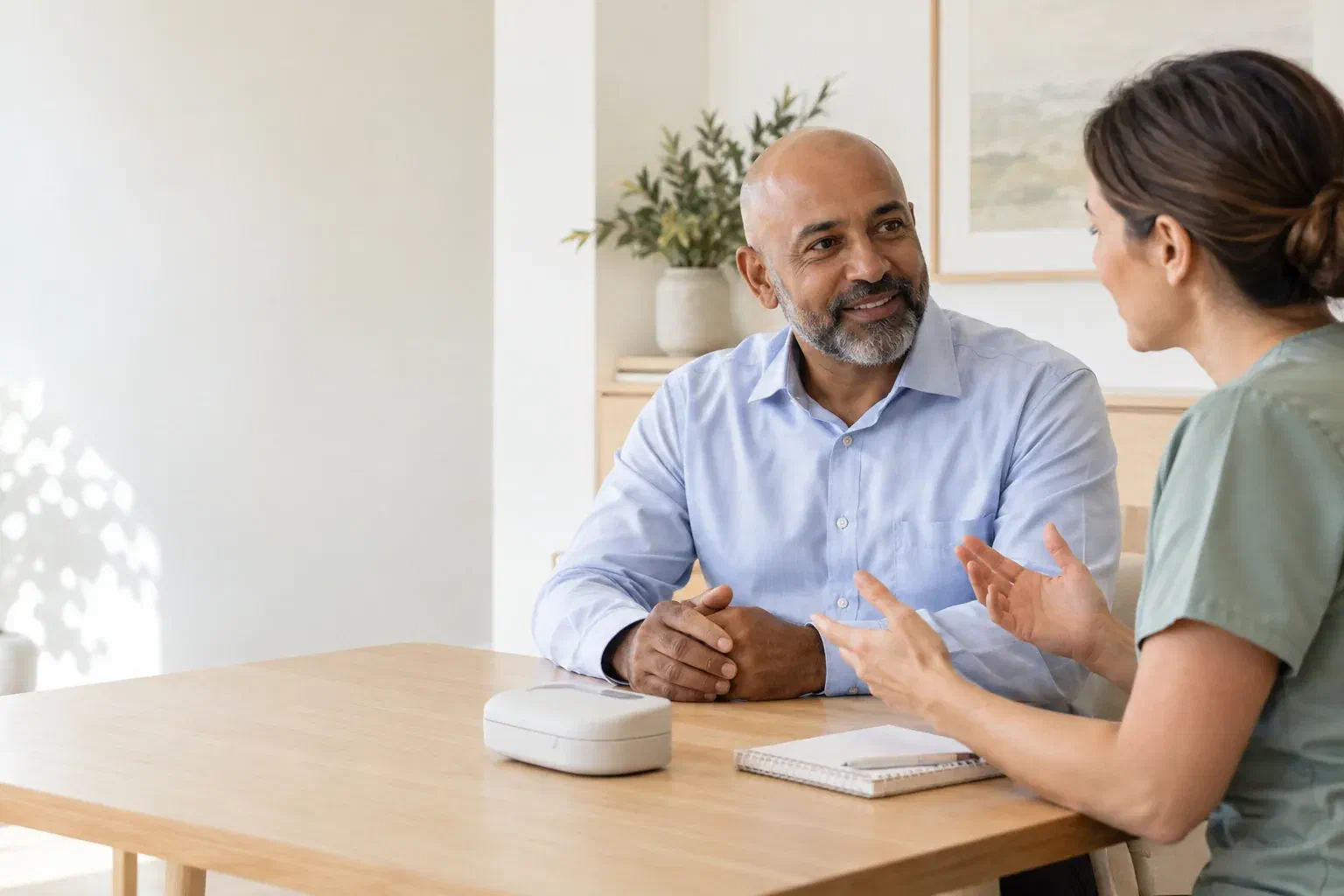
Illustrative patient discussing a sleep-related dental appliance assessment with a clinician
Specialized Care

Oral Appliance Therapy in Rockwood

Missing teeth, a bridge, gum concerns or a sore jaw can all raise the same question: can my mouth support a sleep appliance at all? Our Milton dentists examine that carefully, explain what they find, and work alongside the clinician who manages your sleep diagnosis.

Rockwood · is my mouth suited?

The teeth have to do the holding.

Every night, a sleep appliance relies on your teeth and jaw for support. Many designs position the lower jaw a little forward to help keep the airway open, and that places demands on teeth, gums and jaw joints. So once a sleep condition has been diagnosed and an appliance suggested, the dental examination becomes a real deciding factor.

The device is prescribed for a sleep-related breathing problem identified through a medical assessment. It is not the same as a grinding guard and shouldn't be treated as one. Your wish for an alternative to other therapy is a fair starting point, though suitability still depends on the diagnosis, your dental findings and a follow-up plan.

From Rockwood, northwest of Milton, a quick call before booking helps the first visit go further. Have your sleep-care provider's name and reports on hand, and note any dental work you've had or are planning. We'll explain what the assessment covers, whether a referral is involved and why a device is not something to expect immediately.

Ask whether your teeth can support an appliance
Illustrative closed dental appliance case beside water and a notebook on a bedside table
What the exam looks for

Support, health, comfort

Snoring doesn't tell the dentist whether a device will sit securely. Sharing your diagnosis, your treatment so far and your full dental history lets the team see what's established and what needs attention first.

A diagnosis to build on

Bring the sleep report or referral, and name the clinician who manages your sleep care. If no assessment has been done, describe breathing pauses others have seen or significant sleepiness to a physician. Those concerns need medical evaluation before any device is discussed.

The story so far with prescribed treatment

Explain what has made current therapy hard and what adjustments were made. Your sleep-care team might resolve some of those issues directly. Continue treatment that helps while you find out whether an appliance is an option.

Gaps, bridges, gums and jaw joints

Mention missing or loose teeth, bridges, implants, dentures, gum disease, untreated decay, planned restorations and any jaw pain or clicking. Bring an existing appliance if you have one. These shape whether a device can be supported comfortably or whether care or another opinion comes first.

Sleepiness through the day is a reason to seek medical advice and to be careful about safety. Don't drive if you're drowsy. A dental appointment about appliances should never delay assessment of your breathing or a review of prescribed care.

Benefits of a careful start

Suitability checked before anything is made

When the dental assessment is thorough and the sleep-care provider stays involved, each side covers what the other can't. The dentist judges whether your mouth can carry the device safely; the sleep-care provider judges whether it treats the condition. Ask how they'll stay in touch. A secure, comfortable fit is welcome, but it isn't evidence of effective treatment.

Because dental factors can change the plan, ask what happens if the dentist has concerns, or if the appliance later causes discomfort or doesn't help enough. When those possibilities are discussed first, it's easier to raise problems promptly, and an alternative is ready instead of an unused device in a case.

Patient information: AASM and AADSM — oral appliance therapy guideline and follow-up recommendations

A device fitted to your mouth

Ask why a specific design is suitable given your diagnosis and the teeth available for support. Where indicated, qualified clinicians may recommend a custom, adjustable appliance. Confirm the device and who provides it; shop-bought snoring aids aren't equivalent.

Monitoring teeth and gums over time

The dentist should explain possible effects on teeth, gums, jaw joints and bite, and how they'll be tracked. Report tenderness, a loosening tooth or a bite that feels different. Ongoing reviews pick up changes that weren't present at fitting.

Results confirmed medically

Quieter sleep and better energy are good signs, but they can't confirm that sleep apnea is adequately controlled. Your sleep-care provider can outline follow-up testing and how it guides decisions. A device that fits securely still needs its effect assessed.

The sequence

Why does the dental exam come before the device?

Where you start depends on your sleep assessment and dental health. Ask what must be resolved before manufacture, which visits are included and who arranges medical testing or referral.

  1. Discuss the sleep findings

    We talk about your diagnosis, current treatment and what draws you to an appliance. Bring copies of reports and your sleep provider's contact information. Where details are missing, we'll explain how to obtain them and what care continues during the assessment.

  2. A thorough dental assessment

    Teeth, gums, bridges or implants, existing restorations and the jaw are examined. If treatment is needed first, you'll hear why. Before any records are taken or a device is ordered, review the proposal, its limits and likely side effects, the fees and how reviews will work.

  3. Fit and instruction

    The prescribing clinician confirms the fit and shows you insertion, removal, cleaning and any adjustment you're allowed to make. Ask what you should expect to feel and what to report. Moving the jaw forward beyond instructions isn't a reliable way to improve results.

  4. Ongoing dental and sleep reviews

    Keep the recommended dental visits and sleep testing rather than waiting for symptoms. Reviews consider comfort, use, any change in teeth, gums or bite and what the sleep provider learns. The plan may be refined, changed or sent for wider assessment.

After fitting

Keep an eye on the teeth that hold it.

A familiar appliance still needs attention. Keep both providers' contact details handy, and find out early who to call if the device cracks, causes pain or no longer seats as it should.

Use only the settings you were given

Wear the appliance as prescribed and adjust within your clinician's instructions only. Keep a log if one was requested. If the adjustment process is unclear, ask for another demonstration rather than guessing.

Clean and check it, and your teeth

Follow the cleaning and storage advice for its material. Bring it to each dental review and mention damage, loose parts or a changed fit. Tell us about planned fillings, crowns or extractions, since changes to supporting teeth can affect how it sits.

Report symptoms early

Let the right provider know about ongoing sleepiness, returning snoring, witnessed pauses or difficulty wearing the device. Mention gum soreness, a loose tooth or jaw discomfort as well. A quiet night doesn't mean testing or medical care can be dropped.

Patient information: NHLBI — oral device care and continuing sleep-apnea review

When the mouth shapes the choice

Sometimes the dental findings point elsewhere.

An appliance isn't automatically suitable for everyone who snores or has sleep apnea, especially when dental support is limited. Discuss suitability, likely effect, practicality and how results will be checked with your sleep-care clinician.

When it remains the better option

Positive airway pressure, with problems addressed

Raise comfort, equipment or consistency difficulties with whoever manages your sleep care, since adjustments may help. A dental consultation is there to inform the decision, not to imply you should drop prescribed positive airway pressure treatment while other options are explored.

When your teeth and diagnosis support it

A prescribed appliance with dental follow-up

Where the dental and medical findings agree, an appliance can be part of a supervised plan. Ask about the specific device, the support available and how its effect will be objectively reviewed. A secure fit doesn't guarantee adequate treatment of the condition.

When support or the response is in doubt

Dental care first, or another route

Dental treatment, another opinion, more medical assessment or a different therapy may be needed if support is limited, the diagnosis is uncertain or results fall short. Ask which provider guides that choice. An unassessed snoring product isn't a substitute.

Patient information: NHLBI — sleep-apnea treatment options and oral devices

Questions about dental suitability

Can my teeth handle it?

Bring your sleep report, any referral, any denture or existing appliance and notes on past dental work. These answers explain who decides what and the follow-up involved, so you can choose whether to go ahead.

(905) 876-4488
Do I need a certain number of healthy teeth for a sleep appliance?
The dentist assesses whether there’s adequate support based on your teeth, gums and jaw rather than a simple count. If support is limited, they’ll explain the options, which may include dental treatment first or a different approach.
I have gum disease. Can I still be assessed for an appliance?
Yes, you can be assessed, but gum health affects support and comfort. The dentist may recommend treating gum problems before a device is considered. Ask what would need to happen first.
Can a sleep appliance work with dental implants or a bridge?
That depends on the specific restorations and how they fit into the design. Mention them at the consultation so the dentist can examine them and explain whether they affect suitability.
My jaw clicks. Does that rule out oral appliance therapy?
Not necessarily, but jaw symptoms should be assessed before treatment and monitored during use. Tell the dentist about clicking, pain or limited opening, and ask how the device could affect them.
If the dentist says my teeth can support it, is the appliance guaranteed to work?
No. Dental suitability means the device can be worn; whether it treats sleep apnea adequately is checked through the follow-up your sleep-care provider recommends.
Should I stop my current sleep treatment while the dental assessment is underway?
Keep using prescribed treatment unless the clinician managing your sleep condition says otherwise. Discuss any difficulties and transition plans with that provider rather than pausing on your own.
Rockwood · first step

Start with a dental assessment that takes your sleep plan into account.

Call (905) 876-4488 to ask Milton Dental Clinic about assessment and referral. Tell us about your sleep diagnosis and treating provider if you have them, and we'll help you work out what comes next and which records to bring.

Suitability, provision, referral and effectiveness depend on your individual medical and dental findings. Our team can confirm the pathway available; no device, diagnosis or result is guaranteed.

Visit Milton Dental Clinic
Unit 1, 342 Bronte St. S, Milton, ON L9T 5B7
Get directions Clinic hours
Monday–Thursday
11am–7pm
Friday–Sunday
By appointment only

Areas we serve

  • Milton
  • Oakville
  • Mississauga
  • Georgetown
  • Halton Hills
  • Acton
  • Campbellville
  • Brampton
  • Burlington
  • Puslinch
  • Rockwood
  • Erin
  • Caledon
  • Etobicoke
  • Old Milton
  • Bronte Meadows
  • Timberlea
  • Dorset Park
  • Dempsey
  • Clarke
  • Beaty
  • Coates
  • Harrison
  • Scott
  • Willmott
  • Ford
  • Bowes
  • Cobden
  • Walker
  • Mountain View
  • Milton Heights
  • Hawthorne Village
  • Valley View
  • Fallingbrook
  • Nassagaweya
  • Trafalgar
  • Esquesing
  • Nelson
  • Brookville
  • Moffat
  • Glen Williams
  • Norval
  • Limehouse
  • Stewarttown
  • Ashgrove
  • Hornby
  • Silver Creek
  • Speyside
  • Scotch Block
  • North Oakville
  • River Oaks
  • Glen Abbey
  • West Oak Trails
  • Palermo
  • Bronte Creek
  • College Park
  • Joshua Creek
  • Uptown Core
  • Preserve
  • Iroquois Ridge
  • Lisgar
  • Meadowvale
  • Meadowvale Village
  • Churchill Meadows
  • Erin Mills
  • Central Erin Mills
  • Streetsville
  • East Credit
  • Creditview
  • Heartland
  • Sheridan
  • Mount Pleasant
  • Credit Valley
  • Huttonville
  • Churchville
  • Springbrook
  • Northwest Brampton
  • Bram West
  • Fletcher's Meadow
  • Fletcher's Creek South
  • Alton Village
  • Orchard
  • Millcroft
  • Headon Forest
  • Tansley
  • Brant Hills
  • Tyandaga
  • Kilbride
  • Lowville
  • Aberfoyle
  • Morriston
  • Arkell
  • Hillsburgh
  • Freelton
  • Carlisle
  • Waterdown
  • Flamborough
  • Mountsberg

How can we help?

Milton Dental Clinic

Have a question about your smile? Choose the option that works best for you.

For urgent dental concerns, please call.
Messages are reviewed during clinic hours.