

Illustrative patient discussing an oral tissue assessment with a dental clinician
Specialized Care

Oral Biopsy in Acton

Heart medication, diabetes, a recent hospital stay: your health history shapes how a mouth biopsy is planned. For anyone in Acton weighing a tissue sample or specialist referral, we can explain why it may be advised, how your medical picture is factored in, and how the result will be followed up.

Your health, your biopsy plan

Medicines and medical history are part of the plan from day one.

For many adults, the first worry about a biopsy is not the word itself but the pill organiser on the kitchen counter. Can it be done while on a blood thinner? Does diabetes change healing? Those questions belong in the conversation. The procedure itself involves taking a small tissue sample from the mouth for laboratory examination, and it's recommended when the exam cannot explain a change on its own. Being advised to have one is a step toward a diagnosis, not a diagnosis of cancer.

A biopsy can sample a section of an area or, in suitable cases, remove a small lesion entirely. The decision rests on the site, the size, the exam findings and the diagnostic question, and your health history can affect where and how it is done. Ask which approach is planned, and whether a specialist setting would be safer or more appropriate for you.

When you come from Acton, bring a complete, up-to-date list of everything you take, along with any earlier reports about the area. We examine the spot, review that history and discuss how urgently the next step is needed. You should come away knowing who would take the sample and who would review the lab findings with you.

Discuss a biopsy and your health history
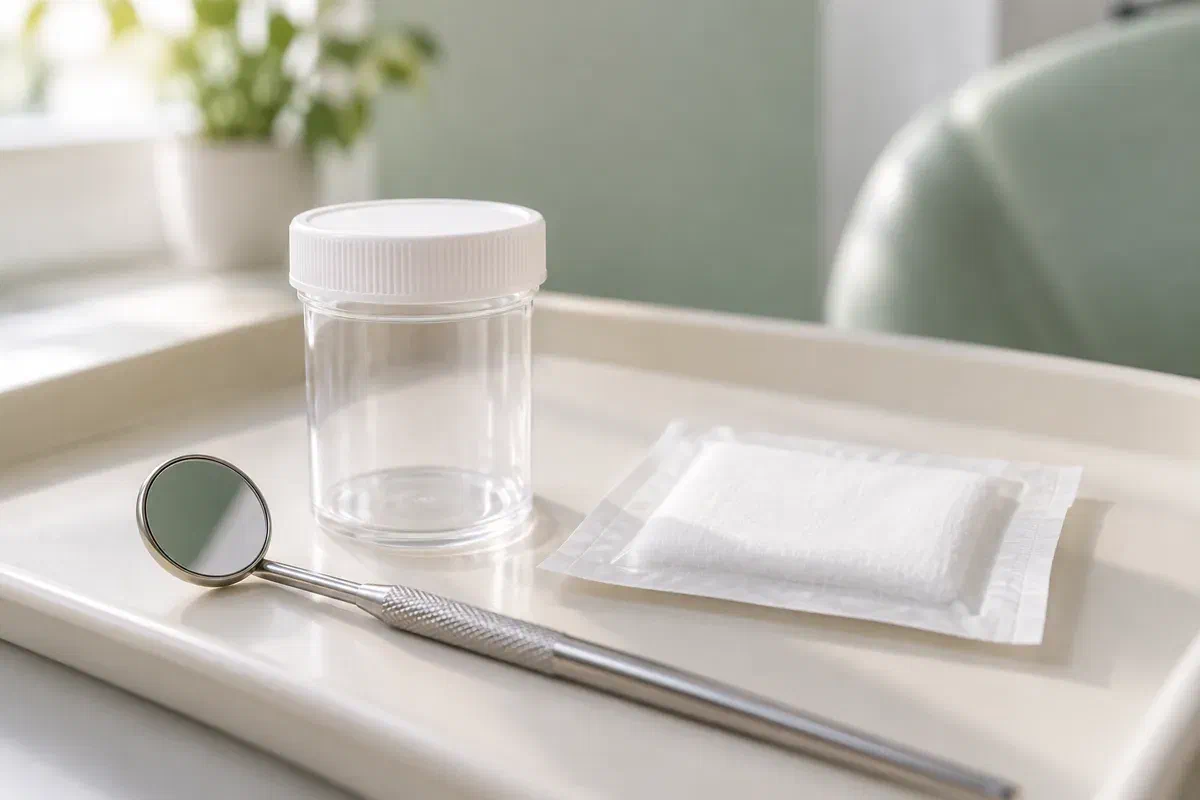
Illustrative empty closed specimen container beside packaged gauze and a dental mirror
Telling the whole story

Describe the lesion, then describe your health.

Neither a photo nor a website can identify what a mouth lesion is. Give the clinician its history: when it appeared, whether it has persisted, any symptoms and what has already been tried. Then add your medical background.

A sore that is slow to heal

Explain how long it has been present and whether it has changed. Conditions such as diabetes, or certain medications, can affect healing, so mention them. Even if a sharp tooth or appliance seems to explain it, ask whether a recheck, sample or referral is the right step.

A lump, a patch or altered feeling

Point out the spot and any change in size, colour, texture or sensation. Note any bleeding, including bleeding that seems heavier than you'd expect, or numbness. Lesions that need assessment are often painless, so comfort shouldn't decide whether you are seen.

Advice from your physician or another dentist

If a doctor or dentist has already suggested a biopsy, bring the referral and any medical letters. Ask how urgently they wanted it handled, and be clear whether your next visit is an assessment, the procedure or a results discussion.

A medical condition is a reason to plan a biopsy carefully, not a reason to skip one that has been recommended. Call the team managing it if the area changes. For uncontrolled bleeding, or difficulty breathing or swallowing, seek emergency medical care immediately.

Why it's worth planning around

A clear diagnosis helps every provider you see.

Your dentist can describe how a lesion looks and feels, but certain answers come only from examining the tissue. Ask what the biopsy is meant to clarify and how different outcomes would alter the plan. If you see several health providers, a clear result also helps them work from the same information, though no one can promise what the report will say.

Arrange the results pathway at the outset: how the report returns, who contacts you and the date to call if it's late. If your physician should receive a copy, ask about that too. Having the sample taken and understanding the diagnosis are two separate stages.

A sample that fits the diagnostic need

The exam determines the approach. Ask whether the clinician plans to take part of the area or all of it, and why. The amount removed doesn't foretell the result; it reflects what the lab needs.

A report explained in context

Ask the treating clinician to describe the findings in plain terms and relate them to the sampled area and to your health. If the original question isn't fully settled, another review or sample may be advised.

Coordination with your other care

The findings may lead to monitoring, treatment or referral. Ask who will coordinate it and how it fits with your other medical care. Even when a small lesion was fully removed, ask whether ongoing checks are needed.

Planning safely

How your health history is built into each step

Let us know if a biopsy, or any procedure in your mouth, makes you nervous. You can ask about the reason, comfort, medicine questions and results before you consent.

  1. Exam and a full medical review

    Describe the lesion's timeline and bring photos or earlier reports. Share every prescription, over-the-counter product and supplement, plus allergies, any bleeding history and medical conditions. The clinician explains whether further assessment or referral is required and how soon.

  2. A tailored plan and consent

    You'll discuss the site, the type of biopsy, the numbing approach and risks that relate to that area and to your health. Where needed, the plan can be coordinated with your prescriber. Ask about stitches and arrangements for afterward, and confirm the provider and setting.

  3. The procedure

    Local anaesthetic is often used, though the approach depends on your circumstances. A tissue sample goes to the lab and the site is managed. Ask for written aftercare, including how it interacts with your usual medicines, and raise any confusion before you go.

  4. Results and coordinated next steps

    Keep the agreed results call or visit. Ask what the diagnosis means, whether treatment is recommended and how the area will be monitored. If extra tests are suggested, find out their purpose and who will arrange them.

Recovery with your health in mind

Aftercare that accounts for your medicines

Healing depends on the biopsy site, how much tissue was removed and your general health. Follow instructions written for you, not an extraction routine or advice given to someone else.

Numbness and pain relief

While the anaesthetic wears off, avoid biting your lip, cheek or tongue. Follow guidance on food, drink and activity. Before taking anything for soreness, ask which pain relievers are safe alongside your prescriptions and conditions.

Cleaning and stitches

Ask how to brush near the site and whether rinsing or stitch care is recommended. Don't pull at the wound or touch it repeatedly. Call the team if something looks unexpected, rather than removing it.

Bleeding and other warning signs

If you take a blood thinner, ask in advance what amount of oozing is expected. Report increasing pain, marked swelling, fever or bleeding that persists after following your instructions. Heavy, uncontrolled bleeding or trouble breathing or swallowing calls for emergency care.

The routes available

Monitoring, a biopsy or a specialist setting

Ask why the suggested option matches your exam and your health. Planned observation, sampling and specialist assessment do different jobs, and none should be used to put off an unresolved concern.

When reassessment is appropriate

A timed recheck

An area might be reviewed after a likely irritant is corrected. Ask when to return and which changes mean calling sooner. Observation needs a reason and a limit; a concerning lesion shouldn't sit on watch indefinitely just because it doesn't hurt.

When the tissue must be examined

Incisional or excisional sampling

Incisional biopsies take a portion; excisional biopsies remove a suitable small lesion completely. The clinician chooses from the findings. Taking away the visible area doesn't by itself end the need for follow-up.

When your health or the site calls for it

A specialist setting

Some situations are better handled by an oral surgeon, oral medicine specialist or other provider with the right setup. Ask what the referral is for, how soon it's needed and who will keep track of the outcome.

Health history questions

Medicines, conditions and mouth biopsies

These can help you prepare for the consultation and results discussion. Your clinician can address your lesion, your health and the planned procedure after examining you.

(905) 876-4488
Does having diabetes affect how a mouth biopsy heals?
It can affect healing for some people. Tell the clinician about the condition and how it is managed. They can tailor the aftercare advice and tell you what to watch for. If your blood sugar has been harder to control lately, say so, because that is useful context for planning the timing of the procedure and the follow-up.
Do I need to bring my medication list to the consultation?
Yes. Include prescriptions, over-the-counter medicines and supplements, with doses if you know them. That list is important for planning any procedure safely. A photo of your pharmacy printout or pill bottles works well if writing it out is a chore. Bringing it to the first visit means fewer follow-up calls back and forth to Acton while the plan is being finalised.
Should my family doctor be told about the biopsy?
Ask the clinician how results are shared and whether a copy can go to your physician. Coordination can be helpful, especially if you see several providers.
Is it safe to keep taking my blood thinner before the procedure?
Never stop or adjust it on your own. The clinician will consider the medicine, the procedure and your health, and may coordinate with your prescriber.
Can I take my usual pain reliever after the biopsy?
Ask first. Some pain relievers may not suit your other medicines or conditions. The clinician can suggest suitable options for your situation and explain how long you might expect to need them.
If my health makes the procedure complicated, will I be referred?
Possibly. Some cases are better managed in a specialist setting. Ask why a referral is suggested, how urgent it is and who will follow up the result.
Planning a biopsy from Acton

Bring your medicine list and your questions.

Call (905) 876-4488 to book time at our Bronte Street practice for an oral lesion assessment, or to go through a biopsy recommendation you've already received. If you were given an urgent timeframe, mention it so we can direct you to the right appointment or referral.

Suitability, provider, setting, sampling method, recovery and lab timing all vary. Your biopsy clinician should confirm when and how the results and follow-up will be handled.

Visit Milton Dental Clinic
Unit 1, 342 Bronte St. S, Milton, ON L9T 5B7
Get directions Clinic hours
Monday–Thursday
11am–7pm
Friday–Sunday
By appointment only

Areas we serve

  • Milton
  • Oakville
  • Mississauga
  • Georgetown
  • Halton Hills
  • Acton
  • Campbellville
  • Brampton
  • Burlington
  • Puslinch
  • Rockwood
  • Erin
  • Caledon
  • Etobicoke
  • Old Milton
  • Bronte Meadows
  • Timberlea
  • Dorset Park
  • Dempsey
  • Clarke
  • Beaty
  • Coates
  • Harrison
  • Scott
  • Willmott
  • Ford
  • Bowes
  • Cobden
  • Walker
  • Mountain View
  • Milton Heights
  • Hawthorne Village
  • Valley View
  • Fallingbrook
  • Nassagaweya
  • Trafalgar
  • Esquesing
  • Nelson
  • Brookville
  • Moffat
  • Glen Williams
  • Norval
  • Limehouse
  • Stewarttown
  • Ashgrove
  • Hornby
  • Silver Creek
  • Speyside
  • Scotch Block
  • North Oakville
  • River Oaks
  • Glen Abbey
  • West Oak Trails
  • Palermo
  • Bronte Creek
  • College Park
  • Joshua Creek
  • Uptown Core
  • Preserve
  • Iroquois Ridge
  • Lisgar
  • Meadowvale
  • Meadowvale Village
  • Churchill Meadows
  • Erin Mills
  • Central Erin Mills
  • Streetsville
  • East Credit
  • Creditview
  • Heartland
  • Sheridan
  • Mount Pleasant
  • Credit Valley
  • Huttonville
  • Churchville
  • Springbrook
  • Northwest Brampton
  • Bram West
  • Fletcher's Meadow
  • Fletcher's Creek South
  • Alton Village
  • Orchard
  • Millcroft
  • Headon Forest
  • Tansley
  • Brant Hills
  • Tyandaga
  • Kilbride
  • Lowville
  • Aberfoyle
  • Morriston
  • Arkell
  • Hillsburgh
  • Freelton
  • Carlisle
  • Waterdown
  • Flamborough
  • Mountsberg

How can we help?

Milton Dental Clinic

Have a question about your smile? Choose the option that works best for you.

For urgent dental concerns, please call.
Messages are reviewed during clinic hours.