

Illustrative patient discussing an oral tissue assessment with a dental clinician
Specialized Care

Oral Biopsy in Brampton

Often it is a spouse, son or daughter who first notices a parent's mouth sore and starts asking questions. For households in Brampton, we can explain why a biopsy or specialist referral may be advised, what each stage involves, and how a family can help keep follow-up on track.

When someone you love needs one

Supporting a relative through a mouth biopsy

Your mother mentions that one side of her mouth feels rough, or your partner has been favouring one side when eating. A dentist takes a look and suggests a biopsy. In plain terms, that means removing a little tissue so a laboratory can study it. It is advised when examining the area is not enough to say what it is. A recommendation like this is part of finding out, and it is not a statement that cancer is present.

There are two broad kinds. One takes a piece of the area. The other removes a small lesion completely, when that is the sensible approach. Which one is used depends on the size, the location, what the exam found and the question the clinician needs answered. It is reasonable for you or your relative to ask whether the procedure should be done by a specialist.

Families from Brampton sometimes juggle several people's schedules and several sets of appointments. A first visit with us is a chance to examine the area, look through any earlier reports and talk about how urgent the next step seems. Whoever is the patient should leave knowing who will collect the sample and who will go over the result, and a family member can write that down.

Book an assessment for a family member
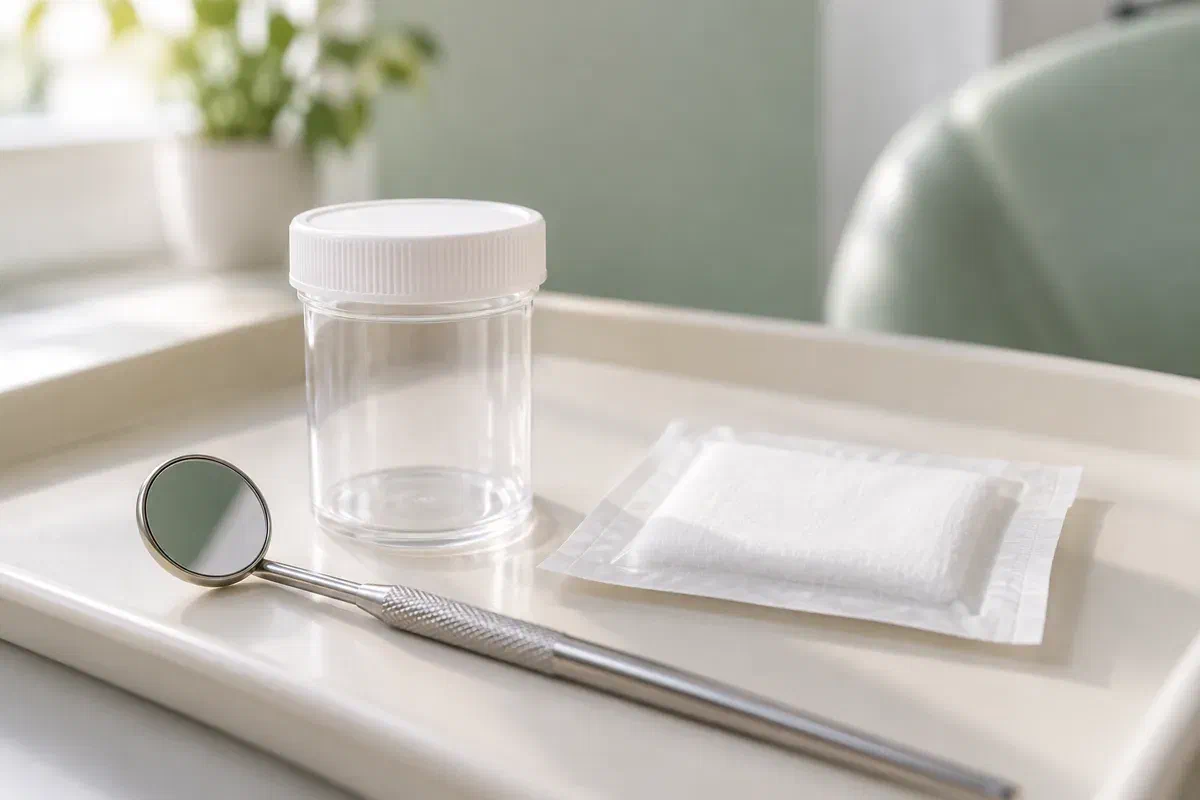
Illustrative empty closed specimen container beside packaged gauze and a dental mirror
What you might notice at home

Small clues that are worth mentioning to the dentist

Neither the patient nor a helpful relative can diagnose a lesion from a photo or a website. What a clinician can use is a clear history: when it began, whether it has stayed, any symptoms and anything already tried.

A sore that hasn't cleared up

Note when it started and whether it seems different now. A denture, a broken tooth or a habit might be rubbing it, which is helpful to mention. An obvious cause still doesn't mean the area can be left unexamined if it fails to heal.

A bump, patch or change in feeling

Say where it sits and whether its size, colour, surface or sensation has shifted. Report any bleeding, numbness or reluctance to chew on that side. Lesions that need checking are frequently painless, so the absence of complaints should not decide whether to book.

A recommendation the patient didn't fully follow

Sometimes an older relative is advised to have a biopsy and doesn't quite catch the details. Bring whatever paperwork exists and ask how urgent it was meant to be. Confirm whether the next visit is for assessment, the procedure or a results talk.

Please don't let a recommended biopsy or specialist visit slide because the area isn't sore or looks like a harmless image. Call the team handling it if it changes. Severe bleeding that cannot be controlled, or any difficulty breathing or swallowing, is a medical emergency.

What the family gains

A shared understanding instead of separate worries

When one person in a family is waiting on a mouth lesion, everyone tends to worry in their own way. An exam can describe the area, but some answers require studying the tissue in a lab. Ask what question the biopsy is meant to answer and what each kind of result would mean for the plan. That shared understanding helps without anyone promising an outcome.

Decide early who keeps track of the follow-up. Ask how the report will come back, who will contact the patient and the date after which to call. The procedure and the explanation are linked, and one being finished does not mean the other is.

A sample chosen for a reason

The clinician selects the sampling approach from the exam findings. Ask whether part or all of the area will be removed, and why. A larger sample does not signal a worse result; it reflects what the lab needs.

Results explained in words everyone can follow

Ask the treating clinician to talk through the report in plain language and connect it to the area that was sampled. If the report doesn't answer everything, another review or sample may follow. If medical English is hard for the patient, bringing a trusted relative to translate the conversation can help.

One person coordinating what's next

Depending on the diagnosis, the area may be monitored, treated or referred on. Ask who leads that and when. Even if a small lesion has been taken out completely, check whether further reviews are recommended.

How it unfolds

What each appointment is for

Some people are frightened by the word biopsy, and older relatives may not say so. Encourage them to mention it. Questions about the reason, comfort and results can be asked before consent at any point.

  1. The exam and a full medicine list

    Share the timeline and any photos or reports. A complete list of medicines matters here, including blood thinners and supplements, along with allergies, bleeding history and medical conditions. The clinician will explain whether a specialist referral or more assessment is needed and how soon.

  2. The explanation and consent

    The clinician covers the site, biopsy type, numbing plan and risks for that area. Ask whether stitches are expected and whether someone should drive or stay with the patient afterward. Confirm the provider and setting rather than assuming the procedure happens on the first day.

  3. The procedure

    Local anaesthetic is used for many oral biopsies, though it depends on the case. Tissue is taken for laboratory examination and the site is managed. Ask for written aftercare that the patient and helper can both read, and ask questions before leaving.

  4. The results visit

    Make sure someone remembers the agreed call or appointment. Ask what the diagnosis means, what treatment if any is recommended and how the area will be checked from here. If more tests are needed, find out why and who books them.

Helping at home

What a helper can watch for in the first days

Instructions depend on the biopsy's location, its size and the patient's health. Follow those, not a routine from someone else's extraction or a cousin's biopsy.

Numbness and meals

While the anaesthetic wears off, a lip, cheek or tongue is easy to bite. Help the patient follow the advice about food, drinks and rest. Ask how much soreness is normal and which pain relievers are suitable with their other medicines.

Cleaning and stitches

Ask how to brush near the site and whether rinsing or stitch care applies. Discourage poking at the wound. If something looks unexpected, call the team instead of trying to remove it.

When to pick up the phone

Call about worsening pain, significant swelling, fever or bleeding that the instructions don't settle. Keep the number on the fridge or in a shared phone. Bleeding that won't stop or any trouble breathing or swallowing needs emergency care.

The choices ahead

Watching, sampling, or a specialist

Ask why the clinician suggests one route. Observation, a biopsy and a specialist referral each have their own purpose, and none should become a soft way of putting a concern off.

When a recheck is appropriate

A planned review

Sometimes the area is reviewed after a sharp tooth or loose denture is corrected. Ask when to return and what changes warrant calling earlier. Monitoring needs a reason and a timeframe, not indefinite watching simply because nothing hurts.

When tissue must be examined

Sampling some or all of the area

Incisional sampling removes a piece of the area; excisional sampling removes a suitable small lesion whole. The clinician decides based on the findings. Removing what's visible does not always end the need for follow-up.

When another provider is better placed

A specialist's assessment

An oral surgeon, oral medicine specialist or another suitable clinician may be recommended. Ask what the referral should determine, how urgent it is and who tracks the result, so the family knows the next appointment.

For patients and the people helping them

Questions families often ask

Use these to prepare for the consultation and results conversation. The clinician can speak to the specific lesion, procedure and follow-up after examining the area.

(905) 876-4488
Can I come into the appointment with my parent?
In most cases a support person can attend if the patient agrees. Ask when you book. Having someone take notes is often helpful, particularly for the results discussion.
My father says the sore doesn't bother him. Should he still go?
Yes, if it has been recommended or isn’t healing. Pain is not a reliable sign of what a lesion is. Encourage him to discuss any doubts with the clinician who recommended the assessment.
Who will the results be given to?
Results are shared with the patient, and with others only with the patient’s consent. If the patient wants a relative involved, mention that to the clinic so it can be noted.
What medicines should we bring a list of?
All of them: prescriptions, over-the-counter products and supplements. Never stop a prescribed medicine without advice. The clinician can coordinate with the prescriber when needed.
Could more than one biopsy be needed?
Sometimes. If the report leaves questions open, further sampling or assessment may be recommended. Ask what remains uncertain and why another step would help.
Can several family members' visits be booked together?
Ask the front desk. Grouping routine visits can save a household in Brampton a few trips, but a biopsy assessment should be booked on the timeline the clinician advises rather than delayed to match other appointments.
Biopsy assessment for Brampton households

Bring the patient, the paperwork and a helper if you like

Our Bronte Street practice can be reached at (905) 876-4488 to arrange an oral lesion assessment or to discuss a biopsy already recommended for someone in your family. Mention any urgency the referring clinician gave so we can set up the appropriate appointment or referral.

Suitability, provider, setting, sampling approach, healing and lab timing all vary. The clinician who performs the biopsy should confirm how and when results and follow-up will happen.

Visit Milton Dental Clinic
Unit 1, 342 Bronte St. S, Milton, ON L9T 5B7
Get directions Clinic hours
Monday–Thursday
11am–7pm
Friday–Sunday
By appointment only

Areas we serve

  • Milton
  • Oakville
  • Mississauga
  • Georgetown
  • Halton Hills
  • Acton
  • Campbellville
  • Brampton
  • Burlington
  • Puslinch
  • Rockwood
  • Erin
  • Caledon
  • Etobicoke
  • Old Milton
  • Bronte Meadows
  • Timberlea
  • Dorset Park
  • Dempsey
  • Clarke
  • Beaty
  • Coates
  • Harrison
  • Scott
  • Willmott
  • Ford
  • Bowes
  • Cobden
  • Walker
  • Mountain View
  • Milton Heights
  • Hawthorne Village
  • Valley View
  • Fallingbrook
  • Nassagaweya
  • Trafalgar
  • Esquesing
  • Nelson
  • Brookville
  • Moffat
  • Glen Williams
  • Norval
  • Limehouse
  • Stewarttown
  • Ashgrove
  • Hornby
  • Silver Creek
  • Speyside
  • Scotch Block
  • North Oakville
  • River Oaks
  • Glen Abbey
  • West Oak Trails
  • Palermo
  • Bronte Creek
  • College Park
  • Joshua Creek
  • Uptown Core
  • Preserve
  • Iroquois Ridge
  • Lisgar
  • Meadowvale
  • Meadowvale Village
  • Churchill Meadows
  • Erin Mills
  • Central Erin Mills
  • Streetsville
  • East Credit
  • Creditview
  • Heartland
  • Sheridan
  • Mount Pleasant
  • Credit Valley
  • Huttonville
  • Churchville
  • Springbrook
  • Northwest Brampton
  • Bram West
  • Fletcher's Meadow
  • Fletcher's Creek South
  • Alton Village
  • Orchard
  • Millcroft
  • Headon Forest
  • Tansley
  • Brant Hills
  • Tyandaga
  • Kilbride
  • Lowville
  • Aberfoyle
  • Morriston
  • Arkell
  • Hillsburgh
  • Freelton
  • Carlisle
  • Waterdown
  • Flamborough
  • Mountsberg

How can we help?

Milton Dental Clinic

Have a question about your smile? Choose the option that works best for you.

For urgent dental concerns, please call.
Messages are reviewed during clinic hours.