

Illustrative patient discussing an oral tissue assessment with a dental clinician
Specialized Care

Oral Biopsy in Burlington

Hearing the word biopsy can make a small spot in your mouth feel enormous. For people in Burlington, our team can slow things down: explain why a tissue sample or referral is being considered, what actually happens, and how the result reaches you.

If the word itself worries you

A biopsy is a question being asked, not an answer being given.

Most people feel a jolt when a dentist mentions a biopsy. That reaction is understandable, and it helps to know what is actually being proposed. A small amount of tissue is removed from the area in question and sent to a laboratory, where it is examined closely. Clinicians suggest this when an exam alone cannot explain a change. The suggestion is a way of investigating. It is not a cancer diagnosis.

The procedure itself takes different forms. In some cases only a piece of the area is sampled. In others a small lesion is removed in full, if that suits the findings. The choice rests on location, size and the specific question the clinician needs answered. You can ask which approach is planned and whether a specialist would be better placed to carry it out.

For anyone travelling from Burlington, a first appointment with us can be mostly talk. We look at the area, hear how it has changed and go over any reports you already have. We can also discuss how quickly things should move. By the end, you should know who would take the sample and who would explain the findings.

Talk through a biopsy concern
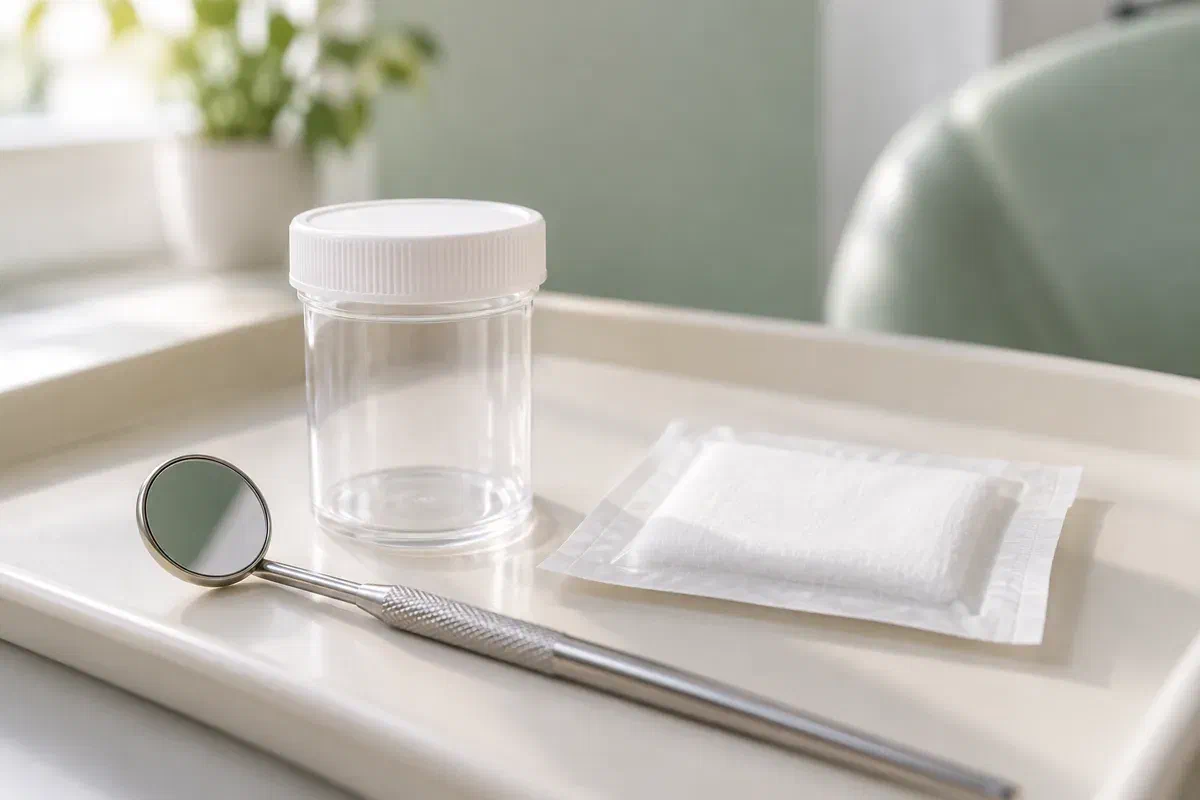
Illustrative empty closed specimen container beside packaged gauze and a dental mirror
Reasons to be seen

You describe it. The exam interprets it.

Late-night searching rarely helps; photos and comparisons online cannot identify a mouth lesion. A clinician will want the basics: the first day you noticed it, whether it has come and gone or never left, how it feels and any treatment so far.

A sore that hasn't healed

Count roughly how long the ulcer or raw spot has been there and note any change. A cheek bite or sharp tooth may well explain it, and you should still mention that, but a probable cause does not cancel the need for an exam. Ask whether the plan is to recheck, sample or refer.

Any unfamiliar lump or patch

Show where it is and say whether it has changed in size, colour, texture or feeling. Bleeding, numbness or difficulty using that part of the mouth are worth mentioning. Many areas that need investigation are painless, so being comfortable is not a sign you can skip the appointment.

A biopsy someone else advised

Bring the referral and ask how soon the referring clinician intended the next step. Clarify whether you are booked for an assessment, the procedure or a results discussion. Each one needs different preparation, and knowing which reduces surprises.

Anxiety is a very human reason to delay, but a recommended biopsy or specialist visit should still go ahead on schedule, even if the area feels fine. Call the team if it changes meanwhile. Trouble breathing or swallowing, or bleeding that won't stop, needs emergency medical care.

Less guessing

Uncertainty is often harder than information.

Waiting with an unexplained spot can be stressful. A clinician can tell you how it looks and feels, but certain questions can only be answered by examining the tissue in a lab. Ask what yours is meant to answer and how possible results would change the plan. Knowing the purpose can ease some of the worry, even though nobody can promise an outcome in advance.

It also helps to know the ending before you begin. Find out by what route the findings return, which person will reach out, and the point at which silence means you should pick up the phone. The procedure is one part; the explanation is the other. Neither is complete without the other.

Sampling that suits the question

What the exam shows determines how the tissue is collected. You can ask if the plan is to take a piece or the entire spot, and the thinking behind it. Please don't read anything into the size of the sample; it is set by what the pathologist needs to look at.

A report you can actually follow

Ask the treating clinician to explain the findings in plain words and link them to the spot that was sampled. If questions remain after the report, a further review or sample may be needed. Context makes the wording far less intimidating.

A plan for what follows

Depending on what the lab reports, you might move on to periodic checks, to treatment, or to another provider. Find out whose job it is to arrange that, and roughly when. A lesion taken out in full can still come with advice to have the spot looked at again later, so ask.

Step by step

What happens, and when you can ask questions.

Tell us if the idea of a biopsy, or any procedure in your mouth, makes you anxious. We would rather know. You can ask about the reasons, comfort and results at every stage before giving consent.

  1. An unhurried exam and health review

    Describe when the area appeared and how it has changed, and bring along any pictures or paperwork. Expect questions about medicines, allergies, any history of bleeding and your general health. From there, the clinician will say whether things should go further, perhaps with a specialist, and how soon.

  2. A clear explanation before consent

    Expect to hear where the sample would come from, which type of biopsy is proposed, how the area would be frozen and what risks apply. Ask about stitches and whether you will want help afterward. Confirm who will do it and where; it is not assumed to happen at the first visit.

  3. The sample, with instructions in hand

    Many oral biopsies are done with local anaesthetic, though the approach depends on your case. Tissue goes to the lab and the site is looked after. Ask for aftercare in writing. If you are feeling shaky or distracted, say so and ask for it to be explained again before you leave.

  4. The results conversation

    Keep the follow-up appointment or call. Ask what the diagnosis means, whether anything needs to be done and how the area will be monitored. If further tests are needed, ask what they are for and who arranges them.

Afterward

Small, steady care while the site heals.

Instructions depend on where the sample came from, how much was taken and your overall health. Follow the ones you were given, not a routine from an old extraction or a friend's experience.

Go easy while you are numb

A frozen lip, cheek or tongue is easy to bite by accident. Follow the guidance about eating, drinking and activity. Ask how much soreness is typical for your procedure and which pain relievers fit your medicines and health.

Clean carefully and leave the site alone

You'll be shown how to keep your teeth clean around the wound, and told whether any rinse or stitch care is part of it. Anxious people often check a healing spot over and over; try to resist. A worrying sight is a reason to phone us, never a reason to pick at it.

Call about anything concerning

Pain that builds instead of easing, swelling that becomes marked, a fever, or oozing your written steps can't control are all worth a call. Keep the number somewhere easy to find. If bleeding is heavy and relentless, or breathing or swallowing gets hard, go for emergency care immediately.

Options the clinician may weigh

Why one route is chosen over another.

Ask why the suggested route fits your exam. Planned observation, tissue sampling and specialist assessment serve different purposes, and none of them should quietly become a way to avoid an open question.

When a recheck makes sense

Reviewing the area again

Sometimes an area is looked at again after a likely irritant is removed. You should be given a return date and a short list of changes that mean calling before then. Observation should come with a reason and a deadline, not an open-ended wait because nothing hurts.

When tissue needs to be studied

Taking a sample

An incisional biopsy takes part of the area; an excisional biopsy removes a suitable small lesion entirely. The clinician chooses based on the findings. Removing the visible area doesn't by itself mean that monitoring is finished.

When another provider fits better

Referring to a specialist

An oral medicine specialist, oral surgeon or other appropriate clinician may be suggested. It's fair to ask what that clinician is meant to figure out, how quickly you should be seen, and which office will chase the outcome. Nobody should leave unsure of their next appointment.

Questions anxious people ask

Honest answers, without false comfort.

These may help you prepare for the consultation and the results discussion. Your clinician can speak to your lesion, procedure and follow-up once they have examined the area.

(905) 876-4488
Is it normal to feel this nervous about a mouth biopsy?
Yes. Many people feel uneasy. Telling the clinician helps, because they can explain each step and answer questions before you agree to anything. You can also ask for written information to read at home.
Will I feel the biopsy being taken?
Local anaesthetic is commonly used to numb the area, though the approach depends on the situation. Ask the clinician what to expect for your site and tell them if you are uncomfortable during the procedure.
Can I ask for the results to be given in person?
You can ask. Some people prefer to hear and discuss results face to face, especially if they want time for questions. Raise this when the follow-up is being arranged.
If the result is fine, does the clinic still follow up?
Ask. Even a reassuring report may come with advice about monitoring or a recheck. Make sure you know whether further review is recommended and when.
Does a painless lesion mean the biopsy can wait?
No. Pain is not a reliable guide to what a lesion is. Talk with the clinician who recommended the biopsy before changing the plan.
Is it okay to bring someone for support?
Usually, yes. Mention it while booking so there’s room for them in the treatment area. A support person can also help you remember instructions and questions.
Biopsy assessment for Burlington

Start with a conversation.

From Burlington, the simplest first step is a phone call: (905) 876-4488 reaches our Bronte Street practice, where you can arrange an oral lesion assessment or talk through a biopsy that has already been suggested. If you were told the next step is urgent, let us know so we can arrange the right appointment or referral.

Suitability, provider, setting, sampling method, recovery and laboratory timing all vary. Confirm your results and follow-up arrangements with the clinician who performs your biopsy.

Visit Milton Dental Clinic
Unit 1, 342 Bronte St. S, Milton, ON L9T 5B7
Get directions Clinic hours
Monday–Thursday
11am–7pm
Friday–Sunday
By appointment only

Areas we serve

  • Milton
  • Oakville
  • Mississauga
  • Georgetown
  • Halton Hills
  • Acton
  • Campbellville
  • Brampton
  • Burlington
  • Puslinch
  • Rockwood
  • Erin
  • Caledon
  • Etobicoke
  • Old Milton
  • Bronte Meadows
  • Timberlea
  • Dorset Park
  • Dempsey
  • Clarke
  • Beaty
  • Coates
  • Harrison
  • Scott
  • Willmott
  • Ford
  • Bowes
  • Cobden
  • Walker
  • Mountain View
  • Milton Heights
  • Hawthorne Village
  • Valley View
  • Fallingbrook
  • Nassagaweya
  • Trafalgar
  • Esquesing
  • Nelson
  • Brookville
  • Moffat
  • Glen Williams
  • Norval
  • Limehouse
  • Stewarttown
  • Ashgrove
  • Hornby
  • Silver Creek
  • Speyside
  • Scotch Block
  • North Oakville
  • River Oaks
  • Glen Abbey
  • West Oak Trails
  • Palermo
  • Bronte Creek
  • College Park
  • Joshua Creek
  • Uptown Core
  • Preserve
  • Iroquois Ridge
  • Lisgar
  • Meadowvale
  • Meadowvale Village
  • Churchill Meadows
  • Erin Mills
  • Central Erin Mills
  • Streetsville
  • East Credit
  • Creditview
  • Heartland
  • Sheridan
  • Mount Pleasant
  • Credit Valley
  • Huttonville
  • Churchville
  • Springbrook
  • Northwest Brampton
  • Bram West
  • Fletcher's Meadow
  • Fletcher's Creek South
  • Alton Village
  • Orchard
  • Millcroft
  • Headon Forest
  • Tansley
  • Brant Hills
  • Tyandaga
  • Kilbride
  • Lowville
  • Aberfoyle
  • Morriston
  • Arkell
  • Hillsburgh
  • Freelton
  • Carlisle
  • Waterdown
  • Flamborough
  • Mountsberg

How can we help?

Milton Dental Clinic

Have a question about your smile? Choose the option that works best for you.

For urgent dental concerns, please call.
Messages are reviewed during clinic hours.