

Illustrative patient discussing an oral tissue assessment with a dental clinician
Specialized Care

Oral Biopsy in Caledon

A mouth lesion can involve more than one office: your dentist, a specialist, a lab and sometimes your family doctor. For households in Caledon, from Bolton to the smaller villages, we can explain why a biopsy or referral may be advised and help you understand who is responsible for each step.

Several providers, one plan

Who does what when a mouth lesion needs a closer look

It's common to leave a dental appointment with a referral to an oral surgeon, an expectation that a lab will be involved and a vague sense that someone will call. An oral biopsy sits at the centre of that: a small piece of tissue is removed from the mouth so a pathology laboratory can examine it. Clinicians advise one when the exam can't explain a change. The advice exists to investigate, and on its own it doesn't mean cancer has been diagnosed.

Depending on the findings, the sample may be a portion of the area or a small lesion removed in full. Location, size, the exam and the diagnostic question all play a role, and so does the setting. Some biopsies are done in a general dental office, while others are better handled by a specialist. Asking which applies to you is a reasonable first question.

When you come to us from Caledon, we can examine the area, look through any reports or referral letters and talk about how quickly the next step should happen. Most importantly, we help you map out the roles: who will take the sample, who receives the report, who explains it and who arranges anything that follows.

Sort out a biopsy pathway with us
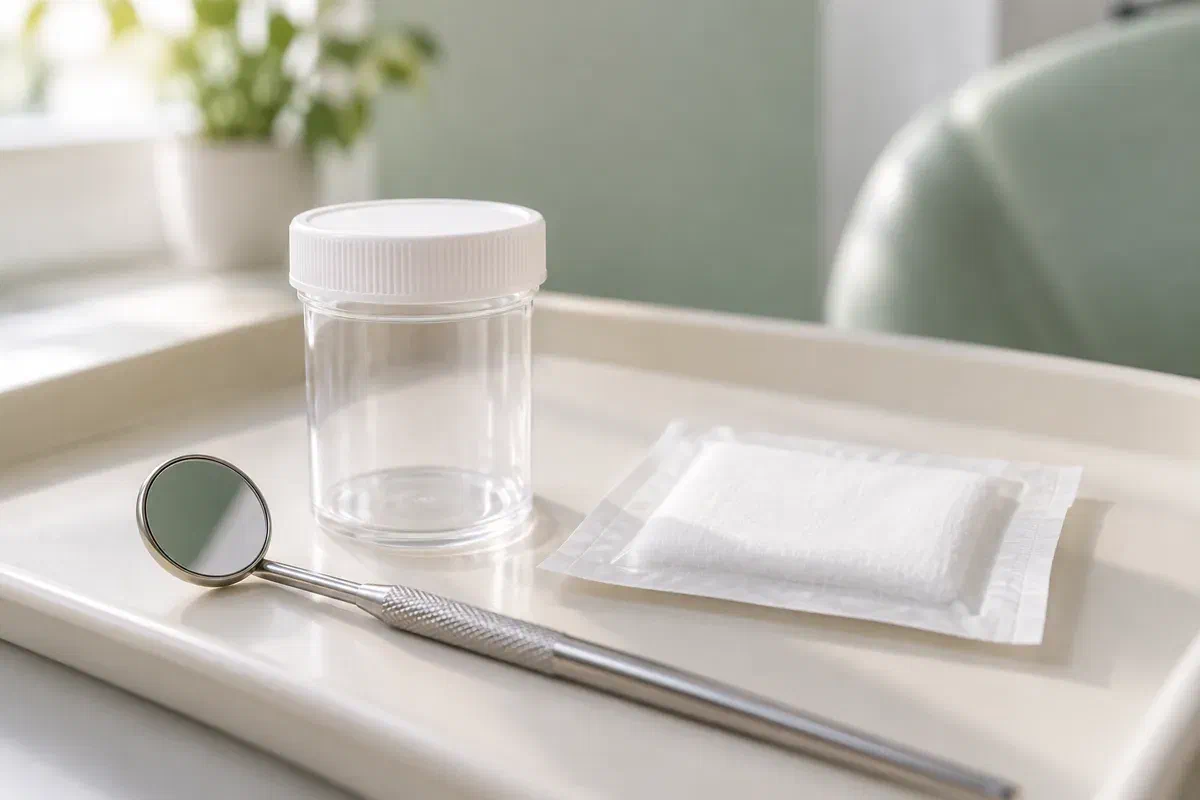
Illustrative empty closed specimen container beside packaged gauze and a dental mirror
Where it often begins

The history you share helps every provider involved.

Neither an online image nor a quick comparison can identify a lesion. A clear account helps each clinician you see: when it appeared, whether it has lasted, how it feels and what has already been tried.

A sore that hasn't resolved

Note when the ulcer or tender spot started and whether it looks different now. If a tooth, habit or appliance seems to be irritating it, mention that. A probable cause is useful information, but it doesn't remove the need for an exam if the area isn't healing.

A lump, patch or altered sensation

Point out the location and describe whether it has grown or changed in colour, surface or feel. Report bleeding, numbness or any difficulty eating or speaking. Lesions needing investigation are frequently painless, so comfort is not a reliable guide.

A referral moving between offices

If a biopsy has already been advised, bring every letter and report and ask how urgently the referring clinician wanted it done. Confirm whether your next booking is to examine the area, to perform the sampling or to discuss a finding.

When several offices are involved, it's easy for a recommended biopsy or specialist visit to drift. Don't let it slip because the area feels fine. Call the team managing it if it changes. Uncontrolled bleeding or difficulty breathing or swallowing needs emergency medical care.

Why coordination helps

Everyone working from the same answer

Your dentist can describe the lesion, but the laboratory is what examines the tissue. Ask what your biopsy should clarify and how different findings would change the plan. When all the providers involved are clear on the question, the answer is easier to act on, though no one can predict it in advance.

Map the results pathway before the procedure. Which office receives the report? Who calls you, and how? On what date should you follow up yourself? Taking the sample and explaining the diagnosis may even happen in different places, so neither should be mistaken for the whole process.

A sample with a clear purpose

The clinician chooses whether to sample part of the area or remove a small lesion based on the exam. Ask which and why. Sample size doesn't forecast the result; it's set by what's needed for a meaningful report.

Results explained by someone who knows your case

Ask the provider who did the biopsy to go through the findings in plain language and relate them to the sampled site. If the report leaves part of the question open, further review or sampling may be recommended.

A single coordinator for next steps

Monitoring, treatment or a further referral may follow. Ask which provider is coordinating and on what timeline. Even after a small lesion has been removed completely, check whether the area needs ongoing review and who will do it.

The pathway, mapped out

Four stages, possibly in more than one office

Mention it if the idea of a biopsy, or a procedure in your mouth, makes you nervous. Questions about the reason, comfort, the providers involved and how results arrive are welcome before you consent.

  1. Assessment and records

    Describe the timeline and bring photos, letters and any prior reports. The clinician reviews medicines, allergies, bleeding history and health conditions, and explains whether further assessment or a specialist is needed and how soon.

  2. Plan and consent

    You'll discuss where the tissue would come from, what kind of biopsy is proposed, the numbing plan and site-specific risks. Ask about stitches and arrangements for afterward. Confirm which provider and which office will perform it.

  3. Sampling

    Local anaesthetic is often used, depending on the case. The tissue is sent for laboratory examination and the site is looked after. Ask for written aftercare, and ask who to call with questions, especially if the biopsy was done somewhere other than your usual dentist.

  4. Results and handover

    Keep the agreed results call or visit. Ask what the report means for you, whether anything needs treating and how monitoring will work. If further tests or another referral are suggested, find out why and who arranges them.

After the procedure

Know whose instructions to follow, and whose number to call.

Aftercare depends on the biopsy site, the extent of the sample and your health. Use the instructions from the provider who performed it, not general extraction advice or someone else's biopsy routine.

Take care while numb

A frozen lip, cheek or tongue is easy to bite. Follow the advice about eating, drinking and activity. Ask how much soreness is likely and which pain relievers are safe with your other medicines.

Clean as directed

Ask how to clean around the area and whether rinses or stitch care are recommended. Leave the wound alone otherwise. If something looks unexpected, phone the office that did the biopsy rather than removing anything.

Call the right office

Report worsening pain, notable swelling, fever, or bleeding that persists despite the instructions to the provider who performed the procedure. For heavy bleeding that won't stop, or trouble breathing or swallowing, get emergency medical care at once.

Possible paths

Review, sample or refer onward

Ask why one route is recommended over another. Monitoring, sampling and specialist care each have a distinct role. None of them should become a way to leave a concern without an owner.

When a recheck is appropriate

Scheduled observation

An area might be reviewed after an irritant is addressed. Ask who will see you, when, and what changes mean calling earlier. Observation needs a reason and a deadline; a suspicious lesion shouldn't stay on watch indefinitely because it's painless.

When tissue must be studied

A biopsy

Incisional biopsies take a section of an area; excisional biopsies remove a suitable small lesion entirely. The clinician decides from the findings. Removing the visible area doesn't by itself close the need for follow-up.

When another provider is needed

A specialist and shared care

You may be referred to an oral surgeon, an oral medicine specialist or another appropriate clinician. Ask what the referral should answer, its expected timing and which office will keep track of the outcome.

Coordination questions

Keeping several providers on the same page

These may help you get ready for the assessment and the results conversation. Your clinician can explain your lesion, the proposed procedure and the follow-up after examining you.

(905) 876-4488
Who is responsible for my result if a specialist did the biopsy?
Usually the provider who performed the biopsy receives the report and explains it, but confirm this beforehand. Ask whether your regular dentist will also get a copy.
Will my regular dentist be updated after a specialist visit?
Ask the specialist’s office. Sharing information between providers helps continuity of care, with your consent. It also means that at your next routine cleaning, your dentist knows which area to keep an eye on and whether any review dates were set, instead of relying on your memory of a conversation that may have happened months earlier.
What should I do if the specialist's office hasn't called me?
Phone the office directly to confirm the referral arrived. If it hasn’t, ask the referring clinician to resend it. Let the referring office know as well if you can’t get an appointment within the recommended timeframe, since they may be able to suggest another provider.
Do I need a referral to see an oral surgeon?
Many specialist offices accept referrals from a dentist or physician. Ask the clinician who recommended the biopsy how the referral will be made.
Can the specialist and my family doctor both see the report?
Ask how reports are shared. With your consent, copies can often be sent to other providers involved in your care. Give each office the correct names and contact details at the start, so nothing is sent to the wrong place.
If I live in a smaller Caledon village, how do I keep everything organised?
Keep a single folder or note with each office’s name, phone number and the date you expect to hear from them. That makes it easier to follow up if a step is delayed.
Biopsy coordination from Caledon

Start with an exam and a clear map of who does what.

For an oral lesion assessment, or to go over a biopsy referral you've already received, call (905) 876-4488. Our Bronte Street team can review the details with you. If you've been told the next step is urgent, mention it so we can help with the right appointment or referral.

Biopsy plans vary by provider, setting, sampling method, recovery and how long the lab takes. Confirm results and follow-up with whichever clinician performs your biopsy.

Visit Milton Dental Clinic
Unit 1, 342 Bronte St. S, Milton, ON L9T 5B7
Get directions Clinic hours
Monday–Thursday
11am–7pm
Friday–Sunday
By appointment only

Areas we serve

  • Milton
  • Oakville
  • Mississauga
  • Georgetown
  • Halton Hills
  • Acton
  • Campbellville
  • Brampton
  • Burlington
  • Puslinch
  • Rockwood
  • Erin
  • Caledon
  • Etobicoke
  • Old Milton
  • Bronte Meadows
  • Timberlea
  • Dorset Park
  • Dempsey
  • Clarke
  • Beaty
  • Coates
  • Harrison
  • Scott
  • Willmott
  • Ford
  • Bowes
  • Cobden
  • Walker
  • Mountain View
  • Milton Heights
  • Hawthorne Village
  • Valley View
  • Fallingbrook
  • Nassagaweya
  • Trafalgar
  • Esquesing
  • Nelson
  • Brookville
  • Moffat
  • Glen Williams
  • Norval
  • Limehouse
  • Stewarttown
  • Ashgrove
  • Hornby
  • Silver Creek
  • Speyside
  • Scotch Block
  • North Oakville
  • River Oaks
  • Glen Abbey
  • West Oak Trails
  • Palermo
  • Bronte Creek
  • College Park
  • Joshua Creek
  • Uptown Core
  • Preserve
  • Iroquois Ridge
  • Lisgar
  • Meadowvale
  • Meadowvale Village
  • Churchill Meadows
  • Erin Mills
  • Central Erin Mills
  • Streetsville
  • East Credit
  • Creditview
  • Heartland
  • Sheridan
  • Mount Pleasant
  • Credit Valley
  • Huttonville
  • Churchville
  • Springbrook
  • Northwest Brampton
  • Bram West
  • Fletcher's Meadow
  • Fletcher's Creek South
  • Alton Village
  • Orchard
  • Millcroft
  • Headon Forest
  • Tansley
  • Brant Hills
  • Tyandaga
  • Kilbride
  • Lowville
  • Aberfoyle
  • Morriston
  • Arkell
  • Hillsburgh
  • Freelton
  • Carlisle
  • Waterdown
  • Flamborough
  • Mountsberg

How can we help?

Milton Dental Clinic

Have a question about your smile? Choose the option that works best for you.

For urgent dental concerns, please call.
Messages are reviewed during clinic hours.