

Illustrative patient discussing changes around a dental implant with a clinician
Specialized Care

Peri-Implantitis Assessment in Campbellville

Out in Campbellville, it's tempting to wait for the next planned trip into town before mentioning a tender implant. A quick call first lets our team judge how soon you should be seen, then the assessment checks the gum, the bone support and the restoration, and ends with a plan you can organize around.

Implant concerns from Campbellville

Wait for the next trip, or call today?

Rural households tend to bundle errands, and dental visits are no exception. That works well for routine care, but a changing implant shouldn't sit on a list for weeks without a word to anyone. Gum and bone around an implant can become inflamed; when bone support is progressively lost as well, the problem is called peri-implantitis. Similar signs can come from other causes, so it takes an examination to know.

Once you're in the chair, the dentist reviews the soft tissue, takes measurements appropriate to implants, checks the restoration, and looks at X-rays. Earlier images are worth tracking down, because comparing them with new ones is how the clinician judges whether support has changed or simply looks the way it always did.

A short phone call from Campbellville can help you decide when to come in. Describe what you've noticed, roughly when the implant was placed, and who made the crown. If it suits your household, ask whether other family appointments can be booked the same day. No records? Say so; the team can plan the visit around what you have.

Call about an implant concern
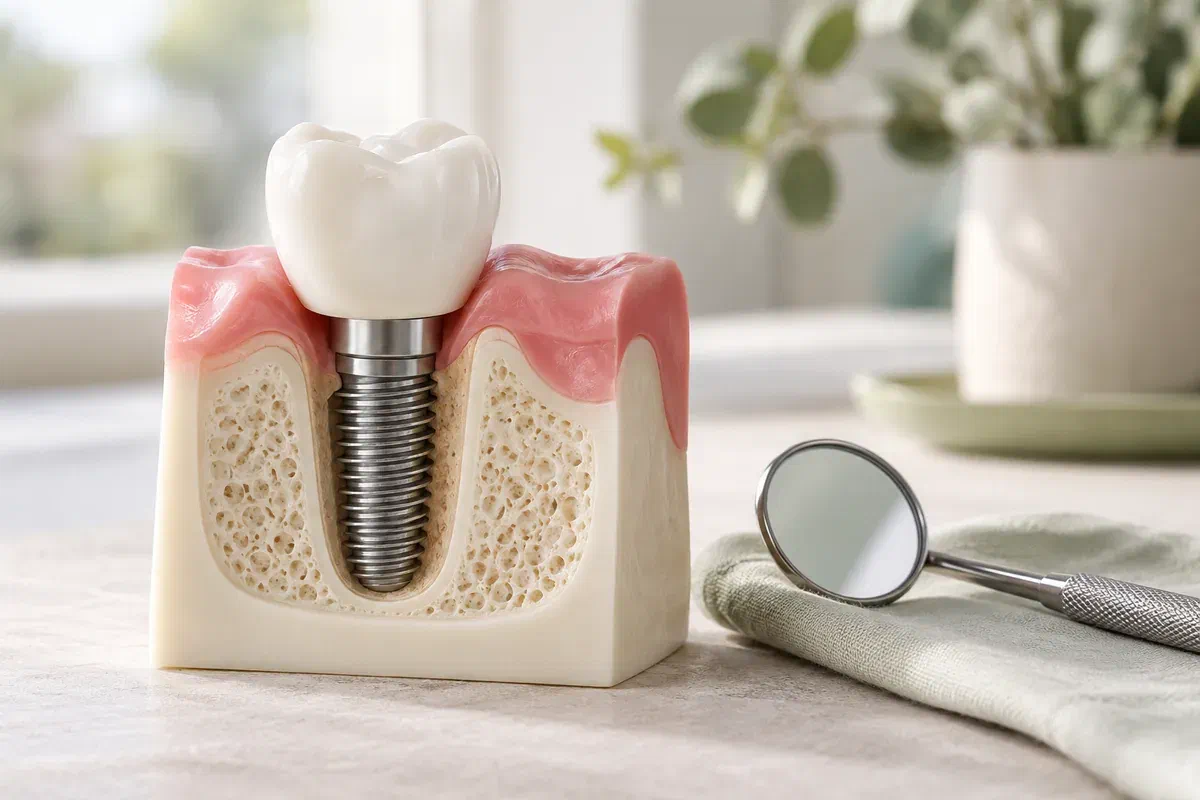
Illustrative implant teaching model with a connected crown, implant, gum, and bone base
What to report on the phone

Describe the change, and we'll help with the timing.

Share which implant, how long the change has been there, and whether eating or cleaning feels different. A comfortable implant may still need review, while a new feeling when biting could point to the crown as much as the tissue.

Bleeding, swelling, redness or pus

Explain whether bleeding is limited to cleaning or happens on its own, and whether any of these signs are increasing. A foul taste or tenderness belongs in the description. This helps the team judge how soon to see you; at the visit, inflammation and bone support are assessed separately.

Gum that's moved, or cleaning that's harder

Mention newly visible metal or crown edge, food collecting, or aids that won't reach. Bring your usual cleaning tools so access can be reviewed in person. Don't scrape the area with workshop or kitchen tools, and avoid forcing anything under the restoration.

Wobble, click or bite change

Report any looseness, a clicking sound, or a change in how the tooth meets its opposite. A loose crown or abutment is not the same problem as an implant moving in bone. Try not to keep checking it while you wait; the dentist will find out what moves.

Phone right away about a loose implant crown, swelling that's growing, discharge, or severe pain. If swelling spreads quickly, breathing or swallowing becomes difficult, or you feel seriously ill, go to the nearest emergency department rather than waiting for a dental appointment.

A plan you can organize around

Know what's wrong, who's next, and when to return.

Planning trips is easier when the findings are clear. By the end, you should know whether the trouble involves the gum, the bone, the crown and its parts, or a mix, and what is still uncertain. Those answers point toward better cleaning, component work, or treatment for established peri-implantitis, each serving a different purpose.

It also helps to know early whether anyone else needs to be involved. Records, the type of restoration, and the treatment required may mean a specialist or the original implant clinic should take part. Ask who arranges that, how quickly, and what to do at home in between.

Patient information: SDCEP — examination of peri-implant tissues and baseline records

Readings that make sense for implants

Probing depths are considered with bleeding, tissue appearance and history. Healthy implants can measure differently from one another, so a single figure isn't a diagnosis. Ask how this visit's findings compare with any earlier record.

Images gathered efficiently

Previous X-rays serve as a reference, and new ones are taken when the question calls for it. Ask what is being looked for and whether older films will do. If no baseline exists, ask what can be said today and how monitoring will be planned.

Clear about what treatment can offer

Ask what the next step is expected to accomplish and how its effect will be measured. Care for an implant that has lost bone can be involved, and keeping it is not assured. Referral or further treatment should come with reasons, not a promise of a quick fix.

From first call to follow-up

Phone, exam, explanation, plan

Don't know who placed the implant or what system it uses? Mention that on the call. The visit begins with the information available and identifies any records or specialist input that would help.

  1. A phone conversation to set timing

    Describe your symptoms, the implant's approximate age, any past trouble, and how it has been maintained. Share the placing clinic's name and any health changes. The team uses this to suggest how soon you should be seen and what to bring.

  2. An unhurried examination

    The dentist checks inflammation, cleaning access and the restoration, with measurements and images as appropriate. Mention whether the findings match the feeling you described. If something is moving, ask which component and whether it needs prompt restorative or specialist care.

  3. A straightforward explanation

    You'll go over whether the signs indicate gum inflammation, bone-support change, a mechanical problem, or a combination, and which questions remain open. Not every implant symptom is peri-implantitis, and a careful assessment says so.

  4. A plan that fits your calendar

    Agree on immediate care, who handles any further treatment, and when the site will be rechecked. Ask whether follow-ups can be grouped with other appointments. Find out how to reach the team if things worsen, and how records will move if another provider becomes involved.

Between trips

Simple habits until the next visit

Home care advice reflects the findings and any treatment you received. Ask for instructions specific to your own crown or bridge, since a technique designed for another implant style may not reach yours.

Gentle, well-chosen cleaning aids

Ask for a demonstration of cleaning around the implant and under any reachable part of the restoration. Mention any spot you can't get to. Avoid sharp tools for deposits and don't try to tighten anything yourself; those jobs need professional equipment.

Phone in with changes

Call about new swelling, discharge, pain or movement, or bleeding that gets worse. Avoid pressing the gum or rocking the crown. A quick call can tell you whether an earlier trip is worthwhile.

See the referral through

If another provider is part of your care, confirm the booking and that records have been sent. Ask who will assess the response to initial treatment. Feeling better doesn't by itself mean the bone question is resolved or the referral can be dropped.

What the findings may lead to

A response for each finding

For every recommendation, ask what it is meant to treat. Gum inflammation, progressive loss of support and a mechanical fault can occur together, but each needs addressing in its own way.

When inflammation and deposits are the main concern

Professional cleaning and easier home care

Early care may focus on a thorough professional clean and coaching on daily cleaning. Ask whether the restoration's shape makes access harder and whether its maker should look at it. Helpful as this can be, it isn't a sure remedy for bone support that's gone.

When findings show disease in the supporting bone

Coordinated care for peri-implantitis

Further treatment or specialist assessment may be required, and surgery can be considered when appropriate. Ask about the likely benefits, limits and outlook. Neither antibiotics nor lasers replace a plan grounded in the diagnosis.

When a component or the prognosis changes the options

Restoration work, or a frank talk about removal

A mechanical fault may be fixed by work on the crown or abutment. An implant with an unfavourable prognosis leads to a different discussion about alternatives. Ask what reasoning sits behind any recommendation; one reading alone doesn't decide it.

Patient information: SDCEP — treatment limitations and referral for peri-implantitis

Questions from Campbellville

Timing, travel and implant tissue

Implant records and earlier X-rays help if you have them, but please call without them too. The visit can clarify which details matter and whether anyone else should be involved.

(905) 876-4488
How do I know whether my implant concern can wait a few days?
Call and describe your symptoms. Increasing swelling, discharge, a loose crown or significant pain usually means being seen sooner. Mild, stable changes may be scheduled more flexibly, but the team will advise based on what you describe.
Can family appointments be booked on the same day as my implant check?
Ask when you call. Coordinating visits can make a trip more practical, as long as your implant concern is seen within a sensible time frame for the symptoms you have.
Is an implant problem urgent if it doesn't hurt?
Not always urgent, but still worth checking. Peri-implant problems can develop without pain, so bleeding, gum changes or looseness deserve an appointment even when you feel comfortable.
Does gum bleeding around the implant mean bone is involved?
Not automatically. Bleeding signals inflammation, but confirming bone involvement requires examination and appropriate images. The dentist will explain which condition fits the findings.
What should I avoid doing to the implant while I wait?
Avoid pressing, rocking or trying to tighten it, and don’t scrape at deposits. Keep cleaning gently with suitable aids, and call if anything worsens before your appointment.
Can the assessment go ahead if I don't know what implant I have?
Yes. Share what you remember. The team can assess the tissue and restoration and discuss whether records or specialist input should be sought before any repairs are planned.
Booking from Campbellville

One phone call can settle the timing.

Reach Milton Dental Clinic at (905) 876-4488 to talk through your implant concern. Describe any bleeding, swelling, looseness or pain, and the team can suggest how soon to come in and help plan the trip.

Diagnosis, treatment complexity, referral and the implant's outlook depend on individual findings. An assessment can't guarantee the implant will be kept or that a specific surgical treatment will be on offer.

Visit Milton Dental Clinic
Unit 1, 342 Bronte St. S, Milton, ON L9T 5B7
Get directions Clinic hours
Monday–Thursday
11am–7pm
Friday–Sunday
By appointment only

Areas we serve

  • Milton
  • Oakville
  • Mississauga
  • Georgetown
  • Halton Hills
  • Acton
  • Campbellville
  • Brampton
  • Burlington
  • Puslinch
  • Rockwood
  • Erin
  • Caledon
  • Etobicoke
  • Old Milton
  • Bronte Meadows
  • Timberlea
  • Dorset Park
  • Dempsey
  • Clarke
  • Beaty
  • Coates
  • Harrison
  • Scott
  • Willmott
  • Ford
  • Bowes
  • Cobden
  • Walker
  • Mountain View
  • Milton Heights
  • Hawthorne Village
  • Valley View
  • Fallingbrook
  • Nassagaweya
  • Trafalgar
  • Esquesing
  • Nelson
  • Brookville
  • Moffat
  • Glen Williams
  • Norval
  • Limehouse
  • Stewarttown
  • Ashgrove
  • Hornby
  • Silver Creek
  • Speyside
  • Scotch Block
  • North Oakville
  • River Oaks
  • Glen Abbey
  • West Oak Trails
  • Palermo
  • Bronte Creek
  • College Park
  • Joshua Creek
  • Uptown Core
  • Preserve
  • Iroquois Ridge
  • Lisgar
  • Meadowvale
  • Meadowvale Village
  • Churchill Meadows
  • Erin Mills
  • Central Erin Mills
  • Streetsville
  • East Credit
  • Creditview
  • Heartland
  • Sheridan
  • Mount Pleasant
  • Credit Valley
  • Huttonville
  • Churchville
  • Springbrook
  • Northwest Brampton
  • Bram West
  • Fletcher's Meadow
  • Fletcher's Creek South
  • Alton Village
  • Orchard
  • Millcroft
  • Headon Forest
  • Tansley
  • Brant Hills
  • Tyandaga
  • Kilbride
  • Lowville
  • Aberfoyle
  • Morriston
  • Arkell
  • Hillsburgh
  • Freelton
  • Carlisle
  • Waterdown
  • Flamborough
  • Mountsberg

How can we help?

Milton Dental Clinic

Have a question about your smile? Choose the option that works best for you.

For urgent dental concerns, please call.
Messages are reviewed during clinic hours.