

Illustrative patient discussing changes around a dental implant with a clinician
Specialized Care

Peri-Implantitis Assessment in Georgetown

A rinse from the pharmacy or a leftover prescription can be tempting when the gum around an implant flares up. Before trying a quick fix, people in Georgetown can have our team find out what is actually happening in the tissue, the bone and the restoration, and agree on care that suits the real cause.

Georgetown peri-implant assessment

Diagnosis before remedy

It's understandable to reach for something from the medicine cabinet when an implant's gum looks angry. The catch is that symptoms around implants have several possible sources. Peri-implantitis is one: inflammation of the tissues around the implant along with progressive loss of the bone that supports it. Gum-only inflammation, trapped debris and a loose part can look and feel surprisingly similar.

Choosing the right care depends on knowing which of these is present. That is what an assessment establishes. The dentist reviews the gum, takes implant-appropriate measurements, checks the restoration, and studies X-rays, comparing with older images whenever they exist, since change over time is what reveals bone loss.

Calling from Georgetown, let us know if you've already tried a rinse or medication, and for how long. Share roughly when the implant was placed and who restored it, and bring any card or report you kept. Lost paperwork is no barrier to booking; the team can talk about how to work without it.

Find out what's behind the symptoms
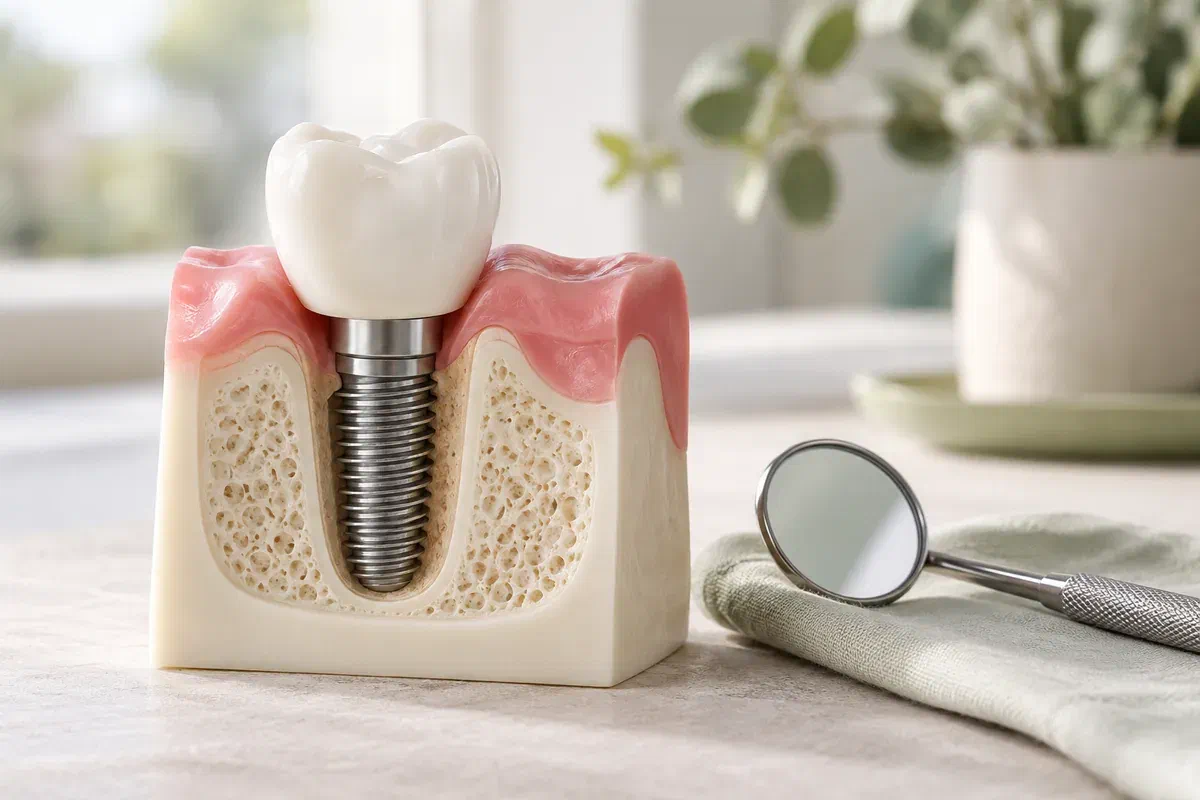
Illustrative implant teaching model with a connected crown, implant, gum, and bone base
Signs that need a professional look

When home remedies aren't the answer

Tell us which implant is bothering you, how long it has been happening, and whether your chewing or cleaning has changed. A pain-free implant can still need review, and an odd bite sensation may involve the crown as much as the tissue below.

Inflamed or draining gum

Report redness, puffiness, bleeding during or apart from cleaning, discharge, or an unpleasant taste, and whether any of it is increasing. Mention remedies you've tried. The examination treats inflammation and bone support as separate questions instead of assuming a single disease.

Shrinking gum or blocked access

Point out any new exposure of metal or crown edge, food catching, or aids that won't reach. A practical access review is part of the visit. Please don't attempt to scrape deposits away with household tools or force anything under the restoration.

Looseness or bite change

Describe a wobble, click, or difference in how the tooth meets its neighbours. A loose crown or abutment calls for different care than an implant that is moving in bone. Avoid testing it repeatedly; the dentist will identify the moving part.

Call without waiting if an implant crown loosens, swelling worsens, discharge appears, or pain is significant. Swelling that spreads rapidly, trouble breathing or swallowing, or feeling seriously ill needs emergency medical care, not an over-the-counter remedy or routine appointment.

Why the cause comes first

A rinse can't fix a loose screw, and cleaning can't rebuild bone.

Each possible cause has its own remedy, which is why a clear explanation is the most valuable result of the visit. Ask whether the trouble lies in the gum, the bone, the restoration, or more than one place, and what is still uncertain. Cleaning, component work, and treatment for established peri-implantitis are not interchangeable.

The assessment should also clarify who will provide the next stage of care. Depending on the records, the restoration, and the treatment required, that might involve the clinic that placed the implant or a specialist. Ask who will reach out to whom and what you should do while waiting.

Patient information: SDCEP — examination of peri-implant tissues and baseline records

Readings interpreted properly

Probing depths at implants are read with bleeding, tissue appearance and history. Healthy implant depths vary, so a single figure isn't a diagnosis. Ask how this exam compares with earlier records and what the overall pattern suggests.

Imaging to answer the bone question

Previous X-rays can provide a baseline, and new images are taken when they will help. Ask what the dentist is checking and whether old films are adequate. Without a baseline, ask what can be concluded today and what monitoring should follow.

No promises a product can't keep

Ask what the proposed treatment can achieve and how its effect will be measured. Managing an implant with bone loss can be complex, and saving it can't be guaranteed. Recommendations should be explained by their reasons, not sold as a one-step cure.

The assessment in four parts

Understand first. Treat second.

Not sure who placed your implant or what type it is? Tell the team. The visit begins with the information on hand and identifies what records or specialist views would help.

  1. History, including what you've tried

    Share the implant's approximate age, past issues, how it's been maintained, recent symptoms, and any rinses or medications already used. Bring the placing clinic's details if available. Your general health and cleaning habits help the dentist read the findings in context.

  2. Examination of every layer

    The dentist checks the gum for inflammation, evaluates access, and inspects the restoration and its connection, with measurements and images as appropriate. Say whether the findings match what you've felt. If anything moves, ask which part it is and whether it needs prompt attention.

  3. An explanation with its uncertainties

    You'll discuss whether the signs point to gum inflammation, bone-support change, a mechanical problem, or a mix, and which conclusions need more evidence. A good assessment is honest about what isn't yet known instead of labelling everything peri-implantitis.

  4. Care, referral and review agreed

    Confirm the immediate plan, who will handle any further treatment, and when the response will be checked. Ask how to get advice if the area flares again. When care is shared, find out how information will pass between the clinics.

During treatment and after

What to do, and what to leave alone

Your home-care instructions depend on the findings and any treatment you've had. Ask for guidance specific to your restoration, rather than a technique meant for a different kind of implant.

Follow the cleaning plan you were shown

Ask for a demonstration of cleaning around the implant and beneath any reachable part of the restoration. Explain where you struggle. Avoid sharp tools for removing deposits, don't tighten anything yourself, and check before adding new rinses or products.

Report changes instead of self-treating

Contact the team about new swelling, discharge, pain or movement, or bleeding that changes. Avoid poking the gum or rocking the crown. Keeping short notes with dates is more helpful at review than repeated home checks.

Keep the referral and the review

If another provider is involved, confirm the appointment and the transfer of records. Ask who will review the response to initial care. Feeling better is welcome, but it doesn't confirm that bone support is stable or that a referral is no longer needed.

Treatment depends on findings

Three directions the plan might take

Ask which problem each suggestion is aimed at. Gum inflammation, ongoing loss of support and a mechanical fault may occur together, and each needs to be addressed on its own merits.

When inflammation and deposits are the main issue

Professional cleaning and improved home care

The starting point may be careful cleaning plus coaching on a routine you can keep up. Ask whether the restoration makes access difficult and whether its maker should review it. This step can matter, but it isn't a guaranteed cure where bone support has already been lost.

When the bone around the implant is affected

Coordinated care for peri-implantitis

Further treatment or specialist input may be needed, and surgery may be an option in suitable cases. Ask about expected benefits, limitations and prognosis. Antibiotics or lasers can't stand in for a management plan built on an accurate diagnosis.

When a part fails or the outlook is uncertain

Restoration repair, or a talk about removal

A mechanical fault may need work on the crown or abutment, whereas an implant with an unfavourable prognosis prompts a broader discussion. Ask what reasoning supports any recommendation and which alternatives exist. No single reading or loose crown decides it.

Patient information: SDCEP — treatment limitations and referral for peri-implantitis

Georgetown treatment questions

Quick fixes and what actually helps

Bring implant records and earlier X-rays if you have them, but don't wait for them to book. The assessment can identify what information is needed and who should be involved.

(905) 876-4488
Can an antiseptic mouthwash cure inflammation around an implant?
A rinse may be recommended as part of care in some cases, but it doesn’t address deposits, restoration problems, or bone loss on its own. Ask the dentist whether a rinse fits your plan.
Should I take leftover antibiotics for a sore implant?
No. Leftover antibiotics may not be appropriate and can mask what is happening. Medicines should only be used when a clinician has assessed the area and explained why they are indicated.
Is laser treatment the answer for peri-implantitis?
Lasers are sometimes discussed, but no single tool replaces a plan based on the diagnosis. Ask what any proposed treatment adds and how its effect will be assessed.
If the swelling goes down, do I still need the appointment?
Yes. Symptoms can settle while the underlying cause remains. Keep the assessment so the dentist can check the gum, bone and restoration properly.
Does gum bleeding near the implant prove peri-implantitis?
No. Bleeding indicates inflammation, but bone involvement must be assessed through examination and images. The dentist will explain whether it is gum-only inflammation or peri-implantitis.
Is it a problem if my implant was placed at another clinic?
Not at all. Share where it was done and any records you have. The team can assess it and discuss coordination with the original provider or a specialist when needed.
From Georgetown

Tell us what's changed and what you've tried.

Milton Dental Clinic can be reached at (905) 876-4488. When you call to book an implant assessment, mention any bleeding, swelling, looseness or pain, plus remedies you've already used, so the team can advise how soon to come in.

The diagnosis, complexity of treatment, any referral and the implant's prognosis all rest on the findings. An assessment doesn't guarantee implant retention or confirm that a particular surgical treatment is available.

Visit Milton Dental Clinic
Unit 1, 342 Bronte St. S, Milton, ON L9T 5B7
Get directions Clinic hours
Monday–Thursday
11am–7pm
Friday–Sunday
By appointment only

Areas we serve

  • Milton
  • Oakville
  • Mississauga
  • Georgetown
  • Halton Hills
  • Acton
  • Campbellville
  • Brampton
  • Burlington
  • Puslinch
  • Rockwood
  • Erin
  • Caledon
  • Etobicoke
  • Old Milton
  • Bronte Meadows
  • Timberlea
  • Dorset Park
  • Dempsey
  • Clarke
  • Beaty
  • Coates
  • Harrison
  • Scott
  • Willmott
  • Ford
  • Bowes
  • Cobden
  • Walker
  • Mountain View
  • Milton Heights
  • Hawthorne Village
  • Valley View
  • Fallingbrook
  • Nassagaweya
  • Trafalgar
  • Esquesing
  • Nelson
  • Brookville
  • Moffat
  • Glen Williams
  • Norval
  • Limehouse
  • Stewarttown
  • Ashgrove
  • Hornby
  • Silver Creek
  • Speyside
  • Scotch Block
  • North Oakville
  • River Oaks
  • Glen Abbey
  • West Oak Trails
  • Palermo
  • Bronte Creek
  • College Park
  • Joshua Creek
  • Uptown Core
  • Preserve
  • Iroquois Ridge
  • Lisgar
  • Meadowvale
  • Meadowvale Village
  • Churchill Meadows
  • Erin Mills
  • Central Erin Mills
  • Streetsville
  • East Credit
  • Creditview
  • Heartland
  • Sheridan
  • Mount Pleasant
  • Credit Valley
  • Huttonville
  • Churchville
  • Springbrook
  • Northwest Brampton
  • Bram West
  • Fletcher's Meadow
  • Fletcher's Creek South
  • Alton Village
  • Orchard
  • Millcroft
  • Headon Forest
  • Tansley
  • Brant Hills
  • Tyandaga
  • Kilbride
  • Lowville
  • Aberfoyle
  • Morriston
  • Arkell
  • Hillsburgh
  • Freelton
  • Carlisle
  • Waterdown
  • Flamborough
  • Mountsberg

How can we help?

Milton Dental Clinic

Have a question about your smile? Choose the option that works best for you.

For urgent dental concerns, please call.
Messages are reviewed during clinic hours.