

Illustrative patient discussing changes around a dental implant with a clinician
Specialized Care

Peri-Implantitis Assessment in Puslinch

Implant problems sometimes need more than one clinician: a general dentist, the team that restored it, perhaps a gum or implant specialist. For people coming from Puslinch, our assessment sorts out what is happening around the implant and who is best placed to handle each part, so care stays coordinated.

Coordinated implant care for Puslinch

Several people may have a role. Start with a clear assessment.

An implant often involves a surgeon who placed it, a dentist who made the crown, and a hygiene team who maintains it. When the surrounding gum becomes sore or bleeds, the first job is finding out what is wrong. Peri-implantitis is inflammation around the implant accompanied by progressive loss of supporting bone. Other problems can mimic it, so an examination comes before any decision about who treats what.

In the assessment, the dentist reviews the soft tissue, measures in a way that suits implants, checks the restoration, and looks at X-rays. Earlier images, whether from the surgeon or a past review, are particularly helpful, since they let the clinician see whether support has changed and how quickly.

If you're coming from Puslinch, gather the names of everyone involved in your implant, even approximately: who placed it, who restored it, and roughly when. Any card or treatment letter is useful. If you can't recall or the records are gone, mention that when booking; the team can work out which details are worth requesting.

Start with an implant assessment
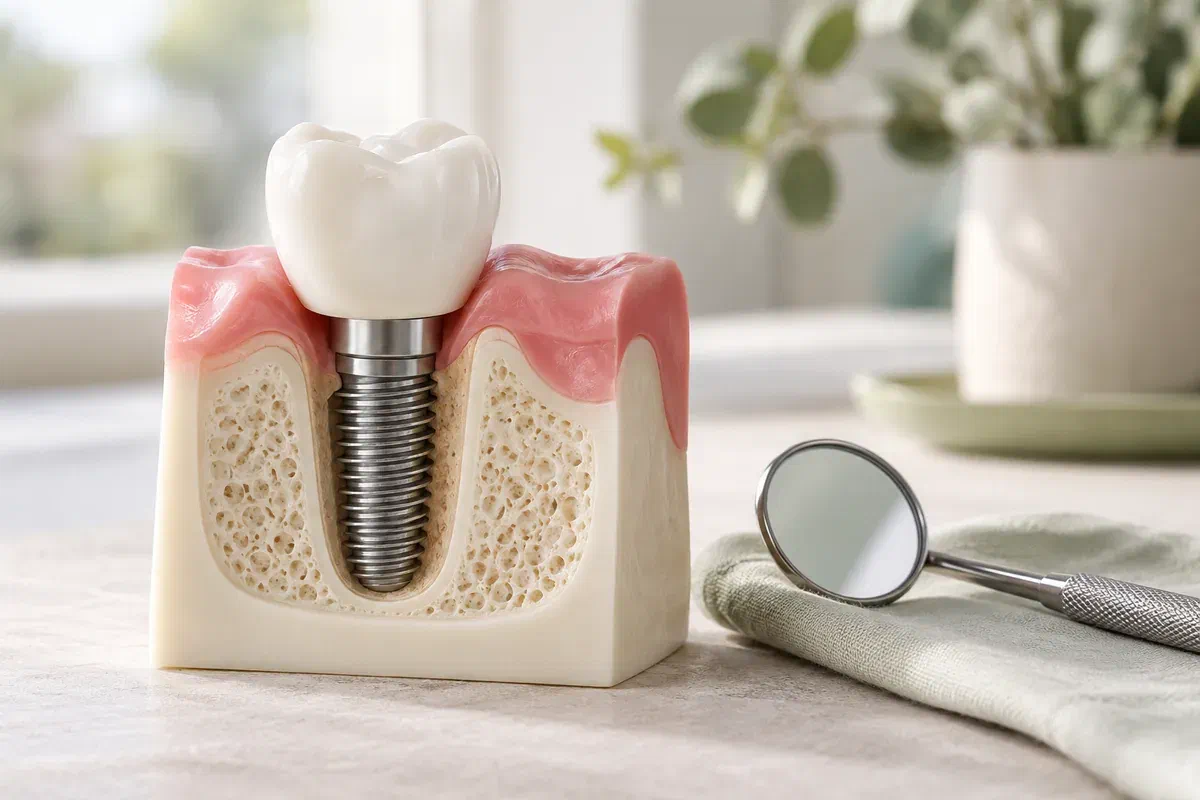
Illustrative implant teaching model with a connected crown, implant, gum, and bone base
Reasons to come in

Changes that deserve a professional opinion

Let us know which implant, when the change started, and what feels different when eating or cleaning. An implant can be comfortable and still need checking, and a new sensation on biting might relate to the restoration as well as the gum.

Inflammation you can see or taste

Mention bleeding during or between cleanings, redness, puffiness, discharge or an odd taste, and whether these are increasing. Tenderness matters too. The dentist looks at inflammation and bone support as separate issues, rather than assuming every bleeding site signals the same disease.

Recession or new cleaning difficulty

Describe more visible crown edge or implant surface, food packing in, or floss and brushes that no longer reach. These details help decide whether the restoration also needs attention. Don't scrape exposed areas with household tools or force bristles underneath.

Movement or an altered bite

Report looseness, clicking, or a change in how the tooth meets its neighbours. A moving crown or abutment usually goes to the restoring dentist; an implant moving in bone is a different matter. Avoid testing it so the source can be identified cleanly.

Call promptly about a loose implant crown, worsening swelling, discharge, or significant pain. If swelling spreads fast, breathing or swallowing is affected, or you feel seriously unwell, seek emergency medical help instead of waiting for any dental appointment.

Clarity for everyone involved

A shared understanding of what's wrong

When more than one clinician may be involved, a clear summary is what keeps care from stalling. Ask whether the issue is in the gum, the bone, the crown and its connection, or more than one of these, and what remains unknown. That determines whether cleaning, restorative repair, or peri-implantitis treatment is needed, and who should provide it.

Referral is not a hand-off and forget. With your consent, findings and images can be shared with a specialist or the clinic that placed the implant, so nobody starts from scratch. Ask who will make contact, what will be sent, and what care you'll receive while the referral is arranged.

Patient information: SDCEP — examination of peri-implant tissues and baseline records

Measurements other clinicians can use

Probing depths are recorded and interpreted with bleeding, tissue appearance and history. Healthy implant sites vary, so one reading isn't a diagnosis. Ask how today's results compare with earlier records and how they'll be passed on.

Images that travel with you

Previous X-rays give a baseline and new images are added when they help answer the question. Ask whether the images can be shared with a specialist to avoid repeats. With no earlier record, ask what can be concluded now and how monitoring will work.

Honest about outcomes

Ask what each proposed step is meant to achieve and who will check its effect. Care for an implant with bone involvement can be complex, and retention isn't guaranteed. Reasons for referral should be explained, with no suggestion that a single cleaning or product will settle things.

How coordination works

Assess, explain, then connect the right people

If you're unsure who placed or restored your implant, say so. The assessment begins with what is known and identifies which records or specialists would be useful.

  1. List the people and the history

    Share the implant's approximate age, the clinics involved, any past problems, its maintenance history, health changes and recent symptoms. Paperwork helps but isn't essential. This background lets the dentist read the findings in context.

  2. Examine and record carefully

    The dentist assesses inflammation, cleaning access and the restoration, taking measurements and images as indicated. Say whether the findings match what you've felt. If something moves, ask which part and whether restorative or specialist care should follow promptly.

  3. Explain the findings and what's uncertain

    You'll discuss whether the signs suggest gum inflammation, bone-support change, a mechanical fault, or a combination. Ask which points are well established and which need specialist input or further tests to confirm.

  4. Assign roles and set the review

    Confirm who does what next: cleaning here, restorative work, specialist care, or a combination. Agree on when the area will be reviewed and who to call if symptoms change. Ask what will be sent to each provider and when.

While the referral is underway

Stay on top of cleaning and appointments.

Home instructions reflect the findings and any treatment already provided. Ask for guidance tailored to your restoration, rather than a generic method designed for a different implant.

Clean gently with the right aids

Ask the clinician to demonstrate cleaning around the implant and under any reachable part of the restoration. Mention spots you can't reach. Don't remove deposits with sharp objects or try to tighten components at home.

Track symptoms for every provider

Note new swelling, discharge, pain, movement, or changes in bleeding, with dates. Avoid pressing the gum or rocking the crown to see whether it has changed. A single symptom record that you bring to every appointment helps each clinician who sees you start from the same information.

Confirm each step happens

Check that the specialist appointment is booked and records have arrived. Ask who will review the response to initial care. Improved symptoms don't by themselves answer the bone question or make the referral unnecessary.

Who might provide what

Matching each problem to the right clinician

Ask which part of the issue each recommendation addresses, and who will deliver it. Inflamed gum, loss of bone support and a mechanical fault can coexist, but they may be handled by different people.

When inflammation and deposits need managing

Cleaning and home-care coaching

This may be provided here: professional cleaning and practical advice for daily care. Ask whether the restoration's design limits access and whether the restoring clinic should assess it. This step can help, but isn't a guaranteed cure where bone support is lost.

When disease involves the supporting bone

Specialist-led peri-implantitis care

Treatment may need a specialist, and surgery can be considered in suitable cases. Ask about expected benefits, limitations and prognosis. Antibiotics or laser treatment should not be assumed to replace a plan built on the diagnosis.

When a component fails or the prognosis shifts

Restorative repair, or a removal discussion

A mechanical problem may go to the dentist who made the restoration, while an implant with an unfavourable prognosis leads to a broader conversation. Ask what is driving any recommendation and what alternatives exist. One measurement doesn't decide it.

Patient information: SDCEP — treatment limitations and referral for peri-implantitis

Referral questions from Puslinch

Specialists, records and shared care

Bring implant records and earlier X-rays if you have them, but call even if you don't. The assessment can identify what details matter and which clinicians should be involved.

(905) 876-4488
What kind of specialist treats peri-implantitis?
Periodontists, who specialize in gums and supporting structures, often manage peri-implant disease. Oral surgeons or prosthodontists may also be involved depending on the problem. The dentist will explain who is appropriate for your findings.
Will I have to repeat X-rays at the specialist's office?
Not necessarily. With your consent, images can be shared ahead of the referral appointment. The specialist may still need additional views, depending on the question they need to answer, and will explain why if they do.
Can my regular cleanings continue during specialist treatment?
Often yes, but timing and technique may need adjusting around any treatment. Ask both offices how maintenance should be coordinated while care is underway, and which office should see you for routine visits once it is complete.
Who should I call if symptoms flare during a referral?
Ask at the assessment. Generally, contact the clinic currently managing the problem. For rapidly spreading swelling or difficulty breathing or swallowing, seek emergency medical care.
Does a bleeding implant always need a specialist?
No. Bleeding can reflect gum inflammation that may be managed with cleaning and improved home care. Referral is considered when findings suggest bone involvement or complexity beyond routine care.
If a loose crown is the problem, who fixes it?
Often the dentist who made the restoration, or another dentist familiar with the implant system. The assessment can confirm whether the crown, the abutment or the implant itself is involved before anyone decides, and whether the surrounding tissue needs attention at the same time.
Getting started from Puslinch

Bring the names. We'll help connect the dots.

Call (905) 876-4488 to book an implant assessment with Milton Dental Clinic. Mention any bleeding, swelling, looseness or pain, and who placed or restored the implant, so the team can plan the visit and any coordination.

Diagnosis, treatment complexity, referral and the implant's prognosis depend on the findings. Assessment doesn't guarantee the implant will be retained or that a particular surgical treatment is available.

Visit Milton Dental Clinic
Unit 1, 342 Bronte St. S, Milton, ON L9T 5B7
Get directions Clinic hours
Monday–Thursday
11am–7pm
Friday–Sunday
By appointment only

Areas we serve

  • Milton
  • Oakville
  • Mississauga
  • Georgetown
  • Halton Hills
  • Acton
  • Campbellville
  • Brampton
  • Burlington
  • Puslinch
  • Rockwood
  • Erin
  • Caledon
  • Etobicoke
  • Old Milton
  • Bronte Meadows
  • Timberlea
  • Dorset Park
  • Dempsey
  • Clarke
  • Beaty
  • Coates
  • Harrison
  • Scott
  • Willmott
  • Ford
  • Bowes
  • Cobden
  • Walker
  • Mountain View
  • Milton Heights
  • Hawthorne Village
  • Valley View
  • Fallingbrook
  • Nassagaweya
  • Trafalgar
  • Esquesing
  • Nelson
  • Brookville
  • Moffat
  • Glen Williams
  • Norval
  • Limehouse
  • Stewarttown
  • Ashgrove
  • Hornby
  • Silver Creek
  • Speyside
  • Scotch Block
  • North Oakville
  • River Oaks
  • Glen Abbey
  • West Oak Trails
  • Palermo
  • Bronte Creek
  • College Park
  • Joshua Creek
  • Uptown Core
  • Preserve
  • Iroquois Ridge
  • Lisgar
  • Meadowvale
  • Meadowvale Village
  • Churchill Meadows
  • Erin Mills
  • Central Erin Mills
  • Streetsville
  • East Credit
  • Creditview
  • Heartland
  • Sheridan
  • Mount Pleasant
  • Credit Valley
  • Huttonville
  • Churchville
  • Springbrook
  • Northwest Brampton
  • Bram West
  • Fletcher's Meadow
  • Fletcher's Creek South
  • Alton Village
  • Orchard
  • Millcroft
  • Headon Forest
  • Tansley
  • Brant Hills
  • Tyandaga
  • Kilbride
  • Lowville
  • Aberfoyle
  • Morriston
  • Arkell
  • Hillsburgh
  • Freelton
  • Carlisle
  • Waterdown
  • Flamborough
  • Mountsberg

How can we help?

Milton Dental Clinic

Have a question about your smile? Choose the option that works best for you.

For urgent dental concerns, please call.
Messages are reviewed during clinic hours.