

Illustrative patient discussing changes around a dental implant with a clinician
Specialized Care

Peri-Implantitis Assessment in Rockwood

A salty or sour taste that keeps returning near an implant, or a bead of fluid at the gum line, is a signal not to ignore. When you're travelling from Rockwood, our team can help you judge urgency by phone, then assess the tissue, bone support and restoration to find where the trouble starts.

When something tastes wrong

A taste you can't rinse away

Some people never see blood or swelling; they simply notice an unpleasant taste that lingers near one tooth, or a little fluid when they press their tongue against the gum. Around an implant, that can mean the tissues are inflamed. If the inflammation is accompanied by progressive loss of the bone holding the implant, it's called peri-implantitis. Trapped debris or a loose component can cause similar effects, so the source has to be found.

An assessment does that by looking at every layer. Gum tissue is examined and measured in the way implants require, the crown or bridge is checked where it joins the implant, and X-rays are read. Comparing them with any older images matters most for the bone question, because it reveals whether support has changed over time.

From Rockwood, start with a phone call. Describe the taste or fluid, how long it has been going on, and whether there is swelling or pain. Mention roughly when the implant went in and who restored it, and bring any records you kept. Nothing on file? That's fine; tell the team and they'll plan around it.

Get a persistent implant taste checked
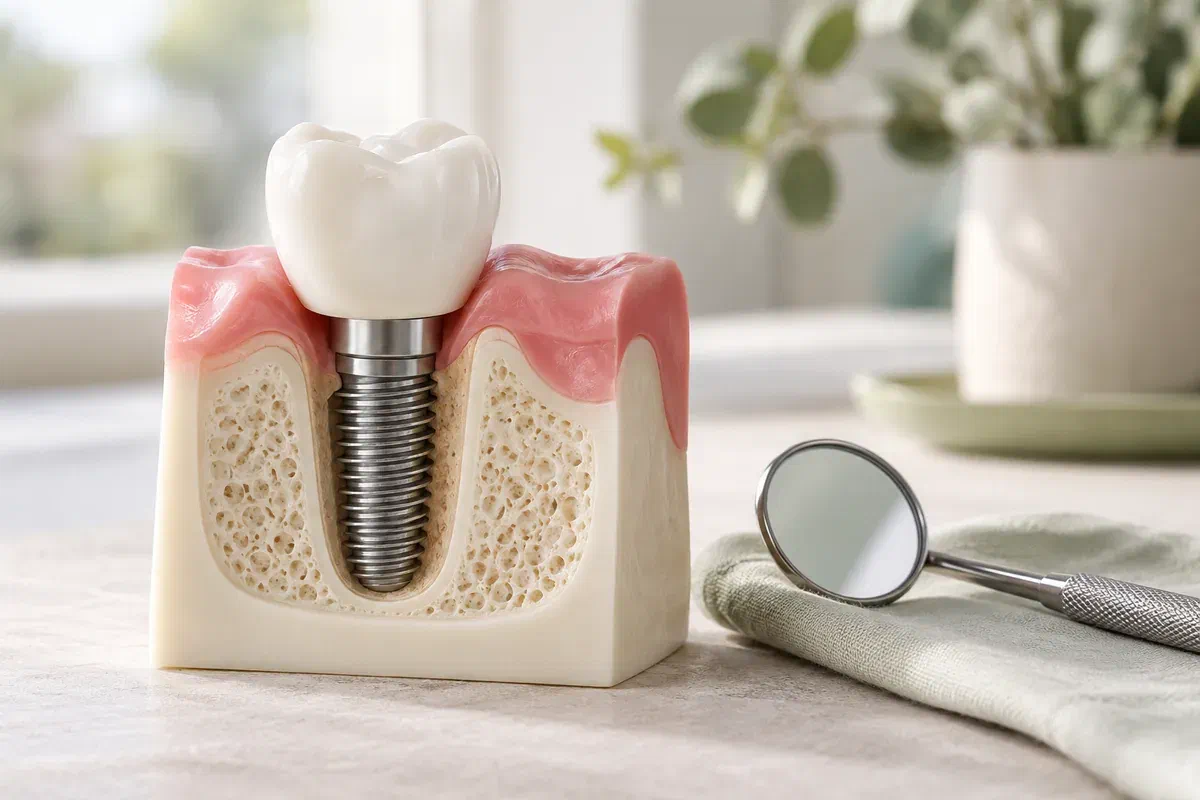
Illustrative implant teaching model with a connected crown, implant, gum, and bone base
Signs to describe

Taste, fluid, swelling, movement: what each might mean

Identify the implant, when you first noticed the change, and anything different about eating or cleaning. An implant can be pain-free and still need review, and a new feeling as you bite may involve the restoration as well as the surrounding tissue.

Discharge, bad taste, bleeding or swelling

Explain whether fluid or bleeding appears when you clean or without any trigger, and whether these signs are increasing. Note any redness or tenderness. The team uses this to judge how soon you should be seen, and the exam then separates inflammation from support loss.

Gum recession or trapped food

Mention newly exposed crown edge or metal, food lodging beside the implant, or cleaning aids that no longer reach. Debris trapped under a restoration can contribute to taste and inflammation. Avoid digging at it with household tools or forcing a brush beneath.

Looseness or a bite that's changed

Report any play, clicking, or change in how the tooth meets the others. A loose crown or abutment can leave a gap where debris collects, and it is a different issue from an implant moving in bone. Leave it alone so the dentist can determine what moves.

Call promptly if discharge continues, swelling increases, an implant crown loosens, or pain is strong. If swelling spreads quickly, you have difficulty breathing or swallowing, or you develop a fever and feel seriously unwell, seek emergency medical care rather than waiting for a dental visit.

Finding the source

Where the taste comes from changes what helps.

The assessment should leave you knowing whether the taste or fluid is coming from inflamed gum, a bone-support problem, a gap at the restoration, or several of these at once, and which points remain unclear. Cleaning, a component repair, and treatment for established peri-implantitis each do a different job, so this distinction matters.

Next comes deciding who carries the care forward. Available records, how complex the restoration is, and the treatment required can make it sensible to involve the original implant team or a specialist. Ask who will make the call, how soon, and what you should do at home while waiting.

Patient information: SDCEP — examination of peri-implant tissues and baseline records

Readings in their proper context

Probing depths are interpreted alongside bleeding, discharge, tissue appearance and history. Healthy implant sites differ, so a single figure isn't the diagnosis. Ask how this exam compares with earlier records and what the findings suggest together.

X-rays to answer one key question

Earlier images show where bone levels used to be; new ones are taken when they will add information. It's fair to ask what the images are meant to reveal and whether older films are clear enough. Without them, ask what can be concluded today and how monitoring will proceed.

Realistic about what comes next

Ask what any recommended step aims to achieve and how its effect will be checked. Managing peri-implantitis can be complex, and keeping the implant isn't guaranteed. Expect an explanation of why referral or treatment is advised, not a promise that one rinse or cleaning will clear it up.

How the assessment runs

From the first call to an agreed plan

Placed at another clinic, or not sure of the details? Tell the team. The visit starts with whatever you can share and works out which records or specialist views would help.

  1. Triage by phone

    Describe the taste, any fluid, swelling or pain, and how long it has lasted. Share the implant's approximate age, the placing clinic, and any health changes. The team uses this to suggest how soon to come in and what to bring.

  2. Examine where it starts

    Expect a search for inflammation and discharge, a look at how well you can reach the site, and a check of the restoration where it meets the implant, backed by measurements and X-rays when useful. Speak up if what's found doesn't fit what you've felt. If something moves, ask which part and how urgently it should be dealt with.

  3. Explain the probable cause

    You'll go over whether the signs point to soft-tissue inflammation, a change in bone support, a mechanical gap, or a combination, and which conclusions need more evidence. A careful assessment won't call every taste or bleed peri-implantitis.

  4. Agree on next steps

    Confirm immediate care, who will provide further treatment, and when the response will be reviewed. Ask how to reach the team if discharge or swelling returns. If another clinic is involved, check what will be sent and when.

Caring for the area at home

Keep it clean and keep watching.

Home instructions follow from the findings and any treatment carried out. Ask for a method built around your own restoration, since cleaning aids that suit one implant may miss another.

Thorough but gentle cleaning

Have the clinician show you how to reach the margins of the implant and the underside of the crown or bridge, where debris likes to hide. Mention places you can't reach. Avoid pointed tools and never attempt to tighten a component yourself.

Notice whether the taste returns

Report any return of taste or fluid, new swelling, pain or looseness, and changes in bleeding. Avoid pressing on the gum to produce discharge or rocking the crown. A short dated note helps at review.

Finish what was arranged

Where a specialist or another office is taking part, check that a date is booked and your notes and images have reached them. Find out who will judge whether the first stage of care worked. A taste that fades is good news, but the bone question stays open until someone has checked.

Options based on findings

Three possible routes

Ask what each recommendation is meant to address. Inflamed tissue, progressive loss of support and a restorative gap can coexist, but each calls for its own response.

When deposits and inflammation are behind the symptoms

Cleaning and better access at home

Initial care may involve careful professional cleaning and coaching on a home routine that reaches the problem spot. Ask whether the restoration's shape traps debris and whether its maker should review it. This can help, but it's not a guaranteed cure for bone already lost.

When disease affects the supporting bone

Coordinated care for peri-implantitis

Further treatment or specialist assessment may be needed, and surgery may be considered in suitable cases. Ask about likely gains, limits and the implant's outlook. Antibiotics or laser therapy aren't a replacement for a plan matched to the diagnosis.

When a part has failed or the prognosis changes

Repairing the restoration, or discussing removal

A loose or poorly sealing component may need restorative work, while an implant with an unfavourable prognosis leads to a different conversation. Ask what supports any recommendation and what alternatives remain. One measurement doesn't settle it.

Patient information: SDCEP — treatment limitations and referral for peri-implantitis

Rockwood implant questions

Taste, fluid and what they can signal

Records and older X-rays are welcome but not required. Call even if you have none, and the visit can identify which information matters and whether others should be involved.

(905) 876-4488
Why would there be a bad taste near my implant?
It can come from trapped debris, inflamed tissue, discharge, or a gap at the restoration. The dentist will examine the gum, the crown and its connection, and the bone support to find the source rather than guess.
Is fluid coming from the gum around an implant urgent?
Discharge deserves a prompt call. The team will ask about swelling, pain and fever to judge how soon you should be seen. Spreading swelling or trouble breathing or swallowing needs emergency medical care.
Can I use a salt-water rinse while I wait?
Ask the team when you call. A rinse may be suggested for comfort in some cases, but it doesn’t replace an assessment, and it won’t fix a loose part or bone loss on its own.
Does discharge mean the implant has to come out?
Not necessarily. Discharge shows the area needs attention, but decisions about the implant’s future depend on the full set of findings, including bone support and the restoration.
Could a loose abutment cause the taste rather than the gum?
It’s possible. A loose or poorly fitting component can allow debris to collect. The dentist will check both the parts and the tissue, since mechanical and tissue problems can occur together.
Does bleeding with the taste mean bone has been lost?
Not by itself. Bleeding and taste signal inflammation, but bone involvement must be confirmed with an examination and appropriate images. The dentist will explain which condition fits.
Calling from Rockwood

Something tastes off? A quick call helps set the timing.

Ring Milton Dental Clinic on (905) 876-4488 to talk through your symptoms and book an implant assessment. Mention any discharge, swelling, looseness, fever or pain so the team can judge the urgency and the right first step.

The diagnosis, complexity of care, need for referral and implant prognosis all rest on the examination. Nobody can promise in advance that the implant will be saved, or that a specific surgical option will suit your case.

Visit Milton Dental Clinic
Unit 1, 342 Bronte St. S, Milton, ON L9T 5B7
Get directions Clinic hours
Monday–Thursday
11am–7pm
Friday–Sunday
By appointment only

Areas we serve

  • Milton
  • Oakville
  • Mississauga
  • Georgetown
  • Halton Hills
  • Acton
  • Campbellville
  • Brampton
  • Burlington
  • Puslinch
  • Rockwood
  • Erin
  • Caledon
  • Etobicoke
  • Old Milton
  • Bronte Meadows
  • Timberlea
  • Dorset Park
  • Dempsey
  • Clarke
  • Beaty
  • Coates
  • Harrison
  • Scott
  • Willmott
  • Ford
  • Bowes
  • Cobden
  • Walker
  • Mountain View
  • Milton Heights
  • Hawthorne Village
  • Valley View
  • Fallingbrook
  • Nassagaweya
  • Trafalgar
  • Esquesing
  • Nelson
  • Brookville
  • Moffat
  • Glen Williams
  • Norval
  • Limehouse
  • Stewarttown
  • Ashgrove
  • Hornby
  • Silver Creek
  • Speyside
  • Scotch Block
  • North Oakville
  • River Oaks
  • Glen Abbey
  • West Oak Trails
  • Palermo
  • Bronte Creek
  • College Park
  • Joshua Creek
  • Uptown Core
  • Preserve
  • Iroquois Ridge
  • Lisgar
  • Meadowvale
  • Meadowvale Village
  • Churchill Meadows
  • Erin Mills
  • Central Erin Mills
  • Streetsville
  • East Credit
  • Creditview
  • Heartland
  • Sheridan
  • Mount Pleasant
  • Credit Valley
  • Huttonville
  • Churchville
  • Springbrook
  • Northwest Brampton
  • Bram West
  • Fletcher's Meadow
  • Fletcher's Creek South
  • Alton Village
  • Orchard
  • Millcroft
  • Headon Forest
  • Tansley
  • Brant Hills
  • Tyandaga
  • Kilbride
  • Lowville
  • Aberfoyle
  • Morriston
  • Arkell
  • Hillsburgh
  • Freelton
  • Carlisle
  • Waterdown
  • Flamborough
  • Mountsberg

How can we help?

Milton Dental Clinic

Have a question about your smile? Choose the option that works best for you.

For urgent dental concerns, please call.
Messages are reviewed during clinic hours.