

Illustrative patient discussing periodontal findings with a clinician and a supported tooth model
Specialized Care

Periodontal Pocket Treatment in Caledon

Changing dental offices partway through gum treatment can leave you unsure where things stand. If you are coming from Caledon, our team can review earlier pocket charts alongside a fresh examination, explain whether cleaning below the gumline is still indicated and set out how progress will be checked.

Picking up where you left off

New office, old chart, and a gum plan that needs a clear next step

People change dental offices for all sorts of reasons: a move, a retirement, a new work schedule. If gum treatment was underway, the handover matters. Your earlier chart records how far a narrow, rounded probe reached into the space between gum and tooth at several points around each tooth, and those numbers are a useful baseline.

Still, past readings are only part of it. A fresh examination looks again at bleeding, gum position, lost attachment and, where appropriate, bone on images, then compares them with what was found before. Treatment addresses the present condition. Cleaning below the gumline may be needed where indicated, followed by a review that leads toward maintenance, further care or a specialist.

Households spread across Caledon, from Bolton to the smaller villages, often want to avoid repeating work that has already been done. Bring whatever records you have, and ask which teeth are still a concern, what each recommended step will add and how your home routine fits in. Continuity is easier when everyone is reading the same history.

Bring your gum records for review
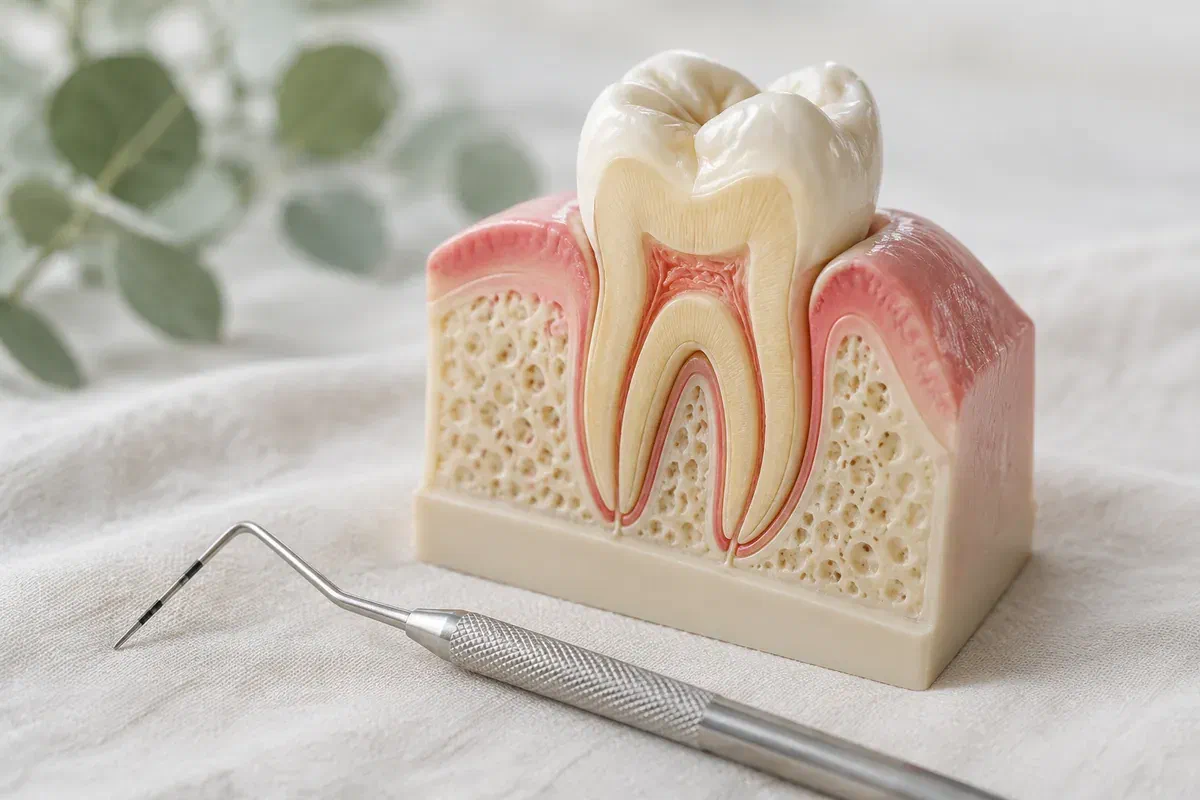
Illustrative tooth-and-gum teaching model beside a periodontal examination probe
Old findings, current findings

What has changed since your last chart?

Share past gum treatment, symptoms and any change in your health or medications since your previous office. Comfortable areas are examined too, because the absence of pain does not mean the supporting tissue is stable.

Inflammation now versus then

Sites that bleed with gentle probing, swollen gum or new recession tell the clinician how the tissue is behaving today. Comparing these signs with the earlier chart shows the trend. You will hear whether a full periodontal charting or new images are needed to complete the picture.

Areas still collecting deposits

Some surfaces stay difficult to clean because of tooth shape, crowding or older restorations. Tell the team where food catches. They can say whether professional cleaning is still needed there or whether adjustments at home would be enough.

Records that show the trend in support

Previous charts, X-rays and specialist letters allow a real comparison of support over time. A tooth that has lost some deserves its own assessment of how it is likely to do, and depth by itself does not answer that.

Do not let a change of office delay advice for new swelling, pus, fever or severe pain; call promptly. Never use a tool to measure or clean a pocket at home while you wait for an appointment.

A smooth handover

One continuous plan, even with a new team

Whatever office provides it, periodontal care aims to bring disease under control and preserve teeth you can look after. A better-looking chart is not the end in itself. Ask what improvement is realistic at each affected site and which limitations will remain, since lost bone, cleaning access and general health affect the outlook.

Knowing where you were in the sequence avoids repeating or skipping a step. Initial advice and cleaning, targeted care under the gum and reassessment each have a role. Ask which stage the records suggest you reached, and what still needs to happen before active treatment can be judged complete.

Patient information: SDCEP — stepwise treatment of periodontitis

Cleaning that builds on earlier work

Deposits at and below the gumline may be removed at sites where current findings support it. Ask how the plan relates to treatment already done and how comfort will be managed. Visit numbers should reflect today’s chart, not a default package.

A home routine checked afresh

A new team may suggest different tools or techniques for your spaces. Ask for a demonstration and mention anything that felt awkward before. The aim is effective cleaning of reachable surfaces; work beneath the gum is for the clinician.

A reassessment that uses all your records

Bleeding, depths, cleaning access and related findings are compared against both the earlier chart and the new baseline. Ask which sites have improved and which still concern the clinician before more nonsurgical care, surgery or a specialist is discussed.

Starting with a new office

Review the past, assess the present, then move forward

Mention sensitivity, anxiety or anything about earlier treatment that was difficult. You can ask for pauses and explanations at every stage, so you can see how each step connects to the plan.

  1. Compare records with a new examination

    The clinician reads your earlier charts and notes, then examines your gums today, with images or added assessment if indicated. Ask how the diagnosis relates to both sets of readings, and whether this visit is assessment, continued care, targeted cleaning or review.

  2. Agree the plan from here

    Discuss which areas still need treatment, how many sessions are likely and whether freezing would help. Your routine and any risk factors are reviewed. Ask what preparation is useful and which after-effects to expect before you consent.

  3. Provide the cleaning that is still indicated

    Suitable instruments are used to clear deposits from the agreed sites. Mention discomfort so the clinician can adjust. Treatment follows the current findings and what can be reached, rather than being promised to clear every pocket in one appointment.

  4. Reassess and choose the next phase

    At the recommended interval, the tissues are examined again. Ask whether the results point to maintenance or more treatment. If a specialist is suggested, or you were already seeing one, clarify how communication and your regular cleanings will be coordinated.

After each session

Simple steps while the tissue heals

Aftercare varies with the extent of cleaning, the use of freezing and whatever else was done. Ask what to expect, especially if the advice differs from what your previous office suggested, and how to report a concern without stopping your home routine.

Follow the routine as now advised

Use the brushing and interdental cleaning demonstrated at this office, with any short-term instructions for treated sites. If a recommended tool differs from your old one and feels awkward, ask for help with size or technique. Avoid hard scraping, picking or unadvised rinses.

Tenderness and a changing gumline

Treated teeth may feel sore or sensitive for a while. As swelling settles, the gum can sit lower and gaps may look wider. Ask whether this is expected for you, and report anything persistent or worsening rather than assuming what it means.

Keep the reassessment with the new team

Comfort does not reveal how every site has responded. The review lets the clinician compare findings across both offices’ records. If the date stops working, call to rearrange so active care does not finish without that check.

Patient information: NHS — dental abscess symptoms and urgent care

If pockets remain

Sites that have not settled are looked at again first

What follows depends on your diagnosis, the treatment completed at both offices and how each site looks now. Ask how a recommendation connects to those findings and what benefit is realistic.

When cleaning and inflammation control are still appropriate

Continued nonsurgical care

Further cleaning beneath the gum may continue active treatment. Ask which teeth would be included and how their response will be measured. Antibiotics, lasers or other additions are not required automatically because a pocket remains.

When disease persists or the history is complicated

Specialist assessment or further treatment

A periodontist can consider more nonsurgical care, a surgical approach or another plan. Ask which site factors shape the advice, and whether an earlier specialist can be involved again. Being sent to a specialist is not the same as being booked for surgery, and no procedure should rest on depth alone.

When active care has reached a sensible review point

Supportive maintenance

Maintenance visits monitor previously affected tissue and provide cleaning support. Ask what interval suits your condition and which findings will be followed. Your gum history from earlier offices remains relevant in this phase.

Patient information: American Academy of Periodontology — nonsurgical treatment and its limitations

Caledon questions about continuing care

Moving your gum care without starting over

Ask the clinician to show you how your old and new findings compare and to explain the plan in plain words. The chart is most helpful when you can see how it shapes treatment, home care and review.

(905) 876-4488
How do I get my gum records sent from my previous dentist?
You can usually ask your previous office to transfer charts and X-rays, and our team can tell you what information is most useful. Bring any paperwork you already have to the first visit.
Will I need new X-rays if my old office already took some?
Not necessarily. The clinician will look at what is available and how recent it is, and only suggest new images if they would add useful information for your diagnosis or plan.
Can readings differ between two offices for the same tooth?
Some variation can occur, and tissue may genuinely have changed. The clinician interprets readings alongside bleeding, attachment and other findings rather than relying on one set of numbers. Ask how the comparison is being made.
Do I have to repeat treatment I already had elsewhere?
Not automatically. The plan depends on current findings. If further cleaning is recommended at some sites, ask why, and how it relates to the care you already received.
Is a deep pocket after earlier treatment a sign surgery is next?
No. The site is reassessed with inflammation, support and previous care in mind. Further nonsurgical treatment, maintenance or a specialist opinion may be discussed. Ask why a particular option is suggested.
Can I clean a deep pocket myself while I wait to be seen?
No. Sharp or improvised tools should not go below the gumline. Keep up your usual brushing and interdental cleaning, and call if swelling, pus or significant pain develops.
Continuing gum care from Caledon

Bring the history, and we’ll work out the next step together

Phone (905) 876-4488 to arrange a gum assessment at our Bronte Street practice or to review pocket treatment that began elsewhere. Bring or request earlier periodontal charts, X-rays and specialist letters so the plan reflects everything already done.

Treatment extent, tissue response, review timing and specialist involvement depend on your current findings. A single pocket reading cannot guarantee a diagnosis, a specific procedure or an outcome.

Visit Milton Dental Clinic
Unit 1, 342 Bronte St. S, Milton, ON L9T 5B7
Get directions Clinic hours
Monday–Thursday
11am–7pm
Friday–Sunday
By appointment only

Areas we serve

  • Milton
  • Oakville
  • Mississauga
  • Georgetown
  • Halton Hills
  • Acton
  • Campbellville
  • Brampton
  • Burlington
  • Puslinch
  • Rockwood
  • Erin
  • Caledon
  • Etobicoke
  • Old Milton
  • Bronte Meadows
  • Timberlea
  • Dorset Park
  • Dempsey
  • Clarke
  • Beaty
  • Coates
  • Harrison
  • Scott
  • Willmott
  • Ford
  • Bowes
  • Cobden
  • Walker
  • Mountain View
  • Milton Heights
  • Hawthorne Village
  • Valley View
  • Fallingbrook
  • Nassagaweya
  • Trafalgar
  • Esquesing
  • Nelson
  • Brookville
  • Moffat
  • Glen Williams
  • Norval
  • Limehouse
  • Stewarttown
  • Ashgrove
  • Hornby
  • Silver Creek
  • Speyside
  • Scotch Block
  • North Oakville
  • River Oaks
  • Glen Abbey
  • West Oak Trails
  • Palermo
  • Bronte Creek
  • College Park
  • Joshua Creek
  • Uptown Core
  • Preserve
  • Iroquois Ridge
  • Lisgar
  • Meadowvale
  • Meadowvale Village
  • Churchill Meadows
  • Erin Mills
  • Central Erin Mills
  • Streetsville
  • East Credit
  • Creditview
  • Heartland
  • Sheridan
  • Mount Pleasant
  • Credit Valley
  • Huttonville
  • Churchville
  • Springbrook
  • Northwest Brampton
  • Bram West
  • Fletcher's Meadow
  • Fletcher's Creek South
  • Alton Village
  • Orchard
  • Millcroft
  • Headon Forest
  • Tansley
  • Brant Hills
  • Tyandaga
  • Kilbride
  • Lowville
  • Aberfoyle
  • Morriston
  • Arkell
  • Hillsburgh
  • Freelton
  • Carlisle
  • Waterdown
  • Flamborough
  • Mountsberg

How can we help?

Milton Dental Clinic

Have a question about your smile? Choose the option that works best for you.

For urgent dental concerns, please call.
Messages are reviewed during clinic hours.