

Illustrative patient discussing periodontal findings with a clinician and a supported tooth model
Specialized Care

Periodontal Pocket Treatment in Milton

Those numbers called out during a gum check describe how the tissue around each tooth is holding up. In Milton, our team can walk you through what the readings show, whether care below the gumline makes sense, and how the response will be checked before anything else is decided.

What the gum chart is telling you

Two, three, five: what those readings actually describe

Lying back in the chair, you may hear a string of small numbers as the clinician moves around each tooth. A thin, gentle probe is resting in the shallow space where the gum meets the tooth, and each figure records how far it slips in. A deeper reading can point toward gum disease, yet on its own it tells only part of the story.

To make sense of a site, the team also looks at whether it bleeds, where the gum sits, how much attachment has been lost and what the supporting bone shows. Treatment then targets the condition behind those findings. It may involve cleaning below the gumline to reduce deposits and inflammation, followed by a review that decides whether more help, routine support or a specialist opinion fits.

For many households in Milton, gum care gets squeezed between school runs and work shifts, so a plan you can follow matters. Ask our team to show you which teeth are involved, why each step is suggested and what is expected of you at home. Numbers you understand are far more useful than a printout you file away.

Talk through your gum readings
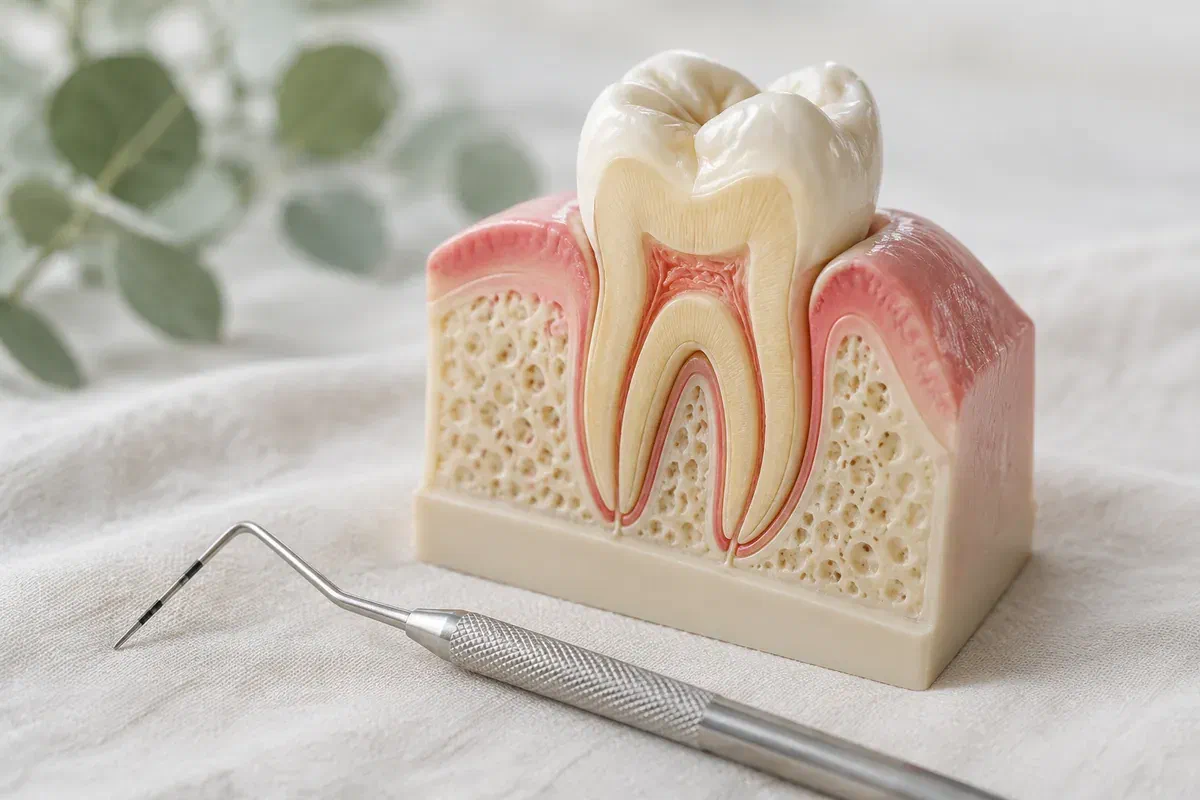
Illustrative tooth-and-gum teaching model beside a periodontal examination probe
Beyond a single measurement

The probe reading sits beside bleeding, gum position and the history of each tooth

Mention any tenderness, past gum treatment or health changes, even ones that seem unrelated. Sites that feel perfectly comfortable are still examined, since an absence of pain does not show that the supporting tissue is stable.

Bleeding, swelling and where the gum sits

A site that bleeds when gently probed is giving useful information about inflammation. Gum that has swollen or pulled back also changes what a reading means. Your clinician can explain how these observations combine and whether a fuller periodontal assessment or extra records would help.

Buildup in places your brush misses

Tell the team where food tends to catch or where floss shreds. Hardened deposits and the shape of certain teeth or fillings can make some surfaces hard to keep clean. You can then learn which spots need professional attention and which adjustments at home would genuinely help.

What earlier care and records show

Past charts, X-rays and notes from a periodontist let the team see whether things are changing. A tooth that has already lost some support deserves its own assessment of how it is likely to do. Pocket depth alone is not a reliable way to judge that outlook.

Call promptly about new swelling, pus, fever or pain that is becoming severe. Please do not push anything into the gum to check or clean a pocket yourself, and do not hold off until a routine visit if a sudden problem appears.

A plan worth asking for

Clear on the sites, the steps and the review that follows

Good periodontal care aims to bring disease under control and help you keep a mouth you can maintain. A tidier chart is not the point by itself. Ask what change is realistic for the teeth involved and what limits remain, because support that has already been lost, difficult access and your general health can all shape the outlook.

It also helps to see the work as stages. Early advice and cleaning, more focused care below the gumline and a later reassessment each have a separate job. Find out which stage you are in and what still has to happen before the dentist can say whether active treatment is finished.

Patient information: SDCEP — stepwise treatment of periodontitis

Cleaning matched to your findings

Professional removal of deposits, above and below the gumline, may be suggested for particular sites. Ask why those areas were chosen and how comfort will be handled. The length of each visit and the number of appointments should follow your chart, not a standard bundle.

Tools that suit your own mouth

A short demonstration with the right brush, interdental cleaner or floss can make home care far more effective. Say so if something feels awkward. The goal is to keep reachable surfaces clean, never to copy the professional instrument work done in the chair.

A follow-up with a defined purpose

At review, bleeding, depths, ease of cleaning and other signs are compared with the earlier findings. Ask which sites improved and which still worry the clinician. Any remaining reading is weighed in context before further nonsurgical care, surgery or a periodontist’s opinion is discussed.

How treatment usually unfolds

Chart, plan, treat, then look again

Let the team know beforehand if your teeth are sensitive or if dental visits make you uneasy. You can ask for a pause or an explanation at any point, so each part of the appointment connects to the plan you agreed.

  1. Confirm what is happening and where

    Your history and periodontal findings are reviewed, with images or further assessment when they would add something. Ask how the diagnosis links to the readings and to the supporting tissue. Be clear whether this visit is an assessment, first-stage care, focused cleaning or a check on earlier treatment.

  2. Agree the visits and your daily routine

    Talk through which areas will be treated, roughly how many appointments are expected and whether freezing is a good idea. Your home routine and any relevant risk factors are reviewed too. Ask how to prepare and which likely after-effects should be covered before you consent.

  3. Carry out the planned cleaning

    Suitable instruments are used to remove deposits in the agreed areas. Speak up if anything is uncomfortable so the approach can change. This work follows the assessment and what can be reached safely; it should not be described as a sure way to clear every pocket in a single sitting.

  4. Review the response and decide what comes next

    Come back at the suggested interval so the tissue can be re-examined. Ask which findings point to maintenance and which call for more care. If a referral is suggested, find out why, and how cleanings and reviews will continue while you wait for that appointment.

The days after your appointment

Follow the instructions written for your treatment

What you are told depends on how much cleaning was done, whether freezing was used and whether anything else was carried out. Ask the person treating you what is normal and how to handle a worry without abandoning your home routine.

Keep to the cleaning you were shown

Carry on with the brushing and between-teeth routine demonstrated at your visit, along with any short-term advice for treated areas. If a tool is hard to use, ask about a different size or method. Avoid digging at the gum, hard scraping or a rinse nobody recommended.

Expect some changes, and mention them

Treated teeth may feel tender or sensitive for a while. As swelling eases, the gumline can shift and gaps between teeth may look different. Ask what to expect for your mouth, and report anything that lingers or gets worse instead of guessing whether it signals harm or success.

Attend the review even if all feels well

Feeling more comfortable does not reveal how each site has responded. The planned check lets the clinician compare findings and decide what is left to do. If the date no longer works, call to move it rather than leaving active care without a proper look at the result.

Patient information: NHS — dental abscess symptoms and urgent care

Where things can go from here

A reading that stays deep is a prompt to reassess

The right next move depends on your diagnosis, the care already given and how each site looks now. Ask how a recommendation connects to those findings and what improvement it can reasonably offer.

When cleaning and calming inflammation are the priority

Nonsurgical care with a planned review

Cleaning below the gumline may form part of active treatment. Ask which sites are included and how their response will be judged. Antibiotics, lasers or other extras are not needed automatically just because a pocket has been recorded.

When disease persists or the situation is complex

More treatment or a periodontist’s view

A gum specialist can consider whether more nonsurgical care, a surgical approach or a different plan suits a site. Ask what particular factors drive that choice. Being referred does not mean surgery is certain, and depth alone does not fully explain any procedure offered.

When active care has reached a sensible review point

Ongoing periodontal maintenance

Regular maintenance visits keep an eye on previously affected areas and add cleaning help where needed. Ask what interval suits your present condition and which findings will be tracked. A history of gum disease stays relevant even once you move into this phase.

Patient information: American Academy of Periodontology — nonsurgical treatment and its limitations

Questions we hear in Milton

Plain answers about gum readings and treatment

Ask the team to show you the areas on your chart and describe the plan in everyday language. The readings matter most once you can link them to treatment, your routine at home and the next review.

(905) 876-4488
What is the clinician doing when they call out numbers around each tooth?
They are recording how far a gentle probe slips into the space between gum and tooth at several points. Bleeding and gum position are noted as well. Together these help build a picture of the supporting tissue, which the team can explain to you afterwards.
Is it normal for my gums to bleed a little during the probing?
Bleeding when a site is gently measured is itself a finding the clinician records, often linked to inflammation. Ask which areas bled and what that suggests. Mention any bleeding you notice at home too, so the full pattern can be considered.
Can one high number on my chart tell me I have gum disease?
Not on its own. The reading is weighed alongside bleeding, gum position, attachment, bone support and your history. Ask how the findings connect and whether more assessment is needed before a diagnosis or treatment plan is settled.
Should I try to clean out a deep spot with a pick at home?
No. Sharp or improvised tools should never be pushed below the gumline. Ask for a demonstration of the cleaning that suits the spaces you can reach. Work below the gum is a professional task, separate from your daily routine.
Does smoking affect how my gums respond to pocket treatment?
Smoking is a recognised risk factor for gum disease and can affect how tissues respond. Tell the team honestly about tobacco or vaping so it can be considered in your plan. Ask what support is available if you are thinking about cutting back.
Why book a re-check when the bleeding has already stopped?
Less bleeding is encouraging, but it does not confirm how every treated site has healed. The review lets the clinician compare readings and other signs and decide whether active care is complete. Keep the appointment so the next step rests on current findings.
Gum care close to home in Milton

Bring your questions, and leave with a plan you can follow

Call our Bronte Street practice at (905) 876-4488 to book a gum assessment or to review pocket treatment that has been recommended. If you have earlier periodontal charts or a specialist’s notes, bring them along so the conversation reflects what has already been done.

The extent of treatment, how tissues respond, review timing and any specialist involvement all depend on your own findings. No single reading guarantees a diagnosis, a specific procedure or a particular result.

Visit Milton Dental Clinic
Unit 1, 342 Bronte St. S, Milton, ON L9T 5B7
Get directions Clinic hours
Monday–Thursday
11am–7pm
Friday–Sunday
By appointment only

Areas we serve

  • Milton
  • Oakville
  • Mississauga
  • Georgetown
  • Halton Hills
  • Acton
  • Campbellville
  • Brampton
  • Burlington
  • Puslinch
  • Rockwood
  • Erin
  • Caledon
  • Etobicoke
  • Old Milton
  • Bronte Meadows
  • Timberlea
  • Dorset Park
  • Dempsey
  • Clarke
  • Beaty
  • Coates
  • Harrison
  • Scott
  • Willmott
  • Ford
  • Bowes
  • Cobden
  • Walker
  • Mountain View
  • Milton Heights
  • Hawthorne Village
  • Valley View
  • Fallingbrook
  • Nassagaweya
  • Trafalgar
  • Esquesing
  • Nelson
  • Brookville
  • Moffat
  • Glen Williams
  • Norval
  • Limehouse
  • Stewarttown
  • Ashgrove
  • Hornby
  • Silver Creek
  • Speyside
  • Scotch Block
  • North Oakville
  • River Oaks
  • Glen Abbey
  • West Oak Trails
  • Palermo
  • Bronte Creek
  • College Park
  • Joshua Creek
  • Uptown Core
  • Preserve
  • Iroquois Ridge
  • Lisgar
  • Meadowvale
  • Meadowvale Village
  • Churchill Meadows
  • Erin Mills
  • Central Erin Mills
  • Streetsville
  • East Credit
  • Creditview
  • Heartland
  • Sheridan
  • Mount Pleasant
  • Credit Valley
  • Huttonville
  • Churchville
  • Springbrook
  • Northwest Brampton
  • Bram West
  • Fletcher's Meadow
  • Fletcher's Creek South
  • Alton Village
  • Orchard
  • Millcroft
  • Headon Forest
  • Tansley
  • Brant Hills
  • Tyandaga
  • Kilbride
  • Lowville
  • Aberfoyle
  • Morriston
  • Arkell
  • Hillsburgh
  • Freelton
  • Carlisle
  • Waterdown
  • Flamborough
  • Mountsberg

How can we help?

Milton Dental Clinic

Have a question about your smile? Choose the option that works best for you.

For urgent dental concerns, please call.
Messages are reviewed during clinic hours.