

Illustrative patient reviewing gum-treatment priorities with a clinician
Specialized Care

Periodontitis Treatment

Periodontitis affects the tissues that support your teeth. Our Milton team can explain the diagnosis, discuss treatment priorities and practical daily care, and help plan the reassessment and maintenance needed to manage your gum health over time.

A closer look at periodontitis

Understand the support your teeth have and the care they need next.

Periodontitis is a disease involving loss of the tissues that support the teeth. It differs from inflammation limited to the gums, although both can involve bleeding or other changes. The examination helps establish the extent of the problem and identify which teeth and sites need attention rather than treating every gum concern as the same condition.

Receiving the diagnosis can raise questions about keeping your teeth, the amount of treatment involved, and whether earlier care has worked. Ask the dentist to explain the findings in plain language. A useful discussion connects the measurements and images to your own mouth, including what is stable, what needs treatment, and what remains uncertain.

At Milton Dental Clinic, we approach the next step as a plan that combines professional care, a manageable home routine, and review. The aim is to address disease and support longer-term stability. No single visit can promise that all lost support will return or that future periodontal attention will no longer be needed.

Discuss a periodontal treatment plan
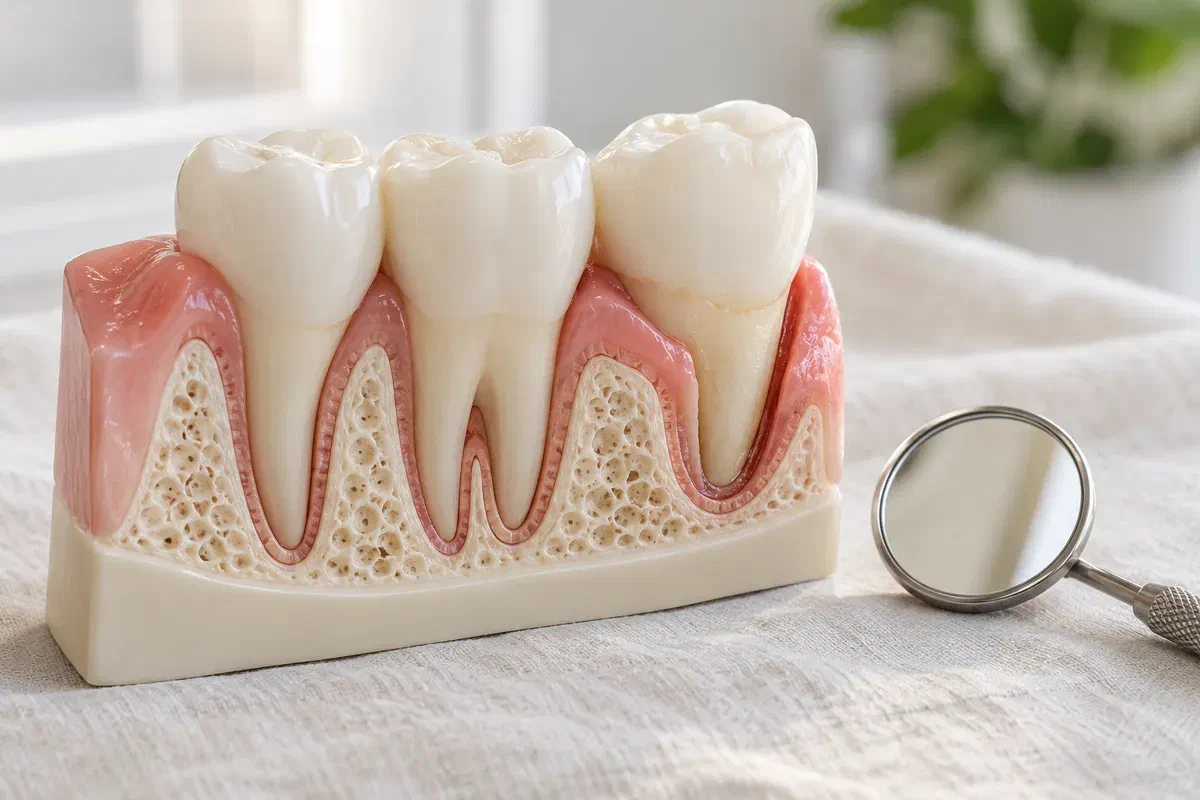
Illustrative connected tooth, gum, and supporting-bone teaching model
What the diagnosis takes into account

Symptoms, support, and previous changes all contribute to the picture.

Tell the team about what you have noticed, but do not wait for pain before arranging care. Periodontal findings can be important even when eating feels comfortable and there is no obvious daily toothache.

Bleeding, recession, or spaces that have changed

Explain changes in the gums, food trapping, or how the teeth look when you smile. Mention whether a tooth feels different when biting. These observations help guide the examination, but the diagnosis also requires assessment of the tissues and support rather than appearance alone.

Previous treatment and the response afterward

Bring earlier periodontal records or specialist recommendations when available. Explain which treatment was completed and whether reassessment took place. Knowing the sequence helps distinguish an untreated problem, a remaining concern, and a change that developed during a period of maintenance.

Health and practical factors affecting daily care

Discuss relevant medical conditions, tobacco use, medicines, and difficulties with cleaning. The conversation should identify useful support, not assign blame. A routine that is hard to perform needs adaptation, especially when dexterity, vision, or other circumstances have changed.

A new gum swelling, discharge, fever, significant pain, or a tooth becoming loose deserves prompt contact. Do not wait for the entire treatment plan to be arranged before reporting an acute change.

Making the plan understandable

Set priorities for the mouth as a whole and explain the outlook tooth by tooth.

The diagnosis is a starting point for decisions, not a prediction that every tooth will have the same outcome. Ask which areas are most affected and what influences their prognosis. If the clinician uses terms such as stage or grade, ask how those terms relate to severity, complexity, and the information available about progression.

Treatment also needs a clear sequence and a realistic way to judge the response. Ask what the first phase is intended to achieve, when it will be reviewed, and what findings could lead to specialist advice. This helps you understand the purpose of each appointment without assuming that the entire course can be decided from one measurement.

Professional care directed at identified disease

The team can explain which deposits and affected sites need treatment and how the work will be organized. Ask about comfort, appointment length, and any local anaesthetic being considered. The planned extent should reflect the examination and your circumstances rather than a standard package for every patient.

A daily routine designed around actual access

Discuss which brushing and interdental tools fit your mouth and ask for a demonstration in the difficult areas. Bring a tool you cannot use comfortably instead of silently giving up on it. Practical instruction is part of the treatment conversation, not a test you must pass before asking for help.

A continuing-care plan that follows the response

Ask what would indicate sufficient stability for maintenance and what would justify further active treatment. The review should be explained through current findings. Continuing appointments are a way to manage a history of disease, rather than proof that the earlier treatment was pointless.

A staged approach to care

Establish the findings, treat the priorities, and reassess before moving on.

Your plan may involve more than one visit and, where appropriate, another provider. Ask who is coordinating each stage and how the findings will be shared if a periodontist is involved.

  1. Assess periodontal health and explain the diagnosis

    The clinician reviews history, examination findings, and appropriate images to understand the condition. Ask which teeth have reduced support and whether further information is needed. The explanation should distinguish established findings from uncertainty and make clear which concerns require prompt attention.

  2. Begin practical plaque control and indicated professional care

    Discuss daily cleaning, relevant risk factors, and professional treatment above and below the gumline where needed. Ask how care will be divided into appointments and how discomfort will be managed. Tell the team about barriers so the approach can be made achievable.

  3. Review the tissue response and remaining concerns

    At reassessment, the team compares relevant findings and discusses which sites have responded. Ask what any remaining inflammation or difficult access means for the next decision. Further treatment should have a stated purpose rather than simply repeat the earlier plan without explanation.

  4. Choose further treatment, referral, or supportive maintenance

    The response and complexity guide whether more active care or specialist assessment is appropriate. When moving into maintenance, agree on the interval and responsibilities. If a tooth has an unfavourable outlook, ask for its specific reasoning and alternatives before deciding on removal.

Supporting the treatment between visits

Keep the routine practical and the review connected to the findings.

Aftercare depends on the professional treatment provided and the condition of your gums. Follow the instructions given for your own sites and ask about anything that makes daily cleaning uncomfortable or confusing.

Follow the demonstrated cleaning approach

Use the agreed tools and technique without forcing devices into spaces where they do not fit. If an area is difficult to reach, explain the problem at review or contact the team for advice. A manageable adjustment to the routine is more useful than adding several unfamiliar products without guidance.

Report symptoms and relevant health changes

Mention persistent sensitivity, new swelling, or changes in tooth comfort or mobility. Keep the team informed about medical treatment and medicines, but do not alter prescribed care on your own. The dental plan may need coordination with other clinicians when your circumstances change.

Complete reassessment and arrange continuing care

Do not assume that less bleeding means all active treatment is complete. Keep the review that checks the response and clarifies the next stage. If attendance becomes difficult, contact the clinic to discuss timing rather than leaving the plan without a follow-up decision.

Choosing further care

Match the next step to the response and the tooth's remaining support.

Discuss the benefits, limitations, and alternatives of each recommendation. A diagnosis of periodontitis does not automatically mean surgery, antibiotics, or extraction of every affected tooth.

When professional cleaning and daily care are the next priorities

Nonsurgical periodontal treatment and reassessment

Treatment can address deposits and inflammation in the affected areas, followed by a review of the response. Ask what is included and what would trigger another stage. An antibiotic or a named technology should not be assumed necessary for every periodontal treatment plan.

When residual disease or complexity needs additional input

Specialist assessment or further site-specific treatment

A periodontist may discuss further nonsurgical or surgical options according to the findings. Ask which goals are realistic and what the procedure would change. Regaining lost support cannot be promised for every site, and the advantages and risks should be explained individually.

When long-term planning becomes the focus

Maintenance or decisions about teeth with a poor outlook

Stable areas may move into supportive care, while a particular tooth may need a separate prognosis discussion. Ask how retention, removal, and any later replacement choices compare for that tooth. The mouth does not have to be treated as though every site has an identical future.

Patient information: American Academy of Periodontology — nonsurgical care and further treatment

Periodontitis treatment questions

Understand the diagnosis without assuming the outcome is already decided.

Ask for an explanation of the affected areas, the immediate priorities, and the longer-term plan. The answers should reflect your examination and the response to care rather than a generic prediction.

(905) 876-4488
Is periodontitis the same diagnosis as bleeding gums alone?
No. Bleeding can occur with different gum conditions, while periodontitis involves loss of supporting tissues. The clinician uses the examination and relevant records to establish the diagnosis. Ask which findings distinguish your condition and how they affect the recommended care.
Does a periodontitis diagnosis mean all my teeth have the same prognosis?
No. The condition and support can differ between teeth and sites. Ask which areas are most affected and what influences each tooth’s outlook. A treatment plan should explain those differences rather than assume every tooth requires the same intervention.
What should I ask if my periodontitis is described by a stage or grade?
Ask the clinician to explain what the terms mean in your case and which findings support them. Then ask how that assessment changes treatment priorities or follow-up. The terminology should help you understand care, not leave you interpreting a label without context.
Can periodontitis treatment guarantee that lost bone will grow back?
No. The main plan addresses disease and supports ongoing stability, while regenerative options may be appropriate only for selected situations. Ask what outcome is realistic at the specific site and what limitations remain. Avoid assuming all supporting tissue can be restored.
Why might I need a periodontist after the first course of gum treatment?
Persistent findings or complex sites may benefit from additional assessment and treatment options. Ask what the referral is intended to clarify and how care will be coordinated. Referral does not automatically mean surgery or that the initial treatment had no useful role.
Can I return for periodontitis care after struggling with the home routine?
Yes. Explain what has been difficult so the team can reassess your condition and adapt the practical advice. You do not need to arrive with a perfect routine. The useful next step is an honest discussion and a plan you can follow.
Periodontitis treatment in Milton

Build a clear plan around your gums, your teeth, and your daily routine.

Call our Bronte Street practice at (905) 876-4488 to discuss a periodontal assessment or an existing diagnosis. Bring earlier gum-treatment records when available so the conversation can connect previous care with the next appropriate step.

Treatment extent, prognosis, specialist involvement, and maintenance intervals vary. The plan requires examination and review; no procedure guarantees complete restoration of lost support or permanent freedom from disease.

Visit Milton Dental Clinic
Unit 1, 342 Bronte St. S, Milton, ON L9T 5B7
Get directions Clinic hours
Monday–Thursday
11am–7pm
Friday–Sunday
By appointment only

How can we help?

Milton Dental Clinic

Have a question about your smile? Choose the option that works best for you.

For urgent dental concerns, please call.
Messages are reviewed during clinic hours.