

Illustrative patient reviewing gum-treatment priorities with a clinician
Specialized Care

Periodontitis Treatment in Acton

The word periodontitis often brings a fear of gum surgery close behind it. In many cases the first phase of care is nonsurgical. We explain your diagnosis, what each stage is for, and when a specialist opinion might genuinely be useful.

Acton · easing the surgery worry

Diagnosis first. The scalpel is rarely where this starts.

A friend mentions their gum surgery, and suddenly your own diagnosis sounds alarming. It helps to know what periodontitis actually is: a disease that has caused loss of the bone and attachment supporting some of your teeth. It goes further than gingivitis, which affects only the gums, but it does not come with an automatic route to the operating chair.

Your first step is a careful explanation. Ask the dentist to talk through your own measurements and X-rays, showing which teeth have reduced support, which are healthy, and where the outlook is still uncertain. With that information, you can weigh any later recommendation on its merits rather than reacting to a word you dread.

Most plans begin with nonsurgical professional treatment, a manageable home routine, and a scheduled review to see how the tissues respond. From Acton, it makes sense to book the first round and its follow-up together. The goal is to control disease and keep things stable; no treatment, surgical or otherwise, can promise that all lost support returns.

Ask about your periodontitis options
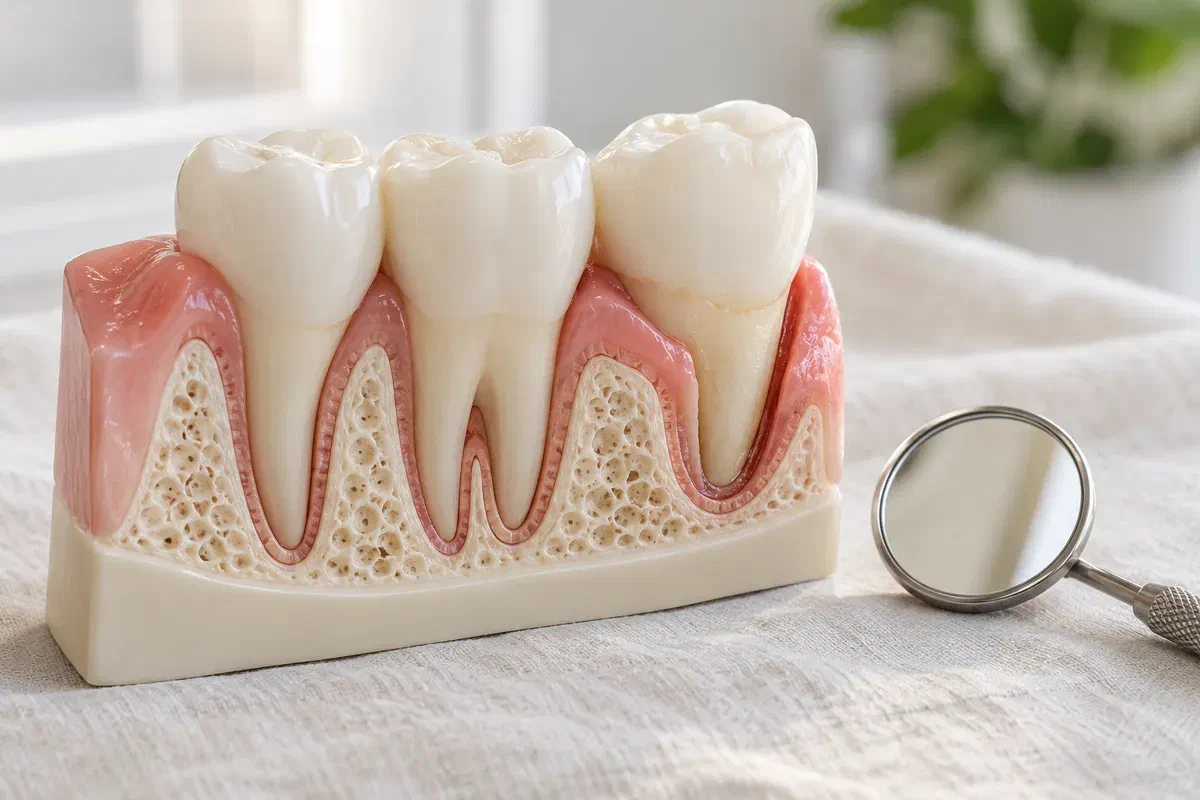
Illustrative connected tooth, gum, and supporting-bone teaching model
What the assessment looks at

Several kinds of information, weighed together

Periodontal problems are not always painful, so describe what you have noticed and book an assessment even when chewing feels fine and no tooth aches.

Visible changes and how teeth feel

Mention bleeding, receding gums, new spaces that catch food, or teeth that feel loose or bite differently. These signs help the clinician focus, but the diagnosis depends on assessing the supporting tissues and bone directly, not on how your smile looks.

Treatment you have already received

If a dentist or periodontist has treated your gums before, share what was done and whether a review followed. Bring records if available. This history helps clarify whether an area needs a first round of care or has changed after earlier treatment.

Health and daily practicalities

Talk about medical conditions, medicines, tobacco use and any difficulty with cleaning. These factors affect how gums respond and what support would help. There is no blame involved, and if your routine has become hard to keep up, it can be redesigned.

Call promptly about new swelling, discharge, fever, severe pain or a loosening tooth. These are reasons to make contact now, not after the full plan is arranged.

Knowing the reasons behind each step

Why would anyone suggest a specialist?

A referral is usually about the details of specific sites, not a judgement on your whole mouth. Ask which teeth are most affected, which are doing well, and what shapes the outlook for each. If the dentist uses a stage or grade, ask what it says about severity, the complexity of care and how the disease has progressed.

It also helps to know the sequence and what success looks like at each point. Ask what the opening phase is meant to achieve, when the response will be measured, and which results might lead to a periodontist’s involvement. That keeps each visit purposeful and prevents one reading from being treated as the final word.

Nonsurgical professional care for affected sites

The team can explain which deposits and areas need treatment and how the appointments will be arranged. Ask about comfort, appointment length and the use of local anaesthetic. The scope should follow from your examination rather than from a standard package.

Daily cleaning matched to your mouth

Ask which brushes and interdental aids fit your spaces, and request a demonstration in the tricky areas. Bring along anything you found hard to use. Learning technique is part of treatment, and the team expects questions. Good daily cleaning also gives the nonsurgical phase its best chance, which is one reason it gets so much attention at every visit.

Continuing care set by your results

Ask what findings would mean you are ready for maintenance and what would suggest further active care, including possible referral. Reviews should be explained using up-to-date measurements. Ongoing visits manage a long-term condition rather than signalling failure.

How the plan usually unfolds

Most people start with treatment that involves no incisions.

Care may span several appointments, and a periodontist may become involved later if needed. Ask who is coordinating each stage and how your records would be shared.

  1. Explain the diagnosis in plain language

    The clinician reviews your history, measurements and suitable X-rays. Ask where support is reduced and whether more information would help. The explanation should show what is established, what is uncertain and whether anything needs early attention.

  2. Begin nonsurgical care and home plaque control

    Professional cleaning beneath the gums where needed is paired with daily cleaning and a look at risk factors. Ask how the work will be split across visits and how comfort will be managed. Raise any barriers so the plan stays realistic.

  3. Measure the response at reassessment

    After a healing period, findings are compared with the starting point, and the team explains which sites improved. Ask what remaining inflammation or difficult access would mean. Any further step should have a stated purpose.

  4. Decide whether more is needed

    The response and the complexity of each site guide whether further nonsurgical care, a specialist assessment or maintenance makes sense. Agree on intervals and responsibilities for maintenance. If a tooth looks unlikely to do well, ask for the reasoning and alternatives before considering removal.

After nonsurgical treatment

A little tenderness, a lot of routine

Aftercare depends on what was done and how your gums respond. Follow the guidance you were given for your own sites, and call if cleaning is painful or the instructions are unclear.

Keep to the demonstrated technique

Use the agreed tools and method without forcing anything into a narrow space. If an area remains hard to clean, raise it at review or phone for advice. A single, well-chosen adjustment usually helps more than several new products bought on a whim.

Tell us about anything unexpected

Report lingering sensitivity, new swelling, or teeth that start to feel unsteady. Keep us informed about medical treatment and prescriptions, and do not change prescribed care without your physician. Your dental plan may need coordination when your health shifts.

Keep the review that decides what comes next

Less bleeding is a good sign, but it does not show that active care is complete. The reassessment measures the response and determines whether referral, more care or maintenance follows. If timing becomes difficult, call to rearrange.

If further treatment comes up

Surgery is one option among several, not the default.

Ask what each recommendation would achieve, its limitations and the alternatives. A periodontitis diagnosis does not mean surgery, antibiotics or extractions are automatically required.

When professional cleaning and daily care are the priority

Nonsurgical periodontal treatment and recheck

Deposits and inflammation are treated at affected sites, followed by a review. Ask what the treatment covers and what would lead to another stage. Antibiotics and branded technologies are not necessary for every periodontal plan.

When disease persists or a site is complex

A periodontist’s assessment or further site care

A specialist may suggest further nonsurgical care or, for some sites, a surgical procedure. Ask what each would change, what recovery involves and what happens if you decline. Regaining lost support is possible only in selected situations, and risks should be explained to you.

When long-term planning takes the lead

Maintenance or a decision about a doubtful tooth

Areas that have settled can move into supportive care while one tooth may need its own discussion. Ask how keeping it compares with removal and later replacement. Your teeth will not all have the same future, and the plan should reflect that.

Patient information: American Academy of Periodontology — nonsurgical care and further treatment

Questions about surgery and referral

Separating the worry from what is actually recommended

Ask for clear explanations of the affected areas, the first priorities and the longer plan. Answers should reflect your examination and response to care, not a general forecast.

(905) 876-4488
Does periodontitis always end in gum surgery?
No. Many plans begin with nonsurgical treatment, and some people never need surgery. Whether further procedures are suggested depends on how specific sites respond. Ask what would need to happen before surgery was even discussed.
What does a periodontist do that my dentist does not?
A periodontist is a specialist in gum and supporting-tissue conditions and may offer additional nonsurgical or surgical options for complex sites. Ask your dentist what the referral would aim to clarify and how care would be shared.
Can I say no to a referral?
Yes. You can ask questions, take time to decide or request alternatives. Ask what the likely consequences of declining would be and whether closer monitoring is an option. A good plan explains the reasoning rather than pressuring you.
Is nonsurgical periodontal treatment uncomfortable?
Experiences vary. Local anaesthetic is often used, and some tenderness afterward is common. Ask the team how comfort will be managed and what to expect over the following days. If dental anxiety is part of the picture, say so when you book, so the pace of each visit can be planned with you rather than around you.
If I am referred, does that mean the first treatment failed?
Not at all. Initial treatment often improves many sites, and referral focuses on the ones that still need attention. Ask which sites are prompting the referral and what the first phase achieved elsewhere.
How can I plan visits from Acton if a referral is added?
Ask how appointments with the clinic and any specialist might be sequenced, and who keeps track of the overall plan. Booking reassessment and maintenance together can reduce trips. Report urgent symptoms promptly in between.
Booking from Acton

Get the facts before you decide anything.

Call (905) 876-4488 to book a periodontal assessment at our Bronte Street office or to discuss a diagnosis you already have. Records from earlier gum treatment help us connect what has been done with the most suitable next step.

Treatment extent, prognosis, specialist referral and maintenance timing vary. Planning requires examination and review, and neither nonsurgical nor surgical care can guarantee complete restoration of lost support or freedom from future disease.

Visit Milton Dental Clinic
Unit 1, 342 Bronte St. S, Milton, ON L9T 5B7
Get directions Clinic hours
Monday–Thursday
11am–7pm
Friday–Sunday
By appointment only

Areas we serve

  • Milton
  • Oakville
  • Mississauga
  • Georgetown
  • Halton Hills
  • Acton
  • Campbellville
  • Brampton
  • Burlington
  • Puslinch
  • Rockwood
  • Erin
  • Caledon
  • Etobicoke
  • Old Milton
  • Bronte Meadows
  • Timberlea
  • Dorset Park
  • Dempsey
  • Clarke
  • Beaty
  • Coates
  • Harrison
  • Scott
  • Willmott
  • Ford
  • Bowes
  • Cobden
  • Walker
  • Mountain View
  • Milton Heights
  • Hawthorne Village
  • Valley View
  • Fallingbrook
  • Nassagaweya
  • Trafalgar
  • Esquesing
  • Nelson
  • Brookville
  • Moffat
  • Glen Williams
  • Norval
  • Limehouse
  • Stewarttown
  • Ashgrove
  • Hornby
  • Silver Creek
  • Speyside
  • Scotch Block
  • North Oakville
  • River Oaks
  • Glen Abbey
  • West Oak Trails
  • Palermo
  • Bronte Creek
  • College Park
  • Joshua Creek
  • Uptown Core
  • Preserve
  • Iroquois Ridge
  • Lisgar
  • Meadowvale
  • Meadowvale Village
  • Churchill Meadows
  • Erin Mills
  • Central Erin Mills
  • Streetsville
  • East Credit
  • Creditview
  • Heartland
  • Sheridan
  • Mount Pleasant
  • Credit Valley
  • Huttonville
  • Churchville
  • Springbrook
  • Northwest Brampton
  • Bram West
  • Fletcher's Meadow
  • Fletcher's Creek South
  • Alton Village
  • Orchard
  • Millcroft
  • Headon Forest
  • Tansley
  • Brant Hills
  • Tyandaga
  • Kilbride
  • Lowville
  • Aberfoyle
  • Morriston
  • Arkell
  • Hillsburgh
  • Freelton
  • Carlisle
  • Waterdown
  • Flamborough
  • Mountsberg

How can we help?

Milton Dental Clinic

Have a question about your smile? Choose the option that works best for you.

For urgent dental concerns, please call.
Messages are reviewed during clinic hours.