

Illustrative patient reviewing gum-treatment priorities with a clinician
Specialized Care

Periodontitis Treatment in Caledon

Antibiotics, lasers, special rinses: it is natural to hope one of them will make periodontitis go away quickly. We explain your diagnosis honestly, what each kind of treatment can and cannot do, and why steady professional care, home cleaning and review remain the foundation.

Caledon · sorting fact from shortcut

Is there a faster way? Here is the honest answer.

Search online after a gum diagnosis and you will find plenty of promises. It helps to start with what periodontitis is: a disease in which the bone and attachment that anchor teeth have been lost in some places. That makes it more involved than gingivitis, where only the gums are inflamed, and it explains why no product or single appointment can simply reset things.

So begin with your own facts. Ask the dentist to explain your measurements and X-rays, showing which teeth have lost support, which are healthy, and where the outlook is unclear. Then ask how the recommended treatment addresses those particular findings. A plan you understand is far easier to trust than a quick fix you read about.

For most people, the foundation is professional treatment of the affected sites, a daily routine you can keep, and a planned review. From Bolton or one of Caledon’s smaller villages, it makes sense to know the full sequence before starting. Treatment aims to control disease and support stability over time, and it cannot guarantee the return of lost support.

Get an honest treatment plan
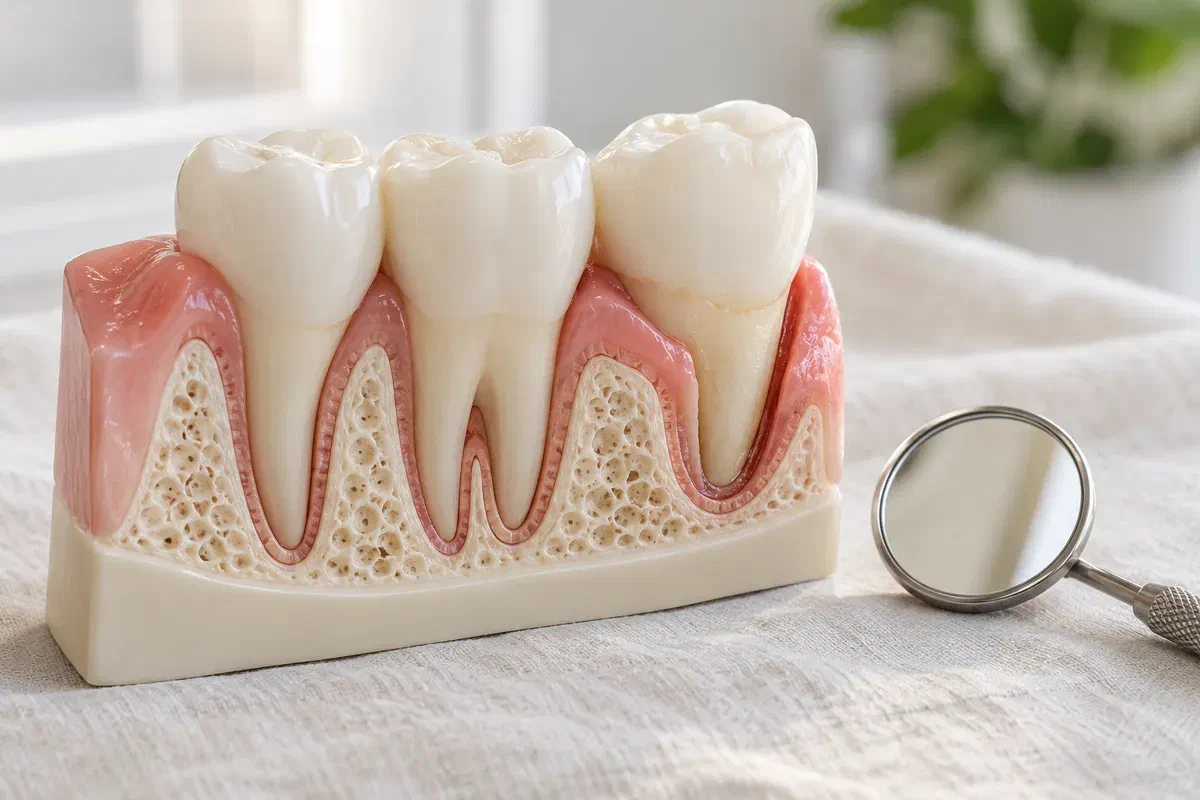
Illustrative connected tooth, gum, and supporting-bone teaching model
Before any treatment is chosen

The diagnosis comes from your mouth, not a brochure.

Periodontal disease is often quiet. Share what you have noticed and book an assessment even when nothing hurts, since symptoms alone do not reveal how much support has been affected.

Changes you have observed

Mention bleeding, gum recession, new gaps that trap food, or a tooth that feels different when you chew. These clues help direct the examination. The diagnosis still requires assessment of the supporting tissues rather than relying on what can be seen.

Treatments you have tried or been offered

Tell the team about earlier deep cleanings, specialist visits, antibiotics or products you have used. Bring records if you have them. Knowing what was done and whether it was reassessed helps separate untreated disease from a site that changed during maintenance.

Health factors and routine difficulties

Share medical conditions, regular medicines, allergies, smoking and anything that makes cleaning hard. This matters for choosing safe treatment, especially if medicines are being considered. The aim is support without judgement, and routines can be adjusted when they no longer fit.

Acute symptoms should not wait for a decision about treatment type. New swelling, discharge, fever, severe pain or a loosening tooth deserve a prompt call.

What treatment is really for

Control the disease, protect the support, review the result

Your teeth will not all share one prognosis, and the plan should reflect that. Ask which areas have the most loss of support, which are sound, and what will shape each tooth’s outlook. If your notes mention a stage or grade, ask how it relates to severity, the complexity of treatment and how quickly the disease has progressed.

Ask, too, how the treatment sequence is built. What will the first phase change? When will it be reviewed? Under what circumstances might antibiotics, other adjuncts or a periodontist be considered? Knowing this makes each step’s purpose clear and avoids pinning hopes on a single product or measurement.

Professional cleaning of affected sites

The team can explain which deposits and areas need attention and how visits will be arranged. Ask about comfort, appointment length and local anaesthetic. The amount of treatment should match your findings, not a branded package or a one-size routine.

Home care that does the daily work

No rinse replaces cleaning between the teeth. Ask which interdental aids fit your spaces and request a demonstration in the hardest areas. Bring tools you have given up on. Practical coaching is as much a part of treatment as anything done in the chair.

Follow-up based on evidence from your mouth

Ask what results would support moving into maintenance and what would point to further active care. Reviews should be explained using current findings. Continuing care is how periodontitis is managed over time, not proof that the earlier work fell short.

The usual route through care

Where adjuncts fit in a stepwise plan

Care typically spans several appointments and may involve a specialist. Ask who coordinates the plan, and how records and any prescriptions will be shared between providers.

  1. Examine and explain the findings

    History, gum measurements and appropriate images are considered together. Ask where support has been lost and whether further information is needed. The explanation should show what is certain, what is not, and what deserves early attention.

  2. Start with plaque control and professional treatment

    Daily cleaning, risk factors and professional care beneath the gums where indicated form the first step. Ask how the visits will be divided and how comfort will be managed. Tell the team about barriers early so the plan stays achievable.

  3. Reassess before adding anything else

    After healing, the team compares findings with the baseline and explains which sites settled. Ask what remaining inflammation or difficult access means. Any added treatment, including adjuncts, should come with a specific reason.

  4. Decide on maintenance, further care or referral

    Response and complexity guide whether more active treatment, a specialist opinion or maintenance makes sense. Agree on intervals and responsibilities. If a tooth has an unfavourable outlook, ask for the reasons and alternatives before removal is decided.

After treatment, at home

Simple tools, used well, outperform clever products.

Aftercare varies with the treatment provided and how your gums respond. Follow the instructions for your own sites, and if you were prescribed anything, use it exactly as directed.

Keep practising the technique you learned

Use the tools and method agreed at your visit, without forcing them into tight spaces. If an area stays difficult, raise it at review or call. One sensible change usually helps more than buying several new products on the strength of an advertisement.

Take prescribed medicines as instructed

If an antibiotic or rinse was prescribed, follow the directions and finish the course as advised. Report side effects, persistent sensitivity, swelling or a tooth that begins to feel loose. Keep both your dental team and physician informed about medicines you take.

Return for the reassessment

Less bleeding is good news but does not confirm that active treatment is complete. The review measures how your gums responded and decides the next stage. If timing becomes difficult, call to rearrange rather than skipping it.

Beyond the first phase

What is offered next should follow the findings.

Ask what each option can achieve, where it falls short and what alternatives exist. Periodontitis does not automatically call for surgery, antibiotics, lasers or extraction.

When professional cleaning and daily care come first

Nonsurgical treatment with planned review

This treatment removes deposits and reduces inflammation, followed by a check of the response. Ask what it covers and which findings would justify another stage. Adjuncts such as antibiotics or specific devices may be considered in selected cases, not as a routine add-on.

When disease persists or a site is complex

Specialist input or targeted treatment

A periodontist can outline additional nonsurgical or surgical approaches. Ask what outcome is achievable and how that option would alter the site. Lost support cannot be restored everywhere, and the risks and benefits should be set out for you.

When long-term planning becomes the focus

Supportive care, or a plan for a weak tooth

Well-settled sites can stay on maintenance while one tooth is assessed separately. Ask how retention, removal and later replacement would compare for that tooth. Each part of your mouth may have a different outlook.

Patient information: American Academy of Periodontology — nonsurgical care and further treatment

Questions about quick fixes

Antibiotics, lasers and other things people ask about

These questions come up often when people are weighing treatment options. Your answers depend on your examination and response to care, so ask the team to relate each one to your own findings.

(905) 876-4488
Can antibiotics cure periodontitis on their own?
No. Antibiotics are not a substitute for professional cleaning and home care, and they are used only in selected situations. Ask whether they are being considered for you and why, and mention any allergies or other medicines.
Is laser treatment better than conventional periodontal treatment?
Lasers are one tool some clinicians use, but they are not required for every plan and should not be assumed superior. Ask what evidence supports any proposed technology for your situation and what the alternatives are.
Will a special toothpaste or rinse fix my gums?
Some products can support your routine, but none replaces professional treatment or cleaning between teeth. Ask the team whether any product would be useful and how it fits with your other care.
Are there natural remedies that treat periodontitis?
Home remedies cannot remove hardened deposits below the gums or restore lost support. If you are using something, mention it so the team can advise whether it is safe alongside treatment.
Why does treatment take several visits if the goal is simple?
Treatment is often divided for comfort and thoroughness, and the tissues need time to heal before reassessment. Ask how your visits will be organized and what each one achieves.
How should I plan appointments from Caledon to avoid unnecessary trips?
Ask for the expected sequence, including reassessment, and book follow-ups before you leave. Hours are Monday to Thursday until 7pm, with Friday to Sunday by appointment. Call promptly about urgent symptoms between visits.
Booking from Caledon

Start with facts, then choose the treatment.

Phone (905) 876-4488 to book a periodontal assessment or to ask about a diagnosis or treatment you have already been offered. Earlier gum-treatment records and a list of your medicines help us link past care with the most suitable next step.

Treatment extent, prognosis, the role of any adjunct, specialist involvement and maintenance intervals vary. Plans require examination and review, and no technology or medicine guarantees full recovery of lost support or lasting freedom from disease.

Visit Milton Dental Clinic
Unit 1, 342 Bronte St. S, Milton, ON L9T 5B7
Get directions Clinic hours
Monday–Thursday
11am–7pm
Friday–Sunday
By appointment only

Areas we serve

  • Milton
  • Oakville
  • Mississauga
  • Georgetown
  • Halton Hills
  • Acton
  • Campbellville
  • Brampton
  • Burlington
  • Puslinch
  • Rockwood
  • Erin
  • Caledon
  • Etobicoke
  • Old Milton
  • Bronte Meadows
  • Timberlea
  • Dorset Park
  • Dempsey
  • Clarke
  • Beaty
  • Coates
  • Harrison
  • Scott
  • Willmott
  • Ford
  • Bowes
  • Cobden
  • Walker
  • Mountain View
  • Milton Heights
  • Hawthorne Village
  • Valley View
  • Fallingbrook
  • Nassagaweya
  • Trafalgar
  • Esquesing
  • Nelson
  • Brookville
  • Moffat
  • Glen Williams
  • Norval
  • Limehouse
  • Stewarttown
  • Ashgrove
  • Hornby
  • Silver Creek
  • Speyside
  • Scotch Block
  • North Oakville
  • River Oaks
  • Glen Abbey
  • West Oak Trails
  • Palermo
  • Bronte Creek
  • College Park
  • Joshua Creek
  • Uptown Core
  • Preserve
  • Iroquois Ridge
  • Lisgar
  • Meadowvale
  • Meadowvale Village
  • Churchill Meadows
  • Erin Mills
  • Central Erin Mills
  • Streetsville
  • East Credit
  • Creditview
  • Heartland
  • Sheridan
  • Mount Pleasant
  • Credit Valley
  • Huttonville
  • Churchville
  • Springbrook
  • Northwest Brampton
  • Bram West
  • Fletcher's Meadow
  • Fletcher's Creek South
  • Alton Village
  • Orchard
  • Millcroft
  • Headon Forest
  • Tansley
  • Brant Hills
  • Tyandaga
  • Kilbride
  • Lowville
  • Aberfoyle
  • Morriston
  • Arkell
  • Hillsburgh
  • Freelton
  • Carlisle
  • Waterdown
  • Flamborough
  • Mountsberg

How can we help?

Milton Dental Clinic

Have a question about your smile? Choose the option that works best for you.

For urgent dental concerns, please call.
Messages are reviewed during clinic hours.