

Illustrative patient reviewing gum-treatment priorities with a clinician
Specialized Care

Periodontitis Treatment in Erin

Being told one tooth has a guarded outlook can overshadow everything else about a periodontitis diagnosis. We explain what that means, set it in the context of your whole mouth, and help you weigh keeping, treating or eventually replacing that tooth with the facts in front of you.

Erin · one tooth, many questions

A doubtful tooth does not define the whole diagnosis.

Hearing the word hopeless or guarded about a particular tooth tends to stick. It can make the rest of the appointment a blur. Periodontitis is a disease involving loss of the bone and attachment that support teeth, and that loss is rarely even. One tooth might be badly affected while its neighbours are holding well, which is also what sets this apart from gingivitis, a gum-only inflammation.

Ask to see the reasoning laid out. What do the measurements and X-rays show for that tooth, and how does it compare with the others? Which teeth look secure? What is still uncertain, and could treatment change the picture? You are entitled to a clear explanation before any decision is made about removal.

For the rest of your mouth, care generally follows a plan of professional treatment, a manageable routine at home, and review. Households in Erin and Hillsburgh often prefer to group visits, and the sequence can be planned with that in mind. The goal is to control disease and keep as much stability as possible, not to promise that lost support returns.

Discuss a tooth with a guarded outlook
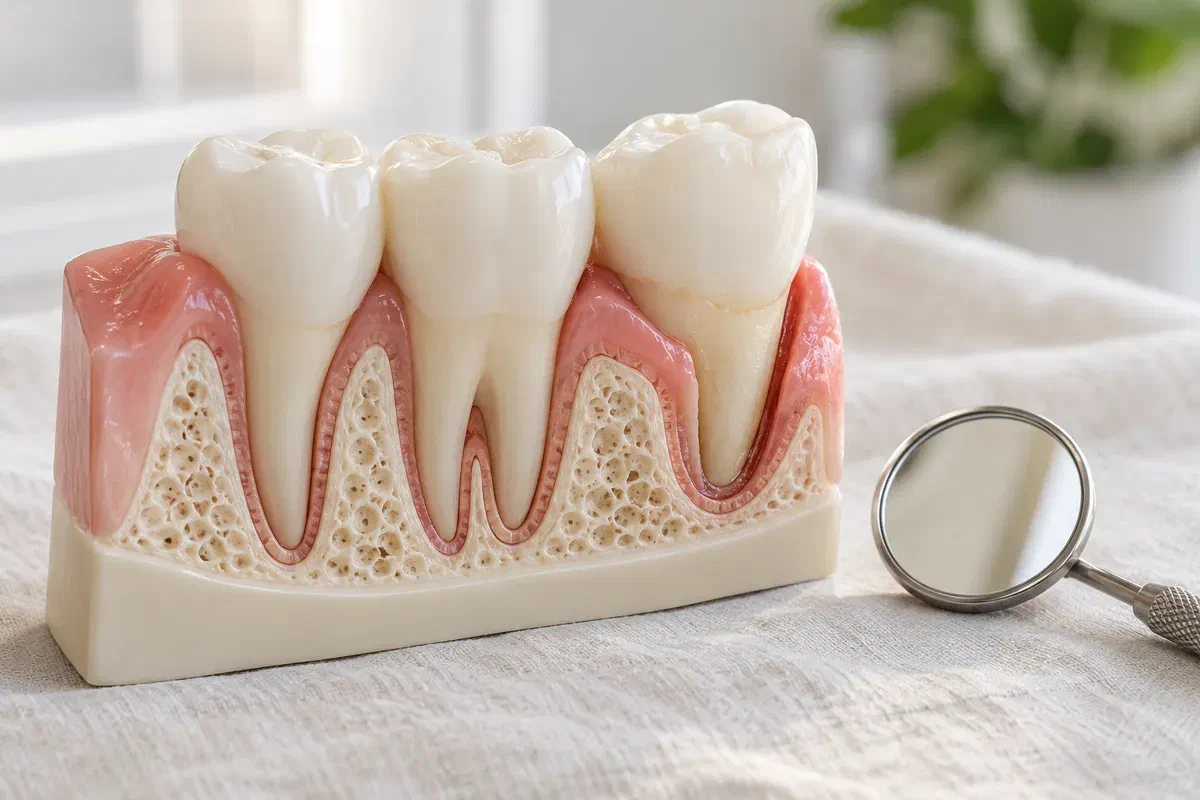
Illustrative connected tooth, gum, and supporting-bone teaching model
Information that shapes each tooth’s outlook

Why do some teeth fare worse than others?

Prognosis depends on several factors working together. Share what you have noticed, and book an assessment even if the tooth in question does not hurt, since periodontal problems are often painless.

How the tooth feels and looks

Mention movement, a change in how it meets the opposite tooth, bleeding, recession or food packing beside it. These observations help the clinician focus, but the outlook depends on measuring remaining support and examining the tooth’s anatomy, not on appearance alone.

What has already been done

Earlier gum treatment, fillings, crowns or root canal work on that tooth all add context. Bring records if you can, and note whether reassessment took place after any periodontal care. That history helps show whether the tooth has been stable, slowly changing or recently worse.

Health and practical considerations

Share medical conditions, medicines, smoking and any difficulty cleaning around that tooth. These factors can influence its prospects. The point is to understand the full situation without blame, and to adapt your routine where access has become difficult.

Do not wait if the tooth becomes markedly looser, painful or swollen, or if you develop a fever or discharge. Call promptly rather than holding the concern for a scheduled visit.

Weighing the options

The whole mouth, then the tooth in question

A plan should look at the overall picture before zooming in. Ask which areas have the most support loss, which are strong, and what will shape each tooth’s future. If your diagnosis includes a stage or grade, ask what it indicates about severity, the complexity of care and the pace of progression so far, and how the doubtful tooth fits into that.

Sequence matters here too. Ask whether the tooth should be treated first and reassessed before deciding, what the opening phase will try to achieve for your mouth generally, and which findings would lead to specialist input. Sometimes the response to initial care clarifies a tooth’s outlook better than any single measurement.

Professional care across affected sites

The team can explain which areas need treatment and how it will be divided between visits. Ask about comfort, length of appointments and whether local anaesthetic is proposed. The scope should follow from your findings and your preferences about the doubtful tooth.

Cleaning that protects neighbouring teeth

A struggling tooth can make cleaning nearby teeth harder. Ask which aids reach those spaces safely, and request a demonstration. Bring any tool that has not worked. Good access helps protect the teeth around the one in question.

Reviews that clarify the decision

Ask what findings at reassessment would make keeping the tooth more or less reasonable. Each review should use current information. Ongoing care manages a history of periodontitis, and revisiting a decision as new findings arrive is part of good planning.

Making the decision step by step

Treat, wait, measure, and only then decide.

Care can involve several appointments and possibly a periodontist or other provider. Ask who coordinates the plan and how findings will be shared if a specialist offers an opinion on the tooth.

  1. Assess the mouth and the specific tooth

    History, gum measurements and appropriate images are reviewed for your whole mouth, with particular attention to the doubtful tooth. Ask what factors drive its outlook and whether more information is needed. Uncertainty should be acknowledged openly.

  2. Start treatment and daily plaque control

    Professional cleaning beneath the gums where needed is paired with home care and attention to risk factors. Ask whether the doubtful tooth will be included in initial treatment and how comfort will be managed. Mention any barriers so the plan stays achievable.

  3. Reassess the response, including that tooth

    After healing, the team compares findings and explains how each area responded. Ask whether the tooth’s outlook has changed and what remaining inflammation or mobility means. Any further care should have a clear purpose.

  4. Choose between keeping, treating further or removal

    Response and complexity guide whether more care, specialist assessment or removal is sensible. Ask for the reasoning, the alternatives and what happens to neighbouring teeth in each case. For the rest of the mouth, agree on maintenance intervals and responsibilities.

Looking after things at home

Care for the doubtful tooth and its neighbours alike

Your aftercare depends on what treatment you had and how the tissues respond. Follow the advice for your specific sites, and ask if cleaning around the affected tooth feels uncomfortable or uncertain.

Use the approach you practised

Stick with the agreed tools and technique, being gentle around a mobile tooth and never forcing anything into a tight space. If the area stays awkward, mention it at review or call. A single sensible change beats a collection of new products.

Report changes to the tooth or your health

Let the team know if the tooth becomes looser, more tender or swollen, or if sensitivity persists elsewhere. Keep us informed about medical care and medicines, without changing prescribed treatment yourself. Coordination with your physician may be needed.

Return for the review that informs the decision

Less bleeding is encouraging but does not settle the tooth’s future or confirm that active care is complete. Keep the reassessment that measures the response. If timing becomes difficult, call to rearrange rather than letting the decision drift.

Possible paths for that tooth

Keep it, treat it further, or plan for its replacement

Discuss the benefits, limits and alternatives of each path. A guarded outlook does not mean removal is the only option, and periodontitis does not automatically lead to surgery or antibiotics.

When the tooth’s response to initial care is still unknown

Nonsurgical treatment and a wait-and-see review

The tooth is treated alongside other affected sites, and its outlook is revisited at reassessment. Ask what result would change the plan. Antibiotics or particular technologies are not automatically needed.

When complexity or remaining disease needs another view

A specialist opinion on that tooth

A periodontist can assess whether further nonsurgical or surgical care could help that site. Ask what success would look like and how likely it is. Regaining lost support is possible only in selected cases, and risks should be explained.

When long-term planning for the tooth becomes central

Removal and later replacement, or continued monitoring

Sometimes keeping a tooth under close watch is reasonable; sometimes removal is the more predictable choice. Ask how retaining it, extracting it and possible replacement options compare, including their effect on neighbouring teeth.

Patient information: American Academy of Periodontology — nonsurgical care and further treatment

Questions about a tooth with a poor outlook

Deciding with clear information, not fear

Ask for explanations that connect the doubtful tooth to the rest of your mouth, the immediate priorities and the longer plan. Answers should be based on your examination and response to care.

(905) 876-4488
What makes a tooth’s prognosis guarded or poor?
It usually reflects how much support remains, the tooth’s shape and roots, mobility and other factors. Ask which of these apply to your tooth and whether any could change with treatment.
Is it better to remove a doubtful tooth early or try to keep it?
It depends on the tooth, its effect on neighbours and your preferences. Sometimes treating and reassessing is sensible; sometimes earlier removal is more predictable. Ask for the reasoning in your case.
Could keeping a weak tooth harm the teeth next to it?
In some situations, an untreatable infected site can affect nearby support. In others, a tooth can be kept safely with monitoring. Ask the dentist how the neighbouring teeth are likely to be affected by each choice.
What replacement options exist if the tooth is removed?
Options may include an implant, a bridge or a removable denture, depending on your mouth and health. Gum disease should be controlled before most replacements. Ask what would suit your situation and when it could be considered.
Can I take time to decide about the tooth?
Often, yes, provided there is no acute infection or pain. Ask how long it is reasonable to wait and what signs would mean a decision is needed sooner.
How can visits from Erin be grouped if removal and replacement are planned?
Ask the team to outline the likely sequence of appointments, including any specialist visits. Grouping where it is clinically sensible can reduce trips. Report urgent changes promptly between visits.
Booking from Erin

Get a clear view of every tooth, including the doubtful one.

To arrange a periodontal assessment or a second look at a tooth you have been told is in doubt, phone (905) 876-4488. Bring earlier gum-treatment and dental records so we can connect what has been done with your options now.

The extent of treatment, prognosis for each tooth, specialist involvement and maintenance intervals vary. Decisions require examination and review, and no procedure guarantees that a doubtful tooth can be kept or that disease will not return.

Visit Milton Dental Clinic
Unit 1, 342 Bronte St. S, Milton, ON L9T 5B7
Get directions Clinic hours
Monday–Thursday
11am–7pm
Friday–Sunday
By appointment only

Areas we serve

  • Milton
  • Oakville
  • Mississauga
  • Georgetown
  • Halton Hills
  • Acton
  • Campbellville
  • Brampton
  • Burlington
  • Puslinch
  • Rockwood
  • Erin
  • Caledon
  • Etobicoke
  • Old Milton
  • Bronte Meadows
  • Timberlea
  • Dorset Park
  • Dempsey
  • Clarke
  • Beaty
  • Coates
  • Harrison
  • Scott
  • Willmott
  • Ford
  • Bowes
  • Cobden
  • Walker
  • Mountain View
  • Milton Heights
  • Hawthorne Village
  • Valley View
  • Fallingbrook
  • Nassagaweya
  • Trafalgar
  • Esquesing
  • Nelson
  • Brookville
  • Moffat
  • Glen Williams
  • Norval
  • Limehouse
  • Stewarttown
  • Ashgrove
  • Hornby
  • Silver Creek
  • Speyside
  • Scotch Block
  • North Oakville
  • River Oaks
  • Glen Abbey
  • West Oak Trails
  • Palermo
  • Bronte Creek
  • College Park
  • Joshua Creek
  • Uptown Core
  • Preserve
  • Iroquois Ridge
  • Lisgar
  • Meadowvale
  • Meadowvale Village
  • Churchill Meadows
  • Erin Mills
  • Central Erin Mills
  • Streetsville
  • East Credit
  • Creditview
  • Heartland
  • Sheridan
  • Mount Pleasant
  • Credit Valley
  • Huttonville
  • Churchville
  • Springbrook
  • Northwest Brampton
  • Bram West
  • Fletcher's Meadow
  • Fletcher's Creek South
  • Alton Village
  • Orchard
  • Millcroft
  • Headon Forest
  • Tansley
  • Brant Hills
  • Tyandaga
  • Kilbride
  • Lowville
  • Aberfoyle
  • Morriston
  • Arkell
  • Hillsburgh
  • Freelton
  • Carlisle
  • Waterdown
  • Flamborough
  • Mountsberg

How can we help?

Milton Dental Clinic

Have a question about your smile? Choose the option that works best for you.

For urgent dental concerns, please call.
Messages are reviewed during clinic hours.