

Illustrative patient reviewing gum-treatment priorities with a clinician
Specialized Care

Periodontitis Treatment in Halton Hills

Smoking, diabetes, certain medicines and a stressful year can all affect how gums behave. We explain how your health and habits relate to your periodontitis findings, without lecturing, and build treatment and review around the life you actually lead.

Halton Hills · gums and general health

Your health history belongs in the gum conversation.

Some people are surprised when the dentist asks about blood sugar, cigarettes or the pills they take each morning. Those questions are there for a reason. Periodontitis, the loss of bone and attachment that hold teeth in place, is influenced by plaque and by the body’s response to it, and several health factors can shape that response. Gingivitis, which stays in the gums, is a separate diagnosis.

None of this is about assigning fault. It is about understanding your situation well enough to plan sensibly. Ask the dentist to explain, using your own measurements and X-rays, where support has been lost, where it is holding, and which factors in your health might be contributing. Uncertain points should be named as uncertain.

With that understanding, the plan brings together professional treatment, a home routine that suits your hands and your schedule, and planned review. Across Georgetown, Acton, Glen Williams and the smaller hamlets, households plan around different rhythms, and the timing can be fitted to yours. Treatment aims for control and stability, not a promise that lost support will return.

Discuss your gum and health findings
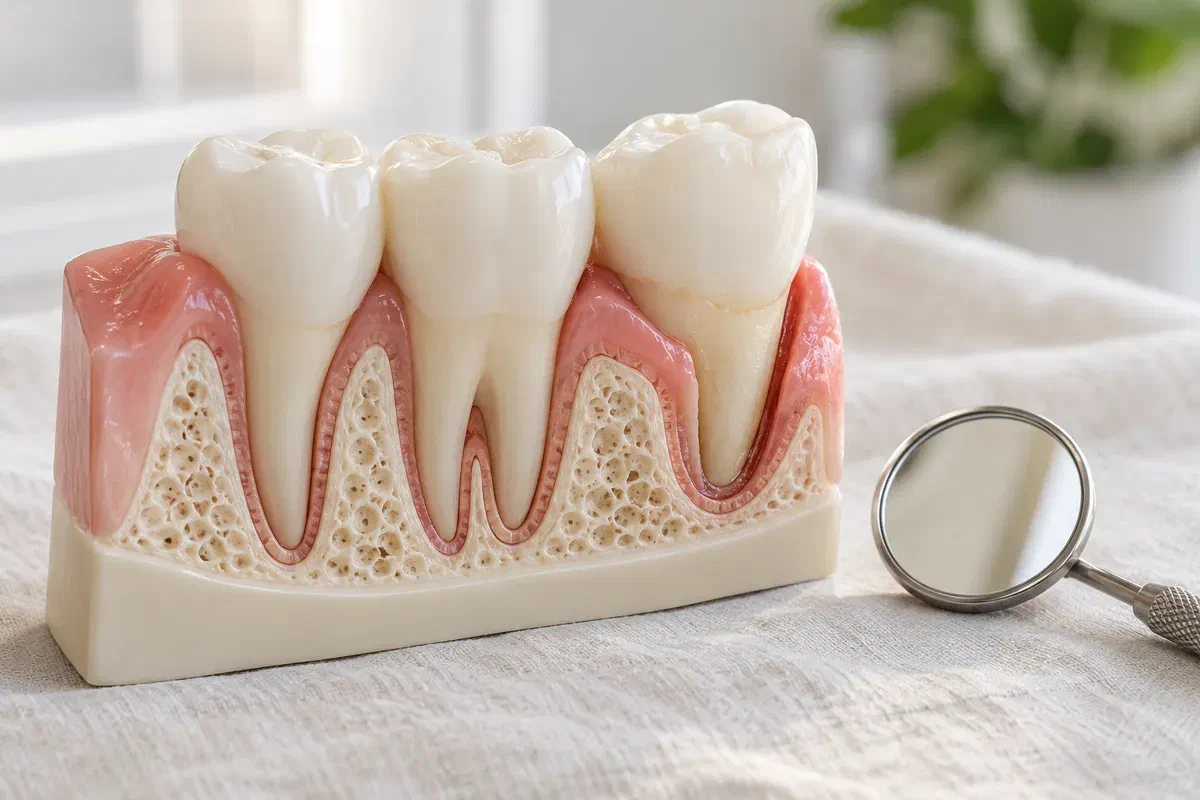
Illustrative connected tooth, gum, and supporting-bone teaching model
The fuller picture

Mouth, body and routine, considered together

Gum disease can be advanced before it hurts. Share what you have seen at home and what is happening with your health, and do not wait for discomfort before booking.

Gum changes you have spotted

Bleeding, gum lines creeping upward, food wedging into new gaps, or a bite that feels off are all worth describing. They help direct the examination. Still, confirming periodontitis requires measuring the tissues and support, and how things look in the mirror only tells part of the story.

What earlier treatment achieved

Records from a previous dentist or periodontist help, especially if they show measurements before and after care. Mention whether anyone checked the result. With that sequence, it becomes easier to tell disease that was never brought under control from new activity during maintenance.

Conditions, medicines and tobacco

Diabetes, some medications, smoking or vaping, and other health changes can affect your gums and healing. Share them openly, along with anything that makes cleaning difficult. The team’s role is to help you work with these factors, and to adapt advice when your circumstances shift.

Please phone promptly about fresh swelling, discharge, fever, intense pain or a tooth that has started to loosen. Do not hold off on an acute problem just because the full plan is not yet in place.

Clarity before commitment

Where health factors fit in the treatment plan

Every mouth has a mix of stronger and weaker sites. Ask the dentist which teeth have the greatest loss of support, which look secure, and which factors, including your general health, might sway each tooth’s outlook. A stage or grade may appear in your notes; ask how it relates to severity, complexity and the observed rate of progression.

Knowing the order of care helps too. What is phase one designed to accomplish? When will your response be assessed? What would prompt a referral? These answers explain why each appointment exists. They also guard against the idea that a single measurement on a single day can settle the whole course.

Professional care targeted to disease

The team can describe which sites have deposits or inflammation that need treatment and how those visits will be arranged. Ask about comfort, appointment length and whether local anaesthetic is suggested. If a health condition affects treatment, ask how that will be accounted for.

Daily cleaning you can keep up

Ask which brushes and interdental aids fit your teeth, and have someone demonstrate the hardest-to-reach places. If stiff joints or reduced eyesight make cleaning harder, say so. Bring tools you have abandoned; finding something that works is part of treatment.

Ongoing care guided by results

Find out what would indicate readiness for maintenance and what might suggest more active treatment. Each review should be explained with current findings. Maintenance manages a long-term condition, and it does not mean earlier care was without value.

Moving through treatment

One stage at a time, with a check in between

Care usually involves multiple appointments and may include a specialist or coordination with your physician. Ask who is overseeing each stage and how information will be shared.

  1. Examine, review your health and explain

    The clinician considers your medical history alongside gum measurements and appropriate X-rays. Ask where support is reduced and whether further information, including from your doctor, would help. You should come away knowing what is clear, what is not and what may need early care.

  2. Combine home plaque control with treatment

    Daily cleaning, risk factors you can change and professional care beneath the gum margin where indicated are addressed together. Ask how many visits it will take and how comfort will be managed. If quitting smoking or managing blood sugar is relevant, ask what support is available.

  3. Reassess the response

    After an interval, the team compares relevant findings and explains which sites have settled. Ask what lingering inflammation or difficult access means for what follows. Further treatment should come with a reason attached rather than repeat the first phase by default.

  4. Choose the next path

    The response, the complexity of each site and your health guide whether more active care or a specialist assessment is sensible. For maintenance, agree on the interval and who does what. Before removal of a doubtful tooth is considered, ask why and what else could be done.

Supporting healing between visits

Keep the team updated as your health changes.

Aftercare depends on the treatment provided and how your tissues respond. Follow the instructions for your specific sites, and ask about anything that makes cleaning painful or unclear.

Use the cleaning approach you were shown

Work with the agreed tools and method, and never force a device into a space too narrow for it. If an area stays difficult, mention it at review or phone for advice. A single practical change is usually more useful than adding several new products without guidance.

Share medical updates and new symptoms

Tell us about new diagnoses, changes in medication or hospital treatment, and about ongoing sensitivity, swelling or teeth that feel different. Never stop or change prescribed care on your own. Your dental plan may need coordinating with your physician when health circumstances change.

Return for review and continuing care

Less bleeding is good news but does not confirm that active treatment is complete. Keep the appointment that checks your response and sets the next stage. If attending becomes hard, call to talk about timing rather than leaving things open.

Further care for Halton Hills, if needed

Options weighed against your response and health

Discuss what each recommendation could offer, where it has limits and what alternatives exist. A periodontitis diagnosis does not make surgery, antibiotics or extraction automatic.

When cleaning and daily care are the first priority

Nonsurgical treatment and follow-up

Treatment removes deposits and calms inflammation at affected sites, then a review checks the result. Ask what is included and what would lead to another stage. Antibiotics and named devices are not automatically part of every periodontal plan.

When residual disease or health factors add complexity

Specialist review or targeted procedures

A periodontist may discuss additional nonsurgical or surgical options and how your health affects them. Ask what is realistic and what a procedure would change. Regaining lost support is not possible at every site, and risks should be discussed individually.

When the long view takes priority

Supportive care or a single-tooth decision

Well-settled sites can continue with maintenance while a struggling tooth receives its own outlook discussion. Ask how retaining it compares with removal and later replacement. Not every tooth has the same future, and the plan should say so.

Patient information: American Academy of Periodontology — nonsurgical care and further treatment

Health and gum-disease questions

How does the rest of my health connect to my gums?

Ask for a clear explanation of the affected areas, the first steps and the longer plan. Answers should be based on your examination and response, not on a generic prediction.

(905) 876-4488
Does diabetes affect periodontitis treatment?
Diabetes is recognized as a factor that can influence gum health and healing. Share your diagnosis and how it is being managed. Ask whether the team would like to coordinate with your physician and how it might affect your plan.
Will quitting smoking help my gums?
Smoking is a known risk factor for periodontitis, and stopping is generally considered helpful for gum health. Ask the team what support is available. Be aware that gums may bleed more at first when you quit, which is worth mentioning at review.
Can my medications affect my gums?
Some medicines can cause dry mouth, gum changes or affect bleeding. Bring an up-to-date list to each appointment. Ask whether any of your medicines are relevant, but do not change prescribed treatment without talking to your physician.
Should I tell my doctor about my periodontitis diagnosis?
It is reasonable to mention it, especially if you have conditions such as diabetes or take medicines that affect bleeding or healing. Ask the dental team whether a letter or summary would be useful.
Does stress have anything to do with gum disease?
Stress can affect habits such as cleaning, sleep and smoking, and may play a role in how the body responds. Ask the team for a routine you can maintain during busier periods rather than one that only works when life is calm.
How can a Halton Hills household coordinate several family members’ dental visits?
Ask whether back-to-back appointments are possible when booking. Mention who needs periodontal treatment and who needs routine care. Grouping visits can reduce trips, though treatment length and timing still depend on each person’s needs.
Booking from Halton Hills

Start with a full, honest picture

Reach our team by phone at (905) 876-4488 to arrange a periodontal assessment or talk over an existing diagnosis. A current medicine list and any earlier gum-treatment records help us connect your health, your history and your next step.

Treatment extent, prognosis, specialist involvement and maintenance timing vary, and general health may influence each. Planning requires examination and review; no procedure guarantees complete recovery of lost support or permanent freedom from disease.

Visit Milton Dental Clinic
Unit 1, 342 Bronte St. S, Milton, ON L9T 5B7
Get directions Clinic hours
Monday–Thursday
11am–7pm
Friday–Sunday
By appointment only

Areas we serve

  • Milton
  • Oakville
  • Mississauga
  • Georgetown
  • Halton Hills
  • Acton
  • Campbellville
  • Brampton
  • Burlington
  • Puslinch
  • Rockwood
  • Erin
  • Caledon
  • Etobicoke
  • Old Milton
  • Bronte Meadows
  • Timberlea
  • Dorset Park
  • Dempsey
  • Clarke
  • Beaty
  • Coates
  • Harrison
  • Scott
  • Willmott
  • Ford
  • Bowes
  • Cobden
  • Walker
  • Mountain View
  • Milton Heights
  • Hawthorne Village
  • Valley View
  • Fallingbrook
  • Nassagaweya
  • Trafalgar
  • Esquesing
  • Nelson
  • Brookville
  • Moffat
  • Glen Williams
  • Norval
  • Limehouse
  • Stewarttown
  • Ashgrove
  • Hornby
  • Silver Creek
  • Speyside
  • Scotch Block
  • North Oakville
  • River Oaks
  • Glen Abbey
  • West Oak Trails
  • Palermo
  • Bronte Creek
  • College Park
  • Joshua Creek
  • Uptown Core
  • Preserve
  • Iroquois Ridge
  • Lisgar
  • Meadowvale
  • Meadowvale Village
  • Churchill Meadows
  • Erin Mills
  • Central Erin Mills
  • Streetsville
  • East Credit
  • Creditview
  • Heartland
  • Sheridan
  • Mount Pleasant
  • Credit Valley
  • Huttonville
  • Churchville
  • Springbrook
  • Northwest Brampton
  • Bram West
  • Fletcher's Meadow
  • Fletcher's Creek South
  • Alton Village
  • Orchard
  • Millcroft
  • Headon Forest
  • Tansley
  • Brant Hills
  • Tyandaga
  • Kilbride
  • Lowville
  • Aberfoyle
  • Morriston
  • Arkell
  • Hillsburgh
  • Freelton
  • Carlisle
  • Waterdown
  • Flamborough
  • Mountsberg

How can we help?

Milton Dental Clinic

Have a question about your smile? Choose the option that works best for you.

For urgent dental concerns, please call.
Messages are reviewed during clinic hours.