

Illustrative patient reviewing gum-treatment priorities with a clinician
Specialized Care

Periodontitis Treatment in Oakville

A periodontal chart full of numbers can be hard to interpret on your own. We can go through those measurements and your X-rays with you, explain what they say about the support around each tooth, and set out the treatment and follow-up that make sense from here.

Oakville · making sense of the numbers

What do all those pocket readings actually mean?

During a gum examination, the clinician gently measures around each tooth and calls out numbers that end up on a chart. Combined with X-rays, those readings show where attachment and bone have been lost. When that loss is present, the diagnosis is periodontitis, a condition that goes beyond the gum inflammation seen in gingivitis even though both may cause bleeding.

It is completely reasonable to want someone to slow down and translate. Which numbers are concerning? Which teeth look solid? Is any of it uncertain? Ask the dentist to point to your own chart and images while explaining, so the diagnosis becomes something you can picture rather than a list of figures you were handed.

Once the findings are clear, planning usually brings together professional treatment, a realistic routine at home, and a scheduled check on progress. Travelling up from Oakville, it helps to know that sequence in advance. Treatment works toward controlling disease and stability over time; it cannot guarantee that lost support will come back.

Have your periodontal findings explained
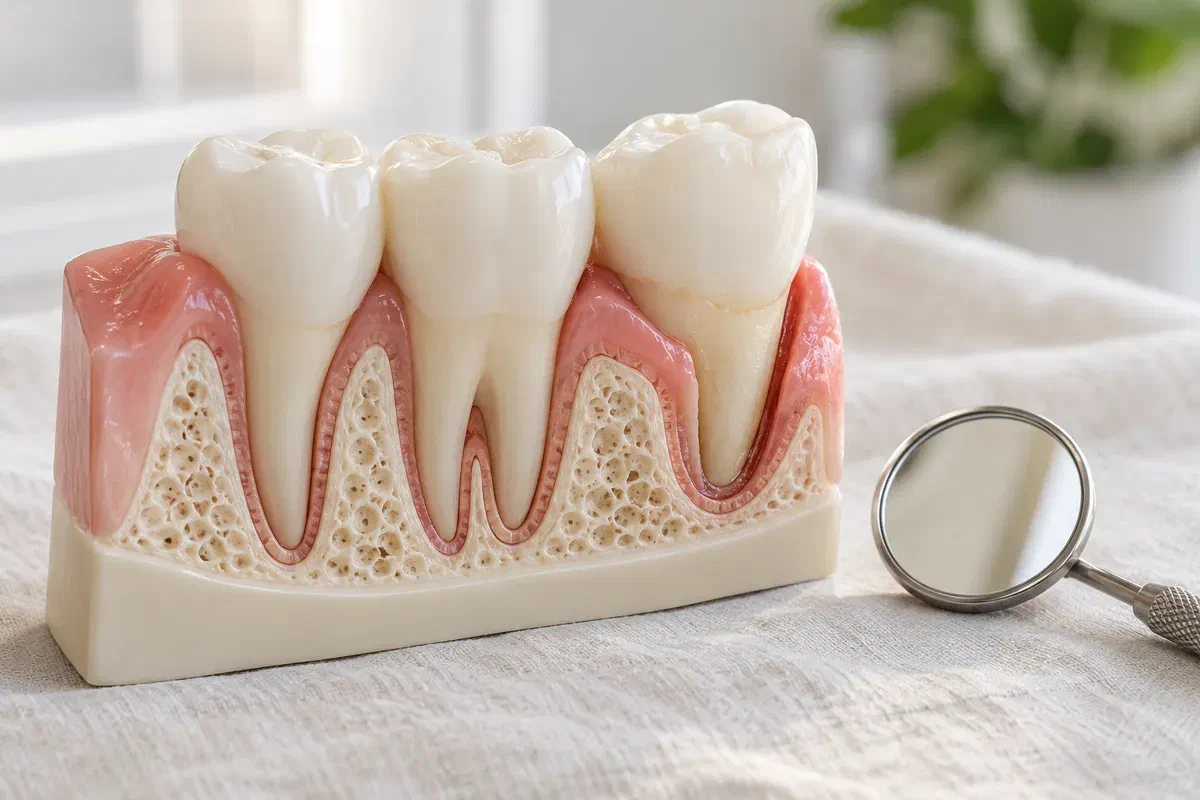
Illustrative connected tooth, gum, and supporting-bone teaching model
Beyond the chart

Measurements matter, and so does your story.

Numbers alone do not capture everything. Tell us what you have noticed, and remember that periodontal problems can be significant even when your teeth feel comfortable and chewing is easy.

The signs you see in the mirror

Gums that bleed, look shorter, or leave longer-looking teeth are worth mentioning, along with new spaces that trap food and any change in how your bite feels. These observations guide where the clinician looks more closely, but only measurement of the supporting tissues can confirm the diagnosis.

Where you have been treated before

If another office recorded a chart or recommended treatment, bring a copy or ask for it to be sent. Note what was completed and whether a follow-up measurement happened. Comparing results over time is one of the clearest ways to tell stable sites from active ones.

Factors that affect healing and cleaning

Share health conditions, regular medicines, smoking and any trouble reaching the back teeth. These details help the team tailor advice without judgement. When circumstances such as grip strength or eyesight change, your routine should change with them rather than becoming a source of frustration.

Swelling that appears suddenly, discharge, fever, strong pain or a tooth that starts to feel loose should be reported promptly. Do not hold an acute problem until the full plan has been booked.

From readings to decisions

Not every high number means the same thing

The chart tells you where disease has left its mark, but each tooth’s outlook still depends on several factors together. Ask which sites are most affected and why some are considered more at risk than others. If your report uses a stage or grade, ask how it reflects severity, treatment complexity and the evidence about how quickly the disease has moved.

Clarity about order matters just as much. Ask what the opening phase of treatment is designed to change, when the team will measure again, and what they would need to see before suggesting a specialist. With those points clear, each appointment has a purpose you understand, and no single reading is expected to decide everything.

Treatment focused on the sites that need it

The team can explain which areas have deposits or inflammation that call for professional care, and how the work will be broken into visits. Ask about comfort measures, how long appointments run and whether local anaesthetic is suggested. The plan should fit your findings rather than a one-size package.

Daily cleaning matched to your spaces

Find out which interdental cleaners fit between your teeth and ask to be shown the tricky spots. If a tool from a previous visit never felt right, bring it along. Learning technique is part of the treatment itself, and asking questions is expected rather than a sign of failure.

Follow-up that responds to the new numbers

Ask what readings would suggest you are ready for maintenance and what would point toward more active care. Every review should be explained using the latest findings. Ongoing visits help manage a history of periodontitis and do not mean the first round of treatment fell short.

What the visits look like

Measure. Treat. Measure again. Then plan the long term.

Expect more than one appointment and, in some cases, a periodontist’s involvement. Ask who is responsible for each stage and how charts and images will travel between offices.

  1. A full periodontal examination with explanation

    The clinician combines your history, the charted measurements and suitable X-rays to understand the condition. Ask which teeth have lost support and whether more information is required. The explanation should make clear what is known, what is uncertain and what may need early attention.

  2. Home plaque control alongside professional care

    This stage covers your daily routine, any risk factors you can change, and professional treatment above and below the gumline where it is indicated. Ask how many visits the work will take and how you will be kept comfortable. Share obstacles early so the plan remains workable.

  3. A second chart to compare the response

    At reassessment, new readings are set against the originals, and the team explains which sites improved. Ask what any remaining inflammation or hard-to-clean areas mean. If more treatment is suggested, it should come with a defined aim rather than repeating the first round automatically.

  4. Further care, specialist input or maintenance

    The way your gums responded, along with the complexity of each site, guides the next decision. If you move to maintenance, agree on the interval and what each side is responsible for. For a tooth with a poor outlook, ask for the specific reasoning and alternatives before considering removal.

Looking after the treated areas

Your routine is what holds the improvement between reviews.

Care at home depends on the treatment you received and how your tissues are settling. Follow the instructions for your own sites and ask whenever cleaning feels sore or unclear.

Practise the technique you were taught

Use the agreed brushes and cleaners without wedging anything into a space too tight for it. If one area keeps giving you trouble, bring it up at review or call for guidance. A single practical adjustment is usually more helpful than trying several unfamiliar products at once.

Report changes in comfort or health

Tell the team about ongoing sensitivity, fresh swelling, or a tooth that feels different or more mobile. Keep us informed about medical treatment and medicines, without changing prescribed care yourself. Your periodontal plan may need input from other clinicians when your health changes.

Return for the comparison visit and beyond

Less bleeding is a good sign, yet it does not tell you that active care is complete. Keep the reassessment that measures the response and outlines the next step. If the date becomes hard to manage, call to rearrange instead of leaving the plan without a decision.

Where the plan can go next

Three directions, chosen by response and remaining support

Ask about the benefits, limits and alternatives of each recommendation. Periodontitis is not an automatic path to surgery, antibiotics or the removal of every affected tooth.

When cleaning and daily care are the immediate focus

Nonsurgical treatment, then a fresh chart

Treatment removes deposits and reduces inflammation at the affected sites, and a later review checks the result. Ask what is included and what would trigger another stage. Antibiotics or a specific branded technology are not routinely required for periodontal treatment.

When persistent disease or complex anatomy needs more input

Specialist review or site-specific procedures

A periodontist may discuss further nonsurgical or surgical treatment based on the findings. Ask what goals are realistic and what a procedure would change for that site. Rebuilding lost support is not possible everywhere, and benefits and risks deserve an individual explanation.

When long-term planning moves to the front

Supportive care or a decision about one tooth

Areas that have settled can enter maintenance while a weaker tooth receives its own prognosis discussion. Ask how keeping it compares with removal and possible replacement. Your teeth do not all share one outlook, and the plan should reflect those differences.

Patient information: American Academy of Periodontology — nonsurgical care and further treatment

Chart and diagnosis questions

Ask until the numbers make sense to you

Request a clear account of the affected areas, the first priorities and the longer plan. Answers should come from your examination and how you respond to care, not from a general forecast.

(905) 876-4488
What is a periodontal pocket, and why does its depth matter?
It is the space between the gum and the tooth where the clinician measures. Deeper readings, together with X-rays and other findings, can indicate lost attachment. Ask which pockets concern the team most and what they hope will change after treatment.
Why does my X-ray show bone loss when my teeth feel fine?
Loss of support can develop without pain or obvious looseness. The X-ray helps show changes you cannot feel. Ask the dentist to point out the affected areas and explain how they relate to your chart readings.
Can I get a second opinion on a periodontitis diagnosis made elsewhere?
Yes. Bring or request your records so findings can be compared. A fresh examination may confirm the diagnosis or clarify uncertain areas. Ask how any difference in recommendations would affect your treatment choices.
Will the readings be taken again after treatment?
Reassessment typically includes measuring again so the response can be judged. Ask when that will happen and which sites will be compared most closely. Changes in the numbers help decide whether maintenance or further care comes next.
Is it possible for some pocket readings to stay deep after treatment?
Yes, some sites may not respond fully. That does not mean treatment was wasted. Ask what a remaining deep reading means at that tooth and whether further nonsurgical care, specialist assessment or closer monitoring is suggested.
How many trips from Oakville should I plan for?
It depends on the extent of treatment and how it is divided. Ask for the expected number of visits and the timing of reassessment so you can plan ahead. Report urgent symptoms promptly rather than waiting for the next booked appointment.
Planning from Oakville

Bring your chart, your questions and any older records

Phone our Bronte Street practice at (905) 876-4488 to arrange a periodontal assessment or discuss a diagnosis you have already been given. Previous charts and X-rays help us link earlier findings with the most suitable next step.

Treatment scope, tooth prognosis, specialist referral and maintenance intervals vary. A plan depends on examination and review, and no procedure guarantees complete recovery of lost support or permanent freedom from periodontal disease.

Visit Milton Dental Clinic
Unit 1, 342 Bronte St. S, Milton, ON L9T 5B7
Get directions Clinic hours
Monday–Thursday
11am–7pm
Friday–Sunday
By appointment only

Areas we serve

  • Milton
  • Oakville
  • Mississauga
  • Georgetown
  • Halton Hills
  • Acton
  • Campbellville
  • Brampton
  • Burlington
  • Puslinch
  • Rockwood
  • Erin
  • Caledon
  • Etobicoke
  • Old Milton
  • Bronte Meadows
  • Timberlea
  • Dorset Park
  • Dempsey
  • Clarke
  • Beaty
  • Coates
  • Harrison
  • Scott
  • Willmott
  • Ford
  • Bowes
  • Cobden
  • Walker
  • Mountain View
  • Milton Heights
  • Hawthorne Village
  • Valley View
  • Fallingbrook
  • Nassagaweya
  • Trafalgar
  • Esquesing
  • Nelson
  • Brookville
  • Moffat
  • Glen Williams
  • Norval
  • Limehouse
  • Stewarttown
  • Ashgrove
  • Hornby
  • Silver Creek
  • Speyside
  • Scotch Block
  • North Oakville
  • River Oaks
  • Glen Abbey
  • West Oak Trails
  • Palermo
  • Bronte Creek
  • College Park
  • Joshua Creek
  • Uptown Core
  • Preserve
  • Iroquois Ridge
  • Lisgar
  • Meadowvale
  • Meadowvale Village
  • Churchill Meadows
  • Erin Mills
  • Central Erin Mills
  • Streetsville
  • East Credit
  • Creditview
  • Heartland
  • Sheridan
  • Mount Pleasant
  • Credit Valley
  • Huttonville
  • Churchville
  • Springbrook
  • Northwest Brampton
  • Bram West
  • Fletcher's Meadow
  • Fletcher's Creek South
  • Alton Village
  • Orchard
  • Millcroft
  • Headon Forest
  • Tansley
  • Brant Hills
  • Tyandaga
  • Kilbride
  • Lowville
  • Aberfoyle
  • Morriston
  • Arkell
  • Hillsburgh
  • Freelton
  • Carlisle
  • Waterdown
  • Flamborough
  • Mountsberg

How can we help?

Milton Dental Clinic

Have a question about your smile? Choose the option that works best for you.

For urgent dental concerns, please call.
Messages are reviewed during clinic hours.