

Illustrative consultation about a changing gumline and tooth sensitivity
Specialized Care

Receding Gums Assessment in Halton Hills

Maybe it is the way one front tooth now looks taller in photos, or a gum edge that no longer matches its neighbour. A receding gums assessment for Halton Hills households sorts out what is cosmetic, what is about gum health, and what deserves attention first.

Halton Hills · smile and gumline

It bothers you when you smile. That is a fair reason to ask.

Appearance is a perfectly reasonable concern. When a gum recedes, its edge creeps up (or down, on the lower teeth) and shows more of the tooth, sometimes revealing a slightly different colour where the root begins. That change can be obvious in a photograph long before it causes any discomfort. What a picture cannot reveal is why the gum moved or whether it will move again.

So the assessment looks beyond the look. The clinician reviews the gum tissue, the newly visible root, nearby teeth and restorations, your cleaning routine and your history. Recession may involve several contributing factors, and it is not always a sign of one particular condition. A single uneven spot is interpreted with the whole mouth in view.

Families across Halton Hills often mention this at a regular checkup and then want a proper conversation. Tell us which tooth bothers you, when you first noticed it and what you hope might change. We will explain what the examination shows about gum health, what can simply be watched, and where a periodontist’s view of appearance options could help.

Ask about an uneven gumline
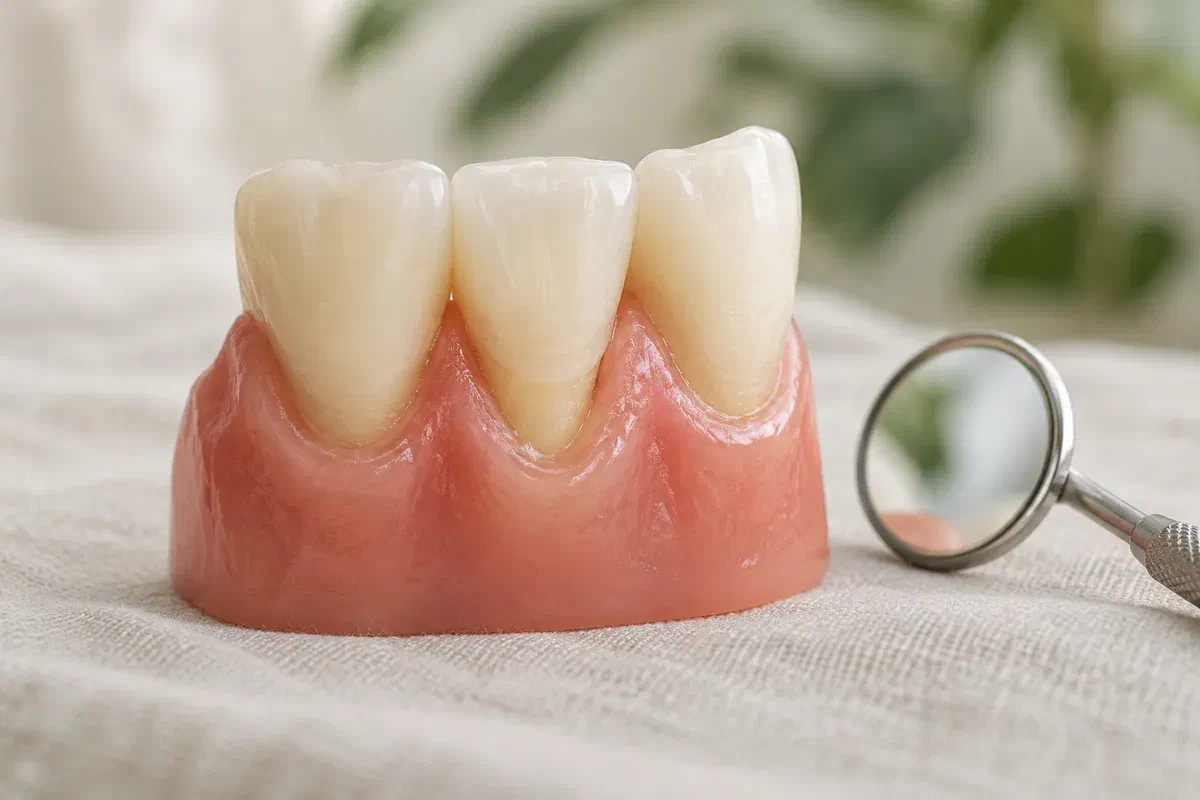
Illustrative teaching model showing an exposed tooth neck beside neighbouring teeth
What to point out

Show us the tooth, then tell us the story.

Use a mirror in the chair to point out what bothers you. If you have older photographs where the smile looks different, or dental records that show the area before, bring them along; measuring is our job, not yours.

The tooth or teeth that look out of line

Mention whether it is one tooth or a pattern across several, and note braces, veneers, crowns or earlier gum treatment. These clues help guide the examination. They do not prove why the gum changed, and they cannot show on their own whether the margin is still shifting.

Any sensitivity that has crept in

Appearance concerns sometimes arrive with twinges from cold drinks or brushing. Describe the triggers and how long the feeling lasts. Because other tooth problems can feel very similar, discomfort that persists, starts unprompted or grows stronger should be examined, not simply blamed on the gum.

Self-consciousness that affects how you clean

Some people brush harder in an effort to make a tooth look better, while others avoid the area. Tell us what you do now and which products you use. The team can suggest a gentle technique that keeps the site clean without irritating it further.

Even a change that is purely about looks for now deserves a health check. A swollen gum, pus, severe pain, or a tooth that has started to move suggests another problem, so mention it straight away when you call.

Looks and health, side by side

Know which concern you are actually dealing with.

A gumline can look uneven for reasons that are harmless, or for reasons that need care. Part of the assessment is checking whether the tissue is inflamed, whether there is any evidence of periodontitis, and whether there is a record of the gum moving. Where nothing has been measured before, the current findings give later visits a reliable reference.

Once health questions are answered, appearance can be discussed honestly. Some cosmetic goals may be realistic at a given site and others may not be. Ask what each suggested option would change about the look, what it would leave as it is, and whether the gum still needs watching regardless.

Patient information: Cambridge University Hospitals — recession factors and soft-tissue grafting

A reference point for the gum’s position

Recording where the gum sits now lets the clinician compare at future appointments. Ask which teeth will be tracked. A consistent clinical check is far more trustworthy than comparing two photographs taken in different light and from different angles.

Guidance you can follow at home

Discuss brushing pressure, appropriate interdental aids and any local irritation that turns up. A demonstration on the tooth that bothers you is often the most helpful part. Gum thickness and the angle of a tooth in the jaw are anatomical, so they are not a reflection of how carefully you brush.

Honest input on specialist options

A periodontist can assess whether a site is suitable for grafting or other approaches aimed at tissue or appearance. Ask what the referral would answer. Going to that appointment is not agreeing to surgery, and the specialist should set out benefits, limits, alternatives and healing time.

What to expect

A careful look in four parts

If you feel self-conscious about the area, or if a spot is tender, say so at the start. Nothing is decided at this appointment until you have heard the findings and had time to think about your options.

  1. Share what you see and what you want

    Describe the change, when it appeared and any previous advice or care. The clinician may ask about cleaning, tobacco, health conditions and medicines. Be clear about your goal, whether that is a more even smile, comfortable brushing or simply understanding the risk of further change.

  2. Check the gum edge, the root and the tooth

    The recession is examined together with gum health, the condition of the tooth and any restorations, and other relevant findings. Measurements or imaging may help with particular questions. Ask what can be established now and whether older photos or records could date the change.

  3. Separate health priorities from cosmetic ones

    Any active disease or irritation is dealt with first. Then sensitivity care, monitoring and appearance-related referral can be considered. Ask which findings support each suggestion, so the plan rests on the examination rather than on a photograph alone.

  4. Agree on care at home and a recheck

    You should leave with instructions for the affected teeth and a date for reviewing them. Ask which signs would justify an earlier call, and if a specialist visit is planned, who is booking it. If several stages are proposed, ask how they fit together.

Caring for a visible root

Clean it kindly, even when you would rather not look at it.

Home care should follow your findings. Ask the team to walk you through a routine you can manage day to day, and try not to change toothpaste, brush and floss all at once without advice.

Use a soft, light-touch technique

A soft brush, gentle pressure and the right aid for between the teeth are usually best. Brushing harder will not raise the gum or improve its look, and skipping the area lets plaque build. Let us know if a recommended aid hurts.

Treat sensitivity if it appears

Should the root become sensitive, the clinician may suggest a desensitizing product or other protective care once the tooth has been checked. Confirm how to use it and when it will be reassessed. Comfort returning does not mean the gum has grown back.

Let the review judge any change

Keep the planned follow-up and mention new symptoms or cleaning difficulties. The clinician will compare findings and adjust the plan. Pulling back your lip in the mirror each morning, or testing the tooth with ice water, is not a reliable check.

Possible paths

What can be done, and what each path is for

Ask what each option would accomplish for the tooth and for the look of your smile. Often, health and daily care come first, and appearance-focused treatment is considered once things are stable.

When watching is enough for now

Monitoring and adjusted home care

A gentler routine, removal of irritation and comparison at future visits may be the right start. Ask why monitoring suits the site and what would change that view. Observation should come with a review date and a clear purpose.

When a health issue needs treatment

Care for disease, decay or sensitivity

Gum disease, root decay or a sensitive surface may need its own care. Ask which problem is being treated and what will not change. A tooth-coloured filling on a worn root, for example, does not move the gum edge.

When tissue or appearance goals need expert input

Specialist consultation on grafting

Grafting may be considered to thicken tissue or improve root coverage at a suitable site. Results vary with the tissue and technique. Ask about realistic coverage, donor tissue, recovery and limits; a perfectly even gumline and protection from future recession cannot be guaranteed.

Patient information: American Academy of Periodontology — gum graft procedures

Gumline appearance FAQs

Questions about how receding gums look

General answers only. In the chair, the clinician can relate what you see in the mirror to what is happening with the gum and tooth underneath, so mention every concern, cosmetic or not.

(905) 876-4488
Why does the exposed part of my tooth look darker or more yellow?
Root surfaces are covered by a different tissue from the enamel on the crown, so they often look slightly darker or more yellow. The clinician will also check for staining or decay to make sure nothing else needs attention.
Can whitening fix the look of an exposed root?
Whitening products are designed for enamel and may not change root colour in the same way. They can also increase sensitivity. Ask before using them on teeth with recession.
What are the small dark gaps appearing between my front teeth?
These are sometimes called black triangles and can appear when gum tissue between teeth reduces. Several factors can be involved. The clinician can assess the area and explain what options, if any, might suit you.
Is a gum graft ever done mainly for appearance?
Grafting can sometimes be considered for appearance as well as tissue health, depending on the site. A periodontist can explain what might be achievable and what the limits are for your particular teeth.
Does a single tall-looking front tooth mean my gums are unhealthy?
Not necessarily. One tooth with recession does not prove periodontitis or any other condition. The clinician looks at the gums more broadly before reaching any diagnosis.
I was planning veneers or crowns. Should the gum be assessed first?
Yes, it is sensible to understand the gum’s health and stability before planning restorations near the gumline. The clinician can advise how recession might affect the timing or design of that work.
From Halton Hills to Bronte Street

Bring the photo that made you wonder.

Reach Milton Dental Clinic about an uneven gumline, a visible root, or sensitivity near the gum. Previous records are helpful if you have them. Together we will look at the area and decide on a sensible next step.

Any recommendation or referral will follow from your examination findings.

Visit Milton Dental Clinic
Unit 1, 342 Bronte St. S, Milton, ON L9T 5B7
Get directions Clinic hours
Monday–Thursday
11am–7pm
Friday–Sunday
By appointment only

Areas we serve

  • Milton
  • Oakville
  • Mississauga
  • Georgetown
  • Halton Hills
  • Acton
  • Campbellville
  • Brampton
  • Burlington
  • Puslinch
  • Rockwood
  • Erin
  • Caledon
  • Etobicoke
  • Old Milton
  • Bronte Meadows
  • Timberlea
  • Dorset Park
  • Dempsey
  • Clarke
  • Beaty
  • Coates
  • Harrison
  • Scott
  • Willmott
  • Ford
  • Bowes
  • Cobden
  • Walker
  • Mountain View
  • Milton Heights
  • Hawthorne Village
  • Valley View
  • Fallingbrook
  • Nassagaweya
  • Trafalgar
  • Esquesing
  • Nelson
  • Brookville
  • Moffat
  • Glen Williams
  • Norval
  • Limehouse
  • Stewarttown
  • Ashgrove
  • Hornby
  • Silver Creek
  • Speyside
  • Scotch Block
  • North Oakville
  • River Oaks
  • Glen Abbey
  • West Oak Trails
  • Palermo
  • Bronte Creek
  • College Park
  • Joshua Creek
  • Uptown Core
  • Preserve
  • Iroquois Ridge
  • Lisgar
  • Meadowvale
  • Meadowvale Village
  • Churchill Meadows
  • Erin Mills
  • Central Erin Mills
  • Streetsville
  • East Credit
  • Creditview
  • Heartland
  • Sheridan
  • Mount Pleasant
  • Credit Valley
  • Huttonville
  • Churchville
  • Springbrook
  • Northwest Brampton
  • Bram West
  • Fletcher's Meadow
  • Fletcher's Creek South
  • Alton Village
  • Orchard
  • Millcroft
  • Headon Forest
  • Tansley
  • Brant Hills
  • Tyandaga
  • Kilbride
  • Lowville
  • Aberfoyle
  • Morriston
  • Arkell
  • Hillsburgh
  • Freelton
  • Carlisle
  • Waterdown
  • Flamborough
  • Mountsberg

How can we help?

Milton Dental Clinic

Have a question about your smile? Choose the option that works best for you.

For urgent dental concerns, please call.
Messages are reviewed during clinic hours.