

Illustrative consultation about a changing gumline and tooth sensitivity
Specialized Care

Receding Gums Assessment in Mississauga

Someone said “a little recession here” during a cleaning, and now you want to know what that means. A receding gums assessment, booked from Mississauga, explains the finding in plain terms and what follows from it: monitoring, care or a referral.

Making sense of the word recession

A word on your chart deserves a proper explanation.

Hearing a dental term in passing, with a mirror in your mouth, is not the best moment to ask questions. Recession describes a gum margin that has moved down from where it used to sit, leaving more of the tooth or root exposed. The term names what can be seen. It does not explain the cause, and it does not say whether the change is continuing.

A dedicated assessment slows things down. The clinician looks at the gum tissue, the root surface, the teeth nearby, how you clean, and your dental and health history. Recession can have several contributing factors and is not always linked to the same condition. One affected site has to be understood in relation to the rest of your mouth.

For people travelling from Mississauga, it helps to bring whatever you were told before, including any notes or numbers from previous checkups. Let us know which part of the finding worries you. We can explain what the examination shows, what simply needs watching, and whether treatment or a periodontal opinion would add anything.

Ask us to explain a recession finding
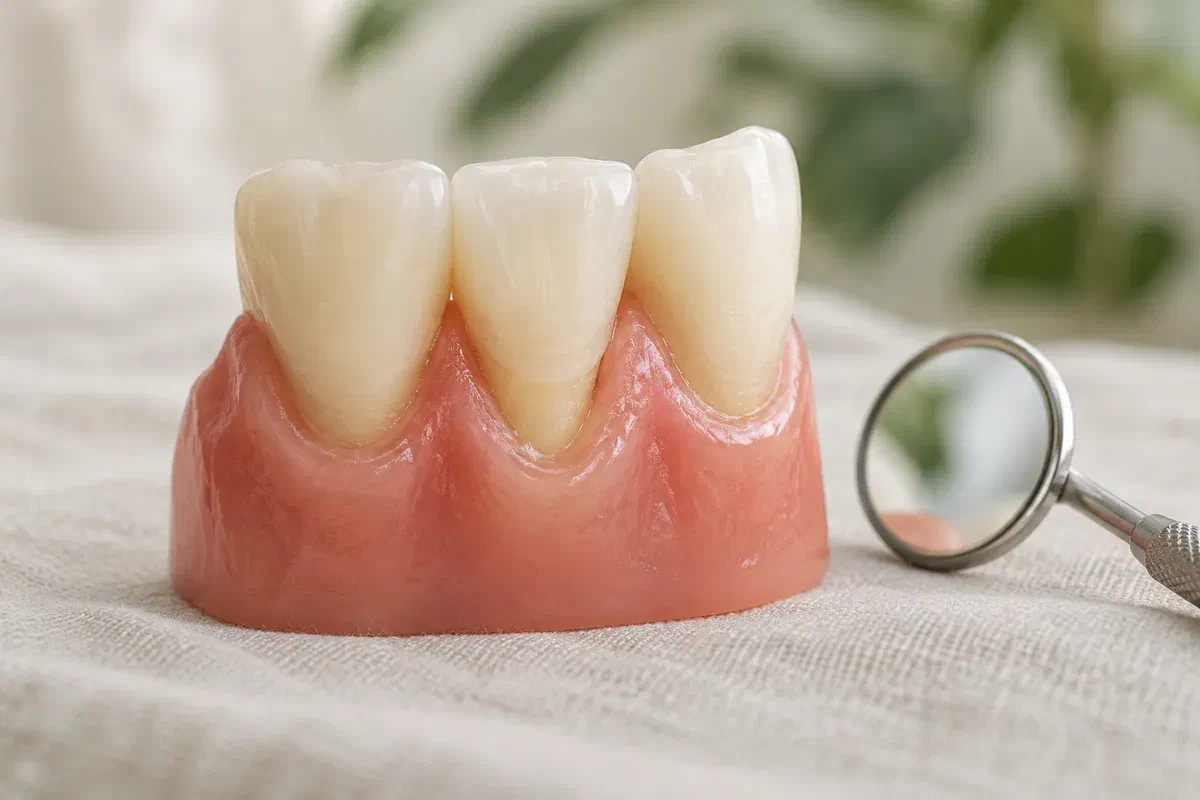
Illustrative teaching model showing an exposed tooth neck beside neighbouring teeth
Bring what you were told

Earlier comments, plus what you notice yourself

There is nothing to measure at home. Share what you have seen and felt, and pass along any records, printouts or photographs that suggest when the change first appeared or was first pointed out.

The teeth that were mentioned, and any you have spotted

Say which areas were flagged before and whether you have seen others. Previous braces, crowns, fillings near the gum and earlier gum treatment are all relevant. They help guide the examination, though none of them on its own proves a cause or shows active change.

Sensitivity you may not have connected to the gum

Some people realise only afterwards that a twinge from cold or from brushing came from the same spot. Describe what triggers it and how long it lasts. Other tooth problems can feel similar, so ongoing, spontaneous or worsening pain should be examined rather than assumed to be recession.

Questions about how you should be cleaning

Being told about recession can make people nervous about brushing at all. Tell the team what you use and where you hesitate. We will help you find a gentle method that still removes plaque, rather than asking for more force or less cleaning.

A finding of recession is worth following up even when nothing hurts. Sudden swelling, pus, intense pain, or a loose tooth may signal something else, so please mention it as soon as you contact us.

From label to understanding

What the finding means for you specifically

The amount of root you can see is only one detail. Three other questions usually matter more: is the gum tissue red or puffy, is there any evidence of periodontitis, and has anyone recorded the position before? When earlier figures cannot be found, the measurements taken at this visit become the reference for later comparison. They are a starting line, not a forecast.

Your priorities shape the next steps. A person mainly concerned about sensitivity might begin somewhere different from one whose recession seems to be increasing, or who struggles to keep a spot clean. Ask which worry a recommendation is meant to resolve and what, if anything, would still be monitored.

Patient information: Cambridge University Hospitals — recession factors and soft-tissue grafting

Numbers you can follow over time

Gum measurements recorded now give future visits something concrete to compare. Ask which teeth are being tracked and what a change would look like. That gives a clearer answer than wondering whether a tooth looks longer in this month’s selfies.

Advice on what you can actually influence

Discuss brushing force, the aids that suit your mouth and any local irritation found. Ask to see the technique on your own teeth. Good advice is realistic. Some contributors, like how thin your gum is or where a tooth sits in the bone, are simply part of your anatomy and have nothing to do with effort.

An honest account of when a specialist helps

A periodontist can look at more complex recession and discuss grafting or other choices. Ask what the referral is intended to clarify. Seeing a specialist does not mean you have agreed to surgery; expect a discussion of benefits, limits, alternatives and recovery.

How we approach it

Explain first. Decide later.

Mention any tender areas, or any nervousness about having your gums measured. The appointment is about understanding the finding, and no procedure is agreed before you have heard and considered the options.

  1. Review what you were told and what you have noticed

    Go over the earlier comment, your symptoms, and any treatment or advice so far. The clinician may ask about cleaning, tobacco, health conditions and medicines. Say what you want from the visit, whether that is comfort, appearance or a sense of how likely progression is.

  2. Measure and examine the gum and surrounding support

    Recession is checked alongside gum health, tooth condition and related findings. Measurements or suitable imaging may help answer specific questions. Ask what can be established today and whether records from previous checkups would show if the change is old or new.

  3. Explain the findings and the options

    Any active gum disease or irritation is addressed first, then sensitivity care, monitoring or specialist input can be compared. Ask what in the examination supports each choice. A recommendation should rest on your findings, not on the label alone.

  4. Settle on home care and a recheck

    You should leave with clear steps for the affected teeth and a date to review them. Confirm which changes mean you should call before then and whether a referral is being made. If several steps are planned, ask about the order and how the first will be judged.

After the explanation

A routine that respects the tissue

Home care should reflect what the clinician found. Ask to be shown a method you can follow comfortably, instead of overhauling your products and technique in one go without guidance.

Clean gently and keep reaching the area

A soft brush, light pressure and the interdental aid recommended for you usually work best. Leaving the area alone out of caution allows plaque to collect, and hard scrubbing will not restore lost gum. Tell us if an aid causes pain.

Use protective or sensitivity care as advised

If the tooth has been checked, the clinician may suggest a sensitivity product or other preventive care. Confirm the directions and the point at which the response will be reviewed. Reduced discomfort is not evidence that the gum position has improved.

Keep the review rather than self-checking

Return for the planned follow-up and mention new symptoms or cleaning trouble. The clinician compares the findings and updates the plan where needed. Tugging at the gum or testing the tooth with cold drinks rarely tells you anything useful.

Where the plan could go

Each option has its own job.

Ask what each choice is meant to achieve for the affected tooth. Often, active disease or daily cleaning is tackled first, and the need for further treatment is reviewed once you see how things respond.

When watching is a reasonable plan

Tailored home care and scheduled monitoring

The clinician may suggest a revised cleaning technique, deal with a source of irritation and compare the site at later visits. Ask why observation suits you and what would change that. Monitoring should come with a set review, not uncertainty.

When disease, decay or sensitivity needs care

Treatment for a separate finding

Gum disease, root decay or a sensitive surface may need its own treatment. Ask which diagnosis is being addressed and what will stay unchanged. Fixing a tooth surface or easing sensitivity does not reposition the gum, even if the two problems occur together.

When the tissue warrants more discussion

A specialist opinion on grafting

In a suitable case, a graft may add tissue or cover part of an exposed root. Outcomes depend on the site and procedure. Ask about realistic coverage, where tissue comes from, recovery and limits; full coverage and permanent protection from recession cannot be promised.

Patient information: American Academy of Periodontology — gum graft procedures

Mississauga recession questions

Understanding what was found

These answers are general. Your examination is what connects the condition of the gum with the health of the tooth, so bring up both comfort and appearance.

(905) 876-4488
What do the numbers called out during gum measuring actually mean?
They are usually measurements in millimetres around each tooth, recording things like pocket depth and gum position. The clinician can explain which figures relate to recession and which relate to gum health, and how they will be compared later.
Is mild recession something that always gets worse?
Not always. Some recession stays stable for long periods, while other sites change. A baseline record and planned reviews are the usual way to find out which applies to you, rather than predicting from appearance.
Can I get a second explanation if I was already told about recession elsewhere?
Yes. You are welcome to book an assessment to have the finding explained again. Bringing any earlier records helps the clinician compare and give you a clearer picture.
Does recession mean my bone is affected too?
Not necessarily. Recession describes the gum position, while bone support is assessed separately, sometimes with imaging. The clinician can explain what the examination shows about the supporting tissues around the tooth.
Can thin gums run in families?
Gum thickness and tooth position vary between people and can be partly inherited. Thinner tissue may be more prone to recession in some cases. The clinician can describe what your gum tissue looks like and what that means for care.
If my gum has receded, should I avoid flossing that spot?
Usually no, but the method matters. The team can show you a gentle technique or suggest a different interdental aid if floss catches or hurts. Mention any discomfort so the cause can be checked.
Arrange a visit from Mississauga

Get the finding explained at your own pace.

Contact Milton Dental Clinic about a recession finding, exposed roots, or sensitivity near the gums. Bring any earlier notes or records, and we will go through the assessment and a practical next step.

Recommendations and referral needs depend on what the examination shows.

Visit Milton Dental Clinic
Unit 1, 342 Bronte St. S, Milton, ON L9T 5B7
Get directions Clinic hours
Monday–Thursday
11am–7pm
Friday–Sunday
By appointment only

Areas we serve

  • Milton
  • Oakville
  • Mississauga
  • Georgetown
  • Halton Hills
  • Acton
  • Campbellville
  • Brampton
  • Burlington
  • Puslinch
  • Rockwood
  • Erin
  • Caledon
  • Etobicoke
  • Old Milton
  • Bronte Meadows
  • Timberlea
  • Dorset Park
  • Dempsey
  • Clarke
  • Beaty
  • Coates
  • Harrison
  • Scott
  • Willmott
  • Ford
  • Bowes
  • Cobden
  • Walker
  • Mountain View
  • Milton Heights
  • Hawthorne Village
  • Valley View
  • Fallingbrook
  • Nassagaweya
  • Trafalgar
  • Esquesing
  • Nelson
  • Brookville
  • Moffat
  • Glen Williams
  • Norval
  • Limehouse
  • Stewarttown
  • Ashgrove
  • Hornby
  • Silver Creek
  • Speyside
  • Scotch Block
  • North Oakville
  • River Oaks
  • Glen Abbey
  • West Oak Trails
  • Palermo
  • Bronte Creek
  • College Park
  • Joshua Creek
  • Uptown Core
  • Preserve
  • Iroquois Ridge
  • Lisgar
  • Meadowvale
  • Meadowvale Village
  • Churchill Meadows
  • Erin Mills
  • Central Erin Mills
  • Streetsville
  • East Credit
  • Creditview
  • Heartland
  • Sheridan
  • Mount Pleasant
  • Credit Valley
  • Huttonville
  • Churchville
  • Springbrook
  • Northwest Brampton
  • Bram West
  • Fletcher's Meadow
  • Fletcher's Creek South
  • Alton Village
  • Orchard
  • Millcroft
  • Headon Forest
  • Tansley
  • Brant Hills
  • Tyandaga
  • Kilbride
  • Lowville
  • Aberfoyle
  • Morriston
  • Arkell
  • Hillsburgh
  • Freelton
  • Carlisle
  • Waterdown
  • Flamborough
  • Mountsberg

How can we help?

Milton Dental Clinic

Have a question about your smile? Choose the option that works best for you.

For urgent dental concerns, please call.
Messages are reviewed during clinic hours.