

Illustrative consultation about a changing gumline and tooth sensitivity
Specialized Care

Receding Gums Assessment in Puslinch

Every other tooth looks fine. Just one has a gum edge that has pulled back. A receding gums assessment for people in Puslinch looks at why a single site behaves differently, and what that tooth, and the rest of your mouth, may need.

Puslinch · one tooth, one question

Why this tooth, and not its neighbours?

It is a common puzzle. A canine or a lower front tooth shows a strip of root while the teeth on either side look untouched. Recession is the term for that: the gum margin has moved down, uncovering more of the tooth. Seeing it on one tooth tells you where it is, but not what drove it or whether it will continue.

Isolated recession often has local reasons. A tooth that sits slightly forward in the jaw may have thinner gum over it. A lip attachment, a filling edge, brushing habits or past orthodontic movement can all play a part, as can gum disease. The assessment brings these together with the root surface and your history, then places that single tooth in the context of the whole mouth.

Rural households around Puslinch tend to plan dental trips carefully, so it is worth making this visit thorough. Tell us when you spotted the change, what has been bothering you and what you would like to understand. We will explain the likely factors, what can be watched, and whether that tooth needs care here or a periodontist’s view.

Have a single receding tooth assessed
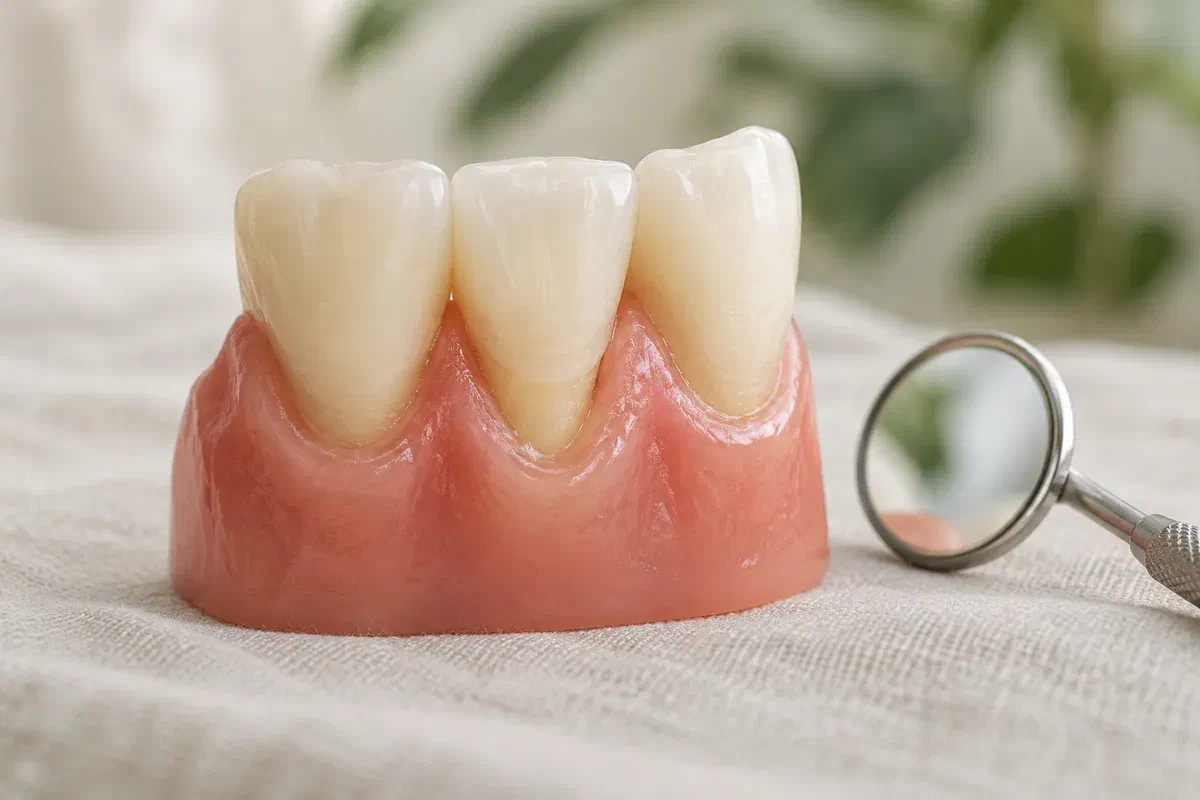
Illustrative teaching model showing an exposed tooth neck beside neighbouring teeth
Details about that one site

Small clues often explain a single spot.

You will not need to measure anything. Point out the tooth, describe what you have noticed, and bring older records or photographs if they suggest when the gum began to change.

How the tooth sits compared with its neighbours

Mention if that tooth has always looked a little forward or rotated, and whether you had braces or a retainer. Note any fillings or crowns there and previous gum treatment. These clues help focus the examination, but they do not prove the cause or show that the gum is still moving.

Sensitivity limited to that tooth

Describe what triggers it, such as cold, sweet food or brushing, and how long it lasts. A single exposed root can be sensitive, but so can a single cracked or decayed tooth. If the discomfort is persistent, arrives on its own or is worsening, it needs examining rather than assuming.

Brushing habits around that area

Right-handed people often press harder on certain teeth, and left-handed people on others. Tell us how you brush and which aids you use. The team can suggest a gentle approach that keeps the site clean without wearing on it.

Even a small, single area of recession is worth assessing. Rapid swelling, pus, intense pain, or a tooth that has become loose may signal a different problem, and should be mentioned without delay.

What the visit can explain

Local factors, wider health, and the outlook for that site

With one tooth affected, it is tempting to treat it as a purely local issue. The assessment checks that assumption. The clinician looks for inflammation, considers whether periodontitis is present anywhere else, and notes the gum position. If there are no earlier measurements, today’s findings become the reference for later checks.

Then comes your agenda. If sensitivity is what bothers you, the first step may differ from the one suggested for a site that seems to be receding further or that is awkward to clean. Ask which concern a recommendation is meant to address, and what else might still be followed separately.

Patient information: Cambridge University Hospitals — recession factors and soft-tissue grafting

A record of that site’s gum position

Measurements recorded now make future comparisons meaningful. Ask whether the neighbouring teeth will be tracked too. A clinical recheck is far more reliable than comparing the tooth to its neighbours in the mirror.

Advice aimed at the local factors

Discuss brushing angle and pressure, suitable aids and any irritation found, such as a rough filling. Ask to see the technique on that exact tooth. Factors like a thin gum or a tooth sitting forward in the bone are anatomy, not a matter of effort.

A clear reason for any specialist visit

Single sites with thin tissue are sometimes referred to a periodontist to discuss grafting or other options. Ask what the referral should answer. A consultation is information, not a commitment to surgery, and it should include benefits, limits, alternatives and recovery.

The appointment, briefly

Focus on the tooth without losing sight of the mouth.

Mention if the area is tender or if gum checks make you anxious. The visit is about understanding that tooth and agreeing on a plan; nothing is scheduled before you have heard the options.

  1. Discuss the tooth’s history

    Explain when you noticed the change, any past treatment on that tooth and any orthodontic history. Your general health, medicines and whether you smoke can matter too. Share the outcome you care about most, from comfortable brushing to appearance.

  2. Examine the site and the rest of the gums

    The clinician assesses the recession, gum thickness and health, the tooth’s position and condition, and nearby attachments, alongside a general gum check. Imaging or measurements are added when a particular question needs them. Find out what today’s findings can settle, and whether older records would help date the change.

  3. Weigh local causes and possible responses

    Any active disease or irritation is addressed first. Then sensitivity care, monitoring or a specialist opinion can be compared. Ask what in your examination points to each choice, so the plan is grounded in findings.

  4. Leave with clear next steps

    You should know how to look after the tooth, when it will be reviewed and what would justify calling sooner. If a referral is planned, check who arranges it. With more than one step, ask about the sequence.

Looking after one exposed root

Gentle attention to a single spot

Home care should reflect the examination. Ask the team to show you exactly how to clean that tooth, and avoid switching several products at once, which makes it harder to tell what helps.

Change the angle, not the force

Soft bristles and a gentle, angled stroke usually suit a single receded tooth, along with a suitable interdental aid. Avoiding the spot lets plaque build, and pressing harder will not restore the gum. Mention any aid that hurts.

Use sensitivity care if it was advised

Once the tooth has been checked for other causes of pain, you might be given a sensitivity toothpaste or a protective treatment. Confirm how and when to use it and when it will be reviewed. Relief does not mean the gum has moved back, and pain that changes deserves another look.

Leave the comparison to the follow-up

Attend the review and describe any new symptoms or difficulties cleaning. Measurements will be compared and the plan updated. Pressing on the gum or checking it with cold drinks every few days will not show whether it is stable.

Options for a single site

Responses range from watching to specialist care.

Ask what each option is supposed to do for that tooth. Often, local irritation or daily care is dealt with first, and the case for further treatment is reviewed once you see the response.

When the site can safely be observed

Local adjustments and monitoring

A change in brushing angle, smoothing an irritating edge and comparison at future visits may be enough. Ask why monitoring is suitable and what would change that judgement. A watching plan should include a review date.

When a separate finding needs attention

Treatment for the tooth or gum condition

Gum disease, decay on the root or a sensitive surface may need its own care. Ask which problem is being addressed and what will remain unchanged. Repairing the tooth or easing sensitivity leaves the gum margin where it is.

When thin tissue or progression is a concern

Specialist assessment for a graft

Where the gum over one tooth is especially thin, grafting may be raised as a way to add tissue or cover some of the root. Results depend on the tooth and the procedure. Ask about likely coverage, donor sites, healing and limits; nobody can promise the root will be fully hidden or that the gum will never recede again.

Patient information: American Academy of Periodontology — gum graft procedures

Single-tooth recession questions

When the gum changes around just one tooth

General answers. Your examination is what connects the condition of the gum with the health of the tooth and the teeth around it.

(905) 876-4488
Why would only one tooth have recession?
Local factors are common: a tooth sitting slightly forward, thin gum over it, a lip attachment, a rough filling or brushing habits. Gum disease can also be involved. The clinician checks which factors seem to apply in your case.
What is a frenum, and can it affect the gum?
A frenum is a small fold of tissue attaching the lip or cheek to the gum. In some cases, one that attaches close to the gum edge may pull on it. The clinician can check whether this seems relevant for your tooth.
Can a tooth that was moved by braces be more likely to recede?
Orthodontic movement can sometimes position a tooth where the gum covering it is thinner. It is one possible factor. Mention your orthodontic history so the clinician can consider it.
Does one receded tooth mean the others will follow?
Not necessarily. Isolated recession can stay isolated, especially when the factors are local. A baseline record and review are the best way to see whether other teeth change over time.
Should the whole mouth be checked, or just the one tooth?
A general gum check is usually part of the assessment. Recession at one site is interpreted alongside the rest of your mouth, which helps rule out a wider problem such as periodontitis.
Planning from Puslinch, can treatment start on the day of the assessment?
Sometimes simple steps such as cleaning advice or smoothing a rough edge can be done the same day, depending on time and findings. Other care may need a separate visit. Ask when booking what might be possible.
From Puslinch to Milton

Bring the tooth that stands out.

Reach out to Milton Dental Clinic about a single area of gum recession, a showing root, or a tooth that has become sensitive at its neck. Previous dental records help, and we will go over what we find and the most sensible next step.

Any treatment or referral depends on the findings at your assessment.

Visit Milton Dental Clinic
Unit 1, 342 Bronte St. S, Milton, ON L9T 5B7
Get directions Clinic hours
Monday–Thursday
11am–7pm
Friday–Sunday
By appointment only

Areas we serve

  • Milton
  • Oakville
  • Mississauga
  • Georgetown
  • Halton Hills
  • Acton
  • Campbellville
  • Brampton
  • Burlington
  • Puslinch
  • Rockwood
  • Erin
  • Caledon
  • Etobicoke
  • Old Milton
  • Bronte Meadows
  • Timberlea
  • Dorset Park
  • Dempsey
  • Clarke
  • Beaty
  • Coates
  • Harrison
  • Scott
  • Willmott
  • Ford
  • Bowes
  • Cobden
  • Walker
  • Mountain View
  • Milton Heights
  • Hawthorne Village
  • Valley View
  • Fallingbrook
  • Nassagaweya
  • Trafalgar
  • Esquesing
  • Nelson
  • Brookville
  • Moffat
  • Glen Williams
  • Norval
  • Limehouse
  • Stewarttown
  • Ashgrove
  • Hornby
  • Silver Creek
  • Speyside
  • Scotch Block
  • North Oakville
  • River Oaks
  • Glen Abbey
  • West Oak Trails
  • Palermo
  • Bronte Creek
  • College Park
  • Joshua Creek
  • Uptown Core
  • Preserve
  • Iroquois Ridge
  • Lisgar
  • Meadowvale
  • Meadowvale Village
  • Churchill Meadows
  • Erin Mills
  • Central Erin Mills
  • Streetsville
  • East Credit
  • Creditview
  • Heartland
  • Sheridan
  • Mount Pleasant
  • Credit Valley
  • Huttonville
  • Churchville
  • Springbrook
  • Northwest Brampton
  • Bram West
  • Fletcher's Meadow
  • Fletcher's Creek South
  • Alton Village
  • Orchard
  • Millcroft
  • Headon Forest
  • Tansley
  • Brant Hills
  • Tyandaga
  • Kilbride
  • Lowville
  • Aberfoyle
  • Morriston
  • Arkell
  • Hillsburgh
  • Freelton
  • Carlisle
  • Waterdown
  • Flamborough
  • Mountsberg

How can we help?

Milton Dental Clinic

Have a question about your smile? Choose the option that works best for you.

For urgent dental concerns, please call.
Messages are reviewed during clinic hours.