

Illustrative patient and clinician discussing assessment of a retained tooth root
Specialized Care

Retained Root Removal in Oakville

Planning an implant or bridge and told an old root is in the way, or might be? We can look at how that fragment relates to the replacement you want and help Oakville households weigh removal, waiting or a surgical opinion.

Replacement planning in Oakville

Before the new tooth, a decision about the old root.

Choosing an implant, bridge or denture often means looking harder at a gap than anyone has in years. That is frequently when a retained root comes to light: a section of tooth left under the gum after the crown wore away, or a tip that remained when the tooth was extracted. It may be causing nothing, or it may explain a lingering niggle.

Whether it should come out is a separate judgement from the replacement itself. The clinician weighs symptoms, any sign of disease, exactly where the fragment lies, and the risks involved in reaching it. A shallow, decayed root over a planned implant site is one scenario; a sliver resting near a nerve, well away from the plan, is quite another.

From Oakville, it helps to arrive with the replacement conversation already started. Bring any treatment proposals, images or notes from another provider, and tell us how the root was first mentioned. We can then discuss the assessment, how the fragment fits with your plan, and whether an oral surgeon should be involved.

Ask how the root affects your plan
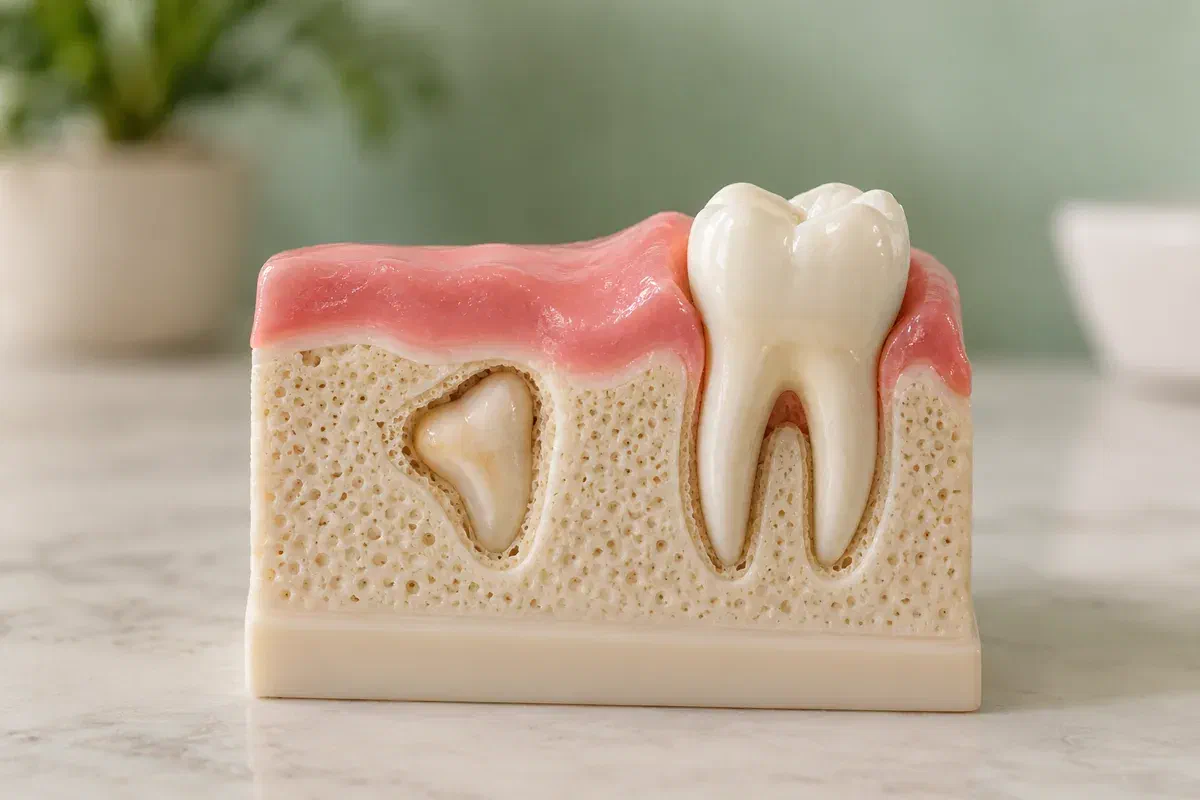
Illustrative cutaway teaching model showing a buried root fragment beside an intact tooth
Why it might need a closer look

Three reasons the fragment deserves attention

Nobody expects you to diagnose the root yourself. Explain what you have felt, what you were told earlier, and what kind of replacement you are considering, so the assessment starts with the full picture.

Tenderness, swelling or a draining spot

These are worth reporting, along with whether they came back after previous care. If there is fever or swelling that keeps widening, mention it when you phone. The source still has to be confirmed by examination, since a sore patch near the root may come from something else entirely.

A point that catches the tongue or a denture

Sharpness near an old site might be root, bone or filling material. Do not dig at it. Let the team know when you first noticed it and whether it scrapes your tongue, presses on a removable appliance, or makes brushing that area awkward.

An implant, bridge or denture in the works

This is the reason many fragments get a second look. The real question is whether this root affects this particular plan and what extra information would settle it. Its presence is weighed against the proposed restoration rather than being treated as an automatic case for surgery.

Some situations need emergency medical help, not a dental appointment: trouble breathing or swallowing, swelling that is spreading fast, or bleeding that will not slow down. Call 911 for those. For an urgent dental issue without them, call the clinic about when you can be assessed.

What a thorough review offers

A recommendation you can follow from start to finish

The consultation should make clear why removal is or is not the better path. You can expect to hear what treatment would solve, what is likely if the root stays, and which risks come with the procedure. That reasoning should come from your examination rather than from an assumption that every leftover piece needs to go.

For anyone planning a replacement, the visit also separates two timelines. Removing a root may clear the way while the implant, bridge or denture still needs its own planning. Ask about healing, any reassessment before the next stage, and who will coordinate between the providers involved once the root itself has been dealt with.

Patient information: York and Scarborough Teaching Hospitals — retained fragments and surgical risks

A clear view of the fragment and its neighbours

The right images can show where the root sits relative to the planned replacement and nearby structures. Request an explanation in plain words and find out whether further imaging would change anything. More pictures are worthwhile only when they answer a specific clinical question.

A reasoned answer about where treatment happens

Access, anatomy, your medical history and the procedure needed all influence who should provide care. Ask why the root can be managed in a general setting or why a referral is preferred. Any referral should explain the question and include what the assessment has already gathered.

Defined follow-up if the root stays for now

When removal is not the advice, ask what review fits and which symptoms should prompt a call. Keep a copy of the decision so whoever places your replacement knows the history. Observation is a deliberate plan, never permission to overlook new swelling or change.

What the assessment involves

From a mention on a treatment plan to a decision you can act on

If an earlier extraction left you wary, or further treatment feels daunting, say so. Knowing that helps the clinician set the pace, explain each stage, and plan any support you need on the day.

  1. Talk through the tooth, the plan and your health

    Explain when the tooth broke or came out, what you were told, and what replacement is proposed. Medicines and medical conditions are reviewed, including bone-related treatment or previous jaw radiotherapy. Do not stop any prescribed medicine yourself; any change must come from the prescribing clinician.

  2. Examine the site and relevant images

    The gums, surrounding teeth and existing records are checked before the clinician explains what is probably happening. Imaging is used where it adds to the decision. You can ask whether the fragment is accessible, whether nearby anatomy complicates removal, and whether a specialist assessment would help.

  3. Compare the options against your goals

    Discuss why treatment might be needed, what it should achieve, the alternatives and the significant risks. If removal is recommended, ask whether a surgical approach is expected and how pain will be managed. Agree on what will be done beforehand and how anything unexpected will be communicated.

  4. Wrap up with aftercare and next steps

    When the root is taken out, the approach depends on its position and can involve reaching it through the gum. Find out what was done and whether stitches or a follow-up are needed. Take written instructions home and confirm when the replacement planning can resume.

Healing before the next stage

Let the site settle and keep the team informed.

Advice varies with how the root was reached, its location and any other work done. Your written instructions from the treating team take precedence over general tips or a past extraction routine.

Hands, tongue and tools off the site

Avoid picking at the area, pulling a stitch, or checking with an instrument to see if anything is left. Follow the advice you were given on cleaning, eating and activity. If something sharp appears, describe it to the team rather than removing it yourself.

Medicines used as prescribed

Confirm the instructions for anything prescribed and mention any suspected reaction or difficulty following them. Do not reach for leftover antibiotics or change blood-thinning treatment without guidance. If sedation was used, its separate transport, supervision and activity limits still apply even when your mouth feels comfortable.

Review attended, worsening symptoms reported

Check whether a planned visit is needed and when the implant, bridge or denture discussion can pick up again. Call about increasing pain or swelling, continued bleeding, or altered sensation that is not improving. A future review date is not a reason to wait if things are getting worse.

Managing the root alongside your plan

Remove, observe or refer, each for a stated reason

What suits you depends on the root, your health and the replacement you want. Ask how each option’s expected benefit compares with its risks, and what would change the advice.

When symptoms, disease or the replacement plan support it

Removing the root

After assessing the site and alternatives, the clinician may recommend taking the root out. That can be simple or may need surgical access. Find out what removal is meant to fix, what care will still be needed, and which complications apply to this root specifically.

When leaving the fragment is the better balance

Monitoring with clear documentation

Certain fragments are left because removal carries more risk than benefit. That requires an individual assessment, not a decision based only on the absence of pain. Ask what is known about the root, how it will be checked over time, and what should prompt another look.

When anatomy, health history or access adds complexity

Oral surgery review first

A specialist can evaluate a deep root or one near important structures, which may matter for implant planning. Clarify what question the referral needs to answer and whether your records can be sent. Until then, follow interim advice and report changes in symptoms or health.

Implant and root questions

Questions people raise before committing to a replacement

Records from earlier care are helpful, and missing ones are no barrier to booking. Tell the clinician what you recall and what still feels confusing about the choice in front of you.

(905) 876-4488
Do I need the root removed before getting an implant?
Not always. It depends on where the fragment is in relation to the planned implant and the surrounding tissue, and whether it shows signs of disease. Some roots need to come out first; others are far enough away to leave. The assessment answers that question for your site.
How long after removing a root can implant planning continue?
That depends on what was involved in removing it, how the site heals, and what the implant provider needs to see. The clinician can explain the expected review and when reassessment makes sense. Ask for this timeline to be shared with whoever is planning the replacement.
Can a bridge be placed over an area with a retained root?
Sometimes, if the fragment is stable and causing no problems, but it needs to be assessed first. The clinician looks at the root, the neighbouring teeth that would support the bridge, and the gum. You will hear whether removal, monitoring or another approach suits that plan.
Why would my implant dentist want a second opinion about the root?
A fragment close to a nerve, the sinus or the planned implant position can change how the site is prepared. A second opinion, sometimes from an oral surgeon, can clarify the safest approach. Ask what question the referral is meant to resolve and make sure your images go with it.
Is a coronectomy root the same as one left by accident?
No. A coronectomy deliberately leaves the roots of selected wisdom teeth to reduce certain risks, with planned follow-up. Other roots remain because a tooth broke down or fractured during removal. If you know which applies, tell the clinician, since the reasons and the review plan differ.
Coming from Oakville, can the assessment and the replacement planning be coordinated?
Yes, and it is worth asking for. Let us know who else is involved in your care and bring their notes or images. Grouping questions into one visit and sharing records promptly can reduce back-and-forth, and you will leave knowing which provider handles each next step.
Book from Oakville

Clear the root question, then plan the replacement.

Call or send us a note about the root you have been told about, or one you suspect. Mention any symptoms, past surgery and the type of replacement on your mind, and together we can decide what assessment and paperwork would be useful.

Urgent symptoms? Call us. Advice on treatment or referral comes after we examine the area.

Visit Milton Dental Clinic
Unit 1, 342 Bronte St. S, Milton, ON L9T 5B7
Get directions Clinic hours
Monday–Thursday
11am–7pm
Friday–Sunday
By appointment only

Areas we serve

  • Milton
  • Oakville
  • Mississauga
  • Georgetown
  • Halton Hills
  • Acton
  • Campbellville
  • Brampton
  • Burlington
  • Puslinch
  • Rockwood
  • Erin
  • Caledon
  • Etobicoke
  • Old Milton
  • Bronte Meadows
  • Timberlea
  • Dorset Park
  • Dempsey
  • Clarke
  • Beaty
  • Coates
  • Harrison
  • Scott
  • Willmott
  • Ford
  • Bowes
  • Cobden
  • Walker
  • Mountain View
  • Milton Heights
  • Hawthorne Village
  • Valley View
  • Fallingbrook
  • Nassagaweya
  • Trafalgar
  • Esquesing
  • Nelson
  • Brookville
  • Moffat
  • Glen Williams
  • Norval
  • Limehouse
  • Stewarttown
  • Ashgrove
  • Hornby
  • Silver Creek
  • Speyside
  • Scotch Block
  • North Oakville
  • River Oaks
  • Glen Abbey
  • West Oak Trails
  • Palermo
  • Bronte Creek
  • College Park
  • Joshua Creek
  • Uptown Core
  • Preserve
  • Iroquois Ridge
  • Lisgar
  • Meadowvale
  • Meadowvale Village
  • Churchill Meadows
  • Erin Mills
  • Central Erin Mills
  • Streetsville
  • East Credit
  • Creditview
  • Heartland
  • Sheridan
  • Mount Pleasant
  • Credit Valley
  • Huttonville
  • Churchville
  • Springbrook
  • Northwest Brampton
  • Bram West
  • Fletcher's Meadow
  • Fletcher's Creek South
  • Alton Village
  • Orchard
  • Millcroft
  • Headon Forest
  • Tansley
  • Brant Hills
  • Tyandaga
  • Kilbride
  • Lowville
  • Aberfoyle
  • Morriston
  • Arkell
  • Hillsburgh
  • Freelton
  • Carlisle
  • Waterdown
  • Flamborough
  • Mountsberg

How can we help?

Milton Dental Clinic

Have a question about your smile? Choose the option that works best for you.

For urgent dental concerns, please call.
Messages are reviewed during clinic hours.