

Illustrative patient and clinician discussing assessment of a retained tooth root
Specialized Care

Retained Root Removal in Rockwood

Some roots are left on purpose, such as after a coronectomy on a wisdom tooth; others remain by chance. From Rockwood, you can find out which situation applies to you and whether removal, continued review or a specialist assessment is the right next step.

Planned or unplanned?

Not every root left in the jaw got there the same way.

Sometimes a root stays behind deliberately. In a coronectomy, for example, the crown of a lower wisdom tooth is removed and the roots are left where they are, usually because they lie close to a nerve. Other retained roots are accidental: a tip that fractured during an extraction, or what is left of a tooth that crumbled from decay.

Knowing which kind you have helps, but it does not decide the next step alone. The clinician still looks at symptoms, signs of infection or disease, the fragment’s exact position and the risks of reaching it. A planned coronectomy root has its own follow-up path, while a decayed stump near the surface may need a different approach entirely.

If you are travelling from Rockwood, gather whatever you have from the original procedure: a letter from a surgeon, a treatment summary, or images. Tell us what you understood at the time and how things have been since. We can then examine the site and discuss whether removal, monitoring or a return to the specialist makes most sense.

Find out what kind of root you have
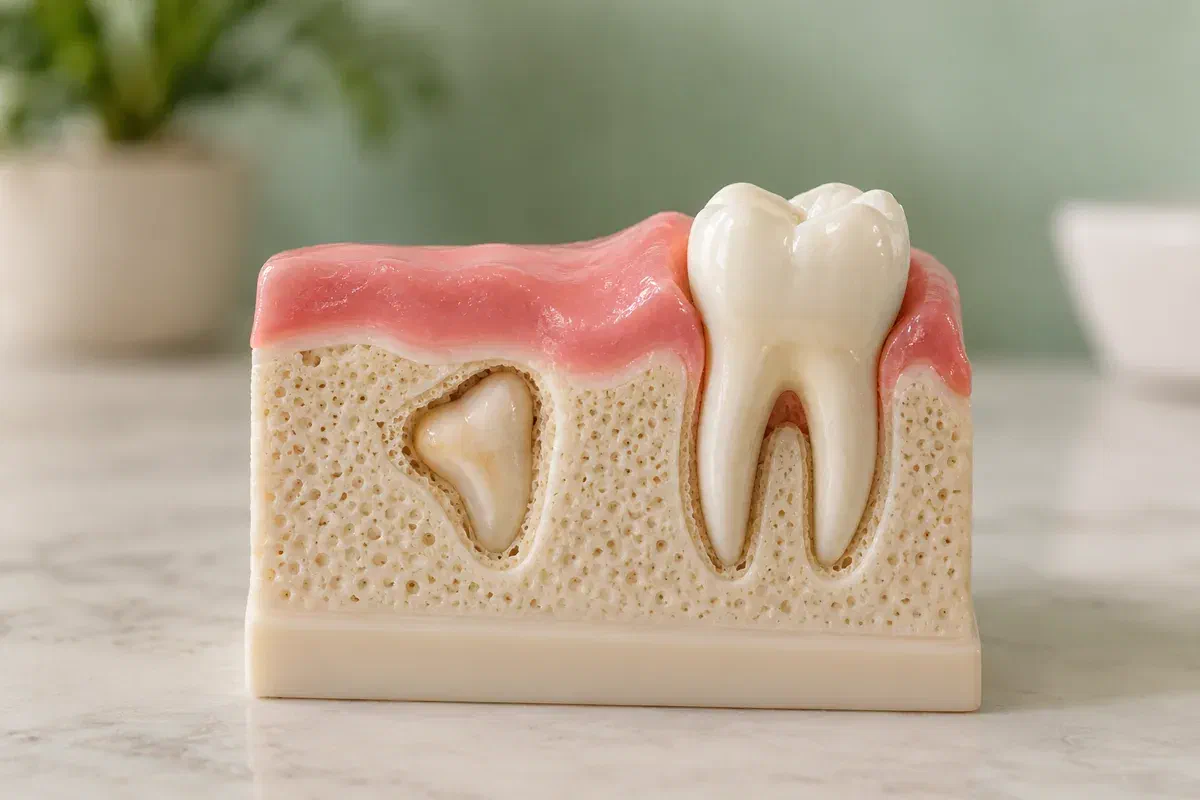
Illustrative cutaway teaching model showing a buried root fragment beside an intact tooth
Reasons to have it checked

Whatever its origin, these signs deserve attention.

There is no need to know whether your root was left deliberately before you call. Explain what you remember about the procedure and what has changed since, and the clinician will build the picture.

Pain, swelling or drainage near the site

Tell us about any of these, including whether they have recurred after earlier treatment. Raise a fever or swelling that is spreading when you phone. Examination is needed to identify the source, since discomfort near a wisdom tooth site can also come from the gum or a neighbouring molar.

A root edge that seems to be surfacing

Occasionally a root that was buried becomes noticeable at the gum. If you feel something hard or sharp, leave it alone. Note when it appeared and whether it rubs the tongue or cheek, traps food or makes cleaning the back of the mouth harder.

Future treatment in the same area

Orthodontic work, a bridge or an implant nearby may prompt a fresh review of the root. Ask whether the fragment affects that plan and what information would help. A root found during planning is assessed with that treatment in mind, not removed by default.

Seek emergency medical care through 911 for difficulty breathing or swallowing, swelling that spreads rapidly, or bleeding that is heavy and uncontrolled. If the concern is urgent but these signs are absent, call the clinic to talk about assessment.

What you can learn from a review

The origin, the condition, and the sensible next step

A review should explain why leaving the root or removing it is the better choice for you now. You should hear what treatment would address, what is likely to happen without it, and what risks the procedure carries. For a planned coronectomy root, it should also confirm whether the original follow-up plan still applies.

Removing a root may resolve one concern while leaving other treatment unfinished, so it helps to keep the decisions distinct. Ask about healing, whether the area will be reassessed, what further dental work might follow, and who will coordinate with the specialist who did the original procedure, if relevant.

Patient information: York and Scarborough Teaching Hospitals — retained fragments and surgical risks

A clearer view of the root and its neighbours

Imaging may show the fragment’s position in relation to the nerve, the sinus or adjacent teeth. Ask for the result in plain language and whether more detailed imaging would change anything. Extra images are useful when they answer a question that matters.

Guidance on who should provide care

Deep roots near a nerve are often managed by an oral surgeon, while more accessible fragments may be treated in a general setting. Your anatomy, access and medical history all play a part. Ask why one is recommended over the other, and what information a referral would include.

A review plan if the root stays

If continued monitoring is advised, ask how often to check the site and which symptoms mean calling sooner. Keep the decision with your records. Monitoring is a deliberate plan, and it still responds to new swelling, pain or change.

What the appointment involves

Piecing together the original procedure and what has happened since

If the earlier surgery was difficult, or you are uneasy about more treatment, let us know. That helps the clinician explain things clearly and plan support for your visit.

  1. History and health review

    Share what you know about the original procedure, including whether it was planned as a coronectomy, and how the area has felt since. The clinician also goes over your medicines and health, asking in particular about bone-related treatment and earlier jaw radiotherapy. Do not stop a prescribed medicine without direction from its prescriber.

  2. Examination and imaging where useful

    The clinician examines the site, neighbouring teeth and available records, then explains what is likely going on. Imaging is used if it would inform the decision. Raise questions about how reachable the root is, what lies close by, and whether the original specialist should see it again.

  3. Discussing removal, monitoring or referral

    Go over the reasons for any treatment, what it should accomplish, other possibilities and the risks that apply to you. If removal is suggested, find out whether surgical access is expected and how comfort will be managed. Confirm the plan before anything starts and how unexpected findings would be communicated.

  4. Instructions and follow-up

    Should removal go ahead, the method depends on the root’s position and may involve opening the gum. Afterward, find out what was done, whether there are stitches, and whether a review is needed. Take written aftercare home and confirm the next stage of any other treatment.

Once treatment is done

Steady healing comes from following your own instructions.

Advice depends on the access needed, where the root sat and anything else done during the visit. The sheet you take home from this visit outranks what you remember from the earlier wisdom tooth surgery.

Leave stitches and the site alone

Try not to explore the area with your tongue, pull at stitches or check for remaining pieces. Keep to the guidance on brushing, rinsing, meals and activity. If you feel a new hard spot, describe it to the team rather than trying to remove it.

Use prescribed medicines as directed

Confirm how to take anything prescribed and report a possible reaction. Leftover antibiotics should not be used, and blood-thinning medicine should not be changed without direction. If sedation was part of the visit, follow its transport, supervision and activity guidance whatever your mouth feels like.

Report symptoms that are getting worse

Check whether a review is planned and when other treatment can resume. Contact the provider about pain or swelling that increases, persistent bleeding, or numbness or tingling that does not improve. A future review is not a reason to wait if things are deteriorating.

What can be done about the root

Three options, matched to how the root came to be there

The best approach depends on the root, its history and your health. Ask how the likely benefit of each option compares with the risks.

When infection, symptoms or upcoming work call for it

Extraction of the remaining root

If the root is causing problems or stands in the way of planned treatment, removal may be recommended after assessment. Access may be simple or surgical. Ask what removal is intended to fix, what care follows, and which complications apply to your particular root.

When a deliberately retained root remains stable

Following the original plan

Coronectomy roots and some other fragments are left because removing them carries more risk than benefit. Staying with that plan depends on a current assessment rather than on comfort alone. Ask what review is advised and which changes mean returning sooner.

When the root lies near a nerve or access is complex

Back to an oral surgeon

A deep root, one close to important structures, or one first treated by a specialist may be better served by a referral. Ask what the referral should resolve and whether your images will be sent. Follow interim advice and report any change.

Rockwood questions about retained roots

Answers about planned and unplanned roots

Paperwork from a surgeon or earlier dentist is very helpful, but you can still book without it. Share what you recall and what you would most like to understand.

(905) 876-4488
What is the difference between a coronectomy and a failed extraction?
A coronectomy is a planned procedure in which the crown of a wisdom tooth is removed and the roots are deliberately left, usually to reduce the risk to a nearby nerve. A fragment left during an extraction is unplanned. The follow-up plans for each can be different.
Can roots left after a coronectomy move over time?
Retained coronectomy roots can sometimes shift slightly as the area heals, which is one reason follow-up is often recommended. Most do not cause problems, but if you notice a new hard spot, pain or swelling, arrange an assessment.
Will the roots of my wisdom tooth ever need to come out?
Many coronectomy roots never need further treatment. Removal may be considered if they become infected, start to surface, or cause other problems. The clinician or the original specialist can explain what to watch for and when a review is useful.
Should I go back to the surgeon who did the original procedure?
That can make sense, especially if they planned the coronectomy and have the original images. The clinician can examine the site and help you decide whether a return to the specialist, a general dental review or another approach is most appropriate.
Is it normal to feel nothing at all where the roots were left?
Yes, many people never notice a retained root after healing. Feeling nothing is a good sign, but it does not replace any follow-up that was recommended. Keep to the review plan and mention the root at routine checkups.
Can numbness after the original surgery be related to the retained root?
Altered sensation after wisdom tooth surgery can have several causes and should be discussed with the clinician or the specialist who treated you. Describe when it started and whether it is changing. New or worsening numbness deserves prompt assessment.
Booking from Rockwood

Bring the surgeon’s letter if you have one.

Contact us about a root left after wisdom tooth surgery, a fragment from another extraction, or one you suspect. Let us know about symptoms, the original procedure and any treatment planned nearby, and we will suggest what to bring and how the assessment will run.

Phone the clinic for urgent symptoms. Recommendations follow an examination.

Visit Milton Dental Clinic
Unit 1, 342 Bronte St. S, Milton, ON L9T 5B7
Get directions Clinic hours
Monday–Thursday
11am–7pm
Friday–Sunday
By appointment only

Areas we serve

  • Milton
  • Oakville
  • Mississauga
  • Georgetown
  • Halton Hills
  • Acton
  • Campbellville
  • Brampton
  • Burlington
  • Puslinch
  • Rockwood
  • Erin
  • Caledon
  • Etobicoke
  • Old Milton
  • Bronte Meadows
  • Timberlea
  • Dorset Park
  • Dempsey
  • Clarke
  • Beaty
  • Coates
  • Harrison
  • Scott
  • Willmott
  • Ford
  • Bowes
  • Cobden
  • Walker
  • Mountain View
  • Milton Heights
  • Hawthorne Village
  • Valley View
  • Fallingbrook
  • Nassagaweya
  • Trafalgar
  • Esquesing
  • Nelson
  • Brookville
  • Moffat
  • Glen Williams
  • Norval
  • Limehouse
  • Stewarttown
  • Ashgrove
  • Hornby
  • Silver Creek
  • Speyside
  • Scotch Block
  • North Oakville
  • River Oaks
  • Glen Abbey
  • West Oak Trails
  • Palermo
  • Bronte Creek
  • College Park
  • Joshua Creek
  • Uptown Core
  • Preserve
  • Iroquois Ridge
  • Lisgar
  • Meadowvale
  • Meadowvale Village
  • Churchill Meadows
  • Erin Mills
  • Central Erin Mills
  • Streetsville
  • East Credit
  • Creditview
  • Heartland
  • Sheridan
  • Mount Pleasant
  • Credit Valley
  • Huttonville
  • Churchville
  • Springbrook
  • Northwest Brampton
  • Bram West
  • Fletcher's Meadow
  • Fletcher's Creek South
  • Alton Village
  • Orchard
  • Millcroft
  • Headon Forest
  • Tansley
  • Brant Hills
  • Tyandaga
  • Kilbride
  • Lowville
  • Aberfoyle
  • Morriston
  • Arkell
  • Hillsburgh
  • Freelton
  • Carlisle
  • Waterdown
  • Flamborough
  • Mountsberg

How can we help?

Milton Dental Clinic

Have a question about your smile? Choose the option that works best for you.

For urgent dental concerns, please call.
Messages are reviewed during clinic hours.