

Illustrative patient describing a painful dental concern to a clinician
Specialized Care

Severe Dental Pain Treatment in Erin

The first step with severe tooth pain is a phone call, and a little preparation makes it more useful. Ring (905) 876-4488 to explain your symptoms and talk about timing. Trouble breathing or swallowing, swelling that is spreading, or feeling very unwell needs emergency care instead.

Erin · before you pick up the phone

A short call, a better plan

When you’re in a lot of pain, it’s hard to think clearly on the phone. You may forget to mention the swelling, or the filling you had last month, or that you’ve already taken four doses of something. Spending two minutes jotting down a few facts beforehand helps the team judge urgency and makes the drive in from the country more likely to be worthwhile.

The person answering isn’t trying to diagnose you over the phone. Severe pain can come from a cracked or decayed tooth, an inflamed or infected nerve, the gums, a recent procedure, or somewhere outside the teeth. That is sorted out at the examination. The call is about safety and timing: spotting warning signs and finding a sensible time to be seen.

From Erin village, Hillsburgh or a farm road in between, phone (905) 876-4488 before travelling. When we can see you depends on your symptoms and what is open in the schedule. If you can’t get through and the tooth needs dental attention now, contact another emergency dental provider. Email and online forms are not monitored for urgent care.

Request a follow-up visit that can wait
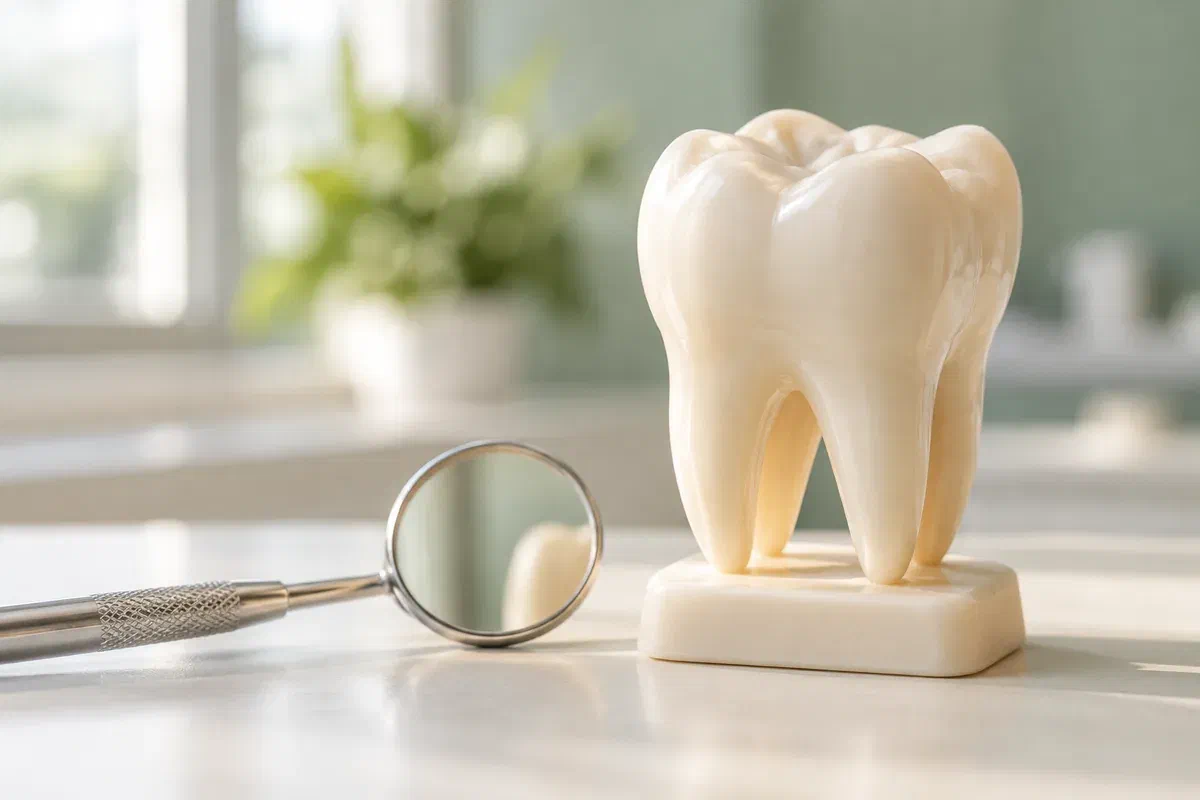
Illustrative molar teaching model and mirror representing a dental assessment
Your call checklist

Three things to have ready

You won’t be asked to name a diagnosis or a tooth number. Begin with whatever scares you most, then cover how it started, how it has changed and any recent dental work or injury.

How the pain behaves

Note whether it arrives on its own or with biting, cold or heat, how long it lasts, whether it wakes you and whether it is getting worse. List what you’ve taken and when, and whether it helped. No need to keep testing the tooth to gather this information.

Swelling, fever, or a jaw that won’t open

Say these first if you have them. Tell us where the swelling is, whether it’s spreading and whether you feel unwell overall. They affect urgency and where care should happen. Pain that eases while swelling grows should be mentioned straight away.

Recent treatment, extractions or injuries

Write down the date and what was done, who did it, and whether you were recovering well before this. Have your aftercare sheet nearby, and the phone number of the other clinic if the work was done elsewhere. That helps the team separate an expected part of healing from something that needs attention.

Skip the dental call and dial 911 for trouble breathing or swallowing, swelling spreading rapidly toward the throat or eye, or bleeding that won’t stop. Jaw pain together with chest pressure, breathlessness, sweating, nausea or light-headedness may be a heart attack, and an ambulance is the right call.

Once you’re in the chair

Questions that help you understand the answer

The examination is where the cause is worked out, and you are part of that conversation. Ask the dentist what they found, what supports their conclusion, and whether another test or a second opinion would be sensible. Pinning down the source matters because treating a tooth that isn’t responsible won’t end the pain.

Keep your notes handy for the second half of the visit too. Ask whether today’s care is a first step to settle things or a suitable long-term treatment, what still needs doing, and what should happen if symptoms don’t improve. That makes it easier to plan any further trips into town.

Where the pain is really coming from

The dentist puts your notes together with the examination and appropriate tests. Mention if the pain moves or involves more than one tooth. If the answer isn’t clear yet, that should be said openly, with a plan to find out more.

What each option involves

Ask how each realistic choice tackles the problem, what it requires and what its limits are. Talk about whether the tooth can be kept and the consequences of removing it. You’re entitled to understand before agreeing, pain or no pain.

What to do once you’re home

Find out what recovery usually feels like, any temporary limits and who to contact if things change. Ask whether another visit is already in the book or a specialist is needed, and take any written instructions offered. If later visits are planned, ask whether they can be scheduled to limit extra drives.

From your call to your follow-up

Here’s the sequence

Add your health conditions, any pregnancy, allergies and a full medication list, including pharmacy products and supplements, to your notes. That helps the dentist assess you and give safe pain advice.

  1. The call: symptoms and red flags

    You run through your notes. The team listens for warning signs and considers whether a dental visit is right or whether you need medical care first. If symptoms worsen after the call, phone again rather than waiting for your slot.

  2. The exam: teeth, gums and history

    The dentist examines the area, may test individual teeth and take suitable X-rays. Mention any recent work and pain in the face, ear or head. Ask what the findings suggest and which parts remain uncertain.

  3. The discussion: first treatment and alternatives

    What is offered depends on the diagnosis, the condition of the tooth and your health. Ask about the aim, important risks and what can happen at this visit. If medicine is recommended, ask how it fits with treating the cause.

  4. The plan: follow-up and when to call sooner

    Check whether treatment is finished or more is needed, and get directions for any temporary repair and for medicines. Know who to contact if the pain becomes hard to manage, swelling starts or something changes.

Afterwards, back home

Follow the advice, and keep notes in case things change

The right steps now depend on the diagnosis and any treatment done. While waiting to be seen, a pharmacist or dentist can suggest short-term relief suitable for your health and medicines. Keep the notes you made for the call; they’re just as useful if you need to phone again.

Track your medicine

Take pain relievers only as labelled or directed, and write down times and doses so you don’t double up. Ask before combining products, which may share an ingredient. Don’t borrow a prescription or press aspirin onto the gum.

Avoid home procedures

Don’t puncture a swelling, file a tooth or try to drain an infection. Eat and clean as advised, choosing softer foods if chewing hurts, and stop testing your bite. Call if eating, drinking or brushing has become difficult, or if you notice a bad taste or new tenderness in the gum.

Keep the next appointment

Let the dentist know how things have changed and attend the follow-up. Less pain doesn’t prove that decay, a crack or another underlying problem has gone. Check with the team before cancelling further care.

What may be recommended

The findings, not the intensity, guide the treatment

Ask why a particular option suits your diagnosis and how it affects that tooth over time. The decision should consider its condition, the alternatives and any care still to come.

If a local problem is found

Repairing or adjusting the tooth

A broken filling or another treatable issue may be fixed or adjusted. Ask whether it’s temporary or final, and how to protect the tooth afterward. A visible flaw still needs to be matched to your symptoms before it’s treated as the cause.

If the nerve or remaining tooth is the issue

Root canal treatment or extraction

Either may be discussed depending on the findings. Ask whether the tooth can be rebuilt, what that would take and what each choice means for you. Strong pain alone doesn’t mean a tooth can’t be saved, or that either procedure is required.

If the source isn’t clear

Further assessment or referral

Pain that doesn’t match what’s found may need more evaluation, sometimes with a specialist or your family doctor. A referral can answer a specific question or handle complex care. Ask about the plan until then and how urgent it is, and avoid irreversible treatment on a tooth that has no clear reason to be treated.

Patient information: American Dental Association — treating dental causes rather than routinely prescribing antibiotics

Erin questions about calling in

What happens when you phone

Phone about pain that is severe or worsening so urgency and availability can be talked through. These answers are general; treatment always depends on an examination and its results.

(905) 876-4488
What will the team ask when I call about severe tooth pain?
Expect questions about when the pain started, what triggers it, how bad it is, and whether you have swelling, fever or difficulty opening your mouth. You’ll also be asked about recent dental work, injuries, health conditions and medicines, so it helps to have those details ready.
Can someone tell me over the phone what’s wrong with my tooth?
Not reliably. A diagnosis needs an examination and often tests. The call is about checking for warning signs and arranging appropriate timing. If symptoms suggest a medical emergency, you will be directed to 911 or emergency care.
What if I can’t reach anyone at the clinic?
If your problem needs immediate dental attention and we can’t be reached, contact another available emergency dental provider. For trouble breathing or swallowing, or rapidly spreading swelling, call 911. Don’t rely on email or the online form for urgent help.
Should I write down the medicines I’ve taken for the pain?
Yes. Note each product, the dose and the time you took it. That helps the dentist and pharmacist give safe advice and avoid doubling up on ingredients. Bring the list, or the packages, to your appointment.
Is the tooth that hurts always the one with the problem?
No. Pain can be felt away from its source, so examination and tests are used to locate it. Mention if the pain seems to move or several teeth feel involved, so the dentist can check more than one area.
If I’m given something for the pain, is that the end of treatment?
Usually not. Medicine may ease symptoms while the underlying problem still needs care. Many dental causes are treated directly rather than with routine antibiotics. Ask what further treatment is planned and when it should happen.
Calling from Erin

Grab your notes, then give us a ring

Call (905) 876-4488 before you set out for Milton Dental Clinic. Have your notes on the pain, swelling, medicines and recent treatment handy. If no one can take your call and you need dental care right now, contact another emergency dental provider.

Email and the online form aren’t for urgent problems. For a medical emergency, dial 911.

Visit Milton Dental Clinic
Unit 1, 342 Bronte St. S, Milton, ON L9T 5B7
Get directions Clinic hours
Monday–Thursday
11am–7pm
Friday–Sunday
By appointment only

Areas we serve

  • Milton
  • Oakville
  • Mississauga
  • Georgetown
  • Halton Hills
  • Acton
  • Campbellville
  • Brampton
  • Burlington
  • Puslinch
  • Rockwood
  • Erin
  • Caledon
  • Etobicoke
  • Old Milton
  • Bronte Meadows
  • Timberlea
  • Dorset Park
  • Dempsey
  • Clarke
  • Beaty
  • Coates
  • Harrison
  • Scott
  • Willmott
  • Ford
  • Bowes
  • Cobden
  • Walker
  • Mountain View
  • Milton Heights
  • Hawthorne Village
  • Valley View
  • Fallingbrook
  • Nassagaweya
  • Trafalgar
  • Esquesing
  • Nelson
  • Brookville
  • Moffat
  • Glen Williams
  • Norval
  • Limehouse
  • Stewarttown
  • Ashgrove
  • Hornby
  • Silver Creek
  • Speyside
  • Scotch Block
  • North Oakville
  • River Oaks
  • Glen Abbey
  • West Oak Trails
  • Palermo
  • Bronte Creek
  • College Park
  • Joshua Creek
  • Uptown Core
  • Preserve
  • Iroquois Ridge
  • Lisgar
  • Meadowvale
  • Meadowvale Village
  • Churchill Meadows
  • Erin Mills
  • Central Erin Mills
  • Streetsville
  • East Credit
  • Creditview
  • Heartland
  • Sheridan
  • Mount Pleasant
  • Credit Valley
  • Huttonville
  • Churchville
  • Springbrook
  • Northwest Brampton
  • Bram West
  • Fletcher's Meadow
  • Fletcher's Creek South
  • Alton Village
  • Orchard
  • Millcroft
  • Headon Forest
  • Tansley
  • Brant Hills
  • Tyandaga
  • Kilbride
  • Lowville
  • Aberfoyle
  • Morriston
  • Arkell
  • Hillsburgh
  • Freelton
  • Carlisle
  • Waterdown
  • Flamborough
  • Mountsberg

How can we help?

Milton Dental Clinic

Have a question about your smile? Choose the option that works best for you.

For urgent dental concerns, please call.
Messages are reviewed during clinic hours.