
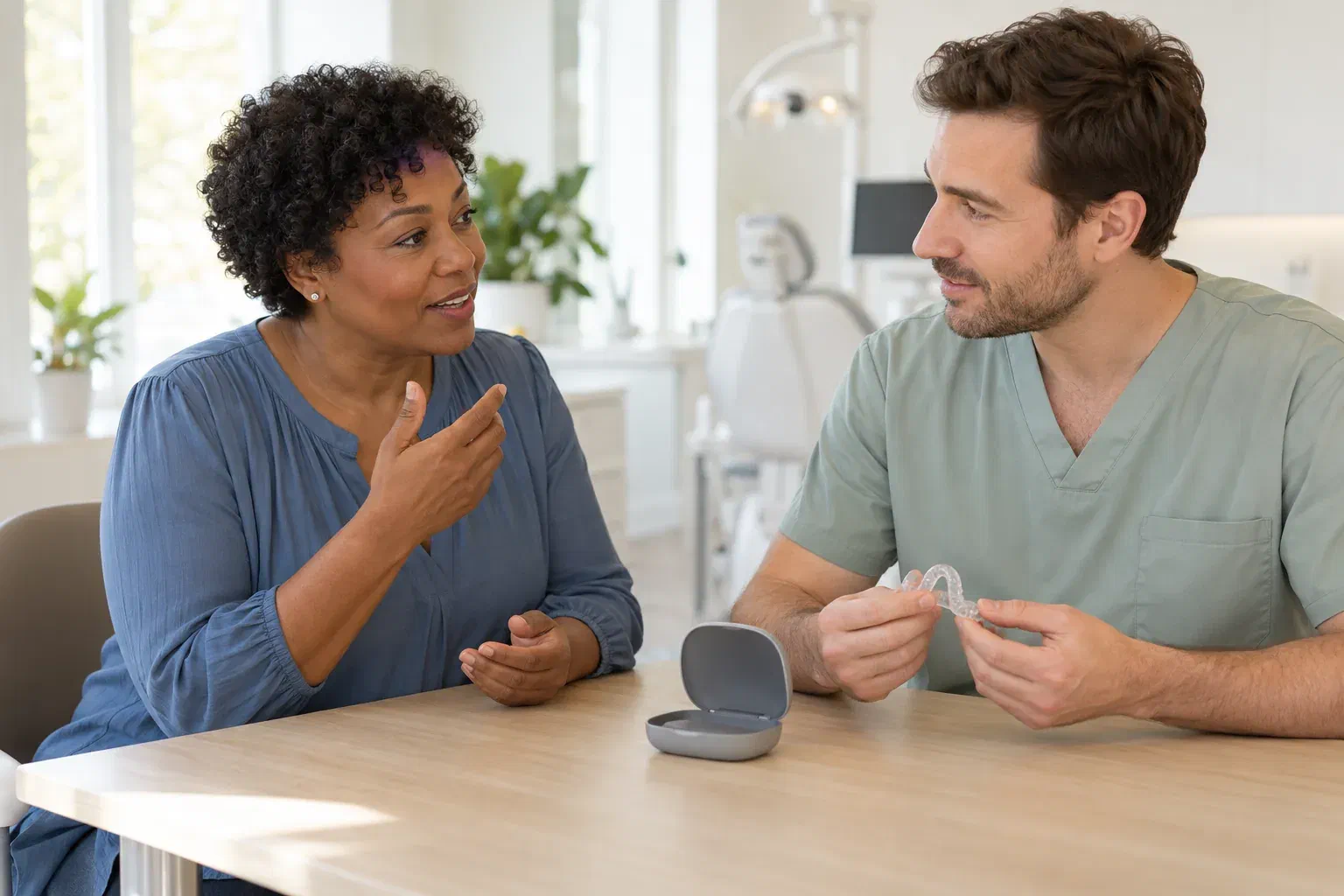
Illustrative discussion about sleep-appliance comfort and fit
Specialized Care

Sleep Appliance Adjustments in Puslinch

Getting a sleep appliance to the right position can take more than one appointment. From Puslinch, plan a sequence of reviews that checks fit, jaw comfort, and settings at sensible intervals, with each step agreed and written down before you head home.

Planning appliance reviews from Puslinch

Sometimes one visit. Often a short series.

In a rural household, every appointment means rearranging the day, so it helps to know what to expect. A simple rub along the gum may be sorted in one sitting. A prescribed change in jaw position, on the other hand, is usually made gradually, with checks in between. Knowing which kind of problem you have, whether fit, contact, or position, lets you plan the right number of trips rather than being surprised.

Gradual does not mean steadily further. Each step is judged on its own, and moving the jaw beyond what suits you can create discomfort without extra benefit. A tighter-feeling appliance is not a sign that treatment is stronger. The setting your clinician is working toward balances your physician’s goal with what your teeth, gums, and jaw tolerate. Comfort along the way is encouraging but is not proof that sleep apnea is controlled.

For the first review, bring the device in its case, your instructions, and any log of earlier changes. Let us know who supplied it and how your nights have been. We can then map out a realistic sequence, decide whether records from the supplying office are needed, and check whether that office should be involved before any change is made.

Plan your sequence of appliance reviews
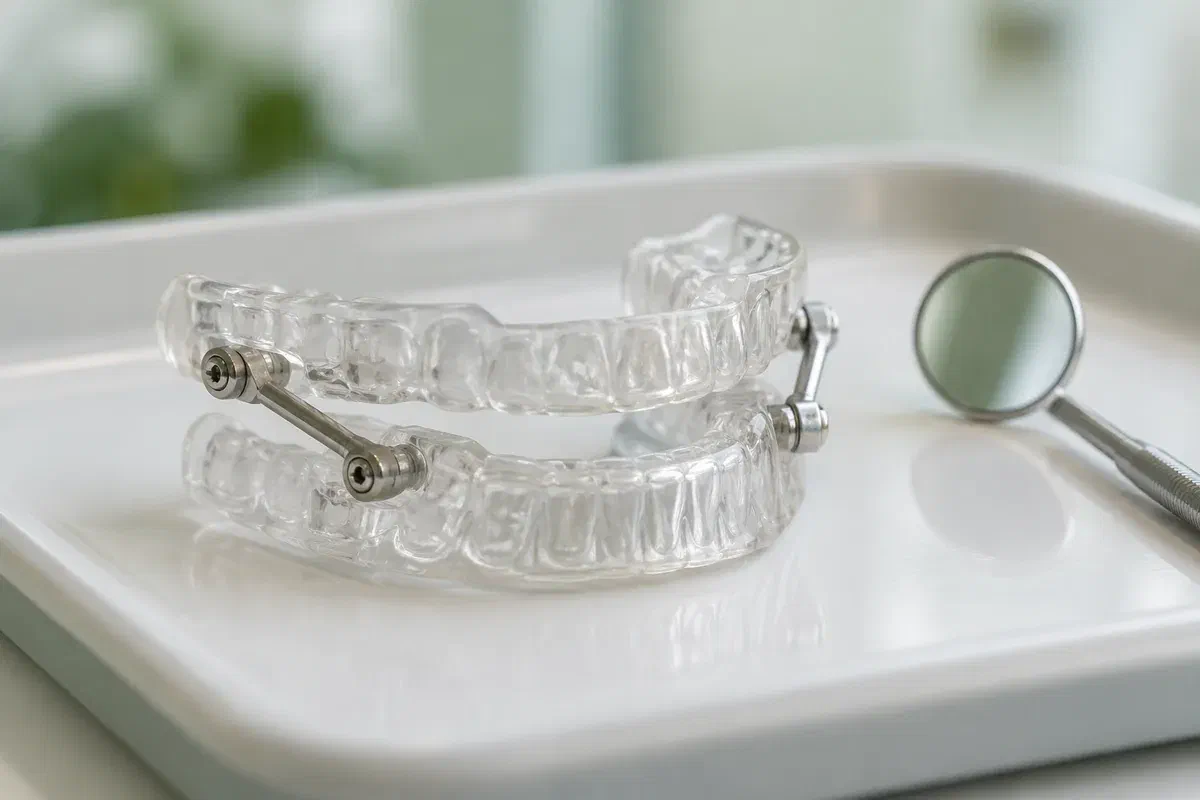
Illustrative connected oral sleep appliance beside a dental mirror
Telling us what you notice between visits

Small details now save extra trips later.

Explain when each concern started and any dental work or device changes since your last review. Do not wear the appliance through pain or force it into place to show us the problem.

A tender area that appears after a step

Describe where and whether it settles once the device is out. A recent crown or filling nearby is worth mentioning. The clinician considers both the device and the tooth or gum involved, since filing the appliance is not always the solution.

Jaw stiffness or a bite that takes time to return

Say whether it shows up overnight, at waking, or through the day, and whether your teeth find their usual contact again. Pain that persists, a locking jaw, or a bite that stays different is a signal to stop advancing and arrange review.

Sleep symptoms that are not improving, or a lost count

Share your log and describe your sleep honestly, including snoring or tiredness. If you are unsure where the setting is, say so instead of estimating. Your physician may also need to consider whether effectiveness should be reassessed.

Stop wearing the appliance if it breaks, has a loose part, causes significant pain, or cannot be seated securely. Phone the managing provider promptly, and check with your sleep physician about overnight treatment while it is out of use.

What a planned sequence offers

Every step has a reason and a checkpoint.

A review at each stage confirms what needs attention before the device is changed again. The concern could be fit, a tissue contact, jaw position, wear, or a dental problem with its own treatment. Changes made for a stated reason can be judged fairly when you return.

Planning also lets you ask practical questions. Which steps can be made at home under instruction, and which need a visit? What should you report by phone? Ask for a demonstration of the mechanism and a written note of each approved step, so there is no doubt between appointments.

Patient information: AADSM — identifying an appropriate therapeutic appliance position

A clear starting record

The clinician reviews the original records and setting at the outset, along with what has changed since the fitting. If the device was supplied elsewhere, ask what details are missing and whether they can be requested. A clear start makes it easier to tell later whether a problem is new or carried over.

Steps matched to findings

A rub, a loose fit, and jaw discomfort each call for different responses. Ask how the exam shapes the recommendation. Sometimes a dental issue is addressed before the next appliance step is taken.

Spaced reviews that fit your schedule

Settle the interval between checks, what to watch for, and which symptoms warrant an earlier call. Grouping your appliance review with other dental care on the same day can reduce trips. A change that feels right in the chair still has to be judged over a stretch of ordinary nights before the next step is considered.

Each review, in four parts

Report, examine, agree, schedule

Bring all parts of the appliance and your current instructions to every visit. If anything was changed or repaired since your last review, tell the clinician exactly what happened.

  1. Report on the nights since the last step

    You describe symptoms, your wear routine, and anything that changed. The clinician asks about dental treatment, your physician’s plan, and the supplier’s guidance. Ask whether the records on file are complete.

  2. Examine the appliance and the mouth

    The device is checked, and the relevant teeth, gums, bite, and jaw are assessed. Ask whether wear or damage affects the next step. A mechanism that still adjusts does not by itself confirm the appliance is sound or correctly positioned.

  3. Agree on the next step, if any

    If a change is suitable, its purpose and the instructions that follow are explained. Some designs need the original provider or a lab. Confirm whether the treatment setting moved or only a fit or contact concern was handled.

  4. Schedule the following check

    Leave with written guidance, the symptoms that should prompt a call, and your next appointment booked. Agree on whether your physician should receive an update. Treatment effectiveness is assessed separately from comfort.

Between appointments

Make only the changes on the written plan.

Your instructions are specific to your device and stage of treatment. If anything is unclear, phone before turning a mechanism, swapping a part, or moving past the agreed setting.

Keep one log for the whole sequence

Note each approved step and its date, with a short comment on how nights went. Bring the log to every review. Avoid testing the fit repeatedly between entries.

Phone early about pain or bite changes

Contact the provider if soreness persists, chewing feels different, or wear is not possible as instructed. A call may save an unnecessary trip, or tell you to come sooner. Never force the appliance or advance through pain, and ask for an interim plan with your physician if wear must stop.

Keep the medical side in the loop

Dental reviews watch how your teeth and jaw respond. Your physician decides how sleep benefit is confirmed, which may include testing once a setting is reached. Let both know about significant changes.

Possible paths at each review

Hold, adjust, or step back and rethink

Ask which option suits what was found and what still needs checking. The aim is appropriate care within your plan, not a fixed number of adjustments.

When the device and tissues support it

A localized comfort change

A rubbing spot or similar fit concern may be eased during the visit. Ask what part is being altered and whether the jaw position is affected. A recheck at the next review should confirm the result.

When progression is part of the plan

The next step in jaw advancement

Some appliances are advanced in small, professionally directed steps. The pace and endpoint are set for you, and holding at a step is sometimes the right call. Ask how the response will be judged. Advancing on your own is not a substitute for review.

When adjustment is not the answer

Repair, replacement, or another approach

Damage, dental changes, or intolerance may require a different plan. Ask whether the manufacturer, the supplying office, or your sleep physician should be involved, and what you should do for treatment if the appliance cannot be worn for a while.

Patient information: AADSM — professional management of oral-appliance side effects

Puslinch questions about the adjustment process

How many visits, and why?

Bring the device and your instructions to each appointment. The right plan depends on the design, the exam, and your medical goals.

(905) 876-4488
How many appointments does it take to adjust a sleep appliance?
It depends on the concern and the design. A simple fit issue may need one visit, while a prescribed position change is often made gradually with checks between steps. Your clinician can outline a realistic plan.
Can some adjustment steps be done at home?
Certain designs allow small, prescribed changes at home, following written instructions from the clinician. Only make the steps you have been authorized to make, at the pace you were given, and record each one. If a step feels wrong or you lose track, phone before doing anything further.
Can I combine an appliance review with my regular cleaning?
Often, yes. Mention it when booking so there is time for both. Grouping visits can reduce trips while still keeping the review thorough. If the appliance needs work that only the supplying office or a lab can do, that part may have to be arranged separately.
What if a step makes my jaw sore?
Stop advancing and contact the provider before the next scheduled step. Describe when the soreness starts and how long it lasts. Significant pain or an unsafe fit may mean pausing wear until you are reviewed, and your sleep physician can advise on interim treatment.
Is there a point where adjusting stops?
Yes. The endpoint is individual and depends on tolerance and treatment response. More advancement is not automatically better. Your clinician and physician will guide when the setting has been reached.
Will I need a sleep test after the adjustments are finished?
That is for your physician to decide. Dental reviews check the device and your mouth, while medical follow-up determines how sleep apnea control is assessed. Ask whether to share your final setting.
Planning from Puslinch

Map out the visits before the first one.

Contact Milton Dental Clinic to plan a sleep appliance review. Tell us what kind of appliance you have, which office made it, and what you have noticed, and we can discuss an assessment, a sensible schedule of follow-up, and any coordination.

Each adjustment should fall within your agreed dental and medical plan.

Visit Milton Dental Clinic
Unit 1, 342 Bronte St. S, Milton, ON L9T 5B7
Get directions Clinic hours
Monday–Thursday
11am–7pm
Friday–Sunday
By appointment only

Areas we serve

  • Milton
  • Oakville
  • Mississauga
  • Georgetown
  • Halton Hills
  • Acton
  • Campbellville
  • Brampton
  • Burlington
  • Puslinch
  • Rockwood
  • Erin
  • Caledon
  • Etobicoke
  • Old Milton
  • Bronte Meadows
  • Timberlea
  • Dorset Park
  • Dempsey
  • Clarke
  • Beaty
  • Coates
  • Harrison
  • Scott
  • Willmott
  • Ford
  • Bowes
  • Cobden
  • Walker
  • Mountain View
  • Milton Heights
  • Hawthorne Village
  • Valley View
  • Fallingbrook
  • Nassagaweya
  • Trafalgar
  • Esquesing
  • Nelson
  • Brookville
  • Moffat
  • Glen Williams
  • Norval
  • Limehouse
  • Stewarttown
  • Ashgrove
  • Hornby
  • Silver Creek
  • Speyside
  • Scotch Block
  • North Oakville
  • River Oaks
  • Glen Abbey
  • West Oak Trails
  • Palermo
  • Bronte Creek
  • College Park
  • Joshua Creek
  • Uptown Core
  • Preserve
  • Iroquois Ridge
  • Lisgar
  • Meadowvale
  • Meadowvale Village
  • Churchill Meadows
  • Erin Mills
  • Central Erin Mills
  • Streetsville
  • East Credit
  • Creditview
  • Heartland
  • Sheridan
  • Mount Pleasant
  • Credit Valley
  • Huttonville
  • Churchville
  • Springbrook
  • Northwest Brampton
  • Bram West
  • Fletcher's Meadow
  • Fletcher's Creek South
  • Alton Village
  • Orchard
  • Millcroft
  • Headon Forest
  • Tansley
  • Brant Hills
  • Tyandaga
  • Kilbride
  • Lowville
  • Aberfoyle
  • Morriston
  • Arkell
  • Hillsburgh
  • Freelton
  • Carlisle
  • Waterdown
  • Flamborough
  • Mountsberg

How can we help?

Milton Dental Clinic

Have a question about your smile? Choose the option that works best for you.

For urgent dental concerns, please call.
Messages are reviewed during clinic hours.