
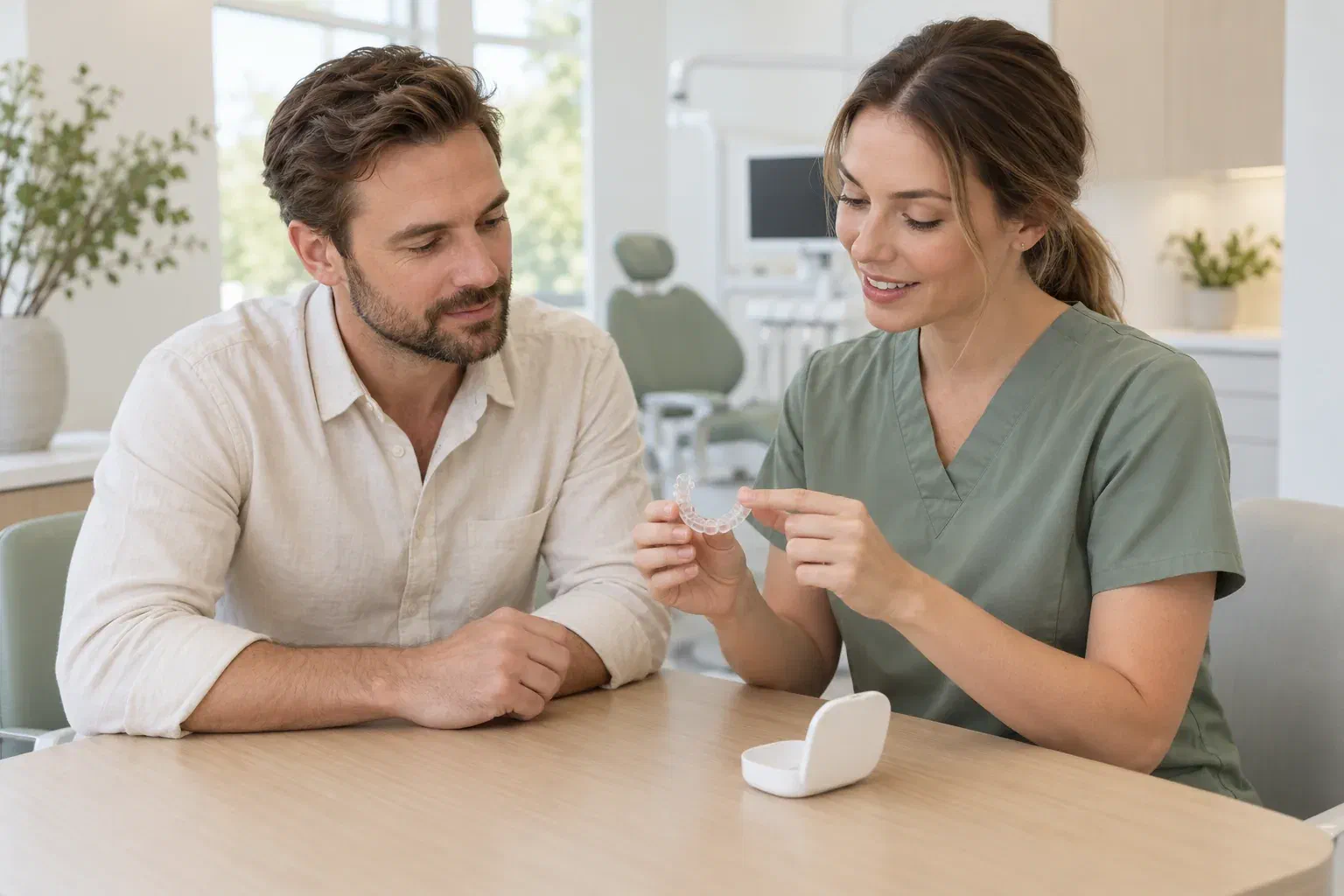
Illustrative explanation of how to handle a custom oral sleep appliance
Specialized Care

Sleep Appliance Fitting in Acton

A custom sleep appliance spends most of the day out of your mouth, in a case, a rinse or a sink. For anyone coming from Acton, the fitting covers that side too: how to clean it, where to keep it and how to keep it safe between nights.

Acton · caring for a sleep appliance

Sixteen hours in a case, eight in your mouth.

Most talk about oral sleep appliances focuses on the night. Yet the device spends far more of each day being rinsed, dried, stored and carried, and that is when many problems start: a warped tray, a lost connector, a chewed edge. The fitting appointment, which comes after assessment and planning, checks the appliance in your mouth and also teaches you to look after it.

Care routines are not interchangeable. Materials, connectors and adjustment parts differ between designs, so a cleaning tip that suits a retainer or a friend's appliance may harm yours. Ask the clinician to show you how this one is handled and cleaned, then repeat it yourself. If small parts, vision or grip make the routine hard, now is the moment to say so.

Before your appointment, let us know whether the appliance has already been prescribed or made, and who is looking after your sleep care. We will go over records and coordination with you. Keep in mind that a device that fits well and stays clean has not, on those grounds alone, been shown to treat a sleep disorder.

Ask what your fitting will cover
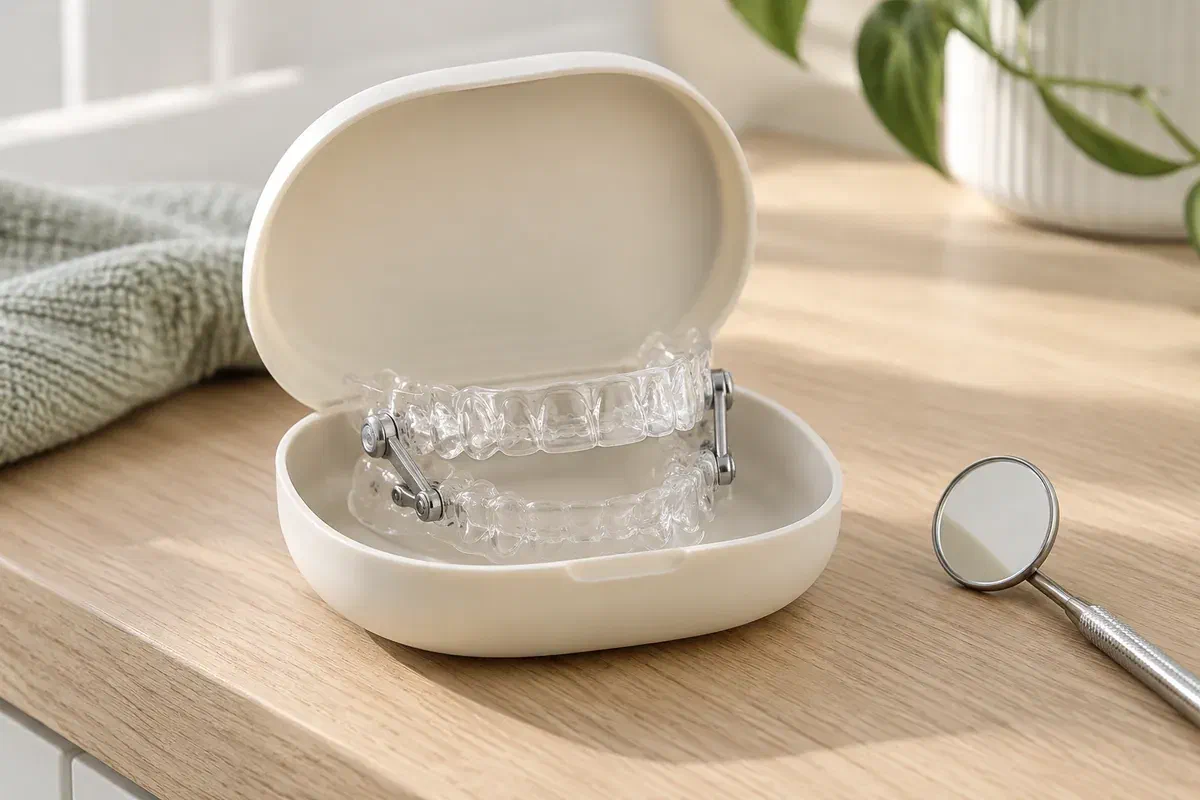
Illustrative connected sleep appliance in an open protective case
Daily-life questions for the clinician

The details that decide whether the device lasts.

Ask about everyday care as readily as you ask about fit. A question that feels trivial in the chair, such as whether to store it wet or dry, can be the one that matters most at home.

Getting it in and out without stress on the parts

Rough handling can strain connectors and edges over time. Learn where to hold this design and how its pieces are meant to engage, then practise removal as carefully as insertion. If you cannot do either smoothly, mention it; prying or biting the tray into position harms both you and the device.

A rough edge or a pressure spot

Run your tongue over the appliance while it is in, and tell the clinician what you notice. Feeling a new device is expected, but pain, a spot that rubs the gums or trays that will not seat need assessment. The clinician can smooth, adjust, investigate further or change the arrangement before you start.

What the starting setting is

Even a care-focused visit has to settle the treatment basics. Ask which setting the plan begins with and whether any change at home is permitted. Clarify the exact steps and the signs that mean stop and phone. Initial settings often change later, and some devices are never adjusted by the wearer.

Mention dental treatment or changes in your teeth since your records were taken. A filling, crown, extraction or new symptom could affect how the appliance seats, so it should be reviewed before regular use begins.

Why the care lesson matters

A well-kept appliance is easier to assess at every review.

First, the fit. The clinician compares your finished appliance with the planned design and with the current state of your teeth and gums. Ask what they are checking and how they would deal with a concern. An appliance made from records still needs a clinical check, and instructions for its care are part of being ready.

Second, the longer view. A starting position and wear schedule may be the opening stage, with comfort and response reviewed later. An appliance that has been cleaned and stored correctly gives a truer picture at those visits. Ask who handles each step and how the medical provider will assess effectiveness.

Patient information: AADSM — appliance delivery, patient instruction, and continuing management

Practising both handling and cleaning

Repeat the insertion, removal and cleaning steps in front of the clinician, asking for another demonstration whenever it helps. Mention any limitation with your hands or eyesight. If someone else will help with care, ask what they should learn instead of assuming any cleaning method will do.

Care instructions written for your materials

Request guidance on cleaning products, water temperature, drying, storage and any permitted adjustment, and keep it with the manufacturer and provider details. A written sheet is useful when parts look alike, or when a cleaning step could be mistaken for a change to the setting.

A starting record and a first review date

Check that the clinician has noted your fit, bite and jaw findings, and write down when your first review is due. Ask how to reach the provider earlier if the appliance is damaged or causes problems. Leave with support arranged, not an expectation to manage alone until a routine checkup.

During the appointment

Fit first, then the care routine, then the plan.

Bring your sleep-care information, any paperwork from the lab and questions about daily care. Mention any changes since the assessment, and allow time for a full demonstration.

  1. Reviewing the prescription and your oral health

    The clinician confirms the intended appliance and pathway, then asks about recent dental work, new symptoms or health changes. Ask whether any of these affects readiness. If a different office supplied the appliance, its prescription and guidance may have to be confirmed before going ahead.

  2. Checking how it sits and how it feels

    Seating and retention are assessed against your teeth, restorations and gums, and edges are checked for comfort. Say what you feel rather than judging whether it is normal. The clinician decides if the appliance is ready to use or needs attention before your plan begins.

  3. Learning handling, cleaning and storage

    You practise insertion and removal and are shown how to clean, dry and store this design. The starting setting is confirmed, along with any change you may make. Ask which parts you may handle and which only a professional should adjust, and ask again if anything is unclear.

  4. Arranging review and medical follow-up

    Agree on a date for the dental review and find out how the sleep provider will check your response. Ask what to do if the device is damaged, causes real discomfort or changes your bite. If use has to wait or stop, confirm what sleep care continues meanwhile.

Everyday care at home

Rinse, clean, dry, case.

Use the cleaning and storage routine written for your device. Methods meant for dentures, retainers or another person's appliance may not be safe for it, even if they seem similar.

Handle it the way you were taught

Seat the appliance at night and remove it in the morning with the technique you practised. Follow your starting routine without improvising. If you cannot manage a step, or wearing it is uncomfortable, call the provider. Never force it, advance a setting early or add something homemade to hold it.

Clean it with approved products only

Ask exactly which cleaner, water temperature and drying method suit this appliance. Avoid boiling water, a hot dishwasher, bleach and anything not approved for it. Keep the case closed and somewhere pets cannot reach, and bring it with the appliance to every review.

Note damage, wear or changes

Write down any crack, discolouration, looseness or difficulty with wear, as well as jaw discomfort or a change in how your teeth meet after removal. Tell the provider rather than working around it, so they can assess the device and involve the medical team if necessary.

Possible results of the fitting

Taking it home is one outcome, not the only one.

Whatever the clinician suggests, ask for the reason and how it affects your schedule. You should take the appliance home once the fit is suitable and you can follow the instructions, never simply to finish the appointment.

Fit and care routine confirmed

Starting regular wear

If the device is suitable, you are given the starting routine and a review date. Ask how to raise a concern in between. At later visits the clinician looks again at comfort, the teeth and jaw, and how your sleep is responding, so this is a starting point.

Fit or oral health needs attention

A little more work first

A sharp edge, a pressure point or recent dental work may mean the appliance needs further attention. Ask if that can happen on the day or involves the lab or another visit. A short, explained delay is better than leaving with something you cannot wear safely.

This appliance does not meet current needs

Looking at a different option

If the findings point away from this device, the next step could be another design, a specialist assessment or a discussion with the medical sleep provider. Ask what changed and what happens next. Your sleep condition should not be left without an agreed plan.

Acton care questions

Keeping the appliance clean, safe and ready.

Materials and design shape the right answers. Bring questions about cleaning and storage so they can be answered with your own appliance in view.

(905) 876-4488
What if my dog gets hold of the appliance?
Do not wear it until it has been checked, even if the damage looks minor. Contact the provider, keep the pieces in the case, and follow your interim sleep-care plan. Storing the case out of reach is the best protection.
Can I brush my appliance with regular toothpaste?
Ask before you do. Some products can be too abrasive for certain appliance materials. Follow the cleaning method and products recommended in your written instructions.
Should the appliance be stored wet or dry?
That depends on the design and materials. Ask at the fitting and check your written guidance. Storing it incorrectly may affect the material or encourage buildup over time.
Should I clean my teeth before putting the appliance in?
Ask your provider what routine they recommend. Many people brush and floss before bed so the appliance sits against clean teeth. Follow the instructions you were given for your device.
My appliance is starting to look discoloured. Is that a problem?
Mention it at your review, or sooner if you notice cracks, roughness or a change in fit. Do not try bleach or harsh cleaners to fix the colour, as they may damage the appliance.
What should I do if I lose my sleep appliance?
Contact the provider as soon as possible, and ask your sleep-care team what treatment to use in the meantime. A replacement or other arrangement can then be discussed. Do not substitute an over-the-counter mouthguard without advice.
Your fitting from Acton

Leave knowing how to look after it.

Reach out to Milton Dental Clinic to book a sleep-appliance fitting and ask what to bring. Share who prescribed the device, whether it is ready, and any dental treatment you have had since your assessment, along with any care questions.

Care and fitting instructions depend on the device and your coordinated plan.

Visit Milton Dental Clinic
Unit 1, 342 Bronte St. S, Milton, ON L9T 5B7
Get directions Clinic hours
Monday–Thursday
11am–7pm
Friday–Sunday
By appointment only

Areas we serve

  • Milton
  • Oakville
  • Mississauga
  • Georgetown
  • Halton Hills
  • Acton
  • Campbellville
  • Brampton
  • Burlington
  • Puslinch
  • Rockwood
  • Erin
  • Caledon
  • Etobicoke
  • Old Milton
  • Bronte Meadows
  • Timberlea
  • Dorset Park
  • Dempsey
  • Clarke
  • Beaty
  • Coates
  • Harrison
  • Scott
  • Willmott
  • Ford
  • Bowes
  • Cobden
  • Walker
  • Mountain View
  • Milton Heights
  • Hawthorne Village
  • Valley View
  • Fallingbrook
  • Nassagaweya
  • Trafalgar
  • Esquesing
  • Nelson
  • Brookville
  • Moffat
  • Glen Williams
  • Norval
  • Limehouse
  • Stewarttown
  • Ashgrove
  • Hornby
  • Silver Creek
  • Speyside
  • Scotch Block
  • North Oakville
  • River Oaks
  • Glen Abbey
  • West Oak Trails
  • Palermo
  • Bronte Creek
  • College Park
  • Joshua Creek
  • Uptown Core
  • Preserve
  • Iroquois Ridge
  • Lisgar
  • Meadowvale
  • Meadowvale Village
  • Churchill Meadows
  • Erin Mills
  • Central Erin Mills
  • Streetsville
  • East Credit
  • Creditview
  • Heartland
  • Sheridan
  • Mount Pleasant
  • Credit Valley
  • Huttonville
  • Churchville
  • Springbrook
  • Northwest Brampton
  • Bram West
  • Fletcher's Meadow
  • Fletcher's Creek South
  • Alton Village
  • Orchard
  • Millcroft
  • Headon Forest
  • Tansley
  • Brant Hills
  • Tyandaga
  • Kilbride
  • Lowville
  • Aberfoyle
  • Morriston
  • Arkell
  • Hillsburgh
  • Freelton
  • Carlisle
  • Waterdown
  • Flamborough
  • Mountsberg

How can we help?

Milton Dental Clinic

Have a question about your smile? Choose the option that works best for you.

For urgent dental concerns, please call.
Messages are reviewed during clinic hours.