
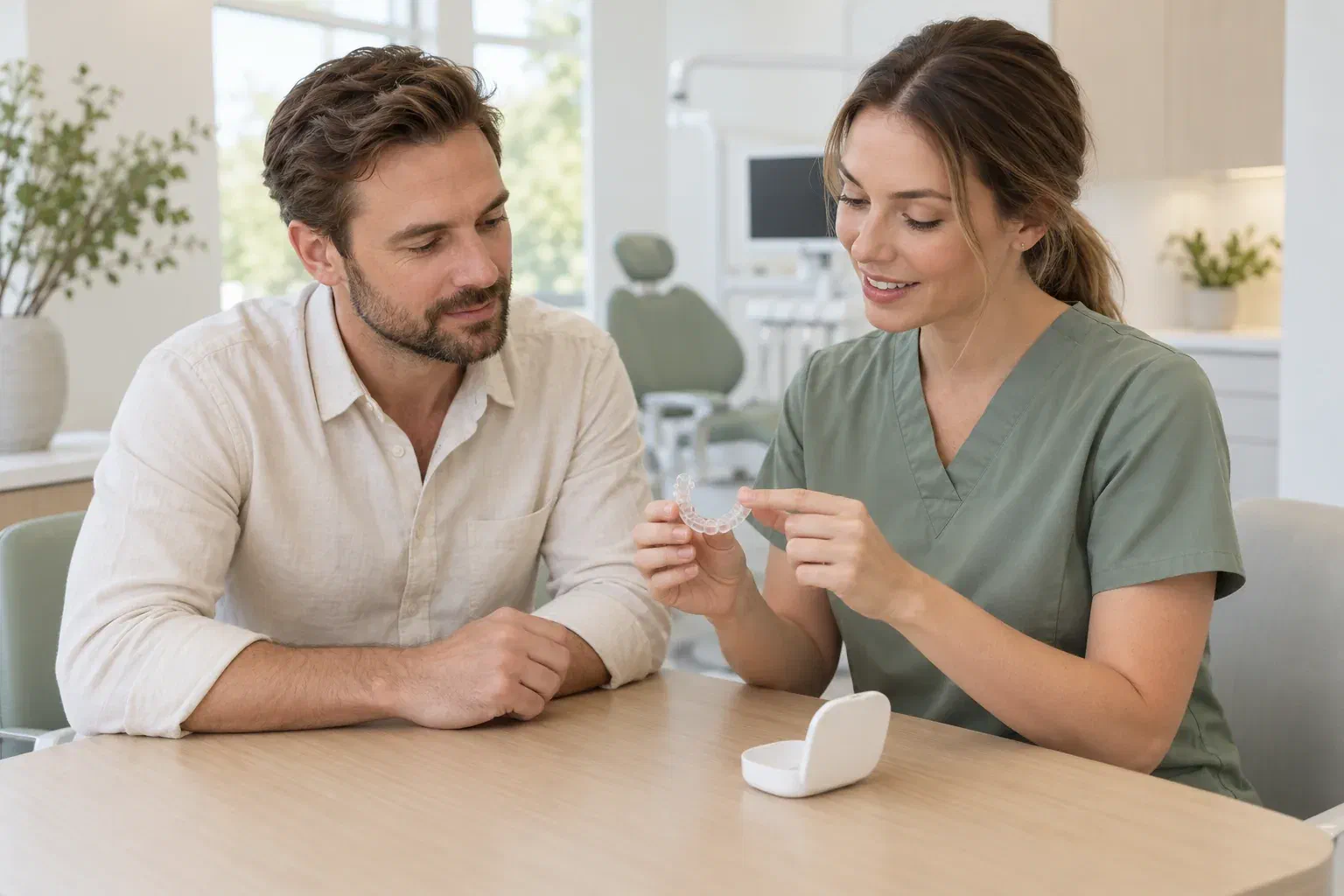
Illustrative explanation of how to handle a custom oral sleep appliance
Specialized Care

Sleep Appliance Fitting in Old Milton

Stiff fingers, reading glasses or a fiddly connector can make a new sleep appliance harder to handle than expected. A careful fitting near Old Milton lets you practise at your own pace and leave with a routine you can actually manage.

Old Milton · handling a new appliance

Can your hands manage it at midnight?

Many people expect the hard part of oral sleep therapy to be getting used to the feeling. Often it is something plainer: pressing two small trays into place, or easing them free in the morning, with hands that are not as nimble as they once were. A fitting appointment is where that practical side gets attention, once assessment and treatment planning have been done.

Each design asks something slightly different of your fingers, and each has its own cleaning and adjustment needs. A neighbour's experience with another device, or a video about a generic mouthpiece, may point you the wrong way. Ask for a demonstration on your own appliance, then take your time repeating it. Arthritis, reduced vision or a tremor are worth mentioning plainly.

Our practice on Bronte Street South sits a short way from Milton's historic downtown. When you get in touch, tell us whether the device has been prescribed or is already made, and which provider is looking after your sleep care. Remember that wearing an appliance comfortably is not the same as a medical finding that it is effective.

Ask about fitting arrangements and practice time
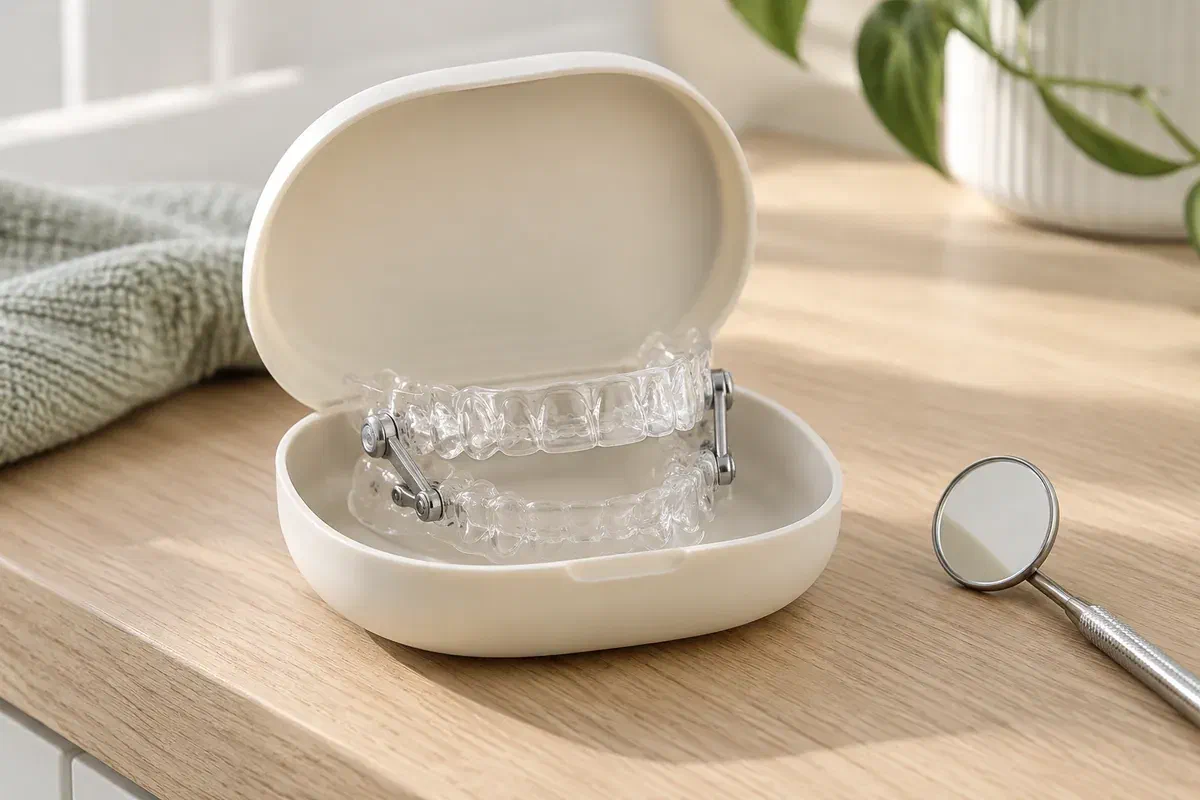
Illustrative connected sleep appliance in an open protective case
Raise these before you go home

Practical limits matter as much as the fit itself.

It can feel awkward to admit that a small task is difficult. Say it anyway. The clinician can only tailor teaching, or reconsider the arrangement, if they know where the routine is breaking down for you.

A grip that struggles with small parts

Show the clinician how you are holding the tray and ask whether there is a better finger position for your design. Practise taking it out several times, not just putting it in. If neither step feels reliable, that is important information. Forcing the tray or clenching it into place is not a workable solution.

Soreness that is easy to dismiss

Long experience with dentures or partials can make some people shrug off pressure. Mention what you notice during the check anyway. Awareness of something new differs from pain, irritation of the gums or a tray that does not settle, and the clinician should decide whether adjustment or more assessment comes first.

Small markings and settings you cannot read

If the adjustment markings are hard to see, say so. Ask which setting is the starting point, whether you are permitted to change it at home, and what would mean stopping and calling. The first position is often not the last, and many appliances are never meant to be adjusted by the wearer.

Let the provider know about recent dental work or any change to your teeth since the records were taken. A new filling, a crown, a lost tooth or a fresh ache can change the fit and should be reviewed before you start wearing the device.

Why the extra practice pays off

Your own hands, your own appliance, a plan you can follow.

At the fitting, the clinician checks the device against the intended design and against your mouth today, which may differ from the day records were taken. Feel free to ask what is being examined and how a concern would be managed. Manufacture alone does not make an appliance ready; clinical fit and clear teaching are both part of it.

This appointment opens a longer stretch of care. The starting position and wear instructions may be early stages, with comfort and treatment response checked later. Find out who is responsible for each part, including how your medical provider will judge whether the appliance is helping, so questions reach the right person.

Patient information: AADSM — appliance delivery, patient instruction, and continuing management

Unhurried practice with the real device

Repeat the steps while the clinician watches and ask them to show you again whenever needed. Describe any handling limits honestly. When a spouse or caregiver may help at night, clarify what they should be taught, rather than assuming any technique that seems to work will be safe for the device.

Large, clear notes you can refer back to

Ask for written instructions on wearing, cleaning, storage and any adjustment you are allowed to make, in a format you can read comfortably. Keep the manufacturer and provider details with them. Notes help most when parts look alike but serve different roles, or when care steps could be confused with setting changes.

A record to compare against later

Make sure your fit, bite and jaw findings are documented and that you know the date of the first review. Ask how to contact the provider before then if a problem appears. You should leave with support arranged, not an expectation that you will cope until the next routine dental visit.

The fitting, step by step

Check, adjust if needed, practise, then plan the follow-up.

Bring whatever sleep-care paperwork you have, plus your reading glasses if you use them. Mention changes since the assessment and ask for enough time to practise until the steps feel manageable.

  1. A look at the prescription and your recent dental history

    The clinician confirms which appliance and pathway were planned, then asks about new dental treatment, symptoms or health changes. Ask whether anything affects readiness for the fitting. If the device came through another office, the original instructions and records may need clarifying before proceeding.

  2. Checking seating, grip on the teeth and the gums

    The appliance is assessed against your natural teeth, crowns or fillings, and the soft tissue. Report pressure or discomfort in your own words instead of deciding whether it is normal. The clinician determines whether it is suitable as delivered or needs work before the starting plan can begin.

  3. Teaching the handling in a way that suits you

    You practise insertion and removal and go over cleaning and storage for this design. The clinician confirms the starting setting and any approved progression. Ask which components you may handle and which are for professional adjustment only, and request another run-through if the mechanism still confuses you.

  4. Setting a review and connecting with your sleep provider

    Confirm when the dental review happens and how the sleep provider will check the response to treatment. Ask what to do about significant discomfort, a bite that feels different, or being unable to wear the device. If wear has to be postponed or paused, clarify the interim plan.

Once the appliance is at home

Small, consistent habits, exactly as taught.

Early wear should follow the plan written for your device. A friend's adjustment routine or soaking method may suit their appliance and still be wrong for yours.

Keep to the technique you practised

Put the appliance in and take it out the way you were shown, and follow the starting schedule. If your hands make a step unreliable, or if wearing it hurts, call the provider. Never force the trays, advance the setting early or add an improvised strap or adhesive to keep things in place.

Clean and store it with care

Confirm which cleaner and water temperature suit the materials, and how to store the appliance between uses. Keep it away from hot water and unapproved products. A case kept in one familiar spot protects it from pets and from being wrapped in a tissue and thrown away. Bring it to each review.

Note difficulties and come to the first review

Write down problems with wear, fit, jaw comfort, or how your teeth meet after taking the device out. Tell the provider what stopped you rather than quietly changing the routine. They can then work on the obstacle and bring in medical input if needed.

Possible outcomes of the visit

Sometimes the right answer is not yet.

Ask why a particular next step is recommended and whether it changes your timeline. Going home with the device should depend on a suitable fit and instructions you can follow, not on getting the delivery visit finished.

When fit and handling have been confirmed

Starting prescribed use

If the appliance is appropriate, the clinician explains how to begin and when you will be seen again. Ask how to raise concerns between visits. The fitting is one stage; comfort, oral effects and the sleep-related response to treatment are reviewed at later appointments.

When something needs to be resolved first

More work on the fit or your teeth

A pressure point, difficulty seating the trays, or recent dental changes may need further attention. Ask whether that can happen today or needs another visit or lab involvement. Understanding the reason for a delay is better than leaving with something you cannot safely use.

When this device does not suit current needs

Reconsidering the design

If handling or fit cannot be made workable, a different design, a specialist referral or a discussion with the medical sleep provider may follow. Ask what has changed the plan and how care continues. Your sleep condition should still have an agreed approach while this is sorted out.

Common questions from Old Milton

Handling, help at home and what to bring.

General advice only goes so far. Bring your questions about grip, vision, cleaning and follow-up so they can be answered with your own device in front of you.

(905) 876-4488
I have arthritis in my hands. Will I be able to use a sleep appliance?
That depends on the design and on how the technique works for you. Mention it at the fitting and practise with the clinician watching. If the steps remain unreliable, they can discuss further teaching, help from someone at home, or whether another arrangement should be considered.
Can my spouse help me put the appliance in each night?
Possibly, if your provider agrees it is appropriate. Bring them to the fitting so they can learn the correct technique for this specific device. A helper should follow the same steps you were taught rather than improvising a method that seems quicker.
Should I bring my glasses to the fitting appointment?
Yes, if you use them for close work. You may need to see small markings, connectors or how the trays line up. Being able to see the details clearly during the demonstration makes it easier to repeat the routine on your own.
Can a sleep appliance be worn with a partial denture?
This needs to be planned for your situation. Tell the clinician about any removable partial, as the appliance design and instructions depend on which teeth it relies on. Do not change how you wear the partial at night without advice.
What happens if the tray will not come out easily at the fitting?
Say so straight away and practise the removal technique for this design with support. Do not plan to pry it out at home with a tool or excess force. If removal stays difficult, more teaching or a change to the arrangement may be needed before you take it home.
Will I need to keep using my current sleep treatment for a while?
Follow the plan agreed with your medical provider. Comfortable wear does not show that sleep apnea is adequately treated. Ask when to begin the appliance, what continues in the meantime and how effectiveness will be measured.
Plan your Old Milton fitting

Book time to learn it properly.

Contact Milton Dental Clinic about a sleep-appliance fitting and the records we will need. Let us know if the device is already made, who prescribed it, any handling concerns, and whether your dental treatment has changed since assessment.

Instructions at the fitting depend on the device and your coordinated care plan.

Visit Milton Dental Clinic
Unit 1, 342 Bronte St. S, Milton, ON L9T 5B7
Get directions Clinic hours
Monday–Thursday
11am–7pm
Friday–Sunday
By appointment only

Areas we serve

  • Milton
  • Oakville
  • Mississauga
  • Georgetown
  • Halton Hills
  • Acton
  • Campbellville
  • Brampton
  • Burlington
  • Puslinch
  • Rockwood
  • Erin
  • Caledon
  • Etobicoke
  • Old Milton
  • Bronte Meadows
  • Timberlea
  • Dorset Park
  • Dempsey
  • Clarke
  • Beaty
  • Coates
  • Harrison
  • Scott
  • Willmott
  • Ford
  • Bowes
  • Cobden
  • Walker
  • Mountain View
  • Milton Heights
  • Hawthorne Village
  • Valley View
  • Fallingbrook
  • Nassagaweya
  • Trafalgar
  • Esquesing
  • Nelson
  • Brookville
  • Moffat
  • Glen Williams
  • Norval
  • Limehouse
  • Stewarttown
  • Ashgrove
  • Hornby
  • Silver Creek
  • Speyside
  • Scotch Block
  • North Oakville
  • River Oaks
  • Glen Abbey
  • West Oak Trails
  • Palermo
  • Bronte Creek
  • College Park
  • Joshua Creek
  • Uptown Core
  • Preserve
  • Iroquois Ridge
  • Lisgar
  • Meadowvale
  • Meadowvale Village
  • Churchill Meadows
  • Erin Mills
  • Central Erin Mills
  • Streetsville
  • East Credit
  • Creditview
  • Heartland
  • Sheridan
  • Mount Pleasant
  • Credit Valley
  • Huttonville
  • Churchville
  • Springbrook
  • Northwest Brampton
  • Bram West
  • Fletcher's Meadow
  • Fletcher's Creek South
  • Alton Village
  • Orchard
  • Millcroft
  • Headon Forest
  • Tansley
  • Brant Hills
  • Tyandaga
  • Kilbride
  • Lowville
  • Aberfoyle
  • Morriston
  • Arkell
  • Hillsburgh
  • Freelton
  • Carlisle
  • Waterdown
  • Flamborough
  • Mountsberg

How can we help?

Milton Dental Clinic

Have a question about your smile? Choose the option that works best for you.

For urgent dental concerns, please call.
Messages are reviewed during clinic hours.