
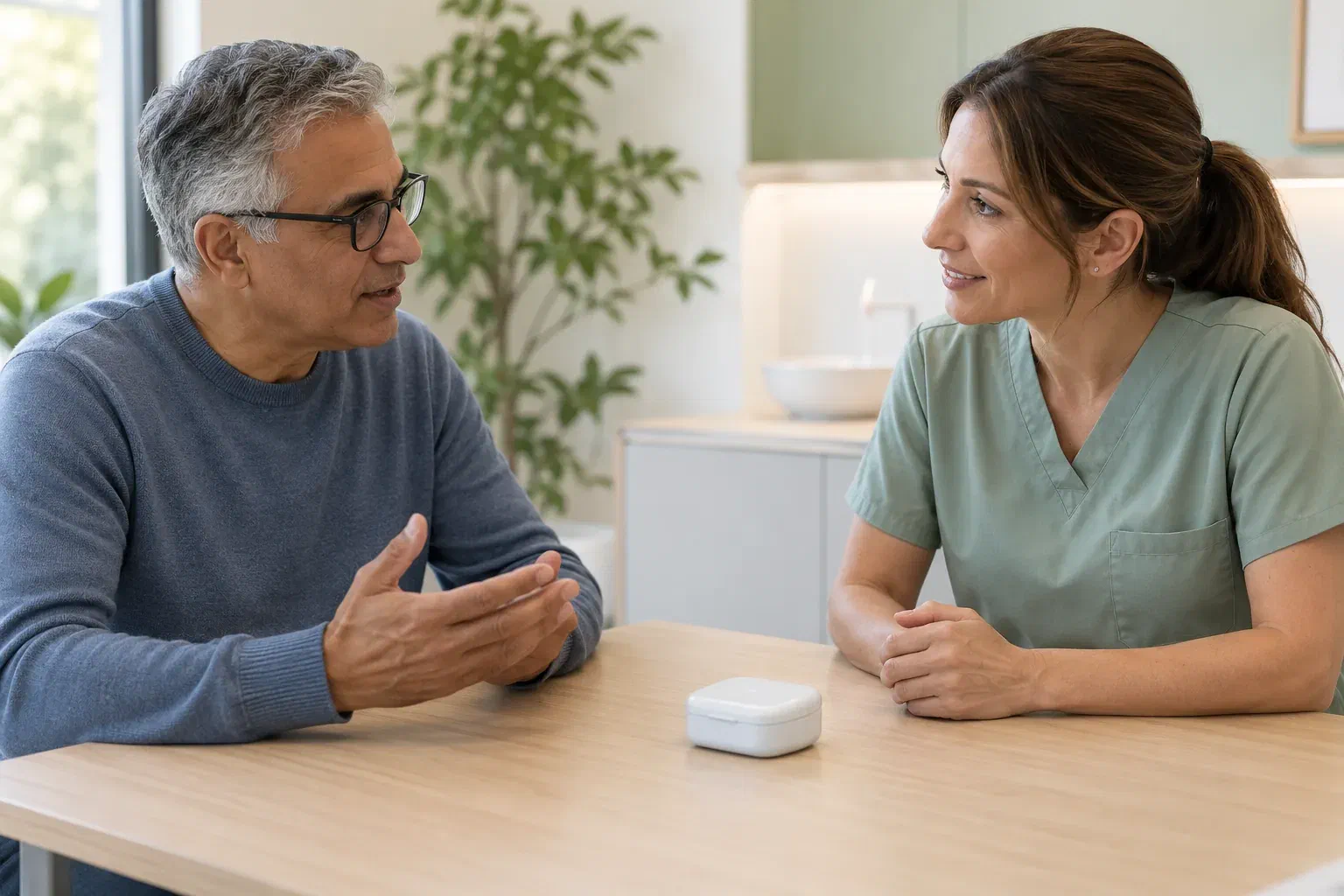
Illustrative discussion about having an oral sleep appliance assessed
Specialized Care

Sleep Appliance Repair in Caledon

A broken sleep appliance can involve three offices at once: the dental team assessing it, the lab or supplier that built it, and the physician managing your sleep treatment. From Bolton or anywhere in Caledon, a clear plan for who does what keeps the repair moving.

Coordinating an appliance repair from Caledon

Three offices, one appliance, and you in the middle

An oral sleep appliance sits where dental care and medical care meet. It was likely prescribed after a sleep assessment, made by a dental lab or manufacturer, and fitted by a dental provider. So when a tray cracks, a connector slips or the fit changes, the question of whether it can be repaired, and safely used again under your treatment plan, may need answers from more than one place.

Being the person who carries the information makes things smoother. Keep the appliance and any loose pieces in a sturdy case. Collect the names and numbers for the office that fitted it, the lab or brand if known, and the physician or clinic managing your sleep care. Jot down when the problem started, plus anything relevant such as a drop, heat, dental work or a fit that had been changing.

Households spread across a large, mostly rural town like Caledon tend to value a single, well-planned visit. When you call, we can discuss the damage, explain how assessment is arranged and say whether we should contact the original supplier before you come in. Some appliances and some damage can’t be repaired, and no particular part, timeline or warranty outcome can be guaranteed before examination.

Start coordinating your appliance repair
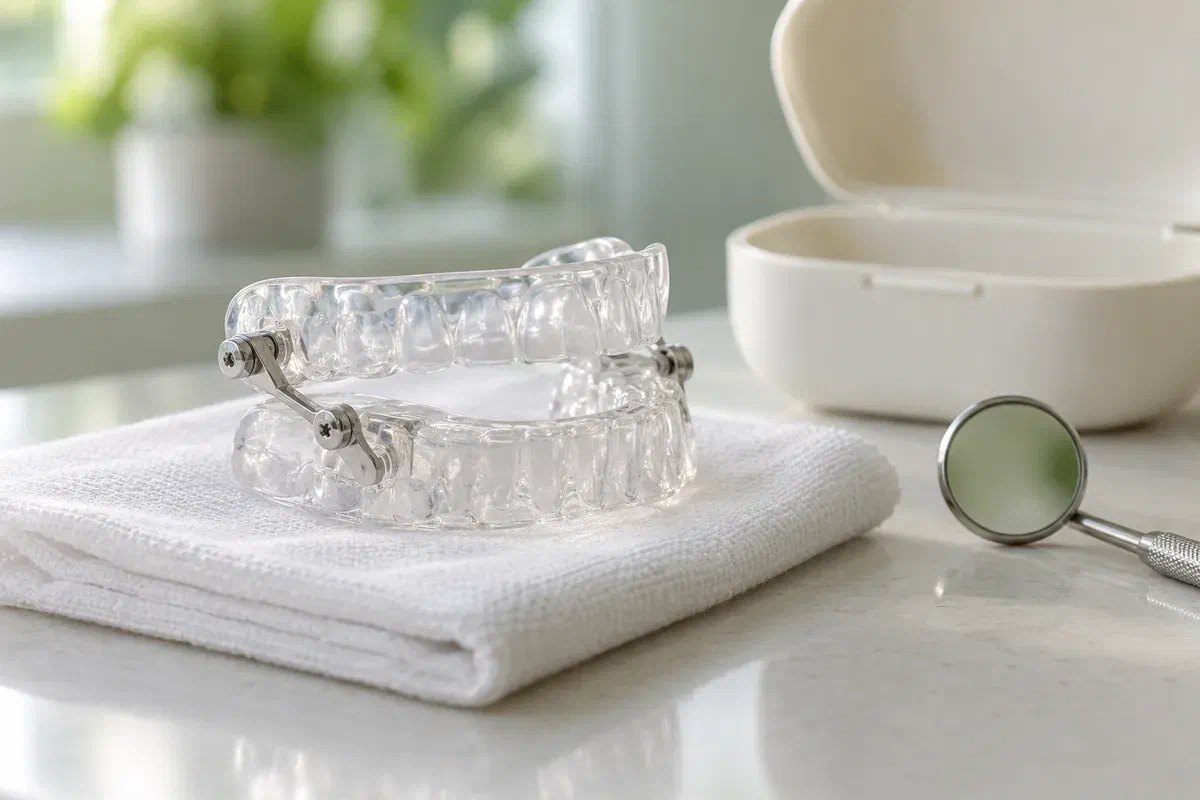
Illustrative intact sleep appliance beside a mirror and protective case before inspection
What to flag on the first call

Give every office the same clear description

When parts are loose, an edge is sharp or the appliance won’t seat safely, stop using it and contact your treating provider. Carrying on for a few nights can blur the details each office needs.

A crack or broken fragment

Keep the pieces in the case with the device, unglued. Note whether the break followed an accident or appeared during regular use. However slight it looks, the crack’s location and the appliance’s construction will guide both the clinician and the lab.

A connector loosened, damaged or missing

Household screws, elastics and online parts can make the supplier’s job harder. Name the affected component and say whether it’s still missing. If it might have been swallowed or inhaled, your first call is for medical advice, before any dental arrangements.

A distorted tray or a change in fit

Report any heat exposure, new crowns or fillings, a sore tooth or difficulty seating it. Don’t force the device or soften it to reshape it. The clinician will work out whether the appliance or your mouth has changed, which also determines who else needs to be involved.

Call 911 for choking or breathing difficulty. If a missing part may have been swallowed or inhaled, get prompt medical advice and describe it. Keep the rest of the appliance available so the component can be identified.

Why coordination makes a better repair

When every office has the facts, the result holds up.

A repair done without the original design details may look right but hold the jaw in a different position from what was prescribed. A coordinated assessment brings together the device’s design and material, the damaged area, the original records and the current state of your teeth and gums. Ask what the proposed work would correct and how its success will be checked.

Your physician has a role too. Tell the sleep clinic the appliance is out of use, and ask what to do until it returns. Don’t assume an older mouthguard, a sports guard or something bought online will provide the same treatment.

Connecting with the original maker

The fitting office, manufacturer or lab may hold the design, settings and compatible parts. Share their contact details, and we can discuss whether to reach out. An unknown brand is a reason to look further, not to use a similar part.

Sharing the cause with everyone involved

Describe earlier pressure spots, past breaks or recent dental treatment. If the cause lies in your mouth or your treatment plan, the sleep physician and the dental team may both need to know, so the same problem isn’t repaired in isolation.

One clear estimate, with the unknowns flagged

Ask what the work involves, how long the device may be away, the likely cost and whether a lab is needed. Where an answer depends on another office replying, a good estimate says so, so you know who you’re waiting on.

How the pieces fit together

A repair plan with clear owners at every step

Bring the device, every part and all the contact details you’ve gathered. You won’t be asked to wear the damaged appliance to demonstrate the problem. The visit maps out what can be handled here and which office handles the rest.

  1. Gather the background in one place

    Explain how the damage happened, what’s missing and whether the appliance can still be worn. Give the details of the fitting office, lab and sleep physician, along with recent dental work, previous repairs and any home attempts.

  2. Assess the appliance and your mouth

    The clinician examines the device with your teeth, gums and bite, to see whether one component is at fault or the overall fit has changed. If the original supplier’s records are needed, that request is made before a repair is recommended.

  3. Assign the next steps

    Agree on repair, replacement assessment or referral, and who carries out each part, whether here, at a lab or with the original provider. Ask about costs where known and your main contact. Let your sleep physician know the plan and the expected gap.

  4. Confirm it’s ready and tell the sleep team

    The repaired appliance has its fit and function checked before nightly use. Ask whether the prescribed position was verified and whether instructions changed, then let your sleep physician know it’s back. They may want to review treatment, as a returned device doesn’t prove therapy is unchanged.

While the offices are talking

Keep the appliance safe and the messages flowing.

A consistent, accurate description of the damage is more helpful than any home repair. Keep the appliance ready for assessment and follow your treating provider’s advice.

Keep everything together

Store the appliance and its pieces in a hard case, away from children and pets. Don’t bend, trim or keep fitting it. If something is missing, make sure each office you speak with knows.

Avoid home fixes that confuse the picture

Glue, heat and substitute parts can change the device and complicate what the lab and clinician see. If something has already been tried, describe it in full so every office is working from the same facts.

Keep your sleep physician up to date

Let the medical sleep provider know when the appliance goes out of use and when it’s expected back. Follow their interim advice, and don’t change PAP settings, stop other therapy or rely on a spare device without their input.

Patient information: NHLBI — keeping sleep-apnea treatment and provider follow-up connected

Routes the plan may take

Here, at the lab or with your original provider

Whichever route the findings support, ask what it should achieve and what remains unknown. A quick fix that skips the original records may not be appropriate if the device can’t regain its prescribed fit or the cause remains.

When the design is supported and the device is sound

Repairing the appliance you have

Repair is worth considering when suitable materials, parts and expertise are available, whether here or through a lab, and the rest of the appliance is in good shape. Ask who will do the work and how the finished device will be checked.

When the damage or your mouth has changed too much

Assessing for a replacement

Extensive damage, warping, unavailable components or significant dental changes may point toward a new appliance. Ask why repair falls short, which records need updating and whether your sleep physician should review the plan first.

When device-specific expertise or a medical review is needed

Handing part of the work to the original supplier

Some repairs are best done by the maker, and your physician may want to reconsider treatment during the gap. Agree on who will contact each office and how you’ll be updated, so no one assumes someone else is following up.

Patient information: AADSM — device management and continued coordinated care

Questions about coordinating care

Who does what when your appliance breaks

The roles depend on how your appliance was prescribed and made. Bring the device and the contact details for everyone involved, rather than relying on photos or general advice.

(905) 876-4488
Do I need to contact the office that originally fitted my appliance?
It often helps. They may have the design details, settings and supplier information needed for a repair. Share their contact details when you call, and we can discuss whether to contact them as part of the assessment.
Will my sleep physician need to be involved in an appliance repair?
They should know the device is out of use, so they can advise on an interim plan. They may also want to review your treatment once the appliance is repaired, particularly if the fit or position has changed.
Can a dental office send my appliance to the lab that made it?
In some cases, depending on the lab and the design. The assessment helps decide whether the work can be done locally, needs the original lab or calls for a replacement review. We’ll explain who is involved before anything is sent.
How do I avoid getting stuck between offices during a repair?
Ask at the first appointment who your main contact is, who will reach out to the lab and the sleep physician, and when you should expect updates. Keep your own list of names, numbers and dates.
What records should I gather before my assessment?
Any instructions, receipts, warranty papers, the name of the fitting office and lab, and your sleep physician’s details. Notes on when the problem began and recent dental work are useful too.
Can the assessment be organised so I only travel in from Caledon once?
Calling first gives us the best chance. Share the damage and contact details, and we’ll explain how assessment is arranged. Whether one visit is enough depends on the findings and whether a lab or the original supplier is involved.
Appliance repair coordination for Caledon

One call to start. A clear plan for everyone after that.

When you phone Milton Dental Clinic, have ready the kind of appliance, the problem you’ve found, whether it’s still in use and who originally provided it. We can explain how assessment works and what we may need from the original provider or your sleep team.

Repair options, turnaround and fees are confirmed only after an examination and once the other offices involved have responded.

Visit Milton Dental Clinic
Unit 1, 342 Bronte St. S, Milton, ON L9T 5B7
Get directions Clinic hours
Monday–Thursday
11am–7pm
Friday–Sunday
By appointment only

Areas we serve

  • Milton
  • Oakville
  • Mississauga
  • Georgetown
  • Halton Hills
  • Acton
  • Campbellville
  • Brampton
  • Burlington
  • Puslinch
  • Rockwood
  • Erin
  • Caledon
  • Etobicoke
  • Old Milton
  • Bronte Meadows
  • Timberlea
  • Dorset Park
  • Dempsey
  • Clarke
  • Beaty
  • Coates
  • Harrison
  • Scott
  • Willmott
  • Ford
  • Bowes
  • Cobden
  • Walker
  • Mountain View
  • Milton Heights
  • Hawthorne Village
  • Valley View
  • Fallingbrook
  • Nassagaweya
  • Trafalgar
  • Esquesing
  • Nelson
  • Brookville
  • Moffat
  • Glen Williams
  • Norval
  • Limehouse
  • Stewarttown
  • Ashgrove
  • Hornby
  • Silver Creek
  • Speyside
  • Scotch Block
  • North Oakville
  • River Oaks
  • Glen Abbey
  • West Oak Trails
  • Palermo
  • Bronte Creek
  • College Park
  • Joshua Creek
  • Uptown Core
  • Preserve
  • Iroquois Ridge
  • Lisgar
  • Meadowvale
  • Meadowvale Village
  • Churchill Meadows
  • Erin Mills
  • Central Erin Mills
  • Streetsville
  • East Credit
  • Creditview
  • Heartland
  • Sheridan
  • Mount Pleasant
  • Credit Valley
  • Huttonville
  • Churchville
  • Springbrook
  • Northwest Brampton
  • Bram West
  • Fletcher's Meadow
  • Fletcher's Creek South
  • Alton Village
  • Orchard
  • Millcroft
  • Headon Forest
  • Tansley
  • Brant Hills
  • Tyandaga
  • Kilbride
  • Lowville
  • Aberfoyle
  • Morriston
  • Arkell
  • Hillsburgh
  • Freelton
  • Carlisle
  • Waterdown
  • Flamborough
  • Mountsberg

How can we help?

Milton Dental Clinic

Have a question about your smile? Choose the option that works best for you.

For urgent dental concerns, please call.
Messages are reviewed during clinic hours.