

Illustrative discussion about having an oral sleep appliance assessed
Specialized Care

Sleep Appliance Repair in Mississauga

You took the appliance out this morning and a small part was gone. Before thinking about repair, make sure that piece isn’t a medical concern. Then, from Mississauga, arrange an assessment of what remains, how it fits and how your sleep treatment continues.

A missing piece, and what to do about it

Where did that little part go?

Many oral sleep appliances rely on small components: a screw that sets the jaw position, an elastic or strap linking the trays, a pin or hinge. When one goes missing overnight, the first question isn’t about the appliance at all. It is whether you could have swallowed or breathed it in. Only once that is addressed does it make sense to ask whether the device can be repaired and still used as your plan requires.

Search the bed, the floor and the case, and if the part turns up, keep it with the appliance. Pack both in a protective container along with any instructions or supplier details. Make a note of when you last saw the piece in place, whether the device had felt loose recently, and whether there has been any dental work or accidental damage.

From Mississauga, especially the western neighbourhoods such as Meadowvale and Churchill Meadows, the trip is straightforward to plan once you have called ahead. Describe which part is missing and we can explain how an assessment is set up and whether the original lab or provider should be contacted. Some designs can’t take a replacement component, and no specific part, timeline or warranty outcome can be promised before the device is examined.

Call about a missing appliance part
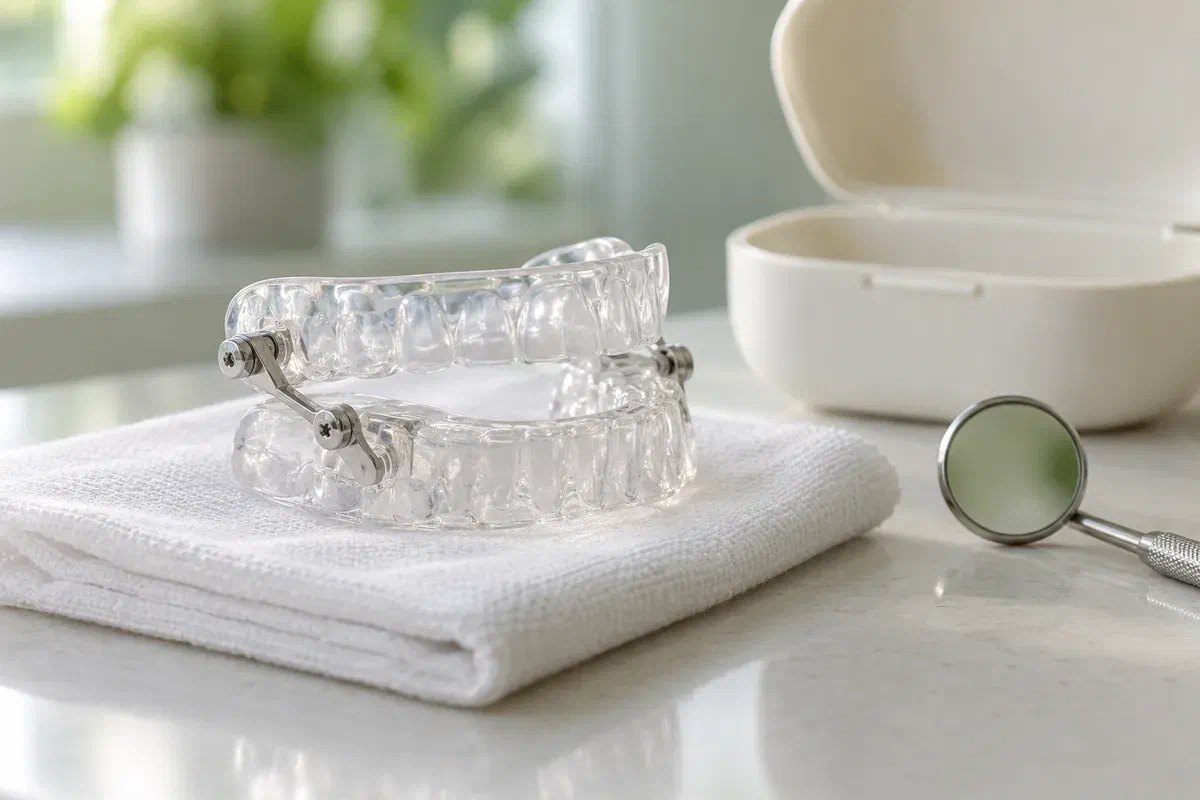
Illustrative intact sleep appliance beside a mirror and protective case before inspection
Problems that call for a pause

Loose, lost or broken: describe it, don’t test it

An appliance with a missing or loose part, a sharp edge or an uncertain fit should stay out of your mouth until your treating provider has advised you. Wearing it again to see what happens can create new risks and blur the cause.

A crack or section that has separated

Keep any separated pieces with the device rather than bonding them. Tell us whether the break came from a fall or appeared with normal wear. A crack near a connector can be what loosened the part in the first place, so location and construction matter more than size.

A screw, band, pin or hinge that is loose or gone

Don’t replace it with a household screw, a hair tie or a part ordered online. Identify which component is affected and whether it is still missing. If there is any chance it was swallowed or inhaled, get medical advice first, and treat the appliance question as secondary.

A fit that feels different around the missing part

With a connector gone, the trays may sit or move differently. Mention this, along with any heat exposure or recent dental treatment. Don’t try to compensate by forcing the device or reshaping it with hot water, because the clinician needs to see the change as it is.

Choking or difficulty breathing is an emergency: call 911. If you are breathing normally but think a part may have been swallowed or inhaled, get prompt medical advice and describe the component. Keep the rest of the appliance available so the missing piece can be identified.

Why replacing a part isn’t just a swap

Small components set the jaw position your treatment relies on.

A replacement screw or band might look right while setting the jaw in a different position from the one prescribed, or wearing unevenly against the trays. An assessment looks at the design, the material, the affected area and your mouth as it is now. Ask what any proposed repair would address and how its effect will be checked.

Until the device is usable again, your treatment is interrupted. Tell your sleep physician, who can advise on an interim plan. Don’t assume a sports guard, an older mouthpiece or a product sold online will do the same job in the meantime.

Finding the right component for your design

Compatible parts often come through the original provider, manufacturer or lab. Bring any documentation and say where the appliance came from. Without a brand name, the answer is to gather details, not to fit something that happens to look similar.

Asking why the part came loose

Mention whether the component had loosened before, whether there were pressure points, and whether you have had recent dental work. A part that keeps working free may signal a wider issue, and your mouth or treatment plan might need review.

Getting the details before saying yes

Ask for the scope of the repair, a sense of the time apart from your appliance, the expected fee and any lab step. A careful estimate separates what is known from what waits on inspection or a reply from another office.

How we work through it

Safety first, then the device, then a plan

Bring the appliance, any recovered parts and your records. Please don’t force the device in to show us how it behaves without the missing piece. Part of the visit is deciding which questions we can settle here and which belong with the maker.

  1. Confirm what is missing and how you are

    Tell us which part is gone, when you noticed, and whether medical advice was sought. Share the supplier’s details, your sleep-care plan, recent dental work and any previous repairs or home adjustments.

  2. Inspect the appliance and your mouth

    The clinician reviews the device along with your teeth, gums and bite. This shows whether the problem is limited to the lost component or affects the fit and condition more broadly. Information from the original supplier may be required before a repair is recommended.

  3. Choose repair, a replacement review or referral

    Go over the options the findings support, including any lab work. Ask what happens in what order, what it may cost where known, and who will keep you posted. While you can’t wear the device, involve your sleep physician in an interim plan.

  4. Verify the repaired device before reuse

    With the part replaced, the clinician seats the appliance and checks that it fits and moves as designed. Find out if the setting your physician prescribed was restored and if anything about nightly wear is different now. Follow-up may still be needed, since a repaired device isn’t proof that treatment is as effective as before.

Until your assessment

Secure what’s left and stay in touch with your physician.

An exact description of the missing part is far more useful than a substitute. Hold on to the appliance just as it is, and let your provider tell you whether it can be worn.

Keep the device and any found parts in a case

Choose a sturdy container and store it out of reach of children and pets. Avoid bending the trays, trimming anything or fitting it repeatedly. If the part is still missing, say so clearly when you call.

Leave out improvised hardware and home fixes

Household screws, elastics, glue and hot water can change the fit or damage the material, and they make assessment harder. If something was already tried, tell us exactly what, so the clinician can account for it.

Plan for the nights without treatment

Call the medical sleep provider when your prescribed appliance can’t be worn safely and ask what to do in the interim. Don’t change PAP settings without advice, stop another prescribed therapy, or assume a spare appliance is suitable because it fits.

Patient information: NHLBI — keeping sleep-apnea treatment and provider follow-up connected

Options once the damage is understood

Each route depends on the part, the design and your mouth

Ask what each approach is expected to achieve and what is still uncertain. The quickest replacement part may not be appropriate if the appliance can’t regain the right fit or the reason it came loose is unresolved.

When a compatible component and sound device are available

Repairing the appliance with a suitable part

Repair may be possible when the right parts, materials and expertise exist and the rest of the appliance is in good shape. Find out if the work goes to a lab and how the device is reviewed when it comes back. Even a successful repair has a limited life, and routine reviews still apply.

When parts are unavailable or damage is extensive

Reviewing the need for a new device

Discontinued components, widespread damage, distortion or a changed mouth may lead to a replacement assessment. Ask why repair is unlikely to work and which records need to be updated. A replacement should follow your current treatment plan rather than copying an old fit or setting.

When part details or a medical review are needed

Contacting the supplier or sleep team

The original supplier may be the only reliable source for a matching component. Your physician may also want to review treatment while the device is out of use. Ask who will reach out to whom and how the decision will reach you.

Patient information: AADSM — device management and continued coordinated care

Missing parts and repair questions

Answers when a component has gone astray

Every appliance is built a little differently. A picture on your phone or a part meant for another model can’t answer these for you, so bring the device and tell us its story.

(905) 876-4488
What if I can’t find a part and think I might have swallowed it?
Treat it as a medical question first. If there is choking or trouble breathing, call 911. Otherwise, seek prompt medical advice and describe the missing part. Keep the rest of the appliance so the component can be identified.
Can I order a replacement screw or band for my appliance online?
It isn’t advisable. A part that looks similar may not match the design or the prescribed position. Bring the appliance for assessment, along with any supplier information, so a compatible component and appropriate repair route can be identified.
Is my sleep appliance still safe to wear without the missing piece?
Don’t wear it until you have advice. Without the component, the trays may not hold the intended position and other parts may loosen. Contact the treating provider and ask your sleep physician what to do in the meantime.
Why would a connector work loose on its own?
Possible reasons include normal wear, earlier damage, pressure from a changed bite or the design itself. The assessment looks at the appliance and your mouth together, so a recurring problem can be identified rather than simply replacing the part again.
Does a replaced component change how my treatment works?
It might, which is why a clinical fit and position review is needed before you resume use. Ask whether instructions have changed, and whether your sleep physician should review treatment after the interruption.
How should I plan a visit from Mississauga for a missing-part repair?
Call first and tell us which part is missing. We can explain how an assessment is arranged and whether to bring supplier details. Pack the appliance and any found components in a case so nothing goes astray on the way.
Repair assessments for Mississauga

Missing a part? Let’s find the right next step.

Get in touch with Milton Dental Clinic and tell us your appliance type, which part is missing or loose, and whether you’ve stopped wearing it. We can explain how assessment is arranged and whether details from the original provider are needed.

Whether a matching part can be fitted, and how long and how costly that is, depends on an examination and on what the supplier or lab can provide.

Visit Milton Dental Clinic
Unit 1, 342 Bronte St. S, Milton, ON L9T 5B7
Get directions Clinic hours
Monday–Thursday
11am–7pm
Friday–Sunday
By appointment only

Areas we serve

  • Milton
  • Oakville
  • Mississauga
  • Georgetown
  • Halton Hills
  • Acton
  • Campbellville
  • Brampton
  • Burlington
  • Puslinch
  • Rockwood
  • Erin
  • Caledon
  • Etobicoke
  • Old Milton
  • Bronte Meadows
  • Timberlea
  • Dorset Park
  • Dempsey
  • Clarke
  • Beaty
  • Coates
  • Harrison
  • Scott
  • Willmott
  • Ford
  • Bowes
  • Cobden
  • Walker
  • Mountain View
  • Milton Heights
  • Hawthorne Village
  • Valley View
  • Fallingbrook
  • Nassagaweya
  • Trafalgar
  • Esquesing
  • Nelson
  • Brookville
  • Moffat
  • Glen Williams
  • Norval
  • Limehouse
  • Stewarttown
  • Ashgrove
  • Hornby
  • Silver Creek
  • Speyside
  • Scotch Block
  • North Oakville
  • River Oaks
  • Glen Abbey
  • West Oak Trails
  • Palermo
  • Bronte Creek
  • College Park
  • Joshua Creek
  • Uptown Core
  • Preserve
  • Iroquois Ridge
  • Lisgar
  • Meadowvale
  • Meadowvale Village
  • Churchill Meadows
  • Erin Mills
  • Central Erin Mills
  • Streetsville
  • East Credit
  • Creditview
  • Heartland
  • Sheridan
  • Mount Pleasant
  • Credit Valley
  • Huttonville
  • Churchville
  • Springbrook
  • Northwest Brampton
  • Bram West
  • Fletcher's Meadow
  • Fletcher's Creek South
  • Alton Village
  • Orchard
  • Millcroft
  • Headon Forest
  • Tansley
  • Brant Hills
  • Tyandaga
  • Kilbride
  • Lowville
  • Aberfoyle
  • Morriston
  • Arkell
  • Hillsburgh
  • Freelton
  • Carlisle
  • Waterdown
  • Flamborough
  • Mountsberg

How can we help?

Milton Dental Clinic

Have a question about your smile? Choose the option that works best for you.

For urgent dental concerns, please call.
Messages are reviewed during clinic hours.