

Illustrative conversation about snoring and oral-appliance suitability
Specialized Care

Snoring Appliances in Caledon

Weighing a dental snoring appliance against other choices? For adults in Bolton and across Caledon, we set out the questions that decide it: what the snoring means medically, what your mouth can support, and what each path asks of you.

Making a decision you can stand behind

Three questions settle most of it.

What is causing the snoring? Can your mouth support a device? And would you realistically wear one most nights? Those three questions sit behind nearly every good decision about a snoring appliance, and they need answering in that order.

The first belongs to a physician. Snoring can accompany obstructive sleep apnea, and no dentist, recording, or online quiz can rule that out. The second is ours: a custom oral appliance usually holds the lower jaw slightly forward overnight, which depends on healthy teeth, gums, and jaw joints. That design is not the same as a grinding or sports guard.

The third is yours. Coming from Caledon, you may also be weighing how many appointments are involved and how a device fits into busy or rural routines. We will lay out what each option asks of you so that whatever you choose, it is based on the findings rather than on a product description.

Work through the decision with our team
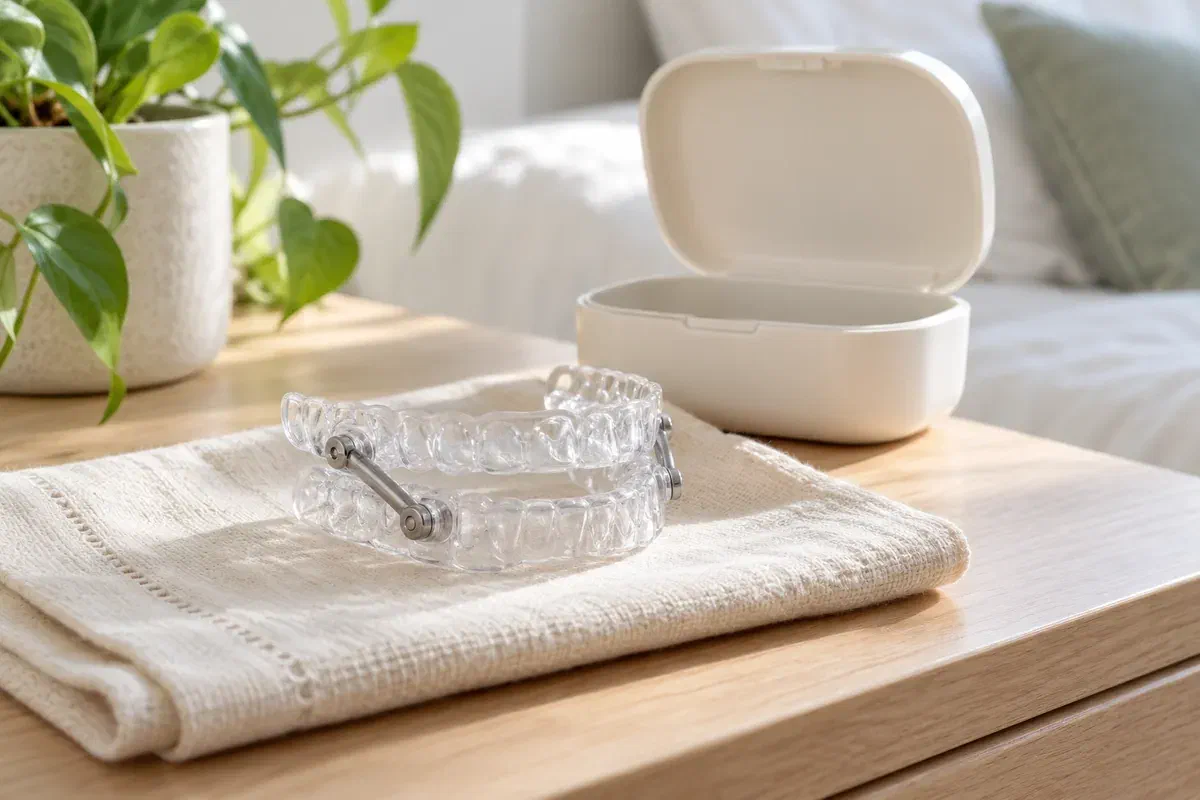
Illustrative custom mandibular advancement appliance beside its protective case
Factors that tip the balance

Some details point toward medical care first.

You do not need to have the answers before you arrive. What you share about your nights, your days, and your teeth helps show which option deserves a closer look, and in what order.

Witnessed pauses, gasping, or fighting sleep by day

These are signs to discuss with your doctor, who can decide whether a sleep evaluation is needed. Choosing a mouthpiece does not replace that step. Mention if drowsiness has affected driving or work that requires full alertness, and whether the pattern is new.

Oral health that may limit the choices

Gum disease, teeth that move or ache, missing teeth, recent restorations, and jaw pain or clicking can narrow or delay the options. Some issues simply change the design; others mean treatment should come first. Fitting over the teeth does not prove a device suits them.

What you learned from earlier attempts

If you have tried a mouthpiece, nasal strips, or other approaches, tell us what happened, and bring any device. That history helps weigh the options. It does not prove that every appliance will fail, nor that a new one will work.

We assess adults for these devices. Snoring in a child calls for a medical evaluation first; an appliance intended for adults is not the place to start.

If an appliance comes out ahead

The details that make it the right choice, not just a choice

Where an appliance is suitable, you should be able to explain to someone else why it was chosen: the purpose, why this design fits your teeth and bite, what it is expected to do, and its limits. A complete plan also covers comfort, handling, side effects to watch for, and the review schedule.

Compare it honestly with your daily life. How comfortable are you wearing something in your mouth all night? Will cleaning it be easy? What happens on nights away, or if you need to remove it quickly? These questions carry real weight in the decision, alongside the diagnosis and our findings.

Patient information: AADSM — assessment, appliance management, and ongoing care

A purpose that fits the diagnosis

A device prescribed for simple snoring is followed differently from one used to treat sleep apnea, so be sure which applies to you. That decides who monitors the result and how. A custom appliance may suit you well, but it is not a catch-all remedy for snoring.

A fitting that confirms the choice

At fitting, the clinician checks the appliance in your mouth and shows you how to seat it, remove it, and care for it. Ask what you may adjust. Your early routine follows your written plan rather than general advice.

Reviews that keep the decision sound

Ask how jaw comfort, tooth soreness, and the way your teeth meet will be monitored, and when your physician will reassess your sleep. A choice that works at first still needs follow-up as the months go by.

How the decision gets made

Gather the facts, compare honestly, then commit.

Paperwork from a sleep clinic, the names of your medicines, and any device you have used are all helpful. Otherwise, come ready to describe the problem; you are not expected to know which option you want.

  1. Understand the snoring and the medical side

    We ask how often you snore, what it affects, and about other symptoms and any testing. If a medical evaluation has not been done, we explain why it comes first and what records would help. Screening raises flags; diagnosis is up to your physician.

  2. Find out what your mouth can support

    The clinician examines your teeth, gums, crowns and fillings, how your bite closes, and how your jaw moves. Ask what the findings mean for each option. Treatment, further assessment, or coordination with another provider may need to come first.

  3. Lay the options side by side

    Discuss what an appliance could offer, its limits, and how it compares with other approaches for your diagnosis. For each one, find out what it costs, how many visits it takes, and what follow-up looks like. If you choose a device, the records and stages are explained; it is not delivered on the first day.

  4. Fit the chosen device and plan its reviews

    We seat the finished appliance, confirm it fits as planned, and send you home with written guidance on handling, cleaning, and starting use. You will know whom to call with soreness or difficulties. Review dates are set before you leave, and, where sleep apnea is involved, so is the plan for your physician to check the result.

Living with the decision

A good choice still needs looking after.

You should leave the fitting with your instructions on paper and our phone number at hand, because the first weeks are when most questions come up. Discomfort deserves a phone call, and advancing the jaw beyond your prescription is unlikely to help.

Handle the device the way you practised

Rehearse insertion and removal at fitting until it feels natural, and keep the instructions somewhere you will actually look. Only make adjustments your plan names. If handling stays difficult after a week or two, that is worth a call; clamping down to seat it or bending a clasp can damage the device or strain a tooth.

Tell us early about aches or bite changes

Note which tooth or side is affected, what time of day it bothers you, and whether you have started leaving the appliance out because of it. We can assess both the device and the teeth it rests on, often at the same appointment. Do not reshape it yourself, and stop using an appliance that is cracked or loose.

Revisit the decision with evidence

At reviews, describe any change in snoring and daytime energy, and how consistently you have worn the appliance. Keep your medical appointments too. A partner’s report helps, but it is not a substitute for evaluating sleep-apnea treatment.

The choices, side by side, for Caledon adults

Compare what each path involves.

Each route below has its own demands on your time, your routine, and your follow-up, so it helps to see them together before deciding. Weigh the assessment findings, what you are willing to commit to, and any sleep condition that needs its own medical care.

If the diagnosis and dental findings favour it

A custom oral appliance

A fitted device with planned reviews may suit some adults. Ask why the design fits your mouth, what it asks of you each night, and which problems mean an early visit. Expect a realistic picture, not a promise of silent nights.

If the cause may be nasal, medical, or habit-related

Medical care for contributing factors

Your doctor can look at congestion, general health, medicines, and lifestyle, and suggest care. Keep prescribed treatment going unless advised otherwise. For some people, this route makes a device unnecessary.

If a sleep disorder has been diagnosed

Sleep-apnea treatment directed by a physician

Options may include PAP, an oral device, or other medical treatment, depending on testing. Your physician decides how effectiveness is confirmed. We contribute the dental side, so the choice reflects what your teeth and jaw can support.

Patient information: NHLBI — medical treatment options for sleep apnea

Caledon questions when comparing options

Before you pick a path for your snoring

Appliances that look alike can do different jobs. Ask about the specific device being proposed and how it compares with the alternatives in your plan.

(905) 876-4488
How do I decide between an oral appliance and PAP?
That decision depends on your diagnosis and is made with your physician. They weigh severity, your health, and your experience with treatment. The dental exam then shows whether your mouth can support a device.
What questions should I ask about cost before deciding?
Ask what the assessment, records, device, fitting, and reviews involve, and whether any dental treatment is needed first. Costs vary by situation, so request an explanation for your plan before committing.
Can lifestyle changes help instead of an appliance?
Your physician can discuss whether factors such as weight, alcohol, sleep position, or medicines may be contributing in your case. A dental appliance does not address those. Ask your doctor what is relevant to you.
Is a snoring appliance really different from a sports mouth guard?
Yes. A sports guard protects the teeth during activity, while a snoring appliance is designed to hold the lower jaw in a planned position overnight. Do not assume any guard you own treats snoring.
What if my teeth are not ready for a device right now?
We explain what needs attention, such as gum health or a tooth that needs repair, and whether an appliance could be reconsidered afterward. Your physician can discuss other options in the meantime.
Once I choose an appliance, how do I know it was the right call?
Follow-up answers that. Your physician may recommend testing where sleep apnea is involved, and dental reviews check the fit, your teeth, and your jaw. Less noise alone does not confirm the result.
Book from Caledon

Get the facts in front of you before choosing.

Contact Milton Dental Clinic to talk through your snoring and the dental side of an appliance decision. Tell us about any sleep testing, current treatment, or devices you have tried, so the first visit focuses on what will help you decide.

Choosing an appliance follows medical evaluation and an individual dental examination.

Visit Milton Dental Clinic
Unit 1, 342 Bronte St. S, Milton, ON L9T 5B7
Get directions Clinic hours
Monday–Thursday
11am–7pm
Friday–Sunday
By appointment only

Areas we serve

  • Milton
  • Oakville
  • Mississauga
  • Georgetown
  • Halton Hills
  • Acton
  • Campbellville
  • Brampton
  • Burlington
  • Puslinch
  • Rockwood
  • Erin
  • Caledon
  • Etobicoke
  • Old Milton
  • Bronte Meadows
  • Timberlea
  • Dorset Park
  • Dempsey
  • Clarke
  • Beaty
  • Coates
  • Harrison
  • Scott
  • Willmott
  • Ford
  • Bowes
  • Cobden
  • Walker
  • Mountain View
  • Milton Heights
  • Hawthorne Village
  • Valley View
  • Fallingbrook
  • Nassagaweya
  • Trafalgar
  • Esquesing
  • Nelson
  • Brookville
  • Moffat
  • Glen Williams
  • Norval
  • Limehouse
  • Stewarttown
  • Ashgrove
  • Hornby
  • Silver Creek
  • Speyside
  • Scotch Block
  • North Oakville
  • River Oaks
  • Glen Abbey
  • West Oak Trails
  • Palermo
  • Bronte Creek
  • College Park
  • Joshua Creek
  • Uptown Core
  • Preserve
  • Iroquois Ridge
  • Lisgar
  • Meadowvale
  • Meadowvale Village
  • Churchill Meadows
  • Erin Mills
  • Central Erin Mills
  • Streetsville
  • East Credit
  • Creditview
  • Heartland
  • Sheridan
  • Mount Pleasant
  • Credit Valley
  • Huttonville
  • Churchville
  • Springbrook
  • Northwest Brampton
  • Bram West
  • Fletcher's Meadow
  • Fletcher's Creek South
  • Alton Village
  • Orchard
  • Millcroft
  • Headon Forest
  • Tansley
  • Brant Hills
  • Tyandaga
  • Kilbride
  • Lowville
  • Aberfoyle
  • Morriston
  • Arkell
  • Hillsburgh
  • Freelton
  • Carlisle
  • Waterdown
  • Flamborough
  • Mountsberg

How can we help?

Milton Dental Clinic

Have a question about your smile? Choose the option that works best for you.

For urgent dental concerns, please call.
Messages are reviewed during clinic hours.