

Illustrative conversation about snoring and oral-appliance suitability
Specialized Care

Snoring Appliances in Campbellville

A snoring appliance is usually worn night after night for the long term. For adults in Campbellville, it helps to understand that commitment up front: the medical check, the dental exam, the side effects to watch for, and the reviews ahead.

Thinking beyond the first night

What does wearing one for years actually involve?

People often picture a snoring appliance as a quick fix: fitted once, worn, forgotten. In practice, a custom device is something many adults wear every night for a long time, with regular check-ups. Knowing that before you begin makes it easier to decide whether it suits your life.

The usual design holds the lower jaw a little forward while you sleep. Over months and years, that steady position can bring side effects worth monitoring, such as jaw tenderness or a gradual change in how the teeth meet. It is also why the device differs from a sports or grinding guard, which serve other purposes.

Before any of that, a physician should look at the snoring, since it can accompany obstructive sleep apnea. From Campbellville, households often prefer to group appointments, so we can map out the likely sequence early. Our examination then shows whether your teeth and jaw are suited to long-term appliance use.

Learn what long-term appliance use involves
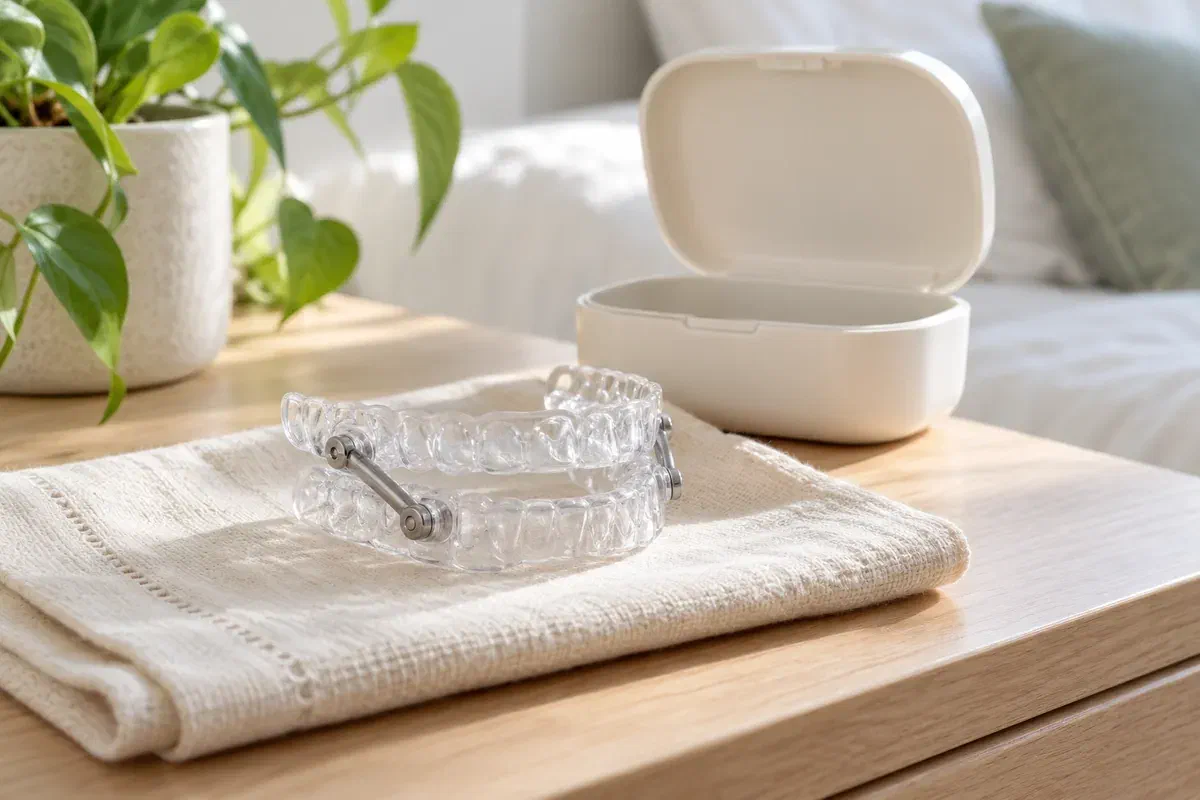
Illustrative custom mandibular advancement appliance beside its protective case
Worth raising at the start

A few details decide whether a long-term device makes sense.

You are not expected to have a diagnosis. Sharing what has been happening helps us see whether a physician should be involved first and whether your mouth can handle nightly wear.

Breathing pauses, gasping, or heavy daytime fatigue

These signs call for a talk with your doctor about a sleep evaluation, and a mouthpiece is no substitute for that. Mention whether they are new or worsening. If tiredness affects your driving or other activities that need full alertness, say so clearly.

Jaw joints, gums, and existing dental work

A history of jaw pain or clicking, gum problems, loose or missing teeth, and recent crowns or fillings all matter for nightly wear over years. They may change the design, suggest treatment first, or make a device unsuitable. Fitting over the teeth is not the same as being right for them.

Previous devices and why they were set aside

Bring any mouthpiece you have tried and explain how it came to you, how long you wore it, and why you stopped. This is helpful context. It neither rules out every appliance nor promises that a different one will be comfortable for years.

This information concerns adults. A child who snores should have a medical assessment; an adult anti-snoring mouthpiece is not an alternative to that.

Planning for the long run

A design you can live with, and a review plan you can keep

For a device you may wear for years, planning matters. You should understand why a particular design suits your teeth, what it is meant to do, and where its limits lie. The discussion should also cover comfort, cleaning, side effects that may develop slowly, and how often you will be seen.

Think about your routine as it really is. Early mornings around the property, frequent overnight trips, or a concern about removing the device quickly are all worth raising. These details belong in the planning conversation, weighed with the diagnosis and our findings, so the plan suits your life.

Patient information: AADSM — assessment, appliance management, and ongoing care

An agreed purpose

Your plan should say whether the device is for diagnosed primary snoring or part of sleep-apnea care. That affects who monitors the response and how. A custom appliance can play a role for the right person, but snoring has many possible causes, and no single device should be sold as the answer to all of them.

A fitting that sets good habits

At fitting, the clinician checks the appliance in your mouth and teaches you to insert, remove, and clean it properly from the start. Ask which adjustments are allowed. Good habits early make long-term use easier, so follow your own written plan.

Reviews that catch slow changes

Ask how gradual changes in your bite, jaw comfort, and the condition of the device will be monitored over the years, and when your physician will want to look at the effect on your sleep again. Check-ups keep their value long after the appliance has become an ordinary part of bedtime.

The path, visit by visit

Plan the visits now, rather than discovering them later

Sleep reports, a medicine list, and any old mouthpiece are useful to bring. If you have none of these, a description of the problem is a fine starting point; you need not have chosen a device.

  1. Discuss sleep, symptoms, and the medical step

    We talk about the snoring, how you feel during the day, and any testing or advice so far. If a medical evaluation is still needed, we explain why it comes first and what records help. Screening questions can raise concerns but cannot diagnose a sleep disorder.

  2. Examine your suitability for nightly wear

    The clinician looks at teeth, gum support, existing restorations, the way your teeth come together, and how the jaw moves. Ask what each finding means for long-term use. Some situations call for treatment, more assessment, or another provider’s input first.

  3. Decide with the long term in mind

    Discuss the expected benefit, limits, and alternatives in light of your diagnosis, including what years of nightly wear might mean. Ask about costs, visit numbers, and follow-up, and whether appointments can be grouped. If you proceed, the records and stages are explained.

  4. Fit the device and book the first reviews

    The appliance is checked in your mouth and you leave with written instructions on handling, cleaning, and your starting plan. Ask how to report soreness. We agree on review dates and how your physician will assess the response over time.

Month by month

Small changes over time are easier to manage when caught early.

You should have written instructions and a clear way to reach us from the first night. Discomfort is worth reporting, and moving the jaw further than prescribed will not necessarily help.

Keep to the routine you were taught

Practise handling the appliance at fitting and keep the instructions in a familiar place. Make only the adjustments your plan allows. If it becomes difficult to handle, ask us instead of biting it into position or bending a component.

Notice gradual shifts

If your teeth start to meet differently in the morning, or a jaw ache lingers, tell us which area and when it happens. Caught early, these changes are easier to assess and manage. Leave any reshaping to us, and set the device aside if it is cracked or has started to fit loosely.

Keep the reviews on the calendar

Tell us how the snoring and your daytime energy have changed and whether you have been wearing the device consistently. Attend your dental and medical follow-ups. A partner’s observations help, but they do not replace evaluation of sleep-apnea treatment.

Options from Campbellville

Long-term device, medical care, or a mix

Ask what may be contributing to your snoring and which approaches suit you, now and over the years. Good advice weighs what the examinations found, how you live, and whether a sleep disorder needs its own treatment from a physician.

When the diagnosis and dental findings support it

A custom appliance for nightly use

A fitted device with an ongoing review schedule may be one option. Ask why the design suits you, how long it might last, and which changes mean a sooner visit. Expect an honest explanation, with no promise of silence and no assumption that one design fits everyone.

When health or lifestyle may play a part

Medical attention to contributing factors

Your doctor can assess nasal issues, general health, medicines, and lifestyle and recommend care. Keep any prescribed treatment unless advised otherwise. If those factors turn out to be central, a long-term device may not be needed.

When a sleep disorder has been diagnosed

Physician-directed sleep-apnea care

Depending on testing, care may include PAP, an oral appliance, or other medical treatment. We provide the dental findings that affect those options and monitor the mouth if a device is used. Your physician continues to oversee how well treatment is working.

Patient information: NHLBI — medical treatment options for sleep apnea

Long-term questions from Campbellville

What to expect after the first year

Appliances that look similar can have very different purposes. Ask about the device being proposed for you and how it fits within your assessment and long-term plan.

(905) 876-4488
How long does a custom snoring appliance usually last?
It varies with the design, how it is cared for, and changes in your mouth. Wear, cracks, or a looser fit are signs it should be checked. Ask about expected lifespan and replacement at your planning visit.
Is it normal for my bite to feel different in the morning?
Some people notice their teeth meet differently for a short time after removing the appliance. Mention it at your review, especially if it lasts longer or seems to be changing. The clinician can assess it rather than you trying to correct it.
Can I group my snoring-appliance visits with other dental appointments?
Often, yes. Tell us when booking and we will try to coordinate reviews with checkups or cleanings where the timing makes sense. Medical appointments are arranged separately with your physician.
Will I need to wear the appliance every night?
Your plan will say how and when to wear it. A device generally helps only when it is in use. If you are skipping nights, tell us and your physician, so the plan can be reviewed rather than abandoned.
Why does the appliance move my lower jaw forward?
A mandibular advancement design holds the jaw in a planned position to help keep the upper airway from narrowing during sleep. The position is set through assessment and instructions. More forward is not automatically better.
Should my sleep apnea be retested once I am used to the device?
Your physician decides that. Snoring less does not confirm sleep apnea is controlled, so testing may be recommended. Dental reviews continue alongside to check your teeth, jaw, and the appliance.
Book from Campbellville

Start with a plan you can see the whole length of.

Contact Milton Dental Clinic to discuss snoring and the dental assessment for an appliance. Tell us about earlier sleep tests, current treatment, or a mouthpiece you have tried, and mention if you would like to group appointments.

Long-term appliance use begins with medical evaluation and an individual dental exam.

Visit Milton Dental Clinic
Unit 1, 342 Bronte St. S, Milton, ON L9T 5B7
Get directions Clinic hours
Monday–Thursday
11am–7pm
Friday–Sunday
By appointment only

Areas we serve

  • Milton
  • Oakville
  • Mississauga
  • Georgetown
  • Halton Hills
  • Acton
  • Campbellville
  • Brampton
  • Burlington
  • Puslinch
  • Rockwood
  • Erin
  • Caledon
  • Etobicoke
  • Old Milton
  • Bronte Meadows
  • Timberlea
  • Dorset Park
  • Dempsey
  • Clarke
  • Beaty
  • Coates
  • Harrison
  • Scott
  • Willmott
  • Ford
  • Bowes
  • Cobden
  • Walker
  • Mountain View
  • Milton Heights
  • Hawthorne Village
  • Valley View
  • Fallingbrook
  • Nassagaweya
  • Trafalgar
  • Esquesing
  • Nelson
  • Brookville
  • Moffat
  • Glen Williams
  • Norval
  • Limehouse
  • Stewarttown
  • Ashgrove
  • Hornby
  • Silver Creek
  • Speyside
  • Scotch Block
  • North Oakville
  • River Oaks
  • Glen Abbey
  • West Oak Trails
  • Palermo
  • Bronte Creek
  • College Park
  • Joshua Creek
  • Uptown Core
  • Preserve
  • Iroquois Ridge
  • Lisgar
  • Meadowvale
  • Meadowvale Village
  • Churchill Meadows
  • Erin Mills
  • Central Erin Mills
  • Streetsville
  • East Credit
  • Creditview
  • Heartland
  • Sheridan
  • Mount Pleasant
  • Credit Valley
  • Huttonville
  • Churchville
  • Springbrook
  • Northwest Brampton
  • Bram West
  • Fletcher's Meadow
  • Fletcher's Creek South
  • Alton Village
  • Orchard
  • Millcroft
  • Headon Forest
  • Tansley
  • Brant Hills
  • Tyandaga
  • Kilbride
  • Lowville
  • Aberfoyle
  • Morriston
  • Arkell
  • Hillsburgh
  • Freelton
  • Carlisle
  • Waterdown
  • Flamborough
  • Mountsberg

How can we help?

Milton Dental Clinic

Have a question about your smile? Choose the option that works best for you.

For urgent dental concerns, please call.
Messages are reviewed during clinic hours.