

Illustrative conversation about snoring and oral-appliance suitability
Specialized Care

Snoring Appliances in Erin

Often it is the person lying awake who first looks into snoring help. For couples in Erin and Hillsburgh, we explain what a partner’s observations mean, why a doctor sees the snorer first, and when a custom appliance may fit.

For the one who hears it

You might be reading this at 3 a.m.

Partners are often the first to go searching for answers. You hear the snoring, and perhaps something else: a long silence, then a snort or gasp. What you notice is genuinely valuable, because the person snoring usually has no idea it is happening. It is also a reason for them to see a doctor before anyone shops for a mouthpiece.

Those pauses can be a sign of obstructive sleep apnea, a medical condition that a physician needs to evaluate. Simple snoring and sleep apnea can sound alike, so neither of you can sort it out by listening. Once the diagnosis is clear, a custom oral appliance that keeps the lower jaw slightly forward may be one option for some adults.

With rural households in Erin often juggling farm hours, school runs, and commuting, it helps to plan this together. Encourage the medical step first. Then come in as a pair if you like: you can describe what you have seen, and we can examine whether the snorer’s teeth and jaw could support a device.

Help your partner take the next step
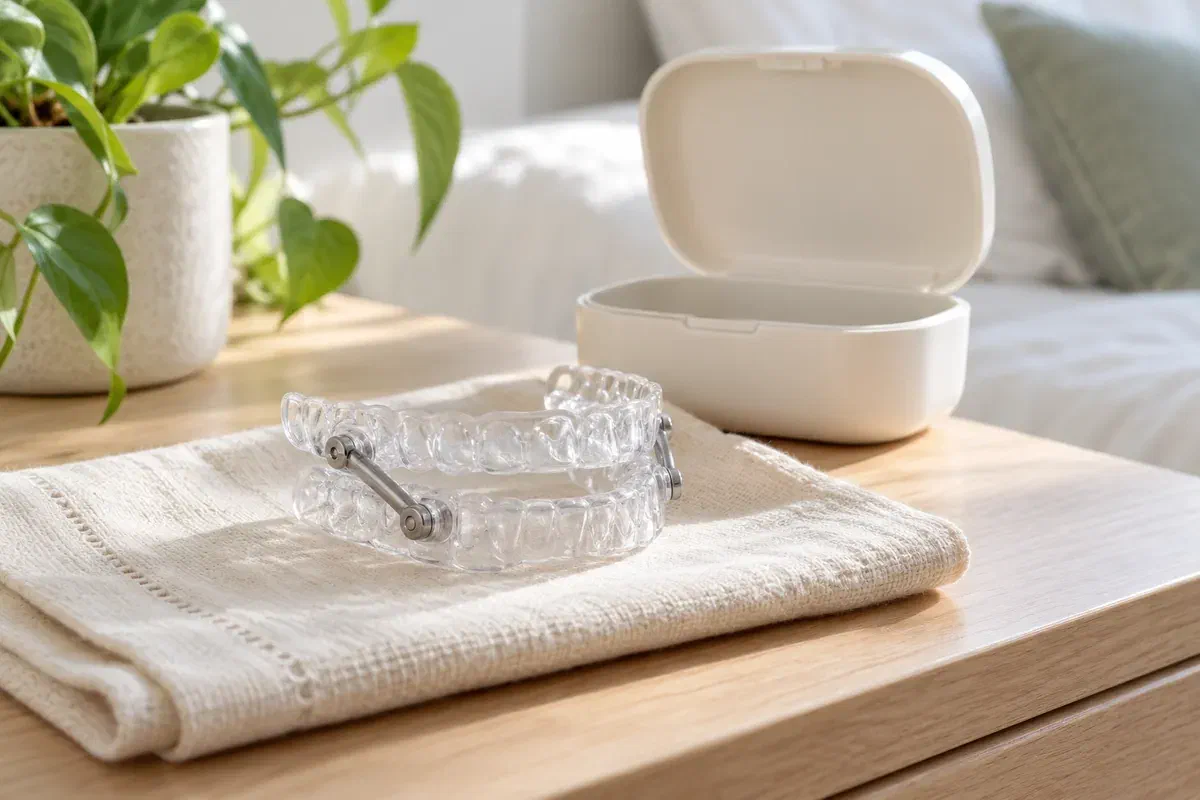
Illustrative custom mandibular advancement appliance beside its protective case
What a partner can tell us

Your observations, and theirs, both count.

Neither of you is expected to make a diagnosis. Between your account of the nights and theirs of the days, we can see whether a physician should be involved before an appliance is discussed.

Silences, gasps, or a partner who cannot stay awake

If you notice breathing pauses or choking sounds, or your partner nods off during the day, they should speak with a doctor about a sleep evaluation. A mouthpiece is not a shortcut. Mention whether sleepiness affects driving, which matters a great deal in a household where most errands mean getting behind the wheel.

Their teeth, gums, and jaw

The person who would wear the device should tell us about loose or painful teeth, gum trouble, gaps, recent crowns or fillings, and jaw pain or clicking. These shape whether an appliance is suitable and which design might work, and some may need treatment first.

That boil-and-bite guard in the bathroom

If a store-bought mouthpiece has already been tried, bring it. Explain how long it was worn and what happened. It is useful information, though it does not prove that all appliances fail or that a custom one is guaranteed to succeed.

This page concerns adults. If one of your children snores, the right first step is a medical evaluation for them, not a grown-up’s device trimmed down or borrowed from a parent.

What a considered plan gives you both

A device chosen for the snorer, with rest for the household in mind

If an appliance is appropriate, the plan should explain the design, why it suits the wearer’s teeth and bite, what it should accomplish, and its limitations. It should also describe comfort, handling, side effects to watch for, and the schedule of reviews. Both of you can ask questions.

Household realities belong in the plan too. Early chores, a toddler who wakes at night, a dog that needs letting out, or a wearer who struggles with fiddly objects can all influence which design makes sense. Raise them while the plan is being made, alongside the diagnosis and our dental findings.

Patient information: AADSM — assessment, appliance management, and ongoing care

One clearly stated aim

Find out whether the appliance is for diagnosed primary snoring or part of treatment for sleep apnea. That shapes who follows up and how. A custom appliance can help in the right situation, but it should never be presented as ending every kind of snoring.

A fitting where the wearer learns the routine

At fitting, the clinician checks the appliance in the wearer’s mouth and shows how to put it in, take it out, and keep it clean. Ask what may be adjusted at home. The starting routine should come from that written plan.

Follow-up that looks past the quiet

Ask how jaw comfort, sore teeth, and any change in the way the teeth meet will be watched, and when the physician should look at the response again. Keep coming to reviews even when nights seem peaceful.

Planning visits from a rural household

Group the appointments, and do the medical step first.

If the snorer has had a sleep study, bring the report, along with the names of any medicines and whatever mouthpiece has already been tried. Without these, a description of the nights from both of you is a perfectly good start, and nobody needs to have settled on a device.

  1. Hear from the wearer and, if helpful, the partner

    We ask about snoring, pauses, daytime sleepiness, and any testing so far. If a medical evaluation has not been done, we explain why it should come before a device. Our conversation can raise concerns, but diagnosis belongs with a physician or sleep-care provider.

  2. Examine the wearer’s mouth

    The clinician looks at the teeth, gums, existing dental work, bite, and how the jaw opens and moves. You will hear what each finding means. If treatment or another opinion is needed first, we can try to plan it alongside other visits to save trips.

  3. Decide together

    Talk through the likely benefit, limits, and alternatives for the diagnosis, and what wearing a device every night involves for the household. Ask about cost and visit numbers. If you go ahead, we explain the records and stages; a device is not handed over at the first visit.

  4. Fit, practise, and plan reviews

    The appliance is checked in the mouth, and the wearer practises handling and cleaning it with written instructions to take home. Ask whom to call about soreness. We agree review dates and how the physician will assess the response where needed.

The first few weeks at home

Speak up early, whichever side of the bed you sleep on.

The wearer should have written instructions and know how to reach us. Discomfort is a reason to call, and moving the jaw further than prescribed is not a way to speed things up.

Keep handling simple and correct

Practise inserting and removing the appliance at fitting and keep the instructions in sight. Make only adjustments the plan permits. If it is still awkward, call us instead of biting it into position or bending a piece.

Watch for soreness or a changed bite

If the wearer has an aching jaw or sore teeth, or their bite feels different, note where and when and let us know. Please avoid home modifications, and stop wearing a device that is damaged or loose.

Keep noticing, both of you

Partners, keep watching for pauses or gasping even if the snoring has eased, and tell the physician. Wearers, keep your dental and medical appointments and be honest about nights you skipped. Quieter nights do not on their own confirm sleep-apnea treatment is working.

Options for households in Erin

Better nights can start in more than one place.

Ask what may be causing the snoring and which approaches suit the wearer and the household. Advice should reflect the assessment, your shared priorities, and any sleep condition that needs its own medical care.

When the diagnosis and dental exam support it

A custom snoring appliance

A fitted device with planned reviews may be one choice. Ask why the design suits the wearer and what should prompt an early visit. It should be explained honestly, with no promise of silence for the partner and no assumption that everyone tolerates one design.

When nose, health, or habits may be involved

Medical attention to other factors

A physician can look at congestion, general health, medicines, and sleep habits, and suggest care. Prescribed treatment should not be stopped without advice. If the main cause lies there, a dental device may not be needed.

When pauses turn out to be a sleep disorder

Treatment for diagnosed sleep apnea

Care may include PAP, an oral appliance, or other medical treatment, depending on testing. We report how the wearer’s teeth and jaw affect those choices. Because breathing during sleep is what matters, the physician continues to oversee the result.

Patient information: NHLBI — medical treatment options for sleep apnea

Questions couples in Erin ask

When snoring keeps two people awake

Mouthpieces that look similar can have very different purposes. Ask about the specific appliance being considered and how it fits within the medical and dental plan.

(905) 876-4488
Should I come to the appointment with my partner?
You are welcome to, if your partner agrees. A bed partner’s description of pauses, gasping, or restless sleep can be very helpful. The examination itself focuses on the person who would wear the device.
My partner stops breathing for a few seconds at night. What should we do?
Encourage them to see a doctor and describe what you have seen. Breathing pauses can be a sign of obstructive sleep apnea, which needs medical evaluation. A dental device should not be chosen before that assessment.
Can a store-bought mouthpiece hide a sleep problem?
Yes, it is possible for any device to reduce noise while a sleep condition continues. That is why the medical step matters, and why follow-up is needed even when nights sound quieter.
Will the appliance be uncomfortable for the person wearing it?
Some people notice jaw or tooth tenderness, especially at first, and changes in saliva are also reported. These should be mentioned at reviews rather than endured. The clinician can check the fit and the plan.
Can we plan the visits around farm or work schedules?
Tell us your constraints when booking. We can often group dental visits and explain the likely sequence early, though the number of appointments depends on the findings and any treatment needed first.
If the snoring is gone, can we skip the follow-up?
Please do not. Quiet nights do not confirm that sleep apnea is controlled, and the physician may recommend testing. Dental reviews also check the wearer’s teeth, jaw, and bite over time.
Book from Erin

One of you hears it. The other wears it. Start the conversation.

Call Milton Dental Clinic to talk about snoring and whether a custom appliance could suit the wearer. Let us know about earlier sleep tests, current treatment, or a mouthpiece already tried, and whether you would like to attend together.

An appliance is considered after medical evaluation and a careful dental examination of the wearer.

Visit Milton Dental Clinic
Unit 1, 342 Bronte St. S, Milton, ON L9T 5B7
Get directions Clinic hours
Monday–Thursday
11am–7pm
Friday–Sunday
By appointment only

Areas we serve

  • Milton
  • Oakville
  • Mississauga
  • Georgetown
  • Halton Hills
  • Acton
  • Campbellville
  • Brampton
  • Burlington
  • Puslinch
  • Rockwood
  • Erin
  • Caledon
  • Etobicoke
  • Old Milton
  • Bronte Meadows
  • Timberlea
  • Dorset Park
  • Dempsey
  • Clarke
  • Beaty
  • Coates
  • Harrison
  • Scott
  • Willmott
  • Ford
  • Bowes
  • Cobden
  • Walker
  • Mountain View
  • Milton Heights
  • Hawthorne Village
  • Valley View
  • Fallingbrook
  • Nassagaweya
  • Trafalgar
  • Esquesing
  • Nelson
  • Brookville
  • Moffat
  • Glen Williams
  • Norval
  • Limehouse
  • Stewarttown
  • Ashgrove
  • Hornby
  • Silver Creek
  • Speyside
  • Scotch Block
  • North Oakville
  • River Oaks
  • Glen Abbey
  • West Oak Trails
  • Palermo
  • Bronte Creek
  • College Park
  • Joshua Creek
  • Uptown Core
  • Preserve
  • Iroquois Ridge
  • Lisgar
  • Meadowvale
  • Meadowvale Village
  • Churchill Meadows
  • Erin Mills
  • Central Erin Mills
  • Streetsville
  • East Credit
  • Creditview
  • Heartland
  • Sheridan
  • Mount Pleasant
  • Credit Valley
  • Huttonville
  • Churchville
  • Springbrook
  • Northwest Brampton
  • Bram West
  • Fletcher's Meadow
  • Fletcher's Creek South
  • Alton Village
  • Orchard
  • Millcroft
  • Headon Forest
  • Tansley
  • Brant Hills
  • Tyandaga
  • Kilbride
  • Lowville
  • Aberfoyle
  • Morriston
  • Arkell
  • Hillsburgh
  • Freelton
  • Carlisle
  • Waterdown
  • Flamborough
  • Mountsberg

How can we help?

Milton Dental Clinic

Have a question about your smile? Choose the option that works best for you.

For urgent dental concerns, please call.
Messages are reviewed during clinic hours.