

Illustrative conversation about snoring and oral-appliance suitability
Specialized Care

Snoring Appliances in Puslinch

Early starts, nights away, a well-used bathroom sink: a snoring appliance has to suit real routines. Adults in Puslinch can talk with us about cleaning, storage and handling, after a doctor has looked at what the snoring means.

The everyday side of an appliance

A device you will handle every single night

Picture the routine: brushing your teeth, rinsing the appliance, slipping it in, and finding it in its case the next morning. Then picture doing that on a camping weekend, after a late shift, or with a head cold. Practicalities like these often decide whether a snoring device gets worn or ends up forgotten in a drawer.

They come second, though. Snoring can be a feature of obstructive sleep apnea, and only a physician’s evaluation can establish whether that applies to you. When the diagnosis supports it, a custom oral appliance that keeps the lower jaw slightly forward during sleep may be offered to some adults. A grinding or sports guard is a different device altogether.

For households in Puslinch, we like to talk about both sides early: the medical step, and how the device would fit around your days. We examine your teeth and jaw, explain whether an appliance looks suitable, and walk through what wearing, cleaning, and storing it would really involve.

Talk through the practical side of a snoring device
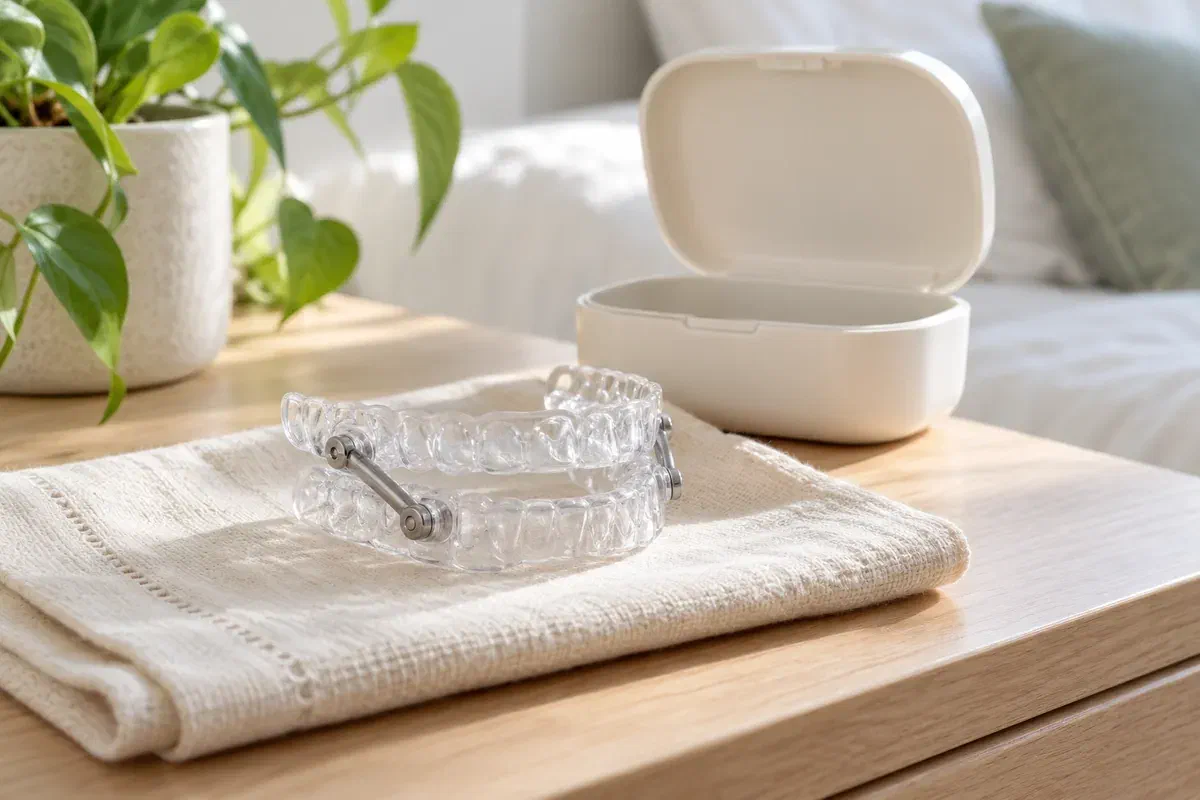
Illustrative custom mandibular advancement appliance beside its protective case
Things to mention first

Before routines, a few health questions

Nobody needs to arrive with a diagnosis. Telling us about your sleep, your days, and your teeth shows whether a physician should be involved before any device is planned.

Silences, gasps, or daytime drowsiness

Speak to your doctor about these and ask whether a sleep evaluation is appropriate. Do not use a mouthpiece to avoid that conversation. If sleepiness has affected driving, operating equipment, or other work needing full attention, mention it plainly and say whether it is getting worse.

Dental issues that could get in the way

Loose or tender teeth, bleeding gums, missing teeth, new crowns, and a jaw that clicks or aches can all affect whether a device is suitable and which design might work. Some need treatment first. A device sitting over your teeth is not proof it suits them.

A mouthpiece that did not fit your routine

If a previous guard was too fiddly, too hard to clean, or kept falling out, bring it and tell us about it. That experience shapes the conversation. It does not prove every appliance will be a struggle, and it does not guarantee a new one will be easy.

Our appliance assessments are for adults only. When a child in the household snores, book a medical evaluation for them rather than trying a device made for grown-ups.

Planning that includes daily life

Practical questions belong in the plan, not after it.

If an appliance is right for you, its design should rest on your examination and diagnosis. Ask what it is meant to achieve, why this style suits your mouth, and what it will not do. You should also hear how comfortable it is likely to be, how to look after it, which side effects to watch for, and when it will be reviewed.

Then bring in your life. Do you travel often, sleep at odd hours, or share a small bathroom? Are you worried about removing it quickly if you need to get up in the night? Those questions shape which design is workable and should be weighed alongside the medical and dental findings.

Patient information: AADSM — assessment, appliance management, and ongoing care

Knowing what the device is for

Find out whether the aim is diagnosed primary snoring or treatment within a sleep-apnea plan. That changes the follow-up and who is involved. An appliance can help in the right circumstances, but it should not be presented as a solution for all snoring.

Hands-on practice at fitting

The clinician checks the fit in your mouth and has you practise placing, removing, and cleaning the appliance before you leave. Ask what you are allowed to adjust. Your starting routine should come from your own written plan, not from someone else’s experience.

Reviews that check comfort and wear

Ask how jaw comfort, the way your teeth meet, and wear on the device itself will be monitored, and when your physician should assess the response. Follow-up stays important after the routine becomes automatic.

From first conversation to fitted device

What each appointment is for

Bring sleep reports, a list of medicines, and any mouthpiece you have tried. If you have none, describing your nights and your routine is enough. There is no need to have chosen a device.

  1. Conversation about sleep and daily routine

    We ask about the snoring, how you feel by day, any testing, and what your nights and mornings look like. If a medical evaluation has not happened, we explain why it should come first. Our questions help identify concerns but do not diagnose a sleep disorder.

  2. Dental and jaw examination

    Next comes a close look at the teeth that would hold a device, the health of the gums around them, any fillings or crowns, how your bite comes together, and how freely your jaw moves. Some findings mean treatment or further assessment should come before an appliance.

  3. A decision that accounts for your routine

    Compare the possible benefit and limits of an appliance with other options suited to your diagnosis, and discuss what daily care involves. Raise cost and the number of visits too. If you proceed, we explain the records needed and the stages; it is not delivered on the first day.

  4. Fitting, practice, and a review schedule

    The device is checked in your mouth and you practise handling and cleaning it. You leave with written instructions for your first weeks and a contact route for problems. We agree on review dates and how your physician will look at whether treatment is working.

Care at home and on the road

Clean it, store it, wear it, and tell us when something is off.

You should go home with written guidance and a way to reach us. Report discomfort rather than putting up with it, and do not move the jaw further forward than your plan allows.

Follow the cleaning and handling steps

Use the care instructions you were given, keep the appliance in its case when not in use, and pack the case when you travel. Make only adjustments your plan names. If handling becomes difficult, ask us rather than forcing or bending it.

Let us know about soreness or fit problems

Describe which area hurts, when it starts, and whether it stops you wearing the device. A trip away is not a reason to ignore a problem. Avoid home repairs, and stop using the appliance if it cracks, warps, or fits unsafely.

Report how nights and days are going

Share any change in snoring and daytime energy, and whether you have managed to wear the appliance regularly, including while away. Keep your follow-ups with us and your physician. A partner’s account is useful, but it is not testing of sleep-apnea treatment.

Puslinch snoring options

Choose the approach that fits both the diagnosis and your days.

Ask what may be behind your snoring and which treatments suit you. A sensible recommendation accounts for your assessment, your routine, and any medical sleep condition requiring separate care.

When diagnosis and dental findings support it

A custom appliance you can manage

A device may be designed for your mouth and fitted with regular reviews. Ask why the design suits you, how easy it is to care for, and what should bring you back early. Its role should be explained without promising silence or assuming everyone adapts the same way.

When other contributors need attention

Medical care for underlying factors

Your doctor may look at congestion, general health, medicines, weight, or sleep habits and recommend care. Do not stop prescribed treatment without advice. If the answer lies there, you may not need a dental device at all.

When a sleep disorder has been diagnosed

Combined care for sleep apnea

Treatment may involve PAP, an oral device, or other care led by your physician, depending on testing. What we learn about your teeth and jaw helps narrow which of those is practical. Since healthy sleep is the goal, your physician continues to check how treatment is working.

Patient information: NHLBI — medical treatment options for sleep apnea

Practical questions from Puslinch

Living with a snoring appliance, night to night

Two mouthpieces can look nearly identical yet be made for different jobs. These answers cover the day-to-day questions; your own instructions always take priority.

(905) 876-4488
How do I clean a custom snoring appliance?
Follow the instructions given for your specific device, since materials differ. In general, rinse and clean it daily and store it dry in its case. Avoid hot water or harsh products unless your instructions allow them, and ask if you are unsure.
Can I take my appliance camping or on a work trip?
Usually, yes. Pack it in its case, keep it clean, and stick to your normal routine. If something breaks or hurts while you are away, stop wearing it and contact us when you can. Ask your physician about sleep treatment in the meantime if needed.
What should I do if I have a cold and cannot breathe through my nose?
Ask us and your physician how to manage your appliance during a cold, as advice depends on your device and diagnosis. A dental appliance does not treat nasal congestion, so mention ongoing blockage to your doctor.
Is a snoring appliance the same thing as a mouth guard?
No. Sports guards and grinding guards protect teeth, while a snoring appliance is built to keep the lower jaw eased forward overnight. Do not assume a guard you own treats snoring. Bring it in and we can explain what it does.
Can I check for sleep apnea without a doctor?
No. A medical evaluation is how sleep apnea is diagnosed, and your physician decides what testing is appropriate. A dental exam or a phone recording cannot rule it out, which is why the medical step comes first.
My partner sleeps better now. Is my treatment finished?
Not necessarily. A quieter night is encouraging, but it does not confirm sleep apnea is controlled. Your physician may recommend testing, and dental reviews continue to check your teeth, jaw, and the appliance.
Book from Puslinch

Bring your questions about the routine as well as the snoring.

Contact Milton Dental Clinic to discuss snoring and whether a custom appliance could work for you. Mention any sleep testing and current treatment, and bring an old mouthpiece if you have one, so our time together starts with what is most useful.

An appliance is offered only when medical evaluation and a dental exam support it.

Visit Milton Dental Clinic
Unit 1, 342 Bronte St. S, Milton, ON L9T 5B7
Get directions Clinic hours
Monday–Thursday
11am–7pm
Friday–Sunday
By appointment only

Areas we serve

  • Milton
  • Oakville
  • Mississauga
  • Georgetown
  • Halton Hills
  • Acton
  • Campbellville
  • Brampton
  • Burlington
  • Puslinch
  • Rockwood
  • Erin
  • Caledon
  • Etobicoke
  • Old Milton
  • Bronte Meadows
  • Timberlea
  • Dorset Park
  • Dempsey
  • Clarke
  • Beaty
  • Coates
  • Harrison
  • Scott
  • Willmott
  • Ford
  • Bowes
  • Cobden
  • Walker
  • Mountain View
  • Milton Heights
  • Hawthorne Village
  • Valley View
  • Fallingbrook
  • Nassagaweya
  • Trafalgar
  • Esquesing
  • Nelson
  • Brookville
  • Moffat
  • Glen Williams
  • Norval
  • Limehouse
  • Stewarttown
  • Ashgrove
  • Hornby
  • Silver Creek
  • Speyside
  • Scotch Block
  • North Oakville
  • River Oaks
  • Glen Abbey
  • West Oak Trails
  • Palermo
  • Bronte Creek
  • College Park
  • Joshua Creek
  • Uptown Core
  • Preserve
  • Iroquois Ridge
  • Lisgar
  • Meadowvale
  • Meadowvale Village
  • Churchill Meadows
  • Erin Mills
  • Central Erin Mills
  • Streetsville
  • East Credit
  • Creditview
  • Heartland
  • Sheridan
  • Mount Pleasant
  • Credit Valley
  • Huttonville
  • Churchville
  • Springbrook
  • Northwest Brampton
  • Bram West
  • Fletcher's Meadow
  • Fletcher's Creek South
  • Alton Village
  • Orchard
  • Millcroft
  • Headon Forest
  • Tansley
  • Brant Hills
  • Tyandaga
  • Kilbride
  • Lowville
  • Aberfoyle
  • Morriston
  • Arkell
  • Hillsburgh
  • Freelton
  • Carlisle
  • Waterdown
  • Flamborough
  • Mountsberg

How can we help?

Milton Dental Clinic

Have a question about your smile? Choose the option that works best for you.

For urgent dental concerns, please call.
Messages are reviewed during clinic hours.