

Illustrative discussion of a planned surgical tooth extraction
Specialized Care

Surgical Tooth Extractions in Milton

Hearing that a tooth needs a surgical extraction often raises more questions than it answers. Talk it through with our Milton team: why removal is proposed, what the extra access involves, which alternatives exist, how comfort is handled, and what recovery asks of you.

What the word surgical is describing

A different route to the same goal, chosen because the tooth calls for it.

Most people picture an extraction as a tooth being loosened and lifted out. A surgical extraction is used when that simple route will not work, perhaps because the tooth sits under gum or bone, has broken down to the root, or has stubborn roots. The clinician may move a small flap of gum aside, take away a little bone, or section the tooth.

Two questions are easy to blur together here. One is whether the tooth should come out at all. The other is how it would be removed if it does. Ask about both. A recommendation for surgery should still come with a clear reason for extraction, an honest look at any option that keeps the tooth, and what each path would mean for you.

Our Milton team can review the findings with you and outline an appropriate pathway, including a referral when the complexity or your own needs point to another provider. Share your medical history, the medicines you take, earlier dental experiences and anything that worries you. You should leave with a plan that covers preparation, comfort, recovery and who to call if things change.

Book a surgical extraction assessment in Milton
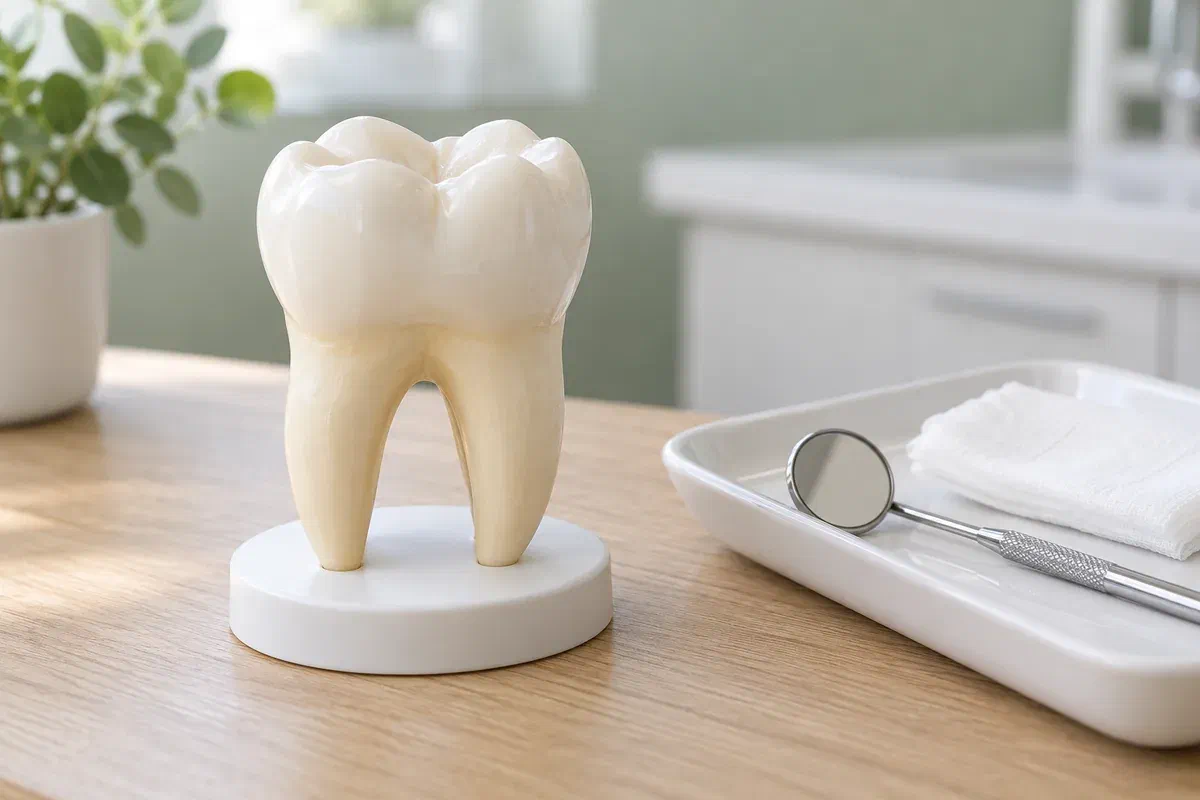
Illustrative two-root molar teaching model beside a dental mirror and gauze
Reasons extra access may come up

Where the tooth sits and what surrounds it decide the approach.

An examination, supported by imaging where appropriate, is what explains the proposed method. Ask how the findings apply to your own tooth, because surgical extractions do not all follow one sequence and they do not all carry identical risks.

Part of the tooth is hidden from view

Gum or bone may cover some of the tooth, or a fractured root may sit below the surface after the crown has broken away. The clinician considers both the position and the reason the tooth is being removed before choosing how to reach it. Being hard to see is not, by itself, a reason to take a tooth out.

Little structure remains, or the roots are awkward

Heavy decay, a crack, or curved and spreading roots can all change how removal is approached. Sectioning a tooth into parts is often planned from the start rather than being a sign that something went wrong. Ask which steps are expected and whether the plan could shift once the clinician can see more.

Nearby anatomy or your health needs extra thought

Nerves, the sinus above the upper back teeth, neighbouring teeth and the supporting bone can all influence the risks and whether referral makes sense. Health conditions and medicines may also change how you prepare and recover. A full history helps the clinician tell you which of these matters for this tooth.

Please do not stop a prescribed blood thinner or any other medicine on your own before surgery. Your treating clinician reviews your history and, where needed, coordinates instructions with the medical provider who prescribed it.

Why planning ahead is worth the time

Fewer surprises on the day, and a clearer picture of the weeks after.

Good planning points to the right technique, the right setting and the right level of support before you sit down in the chair. It is fair to ask how your tooth was assessed and why this particular approach suits it. A useful risk discussion is specific to you; it should help you decide rather than treat every listed complication as equally likely.

It also makes sense to talk about the gap a removed tooth leaves, when that matters. Some extractions are one stage of a wider restorative or orthodontic plan, while others deal with a tooth that simply cannot be kept. Ask whether replacement, monitoring or another step is expected later, and what needs to be arranged before the tooth comes out.

Patient information: Liverpool University Dental Hospital — surgical removal of teeth or roots

Know exactly why the tooth is coming out

Ask what the extraction is meant to solve and why other treatments are unsuitable or less appropriate. You should hear the expected benefits and what could happen if you wait or decide against treatment. Removing a tooth cannot be undone, so the actual findings deserve a careful conversation.

Agree on how comfort will be handled

Talk about local anaesthetic, nerves, past visits that went badly and whether extra support would help. A surgical approach does not mean you will automatically be put to sleep. If another method or provider is needed, ask about any assessment, transport, escort or preparation rules rather than assuming a routine visit.

Have a plan for the first days at home

Ask about meals, work, exercise, medicines and who to contact once you leave. Recovery differs with the procedure and the person. A good plan sets expectations and gives you a contact route, and it makes clear which symptoms deserve a fresh look instead of being endured until a set date.

From first visit to follow-up

How a planned surgical extraction usually unfolds.

Get your questions out of the way before the day, and settle on a hand signal for discomfort or a break. Fasting, medicine or other preparation advice is the treating provider’s to give, and it depends on how you will be numbed and on your health.

  1. Look at the tooth, the images and the options

    The clinician examines the area, considers suitable imaging, and reviews why extraction is proposed alongside your health information. This is the time to ask about the expected approach, any particular risks and whether referral is advised. Check, too, whether anything else has to happen first, such as gathering older records.

  2. Give consent and settle the comfort plan

    Nothing proceeds until you have heard the plan, and the realistic alternatives, and said yes. Numbing is explained, as is any extra support that has been judged suitable for you. Speak up if the area does not feel numb enough or you need to stop for a moment; sharp pain is not something to sit through quietly.

  3. Reach the tooth and remove it or its roots

    Depending on the plan and what is found, the clinician may lift gum tissue, remove some bone or section the tooth. You may still feel pressure, pushing or vibration with local anaesthetic in place. Once the tooth is out, the socket is tidied and, if it helps, closed with a few sutures.

  4. Go home with instructions and a review plan

    Written advice covers bleeding, cleaning, meals, soreness and activity. Find out whether your sutures dissolve and whether a check-up is booked. Keep the clinic’s number handy, and ask what comes next once the area heals.

The healing stretch

Give the site a quiet few days and notice which way it is heading.

Follow the specific instructions your treating clinician gives you. The extent of the surgery, your medical history and any special measures can all alter the advice, so a generic checklist should never override your own care plan.

Leave the clot alone and mind the numb areas

Keep fingers and tongue away from the socket. Early instructions often include not rinsing or spitting on the first day, followed by gentle cleaning when advised. Be careful with hot food and drinks, and avoid chewing your lip or cheek while the anaesthetic is still wearing off.

Stick to the food, activity and medicine plan

Pick foods that feel comfortable, and follow what you were told about exercise, smoking and caring for the site. Take pain relief only as advised and within its label directions, keeping your health and other medicines in mind. Leftover antibiotics are not a substitute for advice, and prescribed medicines should not be changed on your own.

Call when something needs another look

Get in touch for bleeding that will not settle, pain that is severe or climbing, swelling that is getting worse, a fever, or changes in sensation. Describe when it started and how it differs from the instructions you were given. A sore socket is not always an infection, and worsening symptoms are not automatically normal healing.

Patient information: UCLH — protecting the site and following extraction aftercare

Paths worth comparing

Keep the tooth, remove it surgically, or get another opinion first.

The right choice depends on the diagnosis and on what can realistically be done for that tooth. For each route, ask what it involves, where it stops being useful, and what leaving the problem alone would mean.

When the tooth is worth assessing for retention

Saving the tooth when that is realistic

A filling, a crown, root canal therapy or gum treatment might be the answer, according to what has gone wrong. Ask how the tooth is likely to fare and how much treatment it would take. Some damaged teeth really are beyond saving, but you should hear why yours is, or is not, before anything is removed.

When extraction is advised and access is limited

A planned surgical removal

The clinician describes the proposed approach and how to prepare for it. Ask which steps are expected and how recovery and any later dental needs will be handled. Planning should fit both the tooth and the person, without promising a set length of appointment or the same recovery for everyone.

If the tooth or your health needs a different team

Referral or a revised plan

An oral surgeon may be better placed when the anatomy is difficult, the risks are higher or your needs go beyond what our setting offers. Ask what they will look at and whether anything is needed while you wait. Now and then the risks are weighty enough to change the plan for removal, and that is judged case by case.

Common questions from Milton

Things people ask before agreeing to a surgical extraction.

Jot your questions down before the visit, from how the tooth will be reached to how long healing takes. We will sort out with you which of them actually bear on your tooth.

(905) 876-4488
What is the difference between a simple and a surgical extraction?
A simple extraction removes a tooth that can be reached and lifted without extra access. A surgical approach may involve moving gum aside, removing a little bone or sectioning the tooth. The difference lies in how the tooth is reached, not in how carefully either procedure is planned.
Do I need new X-rays if I already had some taken elsewhere?
Possibly not, but it depends on how recent and how clear they are, and on what the clinician needs to see. Bring or request copies of earlier images and records. The clinician decides whether additional imaging is appropriate for planning this particular extraction.
Can I be fully asleep for the procedure?
Many surgical extractions are done with local anaesthetic alone. Other arrangements, or a referral, may be considered after an individual assessment. Mention anxiety or difficult past visits early. Being asleep is only part of a plan when it has been specifically assessed and arranged for you.
Should I keep taking my regular medicines before surgery?
Do not stop or change any prescribed medicine without advice. List everything you take, including supplements, at the assessment. Where a medicine affects bleeding or healing, the treating clinician reviews it and coordinates any instructions with your prescriber.
How soon can I go back to work after a surgical extraction?
It varies with the extent of the procedure, your health and the kind of work you do. Ask the treating provider for advice that fits your job and the tooth involved, rather than relying on a friend’s experience or a previous extraction.
Why might I be referred instead of treated here?
A tooth close to a nerve, an unusually difficult removal, or health and comfort needs that call for extra support can all point to another setting. Ask what the referral should address and what to do while you wait. The aim is to match the procedure with the expertise and support it needs.
Plan your extraction in Milton

Start with a conversation about the reason and the route.

Call Milton Dental Clinic to arrange an extraction assessment or to talk through a recommendation you have already been given. Bring any images and records you have, and let us know about current symptoms, your health and any worries about the procedure.

Your treatment approach and provider are decided through individual assessment. Call promptly for urgent symptoms.

Visit Milton Dental Clinic
Unit 1, 342 Bronte St. S, Milton, ON L9T 5B7
Get directions Clinic hours
Monday–Thursday
11am–7pm
Friday–Sunday
By appointment only

Areas we serve

  • Milton
  • Oakville
  • Mississauga
  • Georgetown
  • Halton Hills
  • Acton
  • Campbellville
  • Brampton
  • Burlington
  • Puslinch
  • Rockwood
  • Erin
  • Caledon
  • Etobicoke
  • Old Milton
  • Bronte Meadows
  • Timberlea
  • Dorset Park
  • Dempsey
  • Clarke
  • Beaty
  • Coates
  • Harrison
  • Scott
  • Willmott
  • Ford
  • Bowes
  • Cobden
  • Walker
  • Mountain View
  • Milton Heights
  • Hawthorne Village
  • Valley View
  • Fallingbrook
  • Nassagaweya
  • Trafalgar
  • Esquesing
  • Nelson
  • Brookville
  • Moffat
  • Glen Williams
  • Norval
  • Limehouse
  • Stewarttown
  • Ashgrove
  • Hornby
  • Silver Creek
  • Speyside
  • Scotch Block
  • North Oakville
  • River Oaks
  • Glen Abbey
  • West Oak Trails
  • Palermo
  • Bronte Creek
  • College Park
  • Joshua Creek
  • Uptown Core
  • Preserve
  • Iroquois Ridge
  • Lisgar
  • Meadowvale
  • Meadowvale Village
  • Churchill Meadows
  • Erin Mills
  • Central Erin Mills
  • Streetsville
  • East Credit
  • Creditview
  • Heartland
  • Sheridan
  • Mount Pleasant
  • Credit Valley
  • Huttonville
  • Churchville
  • Springbrook
  • Northwest Brampton
  • Bram West
  • Fletcher's Meadow
  • Fletcher's Creek South
  • Alton Village
  • Orchard
  • Millcroft
  • Headon Forest
  • Tansley
  • Brant Hills
  • Tyandaga
  • Kilbride
  • Lowville
  • Aberfoyle
  • Morriston
  • Arkell
  • Hillsburgh
  • Freelton
  • Carlisle
  • Waterdown
  • Flamborough
  • Mountsberg

How can we help?

Milton Dental Clinic

Have a question about your smile? Choose the option that works best for you.

For urgent dental concerns, please call.
Messages are reviewed during clinic hours.